
Tucson Marathon
Tucson's marathon starts higher than it finishes. The race drops from Oracle, north of the city, down towards Tucson, with the Santa Catalina mountains alongside for most of the way.
By Global Marathon Routes editorial team · Last reviewed 27 October 2026
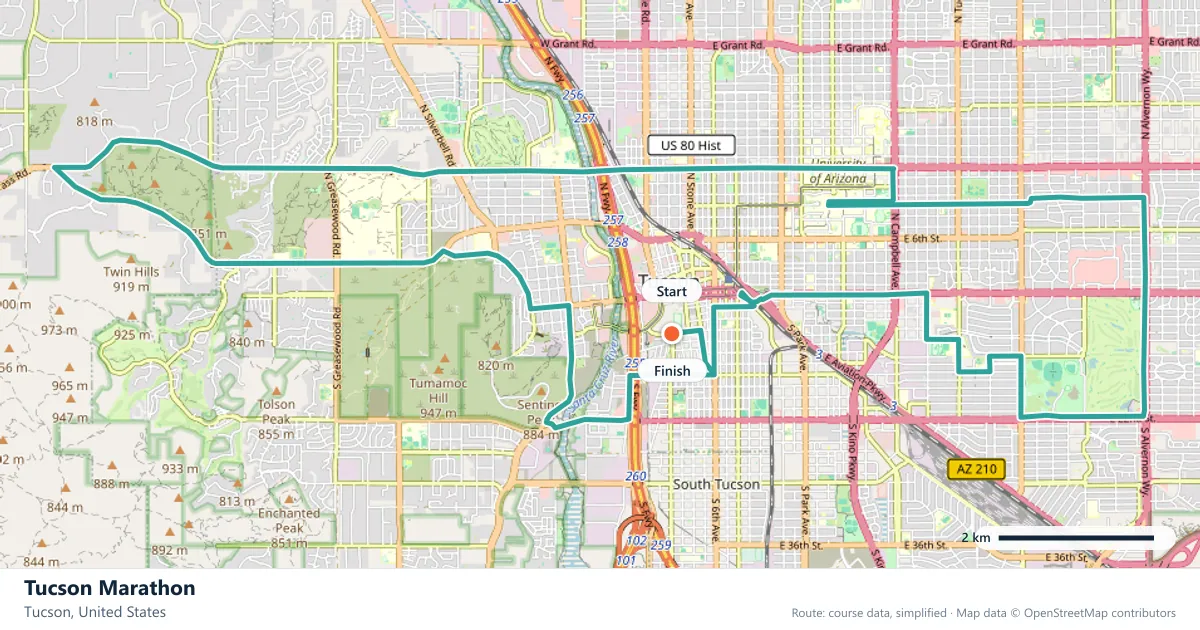
Where does the Tucson Marathon run?
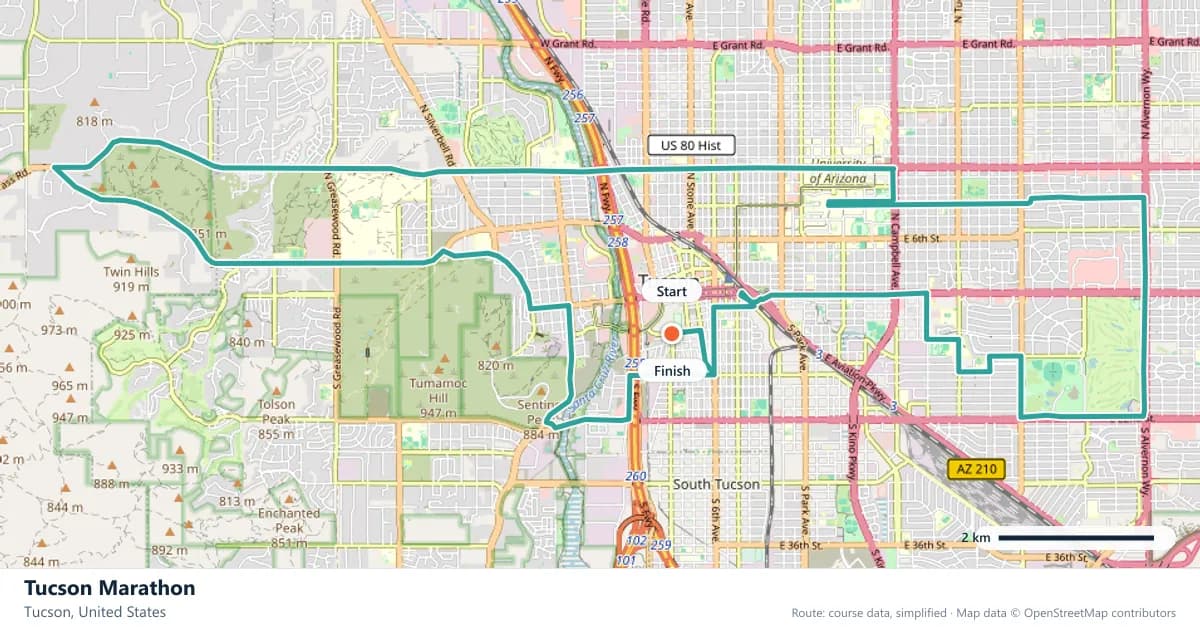
Interactive map
The trace follows the organizer's published course, simplified for the screen: the orange dot is the start, the dark dot the finish. Scroll to zoom, drag to pan.
What is the Tucson Marathon course like?
A December desert race that drops from Oracle down towards Tucson, with the Catalina mountains alongside for most of the way. Net downhill and quick.
- Next edition
- 13 December 2026
- Elevation gain
- 242 m
- Profile
- Undulating
- First run
- —
Course guide
Tucson's marathon starts higher than it finishes. The race drops from Oracle, north of the city, down towards Tucson, with the Santa Catalina mountains alongside for most of the way. The next edition is on Sunday 13 December 2026.
The profile is undulating, with about 242 metres of climbing, but the net direction is downhill. That combination makes it quick: the descent helps, and the rolling sections keep it from becoming a simple gravity-assisted time trial. The Catalinas stay in view for much of the morning, a constant reminder of the ground the course gives back.
The race is a genuine personal-best and debut option, with the obvious warning that a desert December still demands respect. The descent can make the opening miles feel effortless, and that is precisely when discipline matters most.

Controversial Party Banner in Tucson, Arizona, 1916. Photo: Unknown photographer / Wikimedia Commons, Public domain.
The course
The race starts near Oracle and drops towards Tucson, losing more height than it gains. The climbing total is about 242 metres, spread across the route rather than concentrated in one hill. The Catalina mountains remain alongside for most of the way, framing the descent.
The net downhill makes the course quick, but the undulating sections interrupt the descent. Runners who let the early drop carry them too fast will find the later rolling miles harder. The December setting adds a desert character that is part of the race's appeal.
From Oracle to the valley
Oracle sits above the Tucson basin, and the first part of the race gives that height back. The descent is not a cliff; it is a long, rolling drop that alternates between faster stretches and short rises. The effect is a course that feels quick without ever being a straight downhill run.
That shape is important. A pure descent would hammer the quads and make the later miles a survival exercise. The rises break the rhythm just enough to keep the legs working, but they also mean you cannot switch off and let gravity do everything.
Hispanic Heritage Select Photos - Housing in Tucson AZ. Photo: David Valdez Office of Broadcasting Operations, Department of Housing and Urban Development. / Wikimedia Commons, Public domain.
The Catalina skyline
The Santa Catalinas are the range that defines Tucson's northern horizon. They rise sharply from the desert floor, and for most of the race they provide a fixed point to the north. On a clear morning the rock and scrub are sharply lit; the range gives the course a scale that a city marathon rarely has.
The mountains are also a useful pacing marker. As the course drops towards the city, the Catalinas remain in view, and the relationship between the runner and the range barely changes. That constancy can be comforting in the later miles, when the route is rolling and the finish still feels distant.
The range is high enough to carry snow on its upper slopes in winter, a contrast with the desert floor that can be startling in the same view. That vertical distance is part of the course's drama: the race drops towards the city while the mountains stay where they are.
Desert December
December is the desert's running season. The summer heat is gone, the mornings are cool and the light is clear. Tucson's winter climate is one of the reasons the race is held then, and it makes the desert setting feel generous rather than hostile.
Do not mistake a pleasant December morning for an easy one. Desert air can dry you out without the obvious signals of heavy sweating, and the sun is still strong once it is up. Carry fluids as you would for any marathon, use the stations when they come and protect yourself from the glare. The dry air and wide skies make the December date feel like a gift after a summer of heat, and they give the race a character unlike any coastal marathon.
Using the descent without wasting it
The key to Tucson is the first half. The descent offers speed, but taking it too fast turns the rolling second half into a grind. Run the early downhill miles at a controlled effort, keep the stride compact and let the grade give you free pace rather than free rein.
A personal best here is built on restraint, not bravery. The course provides the descent; the runner provides the discipline. If you can hold back through the opening drop, the net downhill will still be working for you when the finish approaches.
Frequently asked questions
Answers to the questions runners ask before entering, drawn from this race's course guide and the directory's own data — the sources behind them are listed below.
When is the Tucson Marathon?
The next edition is on Sunday 13 December 2026, a December race from Oracle down towards Tucson.
Is the Tucson Marathon a flat course?
It is undulating, with about 242 metres of climbing, but it is net downhill overall. That combination makes it quicker than the climbing total suggests, though it is not a flat course.
Is the Tucson Marathon suitable for a first marathon?
Yes. The net descent and modest climbing total make it manageable for a prepared debut, and the December desert conditions are usually kinder than summer. The main risk is going out too fast on the downhill.
Is the Tucson Marathon a personal-best course?
The net downhill and quick profile give it a strong case, and the rolling sections are not severe enough to rule out a fast time. A personal best still depends on controlling the opening miles.
Where is the Tucson Marathon run?
It runs from Oracle down towards Tucson, with the Santa Catalina mountains alongside for most of the way. The course finishes in the Tucson area after a net descent.
Why is the Tucson Marathon considered quick?
The course is net downhill, the climbing total is modest at about 242 metres and the December date avoids the desert summer. Those factors together make it a fast course.
More marathons in United States
More marathons in Americas
Sources for this page
What each source below is used for on this page, and where to check this race yourself.
- World Athletics — the label calendar and the road-race regulations. Used to check whether the race holds a World Athletics label, and its elite competition details.
- AIMS — the international course-measurement standard behind the 42.195 km distance, and the AIMS race calendar.
- The organizer's own publications — course maps, race handbooks and published results. The date, course character and climbing on this page are compiled from them and re-checked each season.
Where do these facts come from?
Dates, course type, climbing and time limits are compiled from the organizer's publications and re-checked each season; elevation is an estimate of total climbing rather than a survey figure. Always confirm race-day details with the organizer before making plans.
Last reviewed 27 October 2026