
Honolulu Marathon
Honolulu's marathon begins in the dark. The start is downtown, before dawn, when the streets are still quiet and the Pacific is a suggestion rather than a view.
By Global Marathon Routes editorial team · Last reviewed 27 October 2026
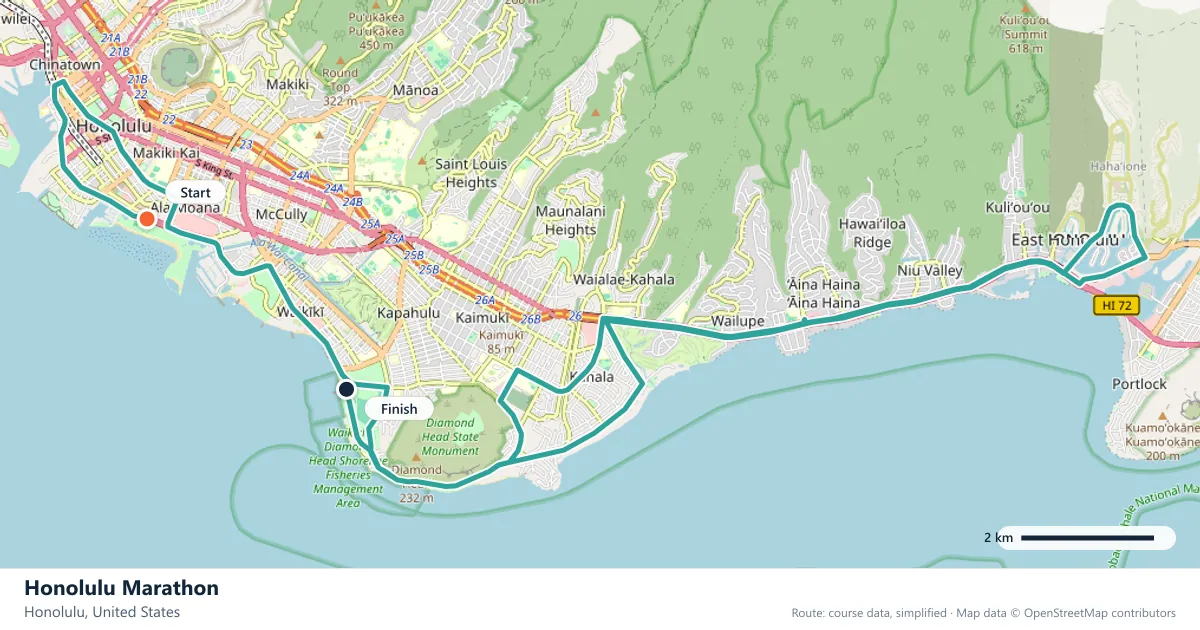
Where does the Honolulu Marathon run?
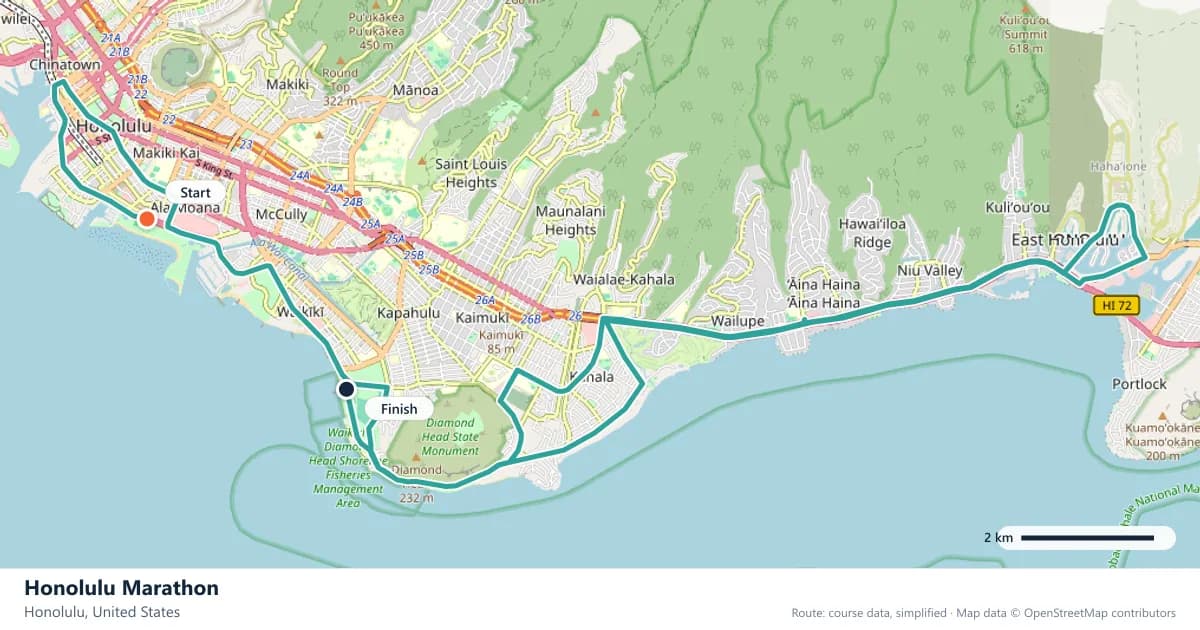
Interactive map
The trace follows the organizer's published course, simplified for the screen: the orange dot is the start, the dark dot the finish. Scroll to zoom, drag to pan.
What is the Honolulu Marathon course like?
A December marathon on Oahu, starting downtown before dawn and running out along the coast past Diamond Head. Warm, humid and famously friendly, with no cut-off in most years.
- Next edition
- 13 December 2026
- Elevation gain
- 141 m
- Profile
- Undulating
- First run
- —
Course guide
Honolulu's marathon begins in the dark. The start is downtown, before dawn, when the streets are still quiet and the Pacific is a suggestion rather than a view. By sunrise the race is out along the coast, with Diamond Head ahead and the water never far away. The day becomes warm, humid and stubbornly cheerful, and unlike any other American marathon.
The 2026 race takes place on Sunday 13 December. The course climbs about 141 metres in gentle rises, but the profile is not the difficulty. Honolulu is warm and humid, and the race is held on Oahu in December. The event holds a World Athletics Elite Label and has a reputation for friendliness, with no cut-off in most years.
That friendliness is real, but it is not an invitation to treat the race casually. The heat is the course's main opponent, and the early start is part of the strategy: get as much of the race done as possible before the sun is high. Runners who respect that arrive with a plan for hydration and pacing rather than a target time borrowed from a cooler race.

2015 Honolulu Marathon. Photo: Anthony Quintano from Honolulu, HI, United States / Wikimedia Commons, CC BY 2.0.
The course
The race starts in downtown Honolulu before dawn and heads out along the coast. The opening kilometres are dark and relatively calm, with the city not yet awake. As the route reaches the shoreline, the course opens up: the ocean on one side, the hills on the other and Diamond Head as the fixed point ahead.
The 141 metres arrive as gentle rises rather than a single climb. The coastal road rolls, but the changes of grade are small enough that the course never feels hilly. Warmth and humidity build through the morning, and a rise that feels easy at dawn can feel much harder after two hours in the sun.
The route is a city marathon with a coastal heart: a long, exposed morning on Oahu, with the water as a constant and the crater as the landmark. The finish comes after the coast, with the heat already having done its work.
Before sunrise
The pre-dawn start is one of the race's defining features. It means an early wake-up, a dark journey to the start and a first hour that feels like a night run. It also means the most forgiving part of the day is saved for the opening miles.
Runners should practise the early start before race week. The combination of a very early alarm, a warm night and a long race is harder than it looks. The reward is a sunrise over the Pacific and a chance to run the coast before the heat becomes oppressive.
The start sets the tone: Honolulu is a friendly race, and the darkness gives the opening miles a quiet, communal feel. Use that calm to settle your pace; the crowds and the scenery will come soon enough.
Heat, humidity and patience
The heat is not a detail at Honolulu; it is the race. The course is warm and humid, and the body's ability to cool itself is the limiting factor. Pace by effort rather than by watch, drink early and often, and accept that the splits will be slower than they would be in a cool, dry city.
Humidity makes the effort feel harder than the temperature alone suggests. Sweat evaporates more slowly, the heart rate drifts upward and the same pace becomes unsustainable. Runners who train in hot conditions have an advantage, but even they need to adjust their expectations on race day.
The absence of a cut-off in most years is part of the race's welcoming character: it is open to runners who need more time, and it removes some of the pressure of a strict clock. It does not make the heat less real, so start conservatively.
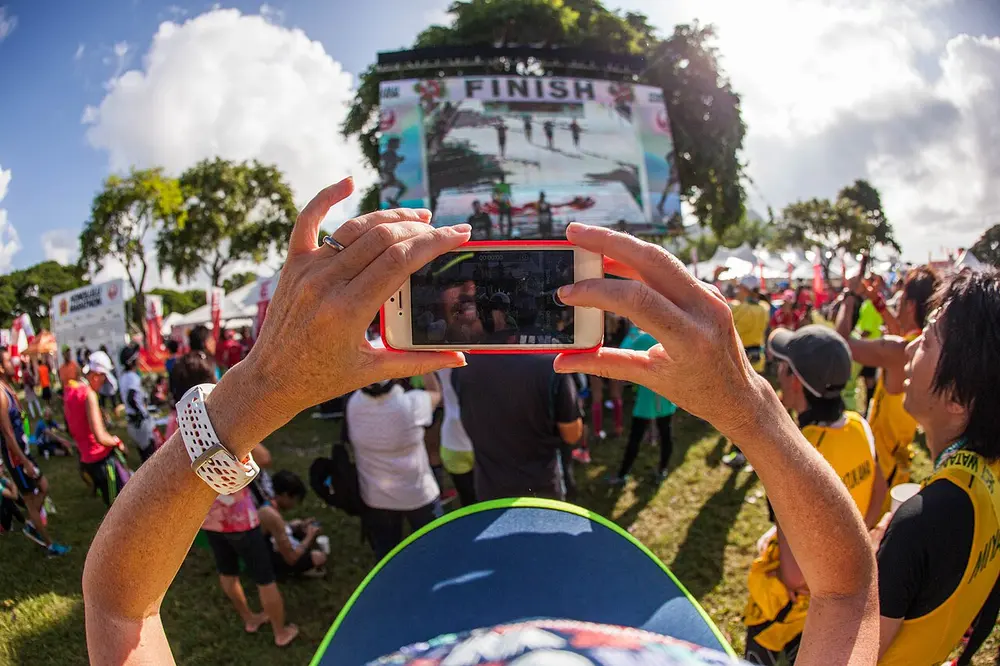
2015 Honolulu Marathon (photo 2). Photo: Anthony Quintano from Honolulu, HI, United States / Wikimedia Commons, CC BY 2.0.
Diamond Head and the coast
Diamond Head is the race's signature landmark. The volcanic crater rises above the coastal road, and the course passes it as the morning brightens. It is the kind of view that makes runners reach for a camera, but it is also a useful checkpoint: once the crater is behind you, the race has entered its second phase.
The coast road is beautiful and exposed. The ocean is close, the sky is wide and the sun is up. There is little shade on the open stretches, and the breeze can be deceptive: it cools the skin without replacing the fluid lost to sweat. Treat every chance to drink as part of the race plan rather than an optional stop.
The finish is a celebration, and Honolulu's reputation for friendliness is earned. But the last few kilometres are still a marathon, and the heat does not switch off at the finish line. Run the race you prepared for, not the one the scenery invites you to run in the first hour.

2015 Honolulu Marathon (photo 3). Photo: Anthony Quintano from Honolulu, HI, United States / Wikimedia Commons, CC BY 2.0.
Frequently asked questions
Answers to the questions runners ask before entering, drawn from this race's course guide and the directory's own data — the sources behind them are listed below.
When is the Honolulu Marathon in 2026?
The race is on Sunday 13 December 2026, starting before dawn in downtown Honolulu.
Is the Honolulu Marathon flat?
It is undulating rather than flat, with about 141 metres of climbing. The rises are gentle and the coastal road rolls rather than climbs, so the profile is not the main difficulty. Heat and humidity matter more.
Is the Honolulu Marathon suitable for a first marathon?
Yes. The atmosphere is welcoming and in most years there is no cut-off. The warmth and humidity still demand respect, so start slowly, train in warm conditions if you can and plan your fluids.
Is Honolulu a good course for a personal best?
It is not a personal-best course. The undulating coastal road and the humid conditions make fast times difficult, even though the climbing is modest. Cooler, flatter races are more accommodating.
Where does the Honolulu Marathon run?
The race starts in downtown Honolulu before dawn and heads out along the coast past Diamond Head. The route is on Oahu, with the Pacific alongside it for much of the morning.
Does the Honolulu Marathon have a cut-off?
In most years there is no cut-off, which is part of the race's welcoming reputation. Runners should still check the current race information, because arrangements can change.
More marathons in United States
More marathons in Americas
Sources for this page
What each source below is used for on this page, and where to check this race yourself.
- World Athletics — the label calendar and the road-race regulations. Used to check whether the race holds a World Athletics label, and its elite competition details.
- AIMS — the international course-measurement standard behind the 42.195 km distance, and the AIMS race calendar.
- The organizer's own publications — course maps, race handbooks and published results. The date, course character and climbing on this page are compiled from them and re-checked each season.
“A World Athletics Label denotes a full application of the Competition and Technical Rules in, at a minimum, the elite component of the competition. Labels also denote superior standards in event organisation, safety and runner experience, support from public authorities to the event and a financial commitment to anti-doping.”
Where do these facts come from?
Dates, course type, climbing and time limits are compiled from the organizer's publications and re-checked each season; elevation is an estimate of total climbing rather than a survey figure. Always confirm race-day details with the organizer before making plans.
Last reviewed 27 October 2026