
Buenos Aires Marathon
Buenos Aires puts its Obelisk where the city's widest avenues meet, and the marathon uses that landmark as a hinge.
By Global Marathon Routes editorial team · Last reviewed 27 October 2026
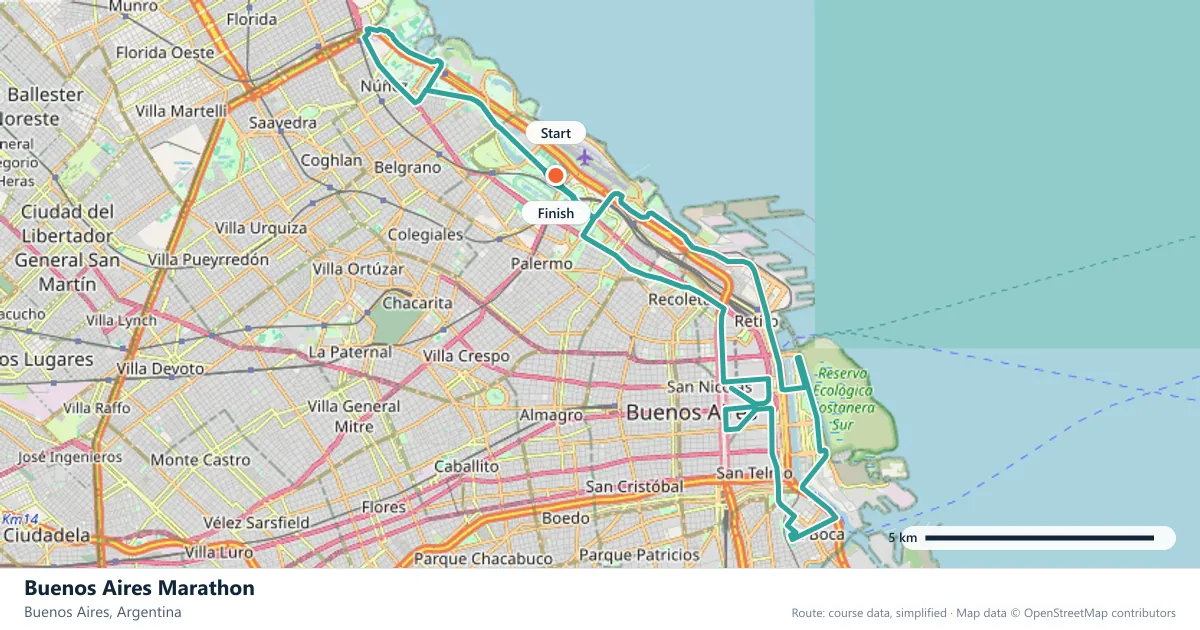
Where does the Buenos Aires Marathon run?
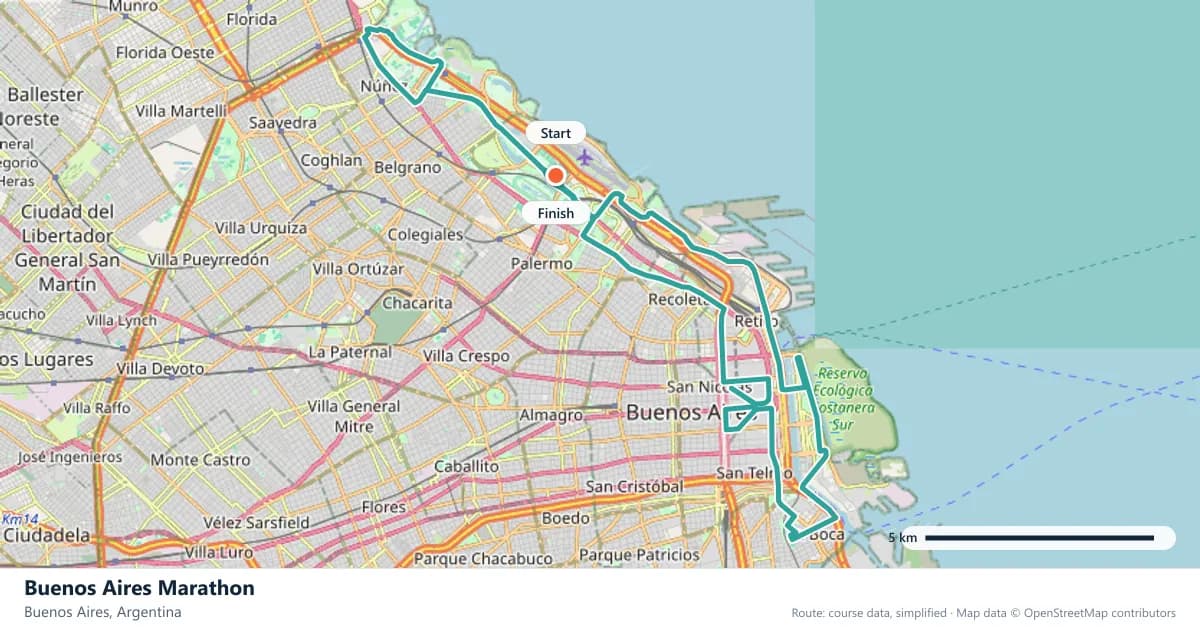
Interactive map
The trace follows the organizer's published course, simplified for the screen: the orange dot is the start, the dark dot the finish. Scroll to zoom, drag to pan.
What is the Buenos Aires Marathon course like?
Argentina's biggest marathon, run through Buenos Aires past the Obelisk and along the Rio de la Plata. Flat and fast, with a spring (southern hemisphere) date.
- Next edition
- September 2027 (expected)
- Elevation gain
- 147 m
- Profile
- Undulating
- First run
- —
Course guide
Buenos Aires puts its Obelisk where the city's widest avenues meet, and the marathon uses that landmark as a hinge. The race is Argentina's largest, and the 2027 edition is expected in September, when the southern hemisphere turns towards spring. From the monument the route reaches the Río de la Plata, follows the waterfront and returns into the capital's grid.
The profile is officially undulating, but the total climb is only about 147 metres. That is a course built for rhythm rather than survival, and the race holds a World Athletics Label. It is also, by the standards of a capital-city marathon, unusually straightforward: no mountain pass, no relentless climb, no technical trail.
What makes it distinct is the setting. Buenos Aires is a city of broad boulevards, port warehouses and river light, and the marathon moves through all three. The result is a race that can produce fast times without feeling like an industrial circuit.
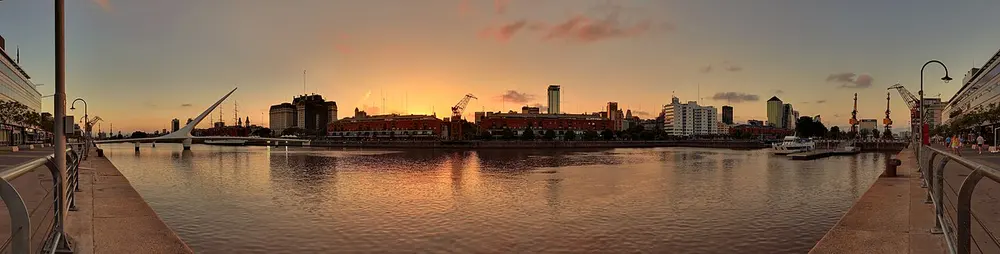
193 - Buenos Aires - Puerto Madero - Janvier 2010. Photo: Martin St-Amant ( S23678 ) / Wikimedia Commons, CC BY-SA 3.0.
The course
The route runs past the Obelisk and along the Río de la Plata, and those two features divide the day. The city sections are wide and straight, with the Obelisk and the Avenida 9 de Julio corridor giving the race its first sense of scale. The riverfront then opens the course up, replacing the grid with water and sky before the route turns back into the streets.
Across 42.195 km the race accumulates about 147 metres of ascent. That is not a level profile on paper, but it is flat in practice: the rises are short, and none lasts long enough to force a change of stride. The wide roads let the field spread quickly, so the opening kilometres are less about traffic and more about finding your own pace.
The Obelisk and the riverfront
The Obelisk stands in the Plaza de la República, a white spike at the intersection of Corrientes and 9 de Julio, and it is the image most runners carry home. It is a city monument rather than a course feature to attack: the race passes it, the photographs happen, and the running continues.
The riverfront is a different Buenos Aires. Puerto Madero's old docks have been turned into a waterfront district of brick warehouses, cranes and promenades, and the river beyond them is so wide that the opposite bank disappears. The street grid gives way to open views, and the running feels less enclosed. The contrast between the two halves of the route is what stops the marathon from blurring into one long avenue.
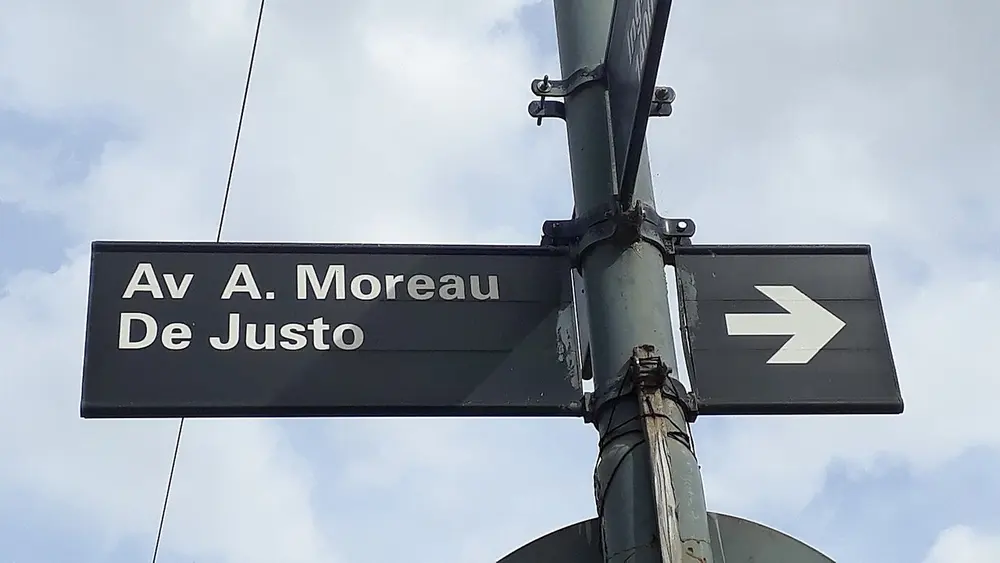
Alicia Moreau de Justo - Calle de Puerto Madero - Ciudad Autónoma de Buenos Aires - Argentina. Photo: Iro Bosero / Wikimedia Commons, CC BY-SA 4.0.
The September date
September is spring in Argentina, which places the race ahead of the Buenos Aires summer rather than in it. The date is expected rather than fixed, so the month is a planning target for now; the exact weekend and race-day arrangements should be confirmed with the organiser before travel is booked.
A spring marathon also suits the city. The parks are coming back to life, the days are lengthening, and the race feels like the start of the running year rather than its end. For runners travelling from the northern hemisphere, the season is inverted, which is part of the appeal.
At Parque Buenos Aires 2023 027. Photo: Photograph by Mike Peel ( www.mikepeel.net ). / Wikimedia Commons, CC BY-SA 4.0.
Pacing the undulations
With about 147 metres across the full distance, the average gradient is negligible. The risk is the opposite of a hilly race: you may run the first half too quickly because nothing is slowing you down. The Obelisk, the river and the scale of the avenues all encourage a fast start.
Treat the first 10 km as a cap rather than a target. The course's few rises are gentle enough to be missed at speed, but they still cost something, and the final city kilometres are where an uneven opening becomes visible. Even splits are both achievable and rewarded here.
A race for a first marathon, and for a time
A first marathon is a realistic target in Buenos Aires. The route has no technical difficulty, the roads are broad and the profile never asks for a change of technique. The caveat is the same one that applies to any fast city course: the distance is still 42.195 km, and enthusiasm in the first hour is the most common mistake.
For a personal best, the case is straightforward. The World Athletics Label reflects the event's organisation, and the 147-metre profile is mild enough that the course does not fight you. The race rewards patience rather than heroics: start controlled, use the riverfront to settle, and leave something for the return into the city.
Frequently asked questions
Answers to the questions runners ask before entering, drawn from this race's course guide and the directory's own data — the sources behind them are listed below.
When is the Buenos Aires Marathon?
The 2027 edition is expected in September, in the southern-hemisphere spring. The exact date has not been confirmed, so treat the month as a planning target and check the organiser's announcement before booking travel.
Is the Buenos Aires Marathon a flat course?
The profile is undulating, but the total climb is only about 147 metres, and the rises are short. In practice it runs like a flat course, which is why it is associated with fast times.
Is Buenos Aires a good first marathon?
Yes. The absence of sustained climbing and the wide roads make it approachable for a debut. The main discipline is holding back early on a course that makes fast running feel easy.
Where is the Buenos Aires Marathon run?
It runs through the Argentine capital past the Obelisk and along the Río de la Plata, with the riverfront and the city grid providing the two halves of the route.
Does the Buenos Aires Marathon hold a World Athletics label?
Yes, it holds a World Athletics Label. The label reflects the event's standing and organisation rather than any particular feature of the course.
Why is the race held in September?
September is spring in Buenos Aires, so the marathon falls before the southern summer. The date is expected rather than confirmed for 2027, and the organiser will publish the final weekend closer to the event.
More marathons in Americas
Sources for this page
What each source below is used for on this page, and where to check this race yourself.
- World Athletics — the label calendar and the road-race regulations. Used to check whether the race holds a World Athletics label, and its elite competition details.
- AIMS — the international course-measurement standard behind the 42.195 km distance, and the AIMS race calendar.
- The organizer's own publications — course maps, race handbooks and published results. The date, course character and climbing on this page are compiled from them and re-checked each season.
“A World Athletics Label denotes a full application of the Competition and Technical Rules in, at a minimum, the elite component of the competition. Labels also denote superior standards in event organisation, safety and runner experience, support from public authorities to the event and a financial commitment to anti-doping.”
Where do these facts come from?
Dates, course type, climbing and time limits are compiled from the organizer's publications and re-checked each season; elevation is an estimate of total climbing rather than a survey figure. Always confirm race-day details with the organizer before making plans.
Last reviewed 27 October 2026