
Chicago Marathon
Chicago is the marathon that made "flat and fast" a global benchmark. The course is a single loop through 29 neighbourhoods, starting and finishing in Grant Park, with the final stretch down Columbus…
By Global Marathon Routes editorial team · Last reviewed 27 October 2026
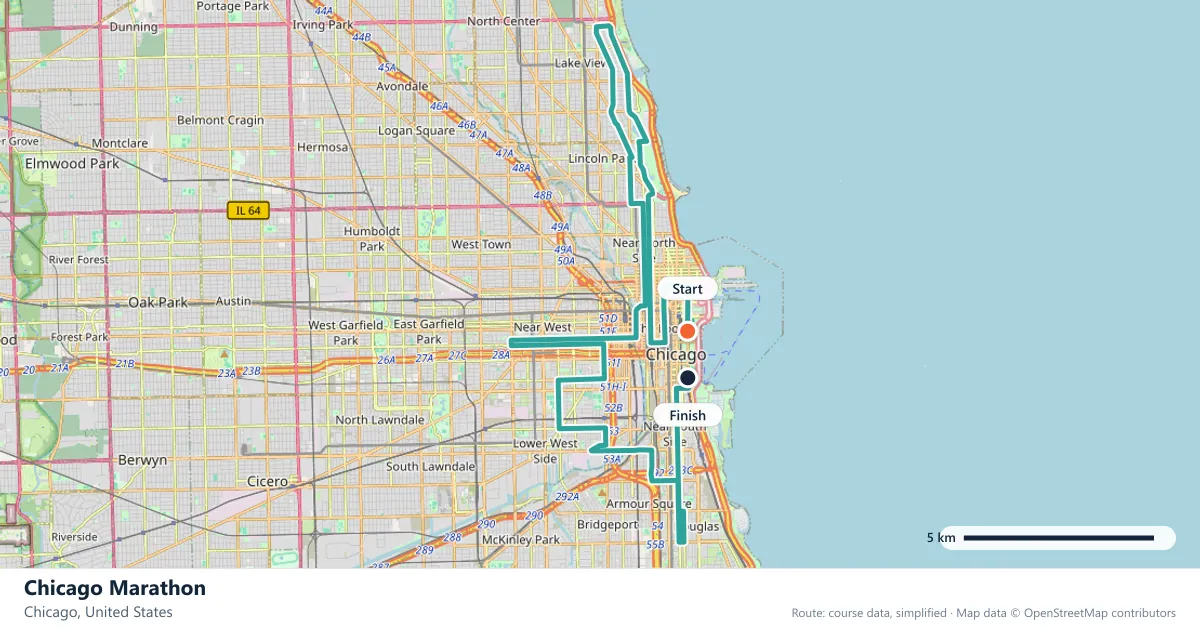
Where does the Chicago Marathon run?
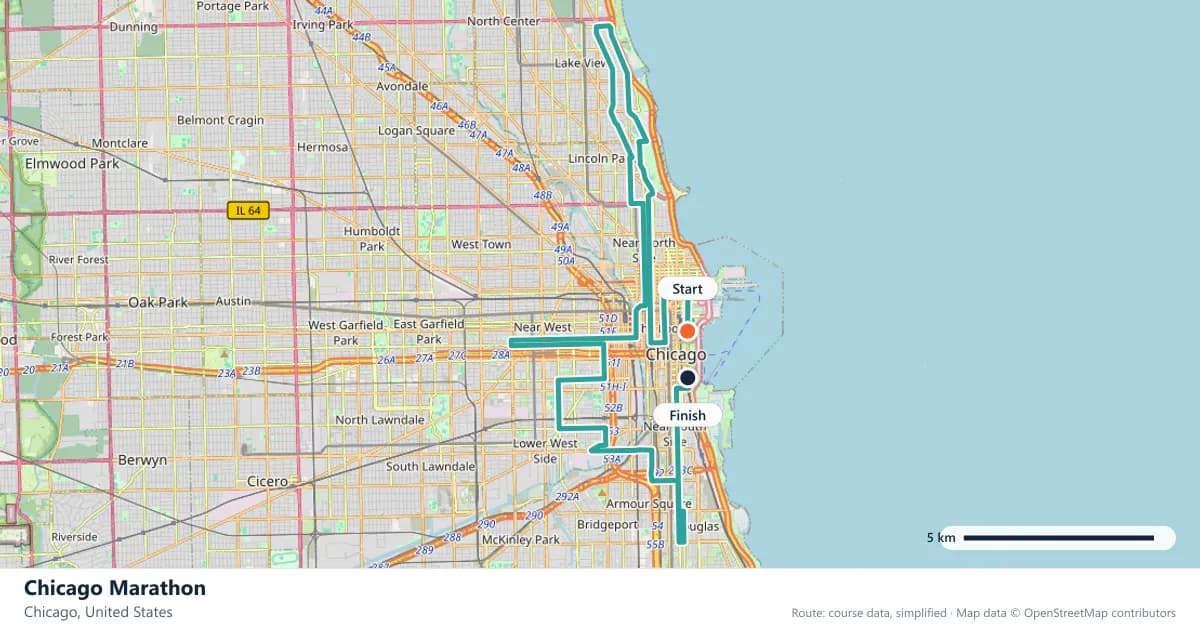
Interactive map
The trace follows the organizer's published course, simplified for the screen: the orange dot is the start, the dark dot the finish. Scroll to zoom, drag to pan.
What is the Chicago Marathon course like?
One of the flattest major courses, a loop through 29 neighbourhoods with the skyline as the backdrop. Chicago has produced world records and remains a favoured personal-best course.
- Next edition
- 10 October 2027
- Elevation gain
- 45 m
- Profile
- Flat
- First run
- —
Course guide
Chicago is the marathon that made "flat and fast" a global benchmark. The course is a single loop through 29 neighbourhoods, starting and finishing in Grant Park, with the final stretch down Columbus Drive. The next edition is Sunday 10 October 2027, the 49th running of the race. Chicago has produced seven world records, and it has been an Abbott World Marathon Major since 2006.
The modern race began in 1977 as the Mayor Daley Marathon, with about 4,200 runners and a five-dollar entry fee. It now welcomes around 55,000 runners from more than 100 countries and all 50 US states, with an estimated 1.7 million spectators on the streets. That scale is part of the experience: Chicago is not a quiet time trial, even though the course is built for one.
The speed comes from the combination of a flat loop, wide roads and a deep field. There is no sustained climb, the river crossings produce only short rises, and the final mile has one small sting on Roosevelt Road. For runners chasing a personal best, the course removes almost every topographic excuse.
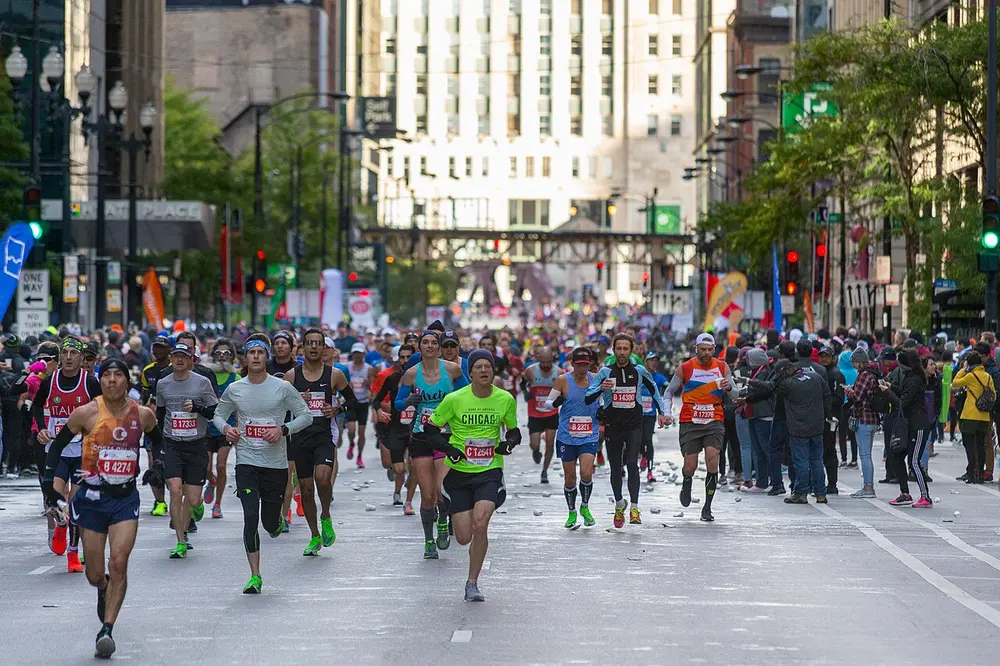
2019 Chicago Marathon. Photo: Kenneth C. Zirkel / Wikimedia Commons, CC BY 4.0.
The course
The race is one loop, not a series of disconnected out-and-backs. From Grant Park the route heads north through River North, Old Town, Lincoln Park and the Lakeview/Wrigleyville area, then turns west through the West Loop. The second half works south through Little Italy, Pilsen and Chinatown before returning north through the South Loop to Grant Park.
The course crosses the Chicago River repeatedly, and each bridge is a small change of grade rather than a hill. The only climb that matters comes late: the short rise on Roosevelt Road in the final mile, often called Mount Roosevelt. After that it is a flat run to the finish, with the final stretch down Columbus Drive.
What makes the loop feel different from a generic city course is the neighbourhood-to-neighbourhood change. The skyline is the backdrop for much of the race, but the streets, crowds and architecture change repeatedly. The course is flat; the experience is not monotonous.
| Race fact | Detail |
|---|---|
| Date | Sunday 10 October 2027 |
| Start and finish | Grant Park, Chicago |
| Field | About 55,000 runners |
| Course | Single loop through 29 neighbourhoods |
| Elevation | About 45 m of climbing |
| Time limit | 6 hours 30 minutes 59 seconds |
| Status | Abbott World Marathon Major |
| Section | What to expect |
|---|---|
| Grant Park start | Wide city streets, dense corrals and a fast opening mile |
| North side | River North, Old Town, Lincoln Park, Lakeview and Wrigleyville |
| West Loop | A westward turn and some of the course's bridge crossings |
| South side | Little Italy, Pilsen and Chinatown |
| Return | South Loop, the Roosevelt Road rise and the Columbus Drive finish |
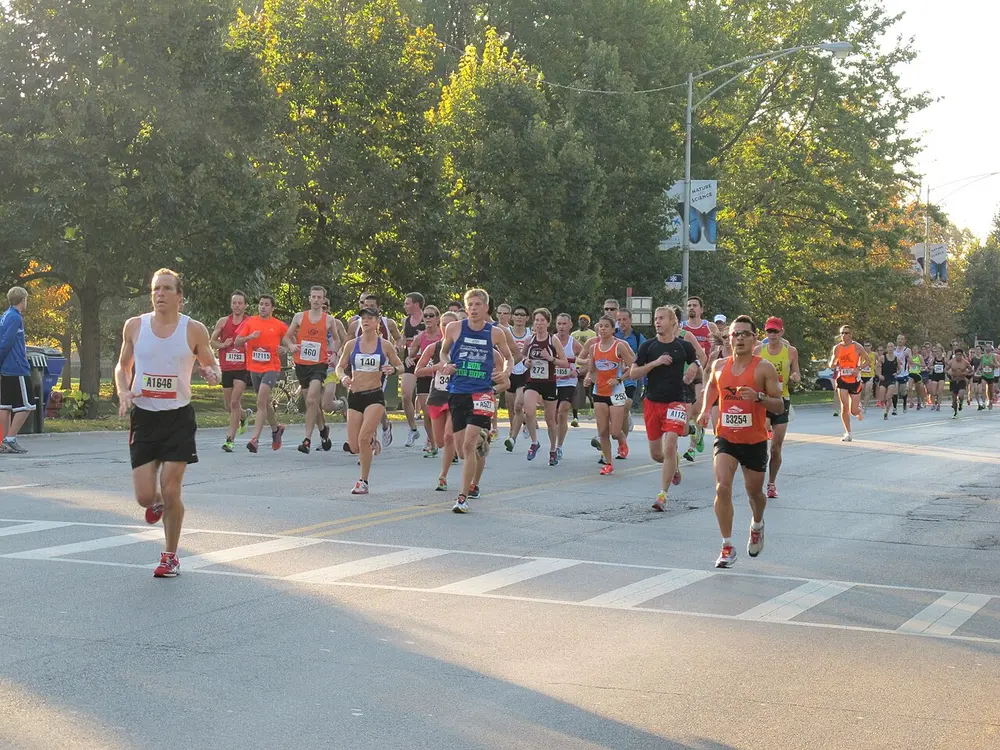
2011 Chicago Marathon runners. Photo: Benjamin Lipsman from Chicago, IL, USA / Wikimedia Commons, CC BY 2.0.
Start, corrals and the clock
Grant Park opens to runners at 5:30 a.m., and the start corrals open at the same time. The waves are strict. Wave 1 corrals close at 7:20 a.m. and the wave starts at 7:35; Wave 2 closes at 7:45 and starts at 8:00; Wave 3 closes at 8:10 and starts at 8:35. The professional races go earlier: the men's and women's wheelchair races start at 7:20 and 7:21, the handcycle at 7:23, and the professional marathon at 7:30.
The course limit is 6 hours 30 minutes 59 seconds, which is roughly a 15-minute per mile pace. The course reopens to traffic on a rolling schedule behind the last starter, and runners who fall behind the pace may be moved onto the sidewalk. Aid stations and traffic support are not guaranteed after the cutoff, so the time limit is a real cut-off rather than a formality.
| Time | What happens |
|---|---|
| 5:30 a.m. | Grant Park, gear check and start corrals open |
| 7:20 a.m. | Wave 1 corrals close; men's wheelchair start |
| 7:30 a.m. | Professional marathon start |
| 7:35 a.m. | Wave 1 start |
| 7:45 a.m. | Wave 2 corrals close |
| 8:00 a.m. | Wave 2 start |
| 8:10 a.m. | Wave 3 corrals close |
| 8:35 a.m. | Wave 3 start |
| 9:30 a.m. | Grant Park opens to spectators |
| 4:00 p.m. | Gear check and 27th Mile Post-Race Party close |
The practical consequence is simple: do not plan to arrive at Grant Park at 7:00 for a 7:35 start and expect a relaxed morning. The corrals close early, and the walk from the CTA or a rideshare drop-off can take longer than the map suggests. The CTA is the organiser's recommended way to reach Grant Park.
Aid stations and fuelling
There are 20 aid stations on the course, roughly one to two miles apart. Each station includes a medical tent, standard and accessible toilets, water, lemon-lime Gatorade Endurance Formula and a public-address announcer. Runner transport vehicles can take runners who cannot continue back to Grant Park.
Culligan water refill stations are available for approved self-carried hydration gear: running vests with front-pocket carry, fuel belts, handheld bottles and soft flasks. Backpacks and running vests with hydration bladders are not permitted. In recent editions the course has also included Maurten gel stations at miles 12.4 and 18.1, bananas around miles 20 to 23, and a Biofreeze cooling zone at mile 21.2; the participant guide for your year confirms the final positions.
The first aid station crush is part of the Chicago experience. With 55,000 runners, the early stations are busy, and the wide roads encourage people to run through them rather than slow down. Carry your own first gel if you want to avoid the busiest table.
Records and the Chicago story
Chicago has produced seven world records. The two course records are among the fastest ever run: Kelvin Kiptum's 2:00:35 in 2023 and Ruth Chepngetich's 2:09:56 in 2024. Both were world records when they were set, and both remain the marks to beat in Chicago.
| Record | Time | Athlete | Year |
|---|---|---|---|
| Men's course record | 2:00:35 | Kelvin Kiptum | 2023 |
| Women's course record | 2:09:56 | Ruth Chepngetich | 2024 |
| Women's world record | 2:14:04 | Brigid Kosgei | 2019 |
| Women's world record | 2:17:18 | Paula Radcliffe | 2002 |
The list of records is not an accident of one exceptional day. Chicago's loop is wide, flat and designed for rhythm; the October date usually brings cool running weather; and the field is deep enough that fast runners always have company. The result is a course that has been a personal-best venue for decades, not just during the super-shoe era.
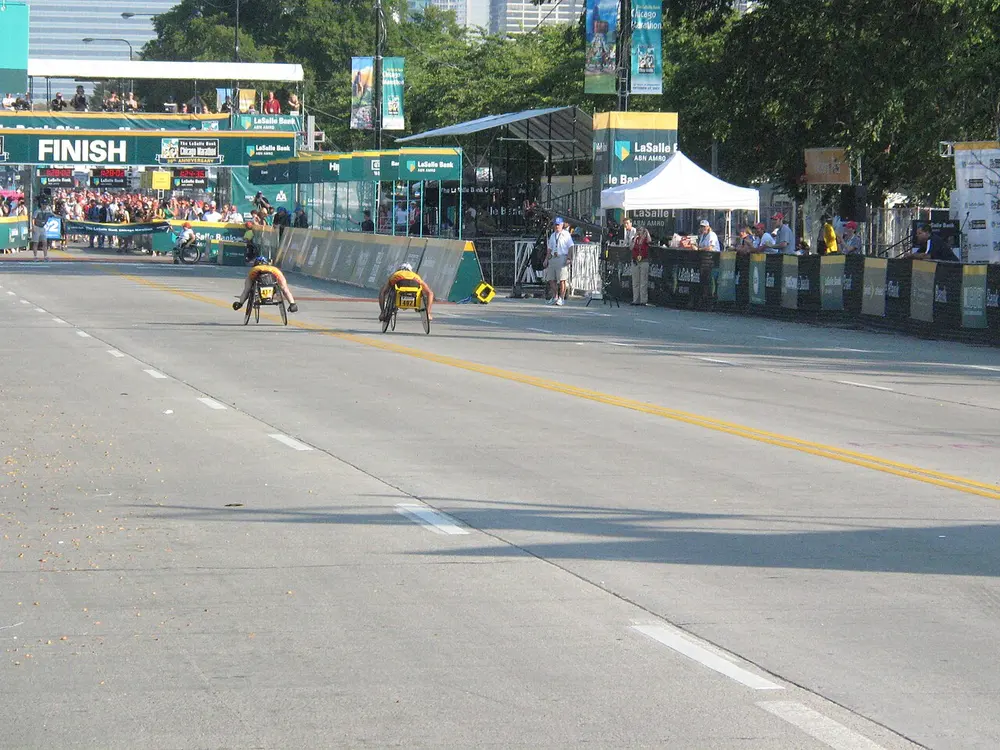
2007 Chicago Marathon finish - mens wheelchair. Photo: User:TonyTheTiger / Wikimedia Commons, CC BY-SA 3.0.
Race weekend and entry
The 2027 race is the 49th running. Applications for the 2027 marathon opened in October 2026 and close at 2 p.m. US Central Time on Thursday 29 October 2026. Runners who are not eligible for a guaranteed entry can enter the non-guaranteed drawing; the event notifies applicants on 8 December, and selected runners must pay and complete registration by 15 December. Guaranteed entry paths, charity places and the tour programme sit alongside the drawing.
Everyone must collect their own bib and timing device at the Abbott Health & Fitness Expo at McCormick Place. The 2027 expo runs Thursday 7 October from 10:00 to 18:00, Friday 8 October from 09:00 to 18:00, and Saturday 9 October from 09:00 to 18:00. There is no race-day packet pickup.
The race is on the second Sunday of October, so the weather is usually cool but can swing from a cold start to a mild afternoon. Layering is more useful than a single warm layer. The start and finish are both in Grant Park; the CTA is the simplest way in and out, and the post-race 27th Mile party runs in the park until 4 p.m.
What to watch for
- The first 10K. The flat opening and the crowd energy make a fast start feel effortless. Chicago rewards even splits, and the second half is where the race is decided.
- The corral closing times. Wave 1 closes at 7:20, Wave 2 at 7:45 and Wave 3 at 8:10. Arriving late means starting in a later wave or missing your corral.
- The Roosevelt Road rise. It is short, but it arrives when the legs are tired and the finish is close. Do not spend the last of your energy before it.
- Aid-station crowding. The stations are frequent, but the early ones are busy. Use the later tables or carry your own first gel.
- The 6:30:59 limit. It is generous for most runners, but the rolling reopen means runners behind the 15-minute-per-mile pace lose course support.
Frequently asked questions
Answers to the questions runners ask before entering, drawn from this race's course guide and the directory's own data — the sources behind them are listed below.
When is the Chicago Marathon in 2027?
The 49th running is on Sunday 10 October 2027, starting and finishing in Grant Park. The race is held on the second Sunday of October. Applications for 2027 close on 29 October 2026 at 2 p.m. US Central Time.
Is the Chicago Marathon a fast course?
Yes. The course climbs only about 45 metres, has no sustained ascent and is wide enough to run your own rhythm. Chicago has produced seven world records, including Kelvin Kiptum's 2:00:35 in 2023 and Ruth Chepngetich's 2:09:56 in 2024. It is one of the standard choices for a personal best.
Where does the Chicago Marathon start and finish?
Both the start and the finish are in Grant Park. The final stretch runs down Columbus Drive. The start is organised into waves, with Wave 1 at 7:35, Wave 2 at 8:00 and Wave 3 at 8:35.
What is the Chicago Marathon time limit?
The limit is 6 hours 30 minutes 59 seconds, roughly a 15-minute-per-mile pace. The course reopens to traffic on a rolling schedule, and runners behind the pace may be moved to the sidewalk or lose aid-station support.
How many aid stations are on the Chicago Marathon course?
There are 20 aid stations, about one to two miles apart, with water, lemon-lime Gatorade Endurance Formula, medical support and toilets. Culligan refill stations are available for approved self-carried hydration gear. Recent editions have also had Maurten gel stations at miles 12.4 and 18.1 and bananas in the final 10K.
How do you enter the Chicago Marathon?
The 2027 race uses a non-guaranteed entry drawing alongside guaranteed entry paths and charity places. The application window closes on 29 October 2026 at 2 p.m. US Central Time; the drawing results are emailed on 8 December, and selected runners must register by 15 December. Everyone collects their own bib at the McCormick Place expo; there is no race-day pickup.
Is Chicago a good first marathon or personal-best race?
It suits both, but the experience is different. The flat course and deep field make a personal best realistic; the 6:30 limit and the size of the event make it approachable for a first marathon. The risks are going out too fast in the opening miles and losing time in the crowded early aid stations.
What are the highlights of the Chicago Marathon course?
The course is a single loop through 29 neighbourhoods: north through River North, Old Town, Lincoln Park and Lakeview/Wrigleyville; west through the West Loop; south through Little Italy, Pilsen and Chinatown; then back to Grant Park for the Roosevelt Road rise and the Columbus Drive finish.
More marathons in United States
More marathons in Americas
Sources for this page
What each source below is used for on this page, and where to check this race yourself.
- World Athletics — the label calendar and the road-race regulations. Used to check whether the race holds a World Athletics label, and its elite competition details.
- AIMS — the international course-measurement standard behind the 42.195 km distance, and the AIMS race calendar.
- The organizer's own publications — course maps, race handbooks and published results. The date, course character and climbing on this page are compiled from them and re-checked each season.
“A World Athletics Label denotes a full application of the Competition and Technical Rules in, at a minimum, the elite component of the competition. Labels also denote superior standards in event organisation, safety and runner experience, support from public authorities to the event and a financial commitment to anti-doping.”
Where do these facts come from?
Dates, course type, climbing and time limits are compiled from the organizer's publications and re-checked each season; elevation is an estimate of total climbing rather than a survey figure. Always confirm race-day details with the organizer before making plans.
Last reviewed 27 October 2026