
La Paz Marathon
La Paz does not ease anyone into the altiplano. The Bolivian capital sits in a steep canyon below the high plain, its streets climbing the canyon walls, and the marathon is run at roughly 3,600…
By Global Marathon Routes editorial team · Last reviewed 27 October 2026
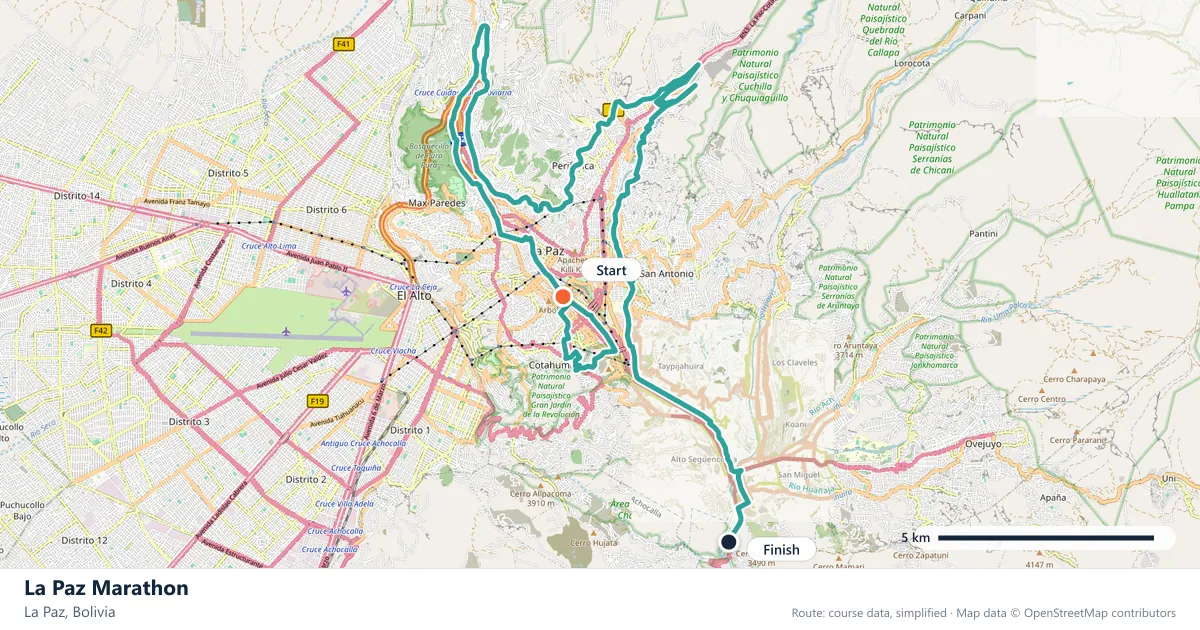
Where does the La Paz Marathon run?
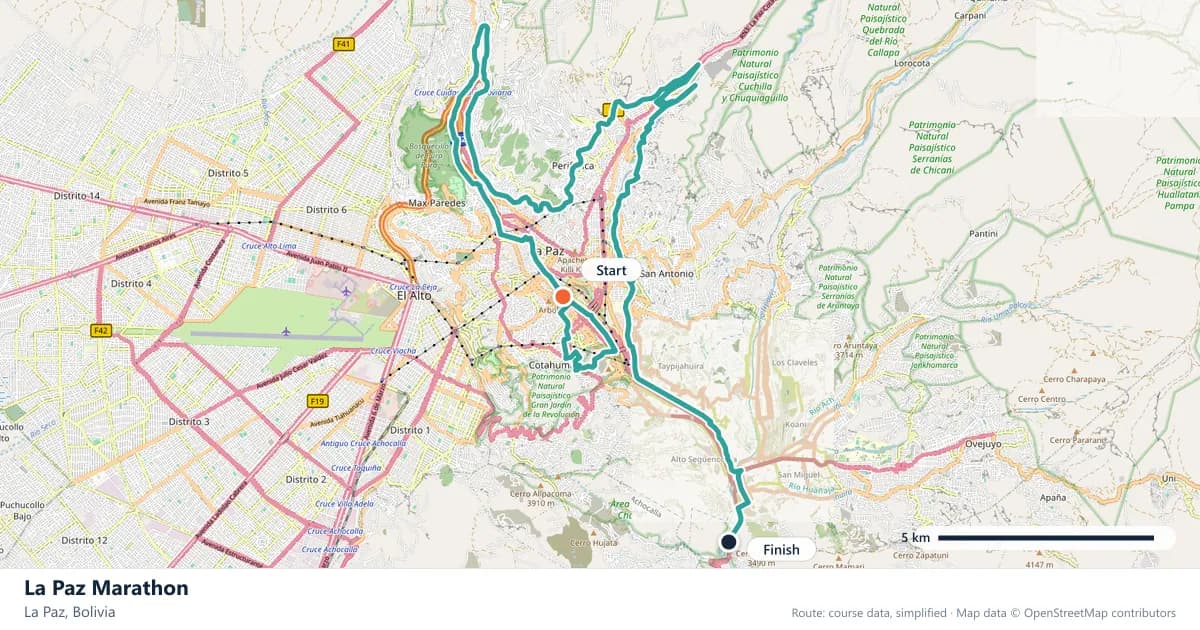
Interactive map
The trace follows the organizer's published course, simplified for the screen: the orange dot is the start, the dark dot the finish. Scroll to zoom, drag to pan.
What is the La Paz Marathon course like?
One of the highest marathons in the world, run at 3,600 metres in the Bolivian altiplano with more than 1,200 metres of climbing. Altitude, not the hills, is the real obstacle.
- Next edition
- 14 March 2027
- Elevation gain
- 1227 m
- Profile
- Hilly
- First run
- —
Course guide
La Paz does not ease anyone into the altiplano. The Bolivian capital sits in a steep canyon below the high plain, its streets climbing the canyon walls, and the marathon is run at roughly 3,600 metres above sea level. The 2027 edition is scheduled for 14 March, and it is one of the highest road marathons in the world.
The course climbs more than 1,200 metres, so the hills are real: 1,227 metres of ascent across the full distance, on a route that is hilly from start to finish. But the altitude, not the gradient, is the obstacle that defines the day. At this height the air is thin enough that an easy kilometre can feel like a hard one, and sea-level pace targets become fiction.
That is the race's character. It is not a city marathon with a mountain view; it is a mountain marathon in a city, and it rewards runners who arrive prepared to move slowly and breathe deliberately.
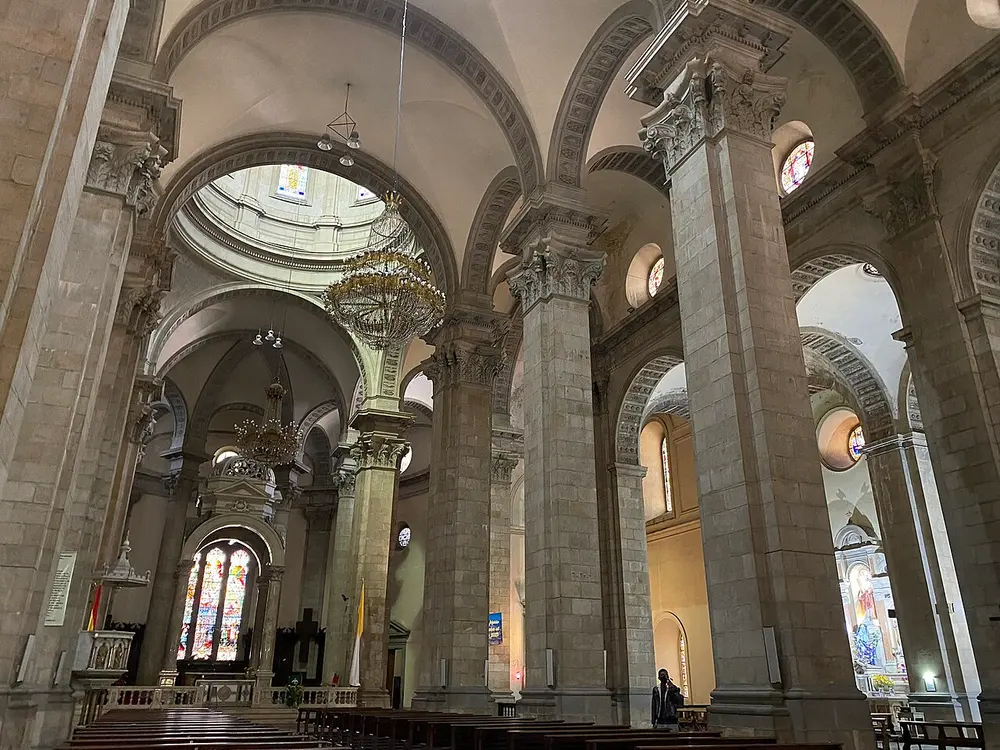
Catedral Basílica Nuestra Señora de La Paz 08. Photo: Yastay / Wikimedia Commons, CC BY-SA 4.0.
The course
The route works through La Paz's urban terrain, accumulating 1,227 metres of climbing over 42.195 km. The climbing is distributed through the route rather than saved for a single pass, and the thin air makes every rise more expensive than the gradient suggests.
Because the city is built on slopes, the course is rarely level for long. That rhythm is exhausting in a way that a single mountain climb is not: the legs never settle, and the effort never becomes automatic. Runners who have trained only on flat roads will notice the difference long before halfway.
A city built in a bowl
La Paz is arranged around a canyon, with the historic centre on the lower slopes and the neighbourhoods spreading up towards the rim. The cathedral and the Plaza Murillo sit in the old heart of the city, and the cable-car network climbs from the centre to the hillside districts. The geography is part of the race: there is no pretending the city is level.
The altiplano begins at the top of the canyon, and the light is thin and sharp at this altitude. Even the views have a different quality, with the snow-covered Illimani visible on clear days. Runners who take a moment to look around will understand why the city's setting is as memorable as its race.
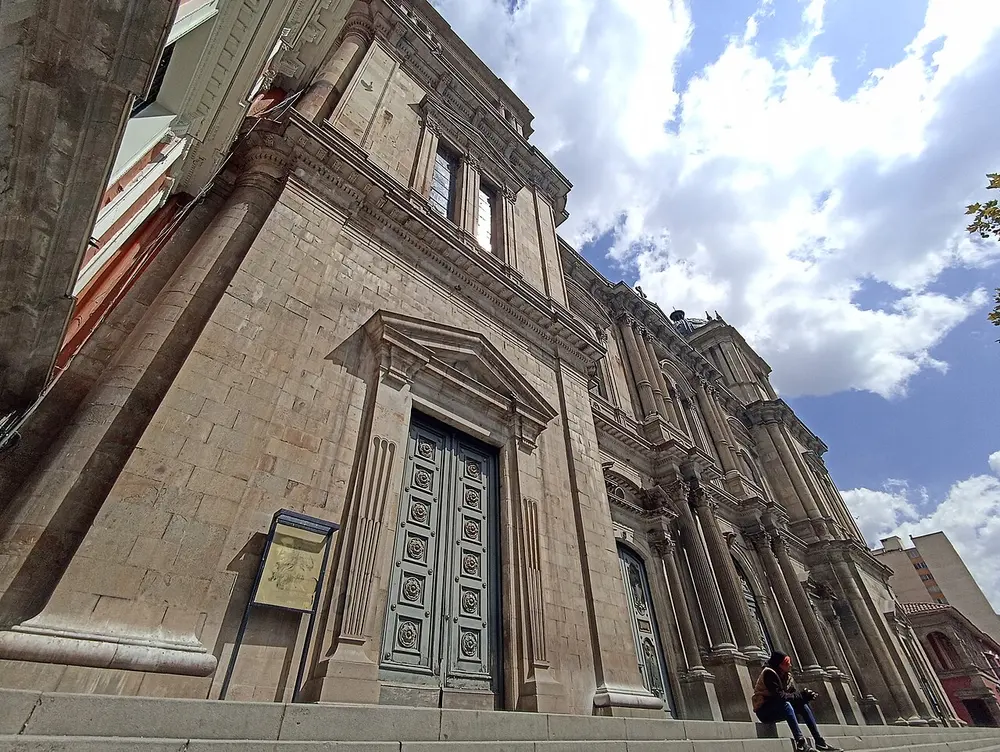
Catedral de Nuestra Señora de La Paz, ángulo contrapicado (ElaTen). Photo: Huayra Eliana Tenorio / Wikimedia Commons, CC BY-SA 4.0.
Altitude before gradient
At 3,600 metres, the oxygen pressure is low enough that breathing and heart rate rise even on gentle ground. The body cannot deliver oxygen to the muscles at the same rate as at sea level, so the same pace costs more. This applies on the downhills as well as the climbs, which is why the usual strategy of recovering on descents does not work here.
Acclimatisation is the only serious preparation. Arriving early, sleeping well, drinking more than usual and avoiding a hard first day all matter more than any last-minute hill session. There is no way to fake fitness for altitude; the body either has time to adapt or it does not.
The debut question at 3,600 metres
A first marathon is possible in La Paz, but it is a very particular kind of debut. The distance is the same, yet the altitude and the 1,227 metres of climbing make it far harder than a flat city race. Runners who choose it for their first 42.195 km should do so because they want the mountain, not because they are looking for an easy introduction.
The practical approach is to plan for a slower day than any training run suggests. Run by effort, walk the steepest sections without shame, and treat the finish as the goal rather than a time. The race is memorable precisely because it is difficult, and the altiplano does not allow a casual effort.
What the day rewards
Patience is the currency here. Start conservatively, keep the effort below the red line for the first half and accept that the second half will be slower. Fuelling and hydration matter, but they cannot compensate for going out too hard in thin air.
The reward is a marathon unlike any sea-level race. La Paz gives runners the canyon, the cathedral, the cable cars and the altiplano in a single morning, and it asks for honesty in return. Few courses expose a pacing mistake as quickly as this one.
Frequently asked questions
Answers to the questions runners ask before entering, drawn from this race's course guide and the directory's own data — the sources behind them are listed below.
When is the La Paz Marathon?
The next edition is scheduled for 14 March 2027, a March race in the Bolivian altiplano.
How high is the La Paz Marathon?
It is run at about 3,600 metres above sea level, which makes it one of the highest road marathons in the world.
Is the La Paz Marathon hilly?
Yes. The course climbs about 1,227 metres and is hilly throughout, with repeated ascents rather than a single climb.
Is altitude or climbing the bigger problem?
Altitude. The 1,227 metres of climbing are substantial, but the thin air affects every kilometre, including the descents. Sea-level pace targets are unrealistic.
Can I run La Paz as my first marathon?
It is possible, but it makes a hard debut. The altitude and repeated climbing demand acclimatisation and a conservative plan, and the race is not a place to chase a time.
Why is La Paz considered such a difficult marathon?
The combination of 3,600 metres of altitude and more than 1,200 metres of climbing leaves no easy section. Breathing, heart rate and recovery all suffer, and the city's slopes keep the legs working throughout.
More marathons in Americas
Sources for this page
What each source below is used for on this page, and where to check this race yourself.
- World Athletics — the label calendar and the road-race regulations. Used to check whether the race holds a World Athletics label, and its elite competition details.
- AIMS — the international course-measurement standard behind the 42.195 km distance, and the AIMS race calendar.
- The organizer's own publications — course maps, race handbooks and published results. The date, course character and climbing on this page are compiled from them and re-checked each season.
Where do these facts come from?
Dates, course type, climbing and time limits are compiled from the organizer's publications and re-checked each season; elevation is an estimate of total climbing rather than a survey figure. Always confirm race-day details with the organizer before making plans.
Last reviewed 27 October 2026