
New York
New York City Marathon · TCS New York City Marathon
By Global Marathon Routes editorial teamPublished Last updated
Interactive course map
aid stations: 21 · landmarks: 10Official course map
Open full size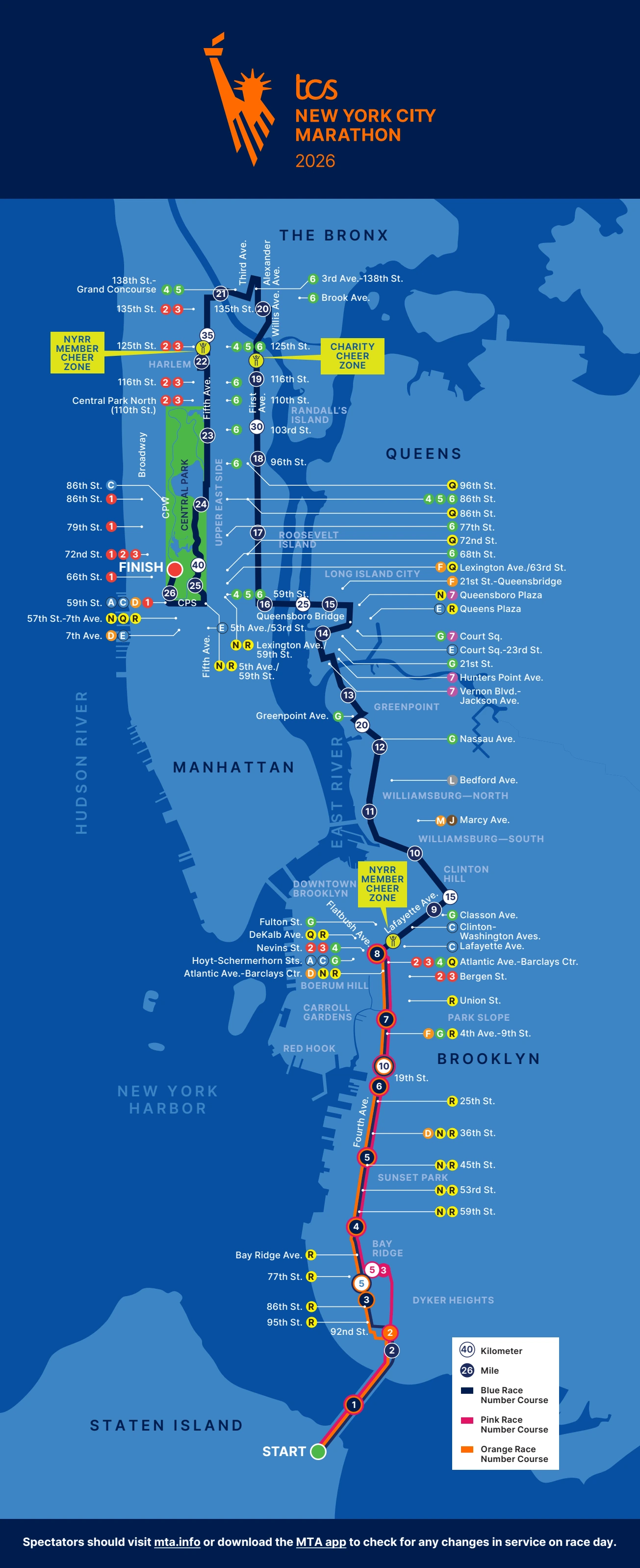
Race facts
TCS New York City MarathonLandmarks along the way
- StartVerrazzano-Narrows Bridge
- 9 kmFourth Avenue, Brooklyn
- 13 kmFlatbush Avenue
- 21 kmPulaski Bridge, halfway
- 25 kmQueensboro Bridge
- 27 kmFirst Avenue, Manhattan
- 32 kmWillis Avenue Bridge, the Bronx
- 39 kmFifth Avenue, Museum Mile
- 41 kmCentral Park South
- FinishCentral Park
Aid stations and timing points
Major stations modelled on the published course maps, plus the half marathon split. Real races place stations closer together, so treat the spacing as indicative.
Course guide
The New York City Marathon is the largest marathon in the world by finisher count, and the only one that touches all five boroughs of the city. It starts on Staten Island and ends in Central Park, with roughly 59,000 runners finishing in a typical edition.
The course
The race opens with the climb onto the Verrazzano-Narrows Bridge, the highest point of the day and the quietest kilometre of the race: the bridge deck is closed to spectators, so all you hear is footsteps and breathing. From Brooklyn the route runs north through Williamsburg, crosses the Pulaski Bridge into Queens, then takes the Queensboro Bridge into Manhattan around the 25 km mark.
The Manhattan miles are the loudest. First Avenue is a canyon of spectators, and the course then swings north through the Bronx before turning back south into Harlem and down Fifth Avenue. The last 800 metres rise gently inside Central Park to the finish line.
| Section | KM | Character |
|---|---|---|
| Staten Island | 0 to 3 | Bridge climb, silent, controlled start |
| Brooklyn | 3 to 21 | Flat, fast, dense crowds |
| Queens | 21 to 25 | Pulaski and Queensboro bridges, two climbs |
| Manhattan | 25 to 32 | First Avenue wall of sound |
| Bronx and Harlem | 32 to 37 | Quieter, slight rises |
| Central Park | 37 to 42.195 | Rolling, then the final uphill drag |
Aid stations and the half split
Water stations are placed at short intervals in the real race, closer together than the major stations marked on the map. The half marathon split and timing mat sits on the Pulaski Bridge at 21.0975 km, which is also the point where the race crosses from Brooklyn into Queens. Energy gels are handed out in the second half, and medical tents cluster around the bridge crossings and the finish.
Use the layer switches on the map above to see the modelled stations for this course, or scroll to the aid station table for the full list.
What to watch for
- Bridge climbs. Verrazzano-Narrows, Pulaski and Queensboro all rise. Plan the effort, do not chase pace uphill.
- Wind and cold. November mornings on the bridge can be windy and raw.
- Crowding. Three-wave start with a long wait on Staten Island before the gun, so bring throwaway layers.
- Pacing. The first 5 km are downhill from the bridge. The temptation to bank time here is the classic New York mistake.
Records
| Category | Time | Athlete | Year |
|---|---|---|---|
| Men's course record | 2:04:58 | Tamirat Tola | 2023 |
| Women's course record | 2:19:51 | Hellen Obiri | 2025 |
Practical notes
- Race day: first Sunday of November. The 2026 edition is scheduled for 1 November 2026.
- Entry: lottery, plus guaranteed entry through a qualifying time, a charity place, or the 9+1 volunteer programme for local runners.
- Getting there: the start is on Staten Island, reached by official buses from Midtown or by the Staten Island Ferry plus a shuttle. Allow a long morning: most runners leave Manhattan before dawn.
- Weather: usually 5 to 12 °C at the start, with a chance of rain.
Frequently asked questions
Quick answers to what runners ask most about this race. Every figure is checked against the official sources listed below.
When is the New York City Marathon?
It is run on the first Sunday of November. The 2026 edition is scheduled for 1 November 2026.
How do you enter the New York City Marathon?
There are four routes in: the entry lottery, a guaranteed place earned with a qualifying time, a charity place, or the 9+1 volunteer programme open to local runners. All of them are oversubscribed, so many runners apply for several years before they get in.
Where does the New York City Marathon start and finish?
It starts at Fort Wadsworth on Staten Island and finishes in Central Park. The course crosses all five boroughs, with four bridges along the way.
Is the New York City Marathon course hilly?
It is rolling rather than flat. The Verrazzano-Narrows Bridge climb at the start is the highest point of the day, the Pulaski and Queensboro bridges rise again around the 21 to 25 km mark, and the last 800 metres climb gently inside Central Park to the finish.
How do you get to the start?
The start village on Staten Island is reached by official buses from Midtown or by the Staten Island Ferry plus a shuttle. It is a long morning: most runners leave Manhattan before dawn, and the start is split into three waves, so bring throwaway layers for the wait.
How many runners take part?
Roughly 59,000 runners finish a typical edition, which makes New York the largest marathon in the world by finisher count.
About this guide
Compiled by the site's editorial team from public race-organizer publications, course maps and results, then re-checked against the official race site before publishing. Course traces on the map follow the organizer's published course, simplified for the screen.
By
Global Marathon Routes editorial team
- Published
- Last updated
Checked against the official sources listed on this page.
Sources for this guide
Facts, dates and records on this page are taken from the primary sources below. Always confirm race-day details with the organizer.
Related links
Encyclopaedia entries for this race and the organizer's own site: history, records and background reading beyond this guide.