
Houston Marathon
Houston's marathon is built around a single idea: the clock. The course is flat, the date is January and the city has spent decades proving that an American winter race can produce fast times.
By Global Marathon Routes editorial team · Last reviewed 27 October 2026
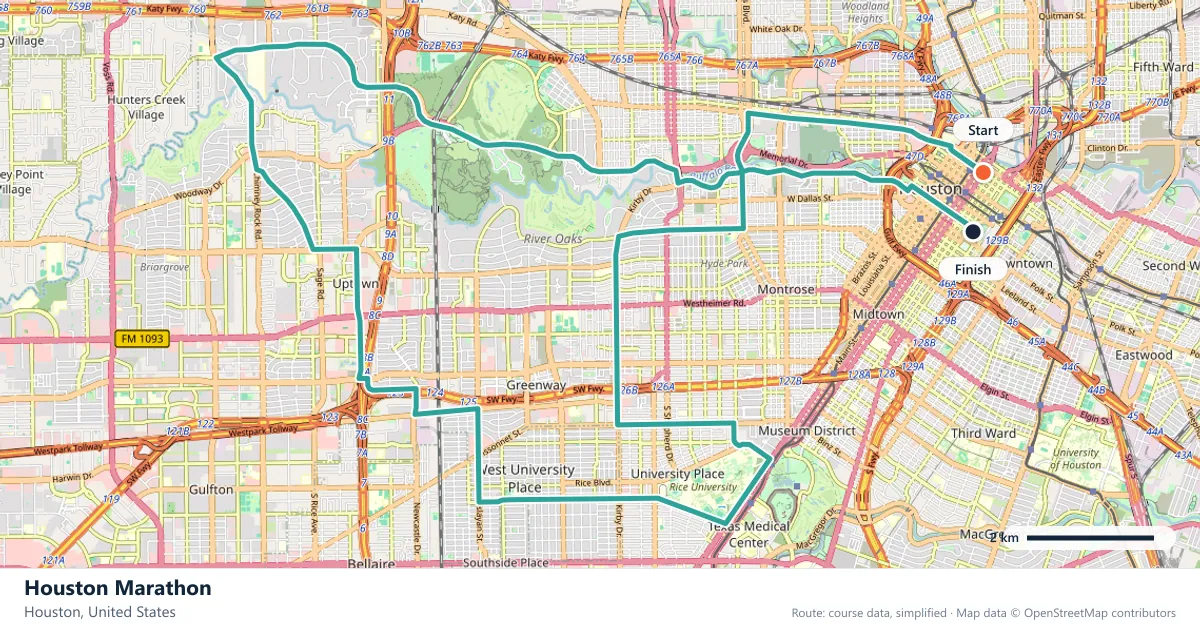
Where does the Houston Marathon run?
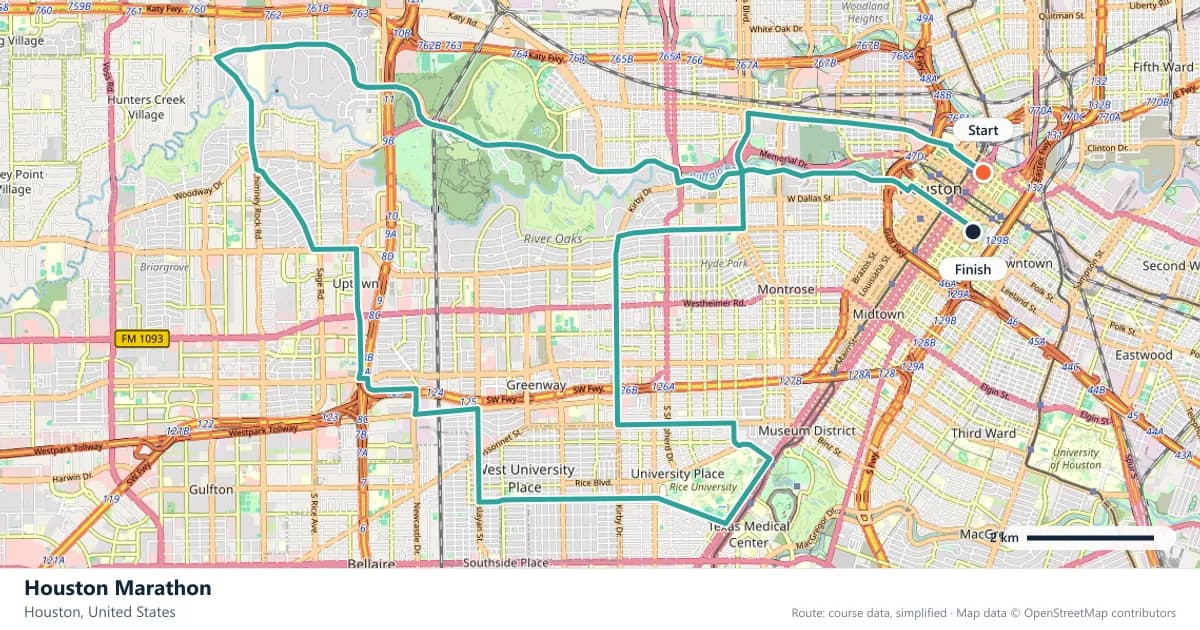
Interactive map
The trace follows the organizer's published course, simplified for the screen: the orange dot is the start, the dark dot the finish. Scroll to zoom, drag to pan.
What is the Houston Marathon course like?
A January race through downtown Houston and the suburbs on a flat, fast course. It doubles as one of the strongest American trials races of the winter.
- Next edition
- 17 January 2027
- Elevation gain
- 65 m
- Profile
- Flat
- First run
- —
Course guide
Houston's marathon is built around a single idea: the clock. The course is flat, the date is January and the city has spent decades proving that an American winter race can produce fast times. Race day is Sunday 17 January 2027, and the marathon doubles as one of the strongest American trials races of the winter, which means it attracts runners with a target.
The route goes through downtown Houston and out into the suburbs, with about 65 metres of climbing across the full distance. That is close to as flat as a major-city marathon gets, and it is the reason the race has a reputation for personal bests. It is also a first-marathon option: the flat ground is forgiving, and the January date gives runners a clear target at the start of the year.
The event holds a World Athletics Gold Label, which reflects both the organisation and the depth of the field. Houston is not a novelty course or a scenic tour; it is a race for people who want to run, and the city's running community treats it that way.
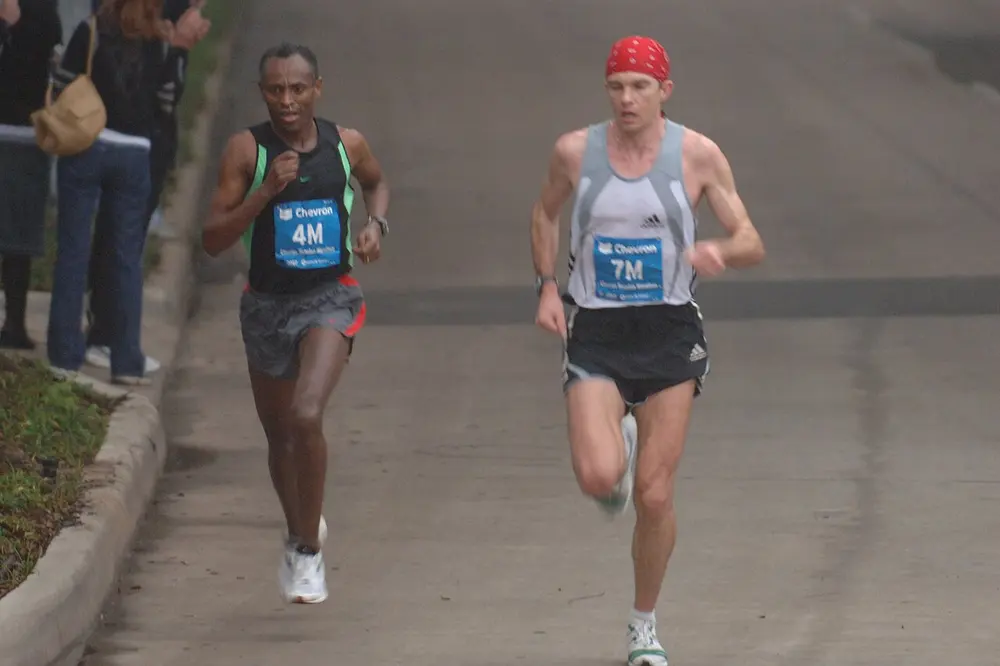
2007 Houston Marathon 02. Photo: Ed Uthman from Houston, TX, USA / Wikimedia Commons, CC BY-SA 2.0.
The course
The race begins in downtown Houston and works outward through the city's neighbourhoods and suburbs. The opening kilometres are urban and dense, with the skyline overhead and the field still packed, before the route settles into the long, flat stretches that define the middle of the race.
There is very little climbing. The 65 metres are spread so thinly across 42.195 kilometres that the course never asks for a real hill effort, and the few rises are short enough to pass almost unnoticed. That is the point: Houston is a course where the terrain does not interrupt the rhythm, and the race becomes a test of pacing and conditioning rather than hill strength.
The flatness cuts both ways. It makes fast times possible, but it also removes the natural check that a climb provides. Nothing on the course will slow an over-ambitious start except your own discipline, and the final kilometres are where that discipline is tested.
Why the clock runs fast
Houston's reputation is built on the combination of a flat course, a January date and a field that comes to race. The marathon is not a casual city loop; it attracts runners chasing qualifying times and personal bests, and the depth of the field pulls the pace along. For a runner with a target, that can be an advantage. For a runner without one, it can be a trap.
The January date sits at the start of the year, when the holidays are over and the spring calendar is still ahead. That makes it a natural goal race for a winter block and a reason to keep training through the darkest months.
The course itself does not have a signature climb or a famous landmark to distract you. It has long, flat roads and a clock. Runners who enjoy that purity will find Houston satisfying; runners who need scenery will find the suburbs repetitive.
A January appointment
A January marathon changes the shape of the training year. The longest runs fall in November and December, when the weather is cooler but the days are shorter, and the final weeks overlap with the holidays. Planning the block around those constraints is part of preparing for Houston.
The race also comes early enough that it can serve as a springboard for a second marathon later in the year. Runners who use Houston as a goal race often find that the fitness carries into the spring, while runners using it as a training race need to be disciplined about not racing it flat out.
The city's size makes the logistics manageable. Houston is a major airport hub, and the course is contained within the city.
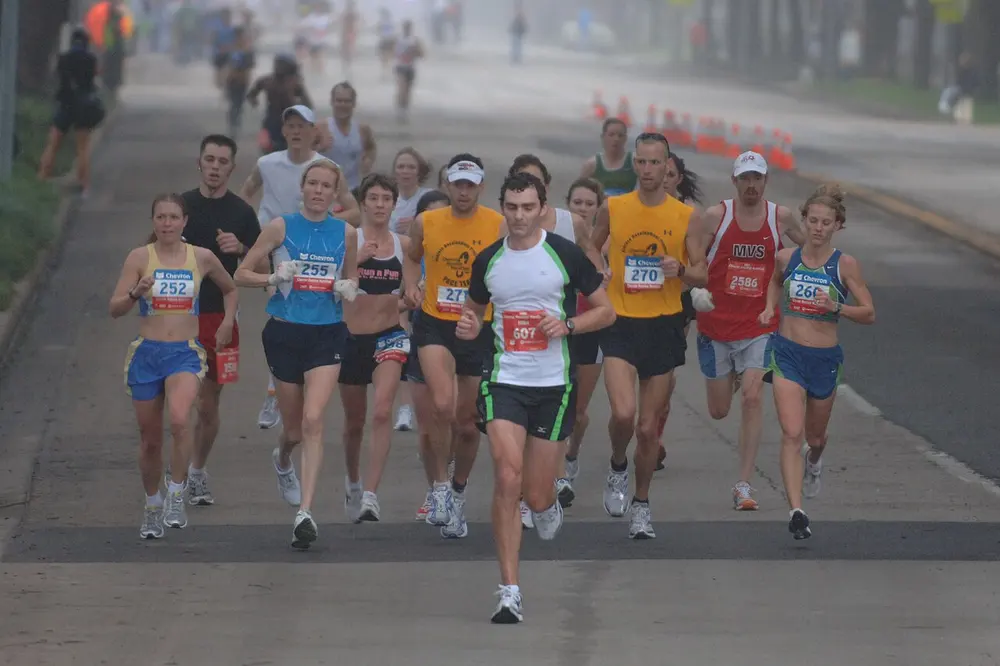
2007 Houston Marathon 08. Photo: Ed Uthman from Houston, TX, USA / Wikimedia Commons, CC BY-SA 2.0.
The Gold Label field
The Gold Label reflects a race that meets standards for organisation, course measurement, timing and elite participation. Houston's Gold Label is consistent with its reputation as a serious winter marathon, and it explains the competitive feel of the race.
That depth is part of the experience. Running in a race where the pace is honest and the runners around you know what they are doing can help, but it can also encourage you to go out faster than planned. The best approach is to use the field for rhythm rather than for pace-setting, and to let the faster runners go.
The label also means the race is part of the international calendar. For runners who care about that side of the sport, Houston offers a serious marathon up close without the scale of a major.
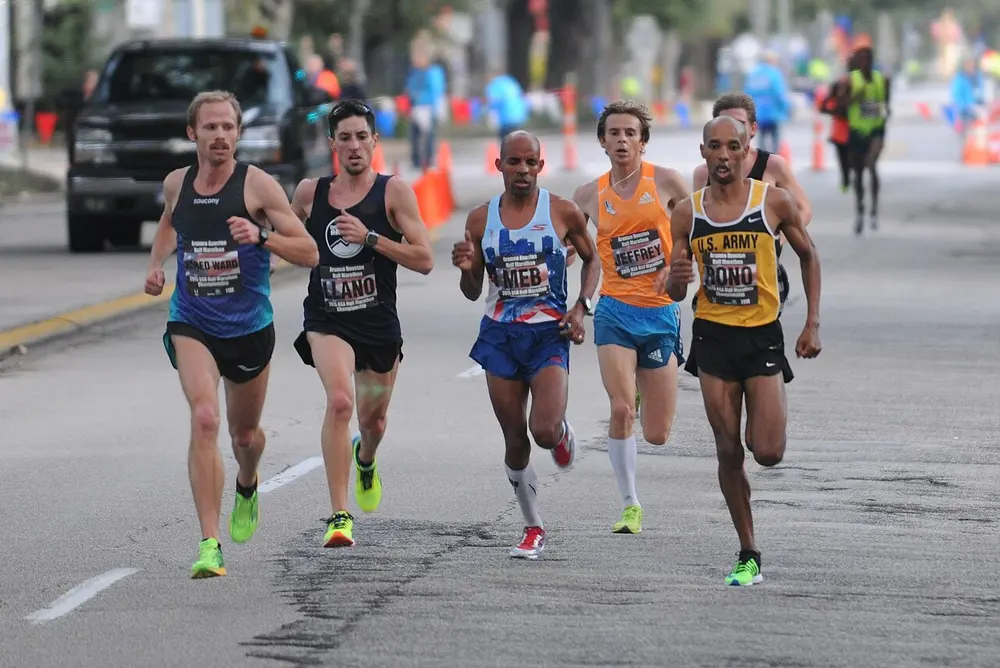
2015 Aramco Houston Half Marathon. Photo: Ed Uthman from Houston, TX, USA / Wikimedia Commons, CC BY 2.0.
Frequently asked questions
Answers to the questions runners ask before entering, drawn from this race's course guide and the directory's own data — the sources behind them are listed below.
When is the Houston Marathon in 2027?
The race is on Sunday 17 January 2027, in downtown Houston.
Is the Houston Marathon flat?
Yes. It climbs only about 65 metres across the full distance, with no sustained ascent. The 65 metres are minimal for a city marathon, and the profile is the main reason for its reputation for fast times.
Is Houston good for a personal best?
The course is suited to fast times. The flat profile, January date and deep field all support fast running, and the event attracts runners chasing qualifying times. Conditions and pacing still decide the outcome.
Is the Houston Marathon suitable for a first marathon?
Yes. The flat course is forgiving, and the January date gives first-timers a clear goal. The caveat is the fast early pace and the temptation to go out too quickly; pick a conservative start and ignore the runners around you.
Where does the Houston Marathon run?
The race runs through downtown Houston and the city's suburbs on a flat, fast course. It stays within the Houston area.
What is the atmosphere like at the Houston Marathon?
It is a serious winter race with a deep field and a clock-focused mood. The course is not scenic in the tourist sense, but the flat roads and the January date give it a clear identity.
More marathons in United States
More marathons in Americas
Sources for this page
What each source below is used for on this page, and where to check this race yourself.
- World Athletics — the label calendar and the road-race regulations. Used to check whether the race holds a World Athletics label, and its elite competition details.
- AIMS — the international course-measurement standard behind the 42.195 km distance, and the AIMS race calendar.
- The organizer's own publications — course maps, race handbooks and published results. The date, course character and climbing on this page are compiled from them and re-checked each season.
“A World Athletics Label denotes a full application of the Competition and Technical Rules in, at a minimum, the elite component of the competition. Labels also denote superior standards in event organisation, safety and runner experience, support from public authorities to the event and a financial commitment to anti-doping.”
Where do these facts come from?
Dates, course type, climbing and time limits are compiled from the organizer's publications and re-checked each season; elevation is an estimate of total climbing rather than a survey figure. Always confirm race-day details with the organizer before making plans.
Last reviewed 27 October 2026