
Toronto Waterfront Marathon
Toronto's marathon finishes beside city hall, but it spends most of its day looking at the lake. The course runs through downtown and along Lake Ontario for long, open stretches, and the 2026 edition…
By Global Marathon Routes editorial team · Last reviewed 27 October 2026
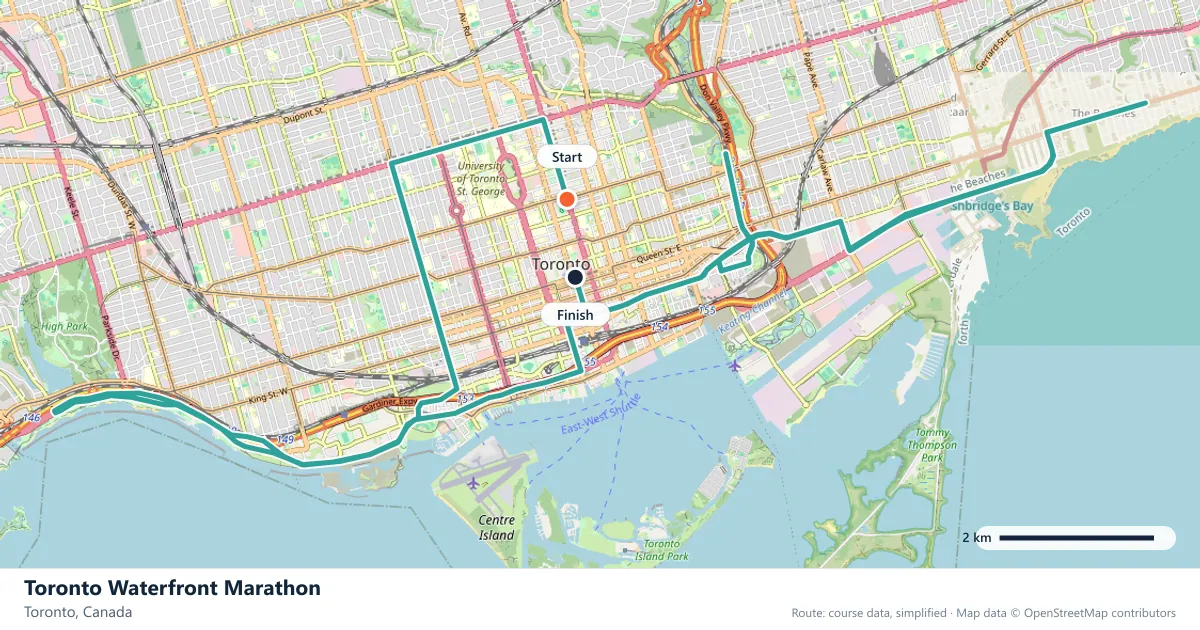
Where does the Toronto Waterfront Marathon run?
Interactive map
The trace follows the organizer's published course, simplified for the screen: the orange dot is the start, the dark dot the finish. Scroll to zoom, drag to pan.
What is the Toronto Waterfront Marathon course like?
A flat, fast lakeside course through downtown Toronto, with long stretches along Lake Ontario and a finish beside city hall. Canada's quickest marathon and its national-championship race.
- Next edition
- October 2027 (expected)
- Elevation gain
- 115 m
- Profile
- Undulating
- First run
- —
Course guide
Toronto's marathon finishes beside city hall, but it spends most of its day looking at the lake. The course runs through downtown and along Lake Ontario for long, open stretches, and the 2026 edition is scheduled for 18 October. It holds a World Athletics Elite Label and doubles as Canada's national-championship marathon.
The profile is undulating, with about 115 metres of climbing, but the word overstates the work. The rises are gentle and short, and the overall trend is flat and quick. That is why Toronto has a reputation as Canada's fastest marathon: the course gives runners room to hold a rhythm without a single significant climb.
The lakeside setting is the other half of the appeal. Long stretches beside Lake Ontario keep the route open and airy, while the downtown sections and the city-hall finish give it a big-city edge. It is a course that can support both a first marathon and a personal best, provided the first half is not raced too hard.
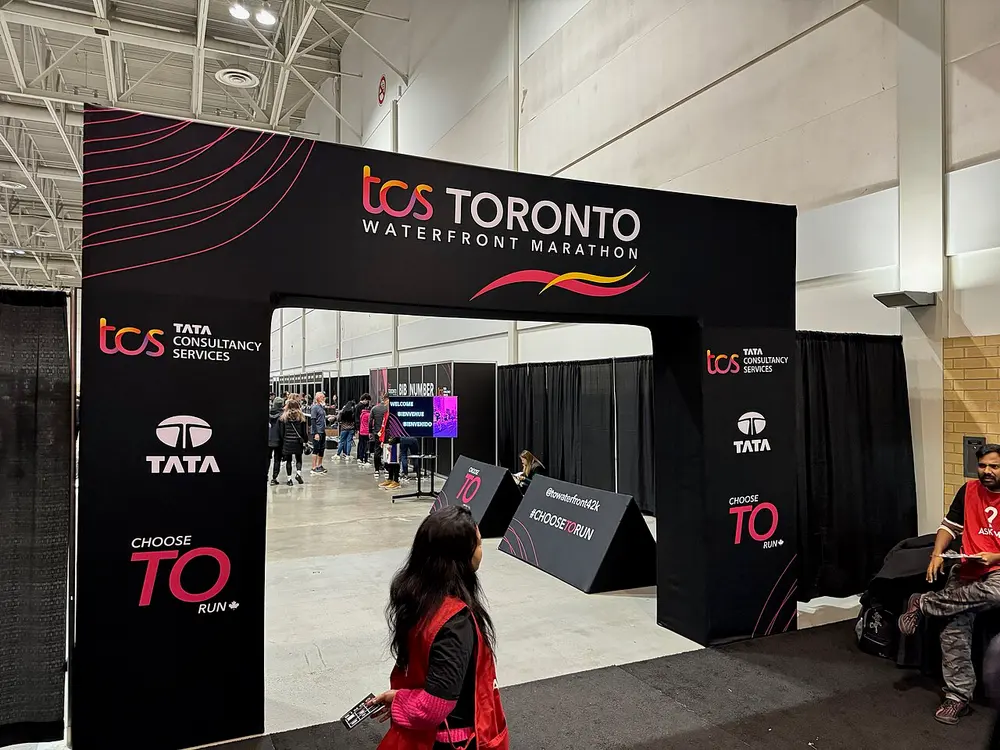
Entry to TCS Toronto Waterfront Marathon Expo. Photo: daveynin from United States / Wikimedia Commons, CC BY 2.0.
The course
The route follows the lakeside through downtown Toronto, using long stretches along Lake Ontario before finishing beside city hall. The waterfront sections are flat and open; the downtown streets add gentle changes of grade and the noise of a major city.
With about 115 metres of gain, the profile is undulating rather than truly hilly. The short rises interrupt the rhythm without breaking it, and the course's speed comes from its openness rather than from a downhill drop. There are few obstacles, but the flat ground can tempt runners into going out too fast.
The lakefront
Lake Ontario gives Toronto its horizon. The waterfront is a long, open edge of parks, harbour and paths, and the marathon uses it for the stretches where the city falls away and the running becomes simple. On a clear morning, the lake can look almost like the sea.
The lakefront is also where the course feels fastest. The ground is flat, the views are wide, and there is little to interrupt the rhythm. Runners who are chasing a time should use these sections to settle rather than to surge, because the downtown kilometres still have to be paid for.
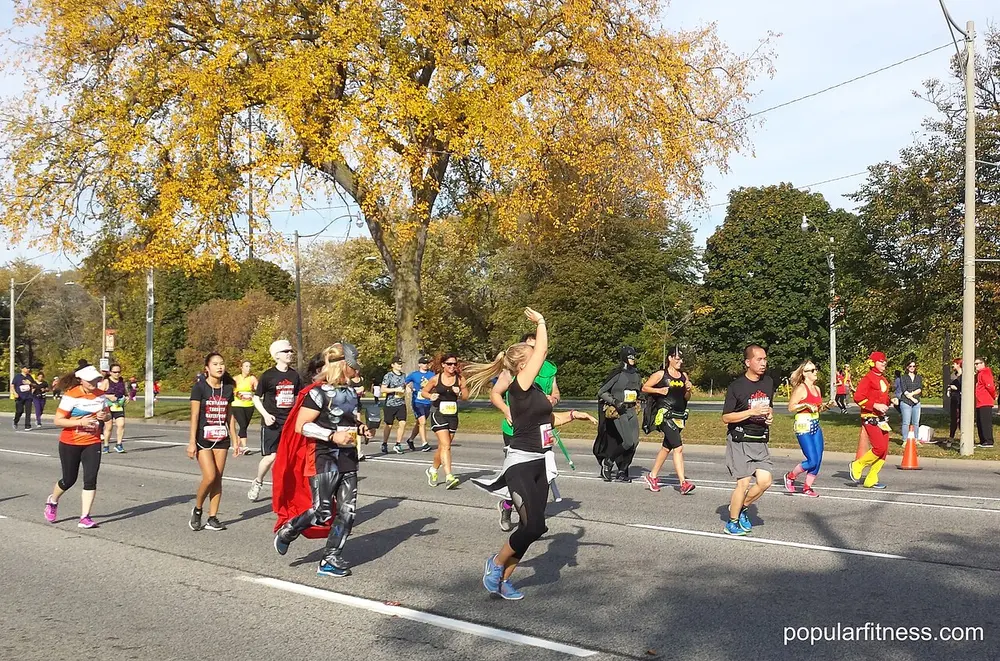
Superheroes at Toronto Waterfront Marathon. Photo: Peter Kudlacz / Wikimedia Commons, CC BY 2.0.
The city-hall finish
The finish beside Toronto City Hall gives the last kilometres a clear target. City Hall is the modern civic centre at Nathan Phillips Square, with its curved towers and open plaza, and it is a recognisable endpoint after the long lakeside run.
A city-hall finish changes the psychology of the final miles. Instead of an anonymous road or an expo car park, the race ends in the middle of the city, with the skyline around it. Runners who know the finish can use it as a marker: once the towers appear, the day is nearly done.
Canada's championship race
The national-championship status gives the race a competitive layer that most city marathons do not have. Canada's best distance runners use it to decide national titles, and the Elite Label reflects the event's standing on the international calendar. For the mass field, the result is a race with a serious front end and a big-city atmosphere.
That combination is unusual. Toronto is both a championship and a people's marathon, with a course fast enough for records and accessible enough for a first attempt. The depth at the front does not change the experience at the back, but it does add a sense of occasion.
Pacing a quick course
The main risk in Toronto is the first 10 km. A flat lakeside course, fresh legs and the pull of the early kilometres can produce a pace that feels comfortable but is too fast. The gentle rises do not punish early enthusiasm; the final downtown kilometres do.
Run the first half by plan, use the lakefront to hold rhythm and save a little for the city streets. The finish beside city hall is worth arriving at with something left, and the course rewards runners who treat its speed as an opportunity rather than a promise.

Hands in the Air - Toronto Waterfront Marathon. Photo: Peter Kudlacz / Wikimedia Commons, CC BY 2.0.
Frequently asked questions
Answers to the questions runners ask before entering, drawn from this race's course guide and the directory's own data — the sources behind them are listed below.
When is the Toronto Waterfront Marathon?
The next edition is expected in October 2027. Final start times and wave arrangements are confirmed closer to the day.
Is the Toronto Waterfront Marathon a flat course?
It is close to flat, with about 115 metres of climbing. The profile is undulating because of gentle rises, but the lakeside stretches are flat and fast.
Is Toronto a good first marathon or personal best?
It works for a first marathon because the course is straightforward and the climbing is modest. It also supports a personal best, thanks to the flat lakefront and the fast overall profile.
Is the Toronto Waterfront Marathon a championship race?
Yes. It is Canada's national-championship marathon as well as one of the country's quickest courses. The race holds a World Athletics Elite Label.
Where does the Toronto Waterfront Marathon finish?
The finish is beside Toronto City Hall, after a course that runs through downtown and along Lake Ontario.
What is the lakefront section like?
It is flat, open and fast, with long views across Lake Ontario. It is the part of the course where pace is easiest to hold, and where restraint matters most.
Why is Toronto considered a fast marathon?
The course climbs only about 115 metres, the lakefront is flat, and there is no significant ascent. The combination of an open route and modest climbing makes fast times possible.
More marathons in Americas
Sources for this page
What each source below is used for on this page, and where to check this race yourself.
- World Athletics — the label calendar and the road-race regulations. Used to check whether the race holds a World Athletics label, and its elite competition details.
- AIMS — the international course-measurement standard behind the 42.195 km distance, and the AIMS race calendar.
- The organizer's own publications — course maps, race handbooks and published results. The date, course character and climbing on this page are compiled from them and re-checked each season.
“A World Athletics Label denotes a full application of the Competition and Technical Rules in, at a minimum, the elite component of the competition. Labels also denote superior standards in event organisation, safety and runner experience, support from public authorities to the event and a financial commitment to anti-doping.”
Where do these facts come from?
Dates, course type, climbing and time limits are compiled from the organizer's publications and re-checked each season; elevation is an estimate of total climbing rather than a survey figure. Always confirm race-day details with the organizer before making plans.
Last reviewed 27 October 2026