
Los Angeles Marathon
Los Angeles is a city that resists a single centre, and its marathon reflects that. The race is a line across the basin, from Dodger Stadium above downtown to Santa Monica on the Pacific.
By Global Marathon Routes editorial team · Last reviewed 27 October 2026
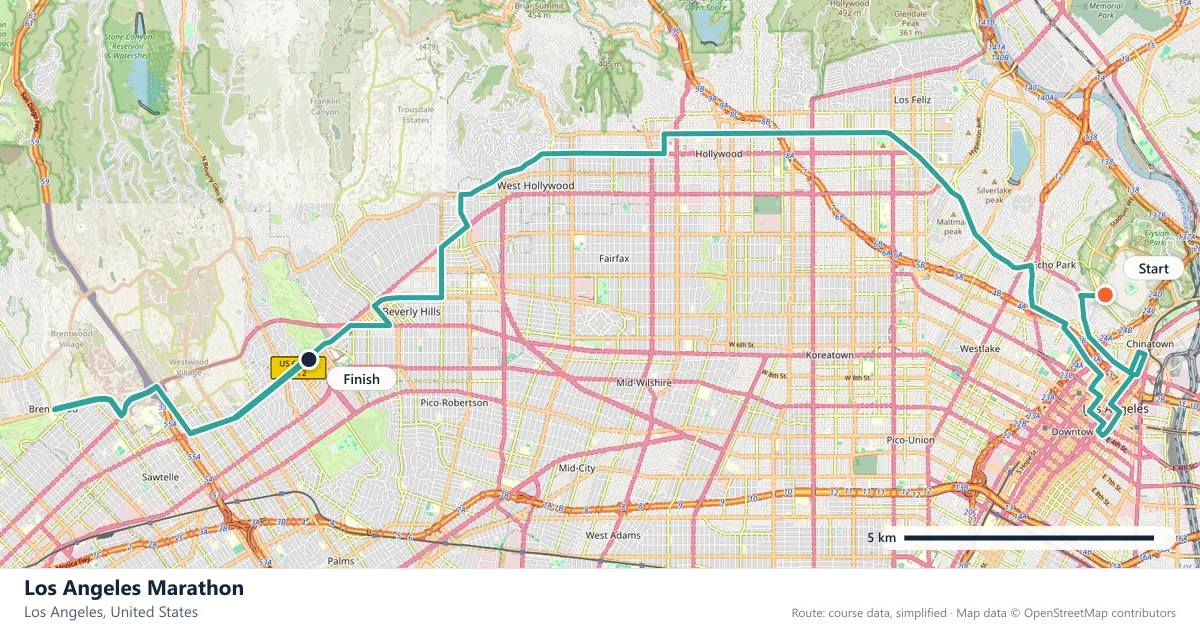
Where does the Los Angeles Marathon run?
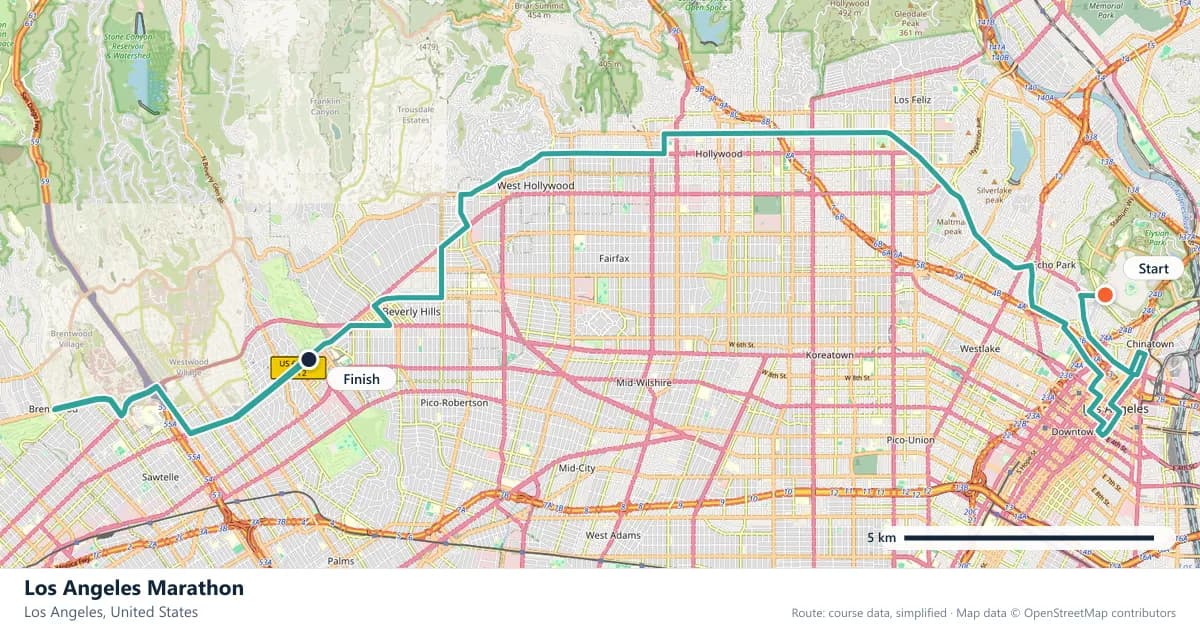
Interactive map
The trace follows the organizer's published course, simplified for the screen: the orange dot is the start, the dark dot the finish. Scroll to zoom, drag to pan.
What is the Los Angeles Marathon course like?
The Stadium to the Stars course runs from Dodger Stadium across the city to the coast at Santa Monica. Rolling hills, long boulevards and a downhill finish by the Pacific.
- Next edition
- 07 March 2027
- Elevation gain
- 290 m
- Profile
- Hilly
- First run
- —
Course guide
Los Angeles is a city that resists a single centre, and its marathon reflects that. The race is a line across the basin, from Dodger Stadium above downtown to Santa Monica on the Pacific. The route is billed as Stadium to the Stars, and the name fits: the course crosses a huge, varied city before dropping to the coast.
Race day is Sunday 07 March 2027. The profile is hilly by the numbers, with about 290 metres of climbing, but the hills are repeated rises rather than one mountain pass. The finish is downhill by the ocean, which gives the race a fast ending after a long, rolling middle. Los Angeles is a first-marathon option rather than a personal-best course, and the point-to-point format makes it a bigger logistical day than a city loop.
That is part of the appeal. The marathon is a tour of Los Angeles at street level, with long boulevards, changing neighbourhoods and the Pacific as the final destination. It is not a race for runners who want a flat, controlled time trial; it is a race for runners who want to cross a city on foot.
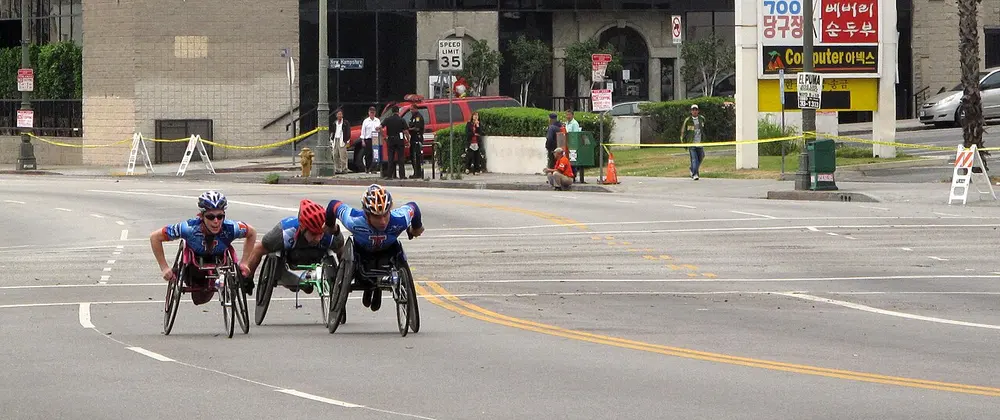
Wheelchair racers Los Angeles Marathon. Photo: Downtowngal / Wikimedia Commons, CC BY-SA 3.0.
The course
The race starts at Dodger Stadium and works across Los Angeles, using long boulevards to connect the city's neighbourhoods on the way to Santa Monica. The opening miles are urban and busy, with the field still dense and the stadium still in the legs, before the route settles into the long, rolling middle.
The 290 metres of climbing arrive in repeated rises rather than a single climb. The course rolls through the middle of the city, with each hill short enough to run but long enough to accumulate. Runners who train only on flat ground will feel the repeated efforts; runners who run rolling roads will recognise the rhythm.
The final section drops toward the Pacific. The downhill finish is one of the race's attractions, but it also loads the quads after a long morning of rolling terrain. The course is point-to-point, and the day has a clear direction: inland at the start, ocean at the finish.
Stadium to the Stars
Dodger Stadium is the race's starting point and its first landmark. The stadium sits above the city, and the opening miles look out over Los Angeles before the route descends into the basin. It is a dramatic way to begin a marathon, and it gives the field a shared sense of occasion before the long crossing.
The middle of the course is a sequence of neighbourhoods and boulevards. Los Angeles is not a city that reveals itself from a single viewpoint; it is a patchwork of districts, and the marathon moves through them one after another.
Santa Monica is the finish and the reward. The Pacific, the beach and the ocean air give the final miles a clear destination, and the downhill approach makes the finish feel fast. After the rolling middle, the coast is a welcome sight.
The hills in the middle
The hills are the race's real test. With 290 metres of climbing, Los Angeles is not a mountain marathon, but it is not a flat city race either. The rises are repeated, and the course rarely allows a long, even rhythm through the middle.
The tactical approach is to run by effort. A pace that feels comfortable on the flat will feel harder on the rises, and a pace that feels hard on the rises will be impossible by Santa Monica. Let the watch drift on the climbs, recover on the descents and keep the effort steady.
Hill training helps, but specificity matters less than patience. The climbs are short enough that a few sessions on rolling roads will prepare most runners. The bigger risk is going out too fast at Dodger Stadium, when the atmosphere and the downhill opening miles make the pace feel easier than it is.
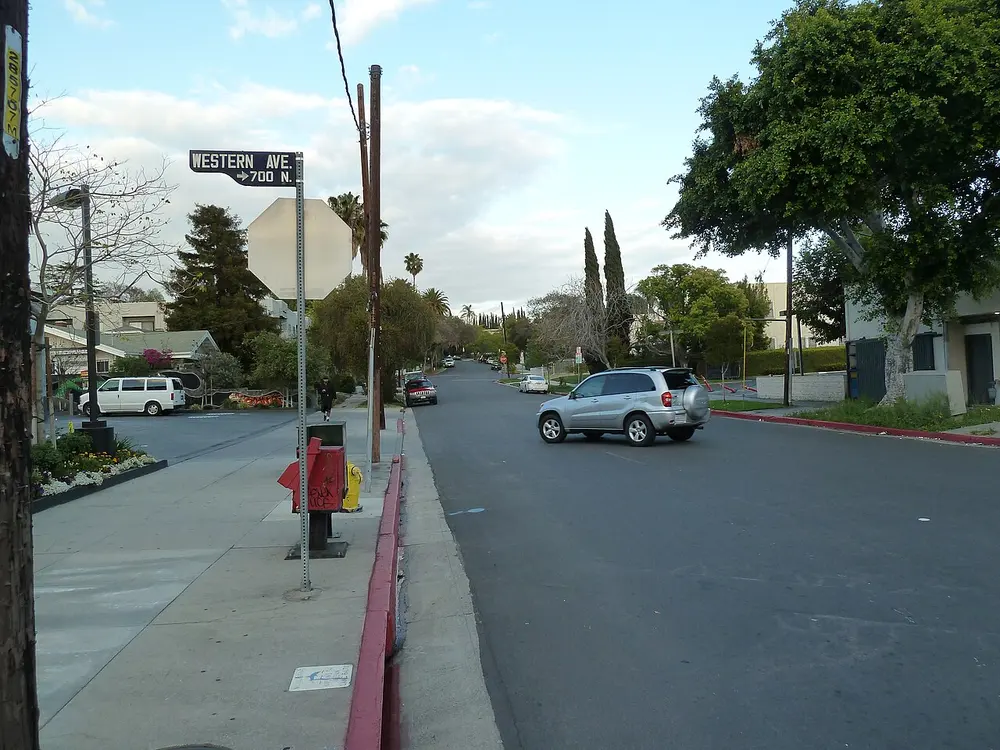
Los Angeles, CA, View E Marathon and Western, 2012 - panoramio. Photo: Chris English / Wikimedia Commons, CC BY-SA 3.0.
Point-to-point planning
The start and finish are in different parts of the city, which makes the logistics more complicated than a loop. Dodger Stadium sits above downtown; Santa Monica is on the coast. Runners need a plan for getting to the start and for getting home from the finish, and supporters need to decide where they want to be.
The point-to-point format also affects the race strategy. The course has a clear direction, and the final miles are far from the start. Runners should carry whatever they need for the second half and should not rely on seeing the same faces throughout the morning.
The reward for that complexity is a course that feels like a journey. Los Angeles is a city of long distances, and the marathon covers one of the longest lines across it. The finish by the Pacific is earned rather than convenient.
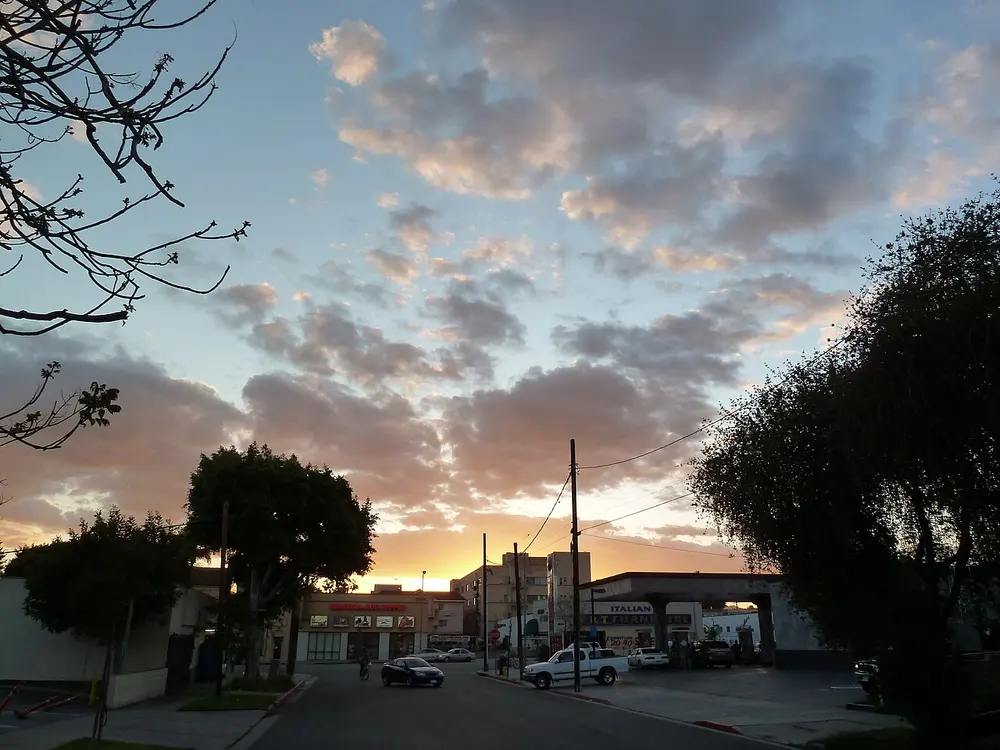
Los Angeles, CA, View W Marathon and Western, 2012 - panoramio. Photo: Chris English / Wikimedia Commons, CC BY-SA 3.0.
Frequently asked questions
Answers to the questions runners ask before entering, drawn from this race's course guide and the directory's own data — the sources behind them are listed below.
When is the Los Angeles Marathon in 2027?
The race is on Sunday 07 March 2027. It is a spring race, run from Dodger Stadium to the coast at Santa Monica.
Is the Los Angeles Marathon fast, flat or hilly?
It is hilly, with about 290 metres of climbing. The route rolls through the city's middle, and although the downhill finish is fast, the repeated hills make even pacing a challenge.
Is Los Angeles suitable for a first marathon?
Yes. The course is manageable with sensible pacing, and the point-to-point route gives the day a clear goal. First-timers should train on rolling ground and start conservatively at Dodger Stadium.
Is Los Angeles a good course for a personal best?
It is not a personal-best course. The 290 metres of climbing and the point-to-point format make it a bigger day than a flat race, even though the downhill finish helps.
Where does the Los Angeles Marathon run?
It runs from Dodger Stadium across Los Angeles to the coast at Santa Monica. The route is point-to-point and finishes by the Pacific.
What is the finish like?
The final miles drop toward Santa Monica, so the finish is downhill by the Pacific. That makes for a fast, celebratory ending, but the quads take a beating after the rolling middle.
More marathons in United States
More marathons in Americas
Sources for this page
What each source below is used for on this page, and where to check this race yourself.
- World Athletics — the label calendar and the road-race regulations. Used to check whether the race holds a World Athletics label, and its elite competition details.
- AIMS — the international course-measurement standard behind the 42.195 km distance, and the AIMS race calendar.
- The organizer's own publications — course maps, race handbooks and published results. The date, course character and climbing on this page are compiled from them and re-checked each season.
Where do these facts come from?
Dates, course type, climbing and time limits are compiled from the organizer's publications and re-checked each season; elevation is an estimate of total climbing rather than a survey figure. Always confirm race-day details with the organizer before making plans.
Last reviewed 27 October 2026