
San Francisco Marathon
The Golden Gate Bridge is the image, but the hills are the race. San Francisco's marathon is a summer loop from the Embarcadero through the city to Golden Gate Park and back, crossing the bridge…
By Global Marathon Routes editorial team · Last reviewed 27 October 2026
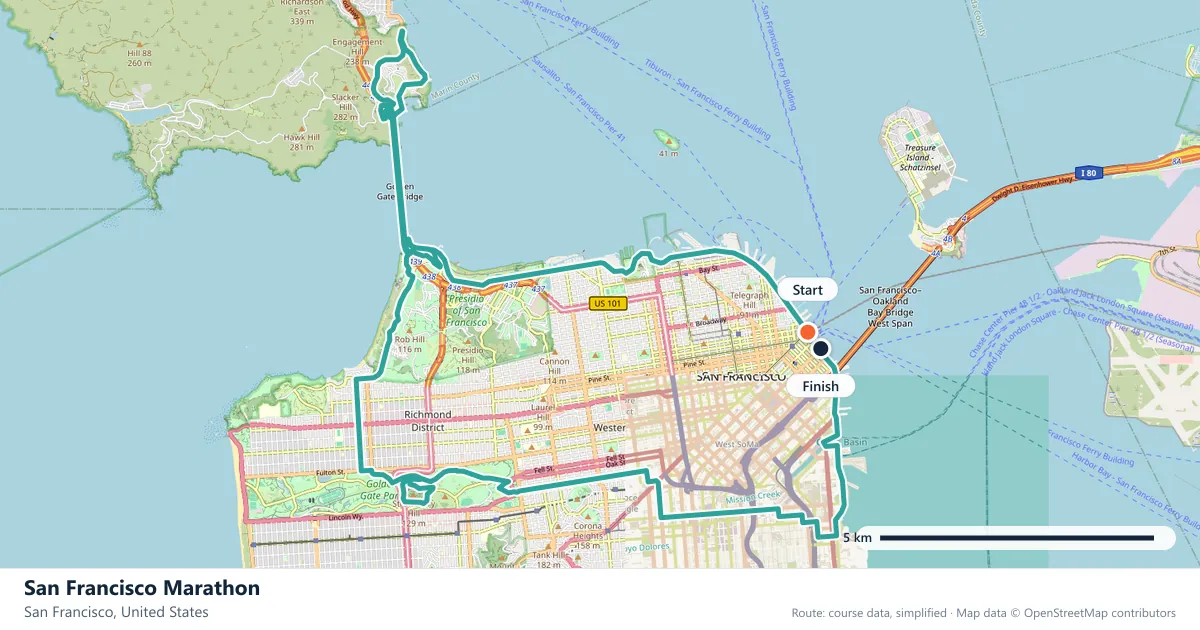
Where does the San Francisco Marathon run?
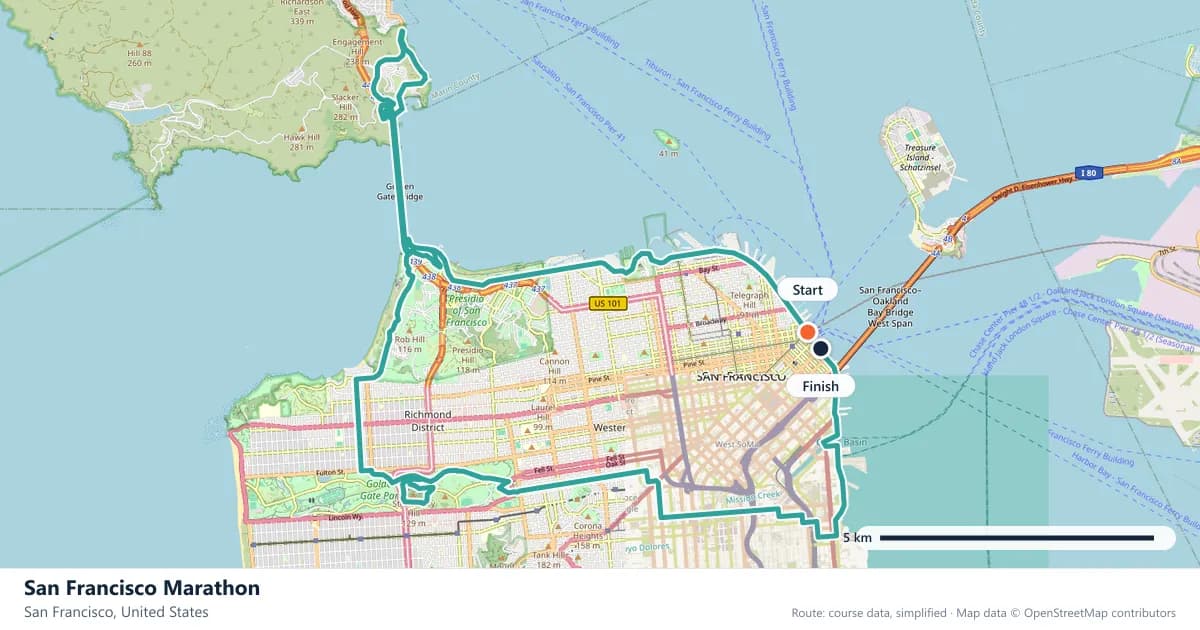
Interactive map
The trace follows the organizer's published course, simplified for the screen: the orange dot is the start, the dark dot the finish. Scroll to zoom, drag to pan.
What is the San Francisco Marathon course like?
A summer loop that crosses the Golden Gate Bridge and works through the city's hills, from the Embarcadero to Golden Gate Park and back. Around 400 metres of climbing, usually in fog.
- Next edition
- 25 July 2027
- Elevation gain
- 416 m
- Profile
- Hilly
- First run
- —
Course guide
The Golden Gate Bridge is the image, but the hills are the race. San Francisco's marathon is a summer loop from the Embarcadero through the city to Golden Gate Park and back, crossing the bridge along the way. The next edition is on Sunday 25 July 2027.
The course climbs about 416 metres, a serious total for a city marathon, and the climbing comes in repeated city blocks rather than one mountain. Fog is usual on race day, so the views can vanish and reappear; the bridge can feel like a world of its own, suspended between the bay and the clouds.
It is a debut course only for runners who respect the elevation. The support and the scenery are memorable, but the second half does not flatten out to rescue tired legs. Train on hills, arrive with an effort-based plan, and treat the bridge as a highlight rather than a race within the race.
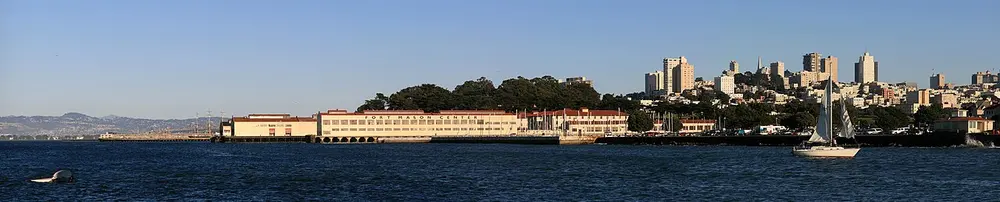
Fort Mason Center and Downtown San Francisco. Photo: Brocken Inaglory / Wikimedia Commons, CC BY-SA 3.0.
The course
The loop works through the city's hills from the Embarcadero, crosses the Golden Gate Bridge and heads towards Golden Gate Park before returning. With about 416 metres of climbing, the profile is the defining feature rather than a detail. The bridge and the park give the course its two scenic anchors, and the city fills the space between them.
San Francisco is compact, but compact does not mean easy. The route repeatedly climbs away from the water and drops back towards it, so the race is a series of short efforts rather than one sustained ascent. That pattern punishes runners who try to hold a flat-course pace through every rise. The bridge is not the whole race, but it is the hinge between the city and the park.
The Golden Gate crossing
The bridge is the moment everyone remembers. Running across the Golden Gate means leaving the city behind for a stretch and heading out over the water, with the towers ahead and the bay below. On a clear morning the view is extraordinary; on a foggy one the bridge becomes an experience of sound and texture rather than panorama.
The crossing is also a place to be careful. The deck is exposed, the surface can be damp, and the scale of the occasion can pull runners faster than planned. Hold your rhythm across the bridge, use the uphill and downhill sections conservatively, and save the urge to surge for dry land.
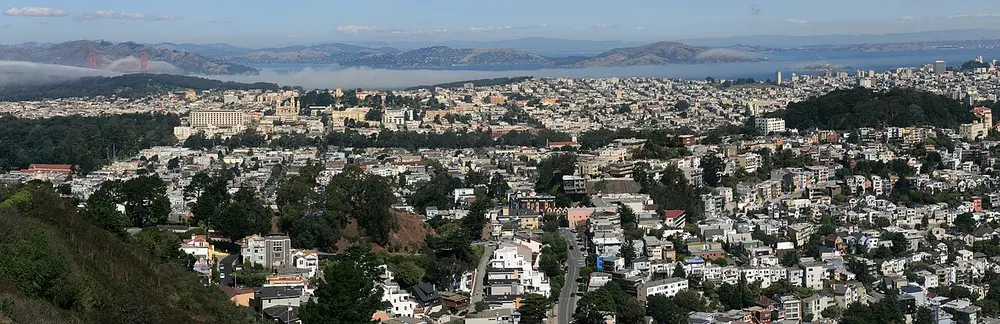
Pano of Golden Gate Bridge and San Francisco from Twin Peaks 1 1. Photo: Brocken Inaglory / Wikimedia Commons, CC BY-SA 4.0.
Fog and the summer start
July in San Francisco is not the city's warmest month, and fog is a usual part of race day. The cool, damp air helps in one sense: it is easier to run in than heat. It complicates the day in another, because the best views may appear and disappear without warning and the bridge can be colder than the streets.
Plan for layers and for visibility. A cap keeps the fog and drizzle off your face, and a light layer that can be discarded is more useful than a heavy jacket. Do not assume that a summer date means sunshine; the coastal fog is part of the race's character.
Hills in city blocks
San Francisco's climbs are short, steep and frequent. None of them lasts long enough to become a mountain pass, but together they add up to 416 metres, and the legs feel every one of them. The right approach is to shorten the stride on the way up, stay relaxed on the way down and avoid trying to recover time on every descent.
Hill training is not optional. Long runs that include repeated climbs will prepare the legs and teach you how to pace by effort rather than by pace. The runners who struggle here are often strong on the flat but unprepared for the constant changes of gradient.
The loop's second half
Because the course is a loop, the second half brings familiar ground. Golden Gate Park and the return towards the Embarcadero give the closing miles a shape you may recognise, and that knowledge can help you pace them. It can also be a trap: familiarity may tempt you to push too early.
The final city miles are still rolling, and the finish does not arrive on a long downhill. Save enough for the last 10 kilometres, use the park to regroup before the waterfront, and let the return to the Embarcadero carry you home.
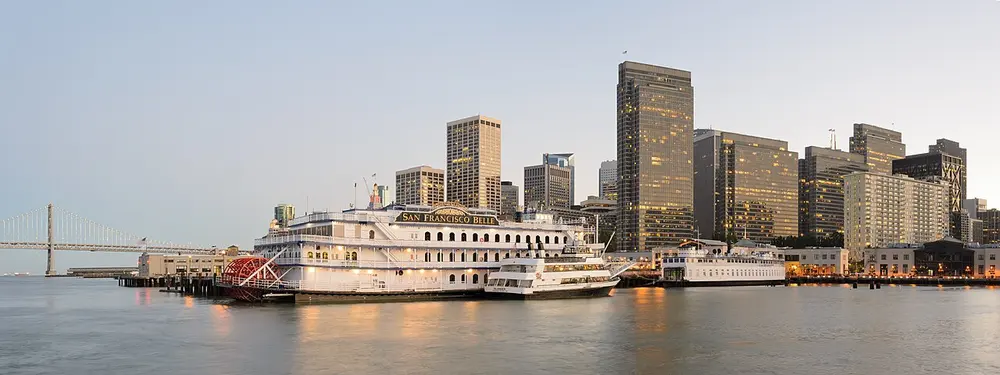
San Francisco from Pier 7 September 2013 panorama edit. Photo: King of Hearts / Wikimedia Commons, CC BY-SA 3.0.
Frequently asked questions
Answers to the questions runners ask before entering, drawn from this race's course guide and the directory's own data — the sources behind them are listed below.
When is the San Francisco Marathon?
The next edition is on Sunday 25 July 2027. It is a summer race that starts and finishes around the Embarcadero.
Is the San Francisco Marathon a hilly course?
Yes. It climbs about 416 metres, with repeated city climbs throughout the loop. There is no flat second half waiting to rescue the legs, and the bridge adds its own exposed terrain.
Is the San Francisco Marathon suitable for a first marathon?
The scenery and support make it memorable, and the distance is manageable for a prepared debut. The climbing, however, makes it a demanding first marathon. A first-timer should train on hills and start conservatively.
Does the San Francisco Marathon cross the Golden Gate Bridge?
Yes. The loop crosses the Golden Gate Bridge and also runs out to Golden Gate Park from the Embarcadero. The bridge is the centrepiece of the route.
What is the weather usually like for the San Francisco Marathon?
Fog is usual on race day, and July mornings can be cool and damp. Plan for layers rather than assuming summer sunshine, especially on the exposed bridge crossing.
Is the San Francisco Marathon a personal-best course?
The 416 metres of climbing and the rolling urban terrain work against an even, fast effort, so it is not the city's obvious time-trial course. The profile is the priority.
More marathons in United States
More marathons in Americas
Sources for this page
What each source below is used for on this page, and where to check this race yourself.
- World Athletics — the label calendar and the road-race regulations. Used to check whether the race holds a World Athletics label, and its elite competition details.
- AIMS — the international course-measurement standard behind the 42.195 km distance, and the AIMS race calendar.
- The organizer's own publications — course maps, race handbooks and published results. The date, course character and climbing on this page are compiled from them and re-checked each season.
Where do these facts come from?
Dates, course type, climbing and time limits are compiled from the organizer's publications and re-checked each season; elevation is an estimate of total climbing rather than a survey figure. Always confirm race-day details with the organizer before making plans.
Last reviewed 27 October 2026