
Rock 'n' Roll San Diego Marathon
Before there were Rock 'n' Roll marathons in other cities, there was San Diego. The original race in the series runs through the city's neighbourhoods and out along the Pacific coast, and the next…
By Global Marathon Routes editorial team · Last reviewed 27 October 2026
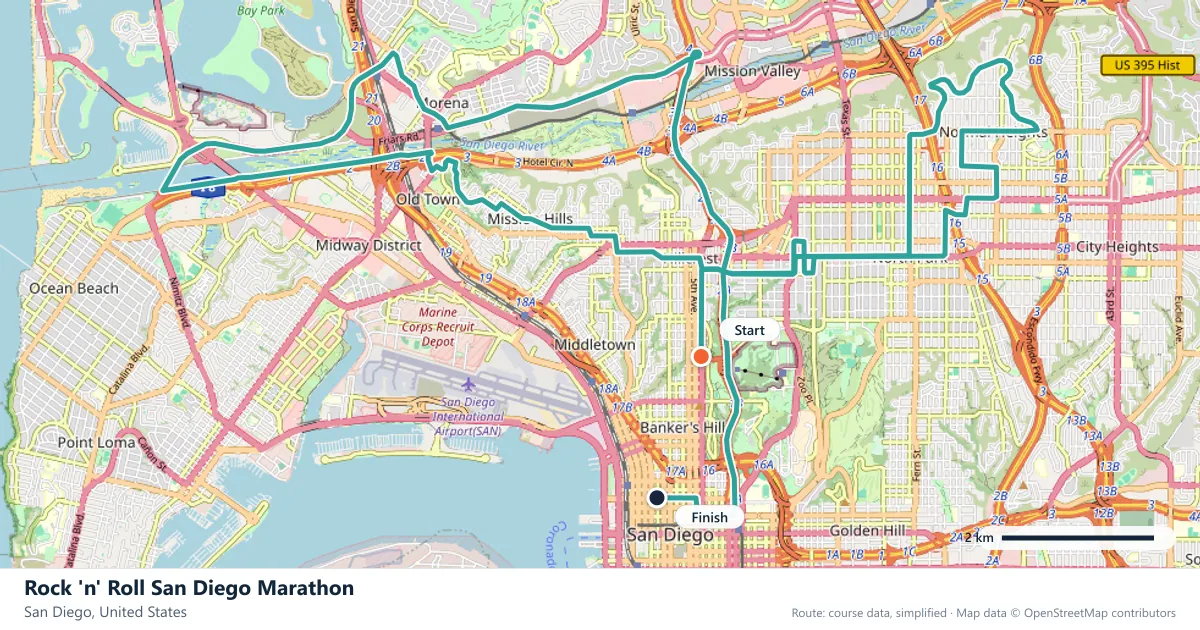
Where does the Rock 'n' Roll San Diego Marathon run?
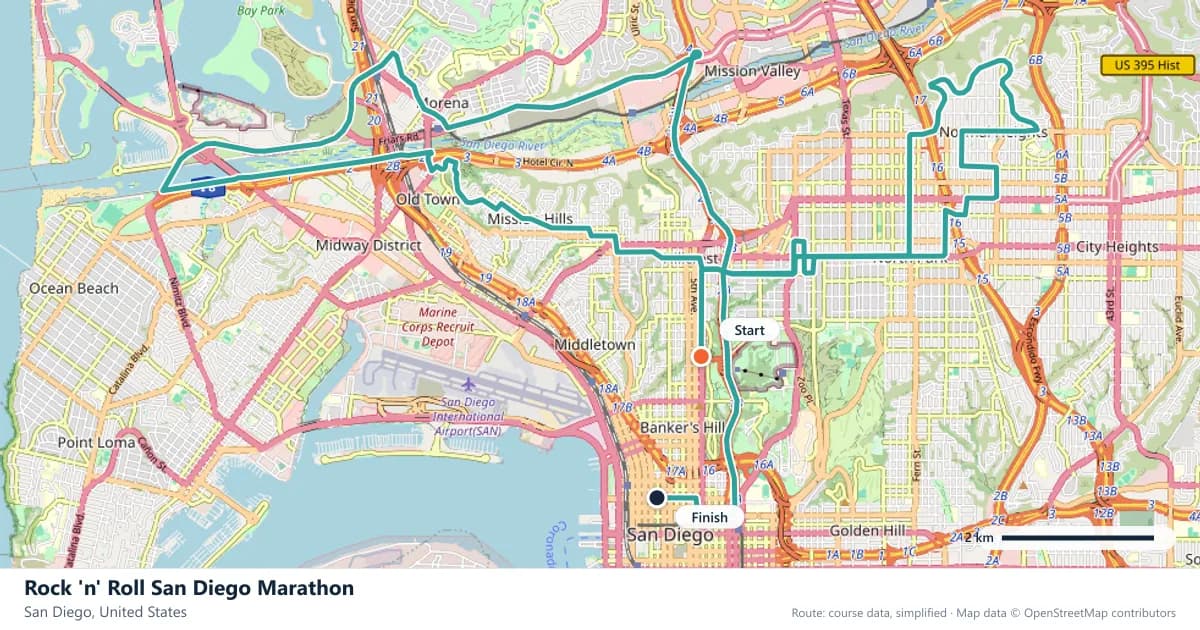
Interactive map
The trace follows the organizer's published course, simplified for the screen: the orange dot is the start, the dark dot the finish. Scroll to zoom, drag to pan.
What is the Rock 'n' Roll San Diego Marathon course like?
The original Rock 'n' Roll race, run in June through San Diego's neighbourhoods and out along the coast. Rolling, with bands on every mile and a big field.
- Next edition
- 06 June 2027
- Elevation gain
- 268 m
- Profile
- Hilly
- First run
- —
Course guide
Before there were Rock 'n' Roll marathons in other cities, there was San Diego. The original race in the series runs through the city's neighbourhoods and out along the Pacific coast, and the next edition is on Sunday 06 June 2027.
The course is hilly, with about 268 metres of climbing, but the climbs are spread through a rolling route rather than concentrated in a single landmark hill. Bands play on every mile, and the field is large, so the day has the feel of a moving festival as well as a race.
For a first marathon, the atmosphere is a genuine asset: there is always another band, another stretch of road and another part of the city to pull you forward. The rolling profile is the caveat, and a big field makes the opening miles a test of patience as much as pace.
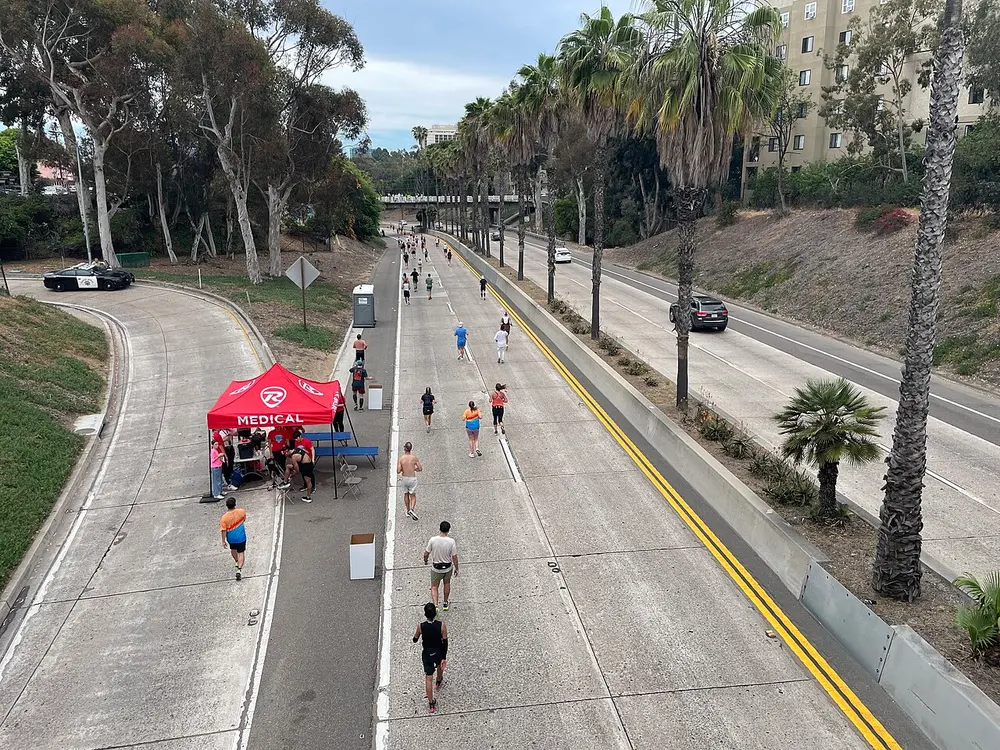
Rock 'n' Roll San Diego Marathon CA163 2025. Photo: Blervis / Wikimedia Commons, CC0.
The course
The route threads through San Diego's neighbourhoods and then runs out along the coast. The climbing totals about 268 metres, spread across a rolling course rather than saved for one hill. The coastline provides the scenic stretch, while the urban miles carry much of the race's rhythm.
San Diego is a city built across mesas and canyons, and the course uses that topography instead of avoiding it. The result is a marathon that never settles into a long flat rhythm. There are easier sections, particularly near the water, but the overall impression is of constant gentle change underfoot.
The original Rock 'n' Roll race
San Diego is where the Rock 'n' Roll format began, and the race still carries the original's mix of live music and a large, enthusiastic field. The bands are not a gimmick bolted onto a conventional marathon; they are part of the rhythm of the day, placed at regular intervals so that the course keeps offering something new.
That history gives the event a different atmosphere from a quiet city race. It is louder, busier and more deliberately entertaining, and the music is as much a part of the route as the coastline. Runners who like a crowd and a soundtrack will find the format suits them; those who prefer silence should prepare for the opposite.
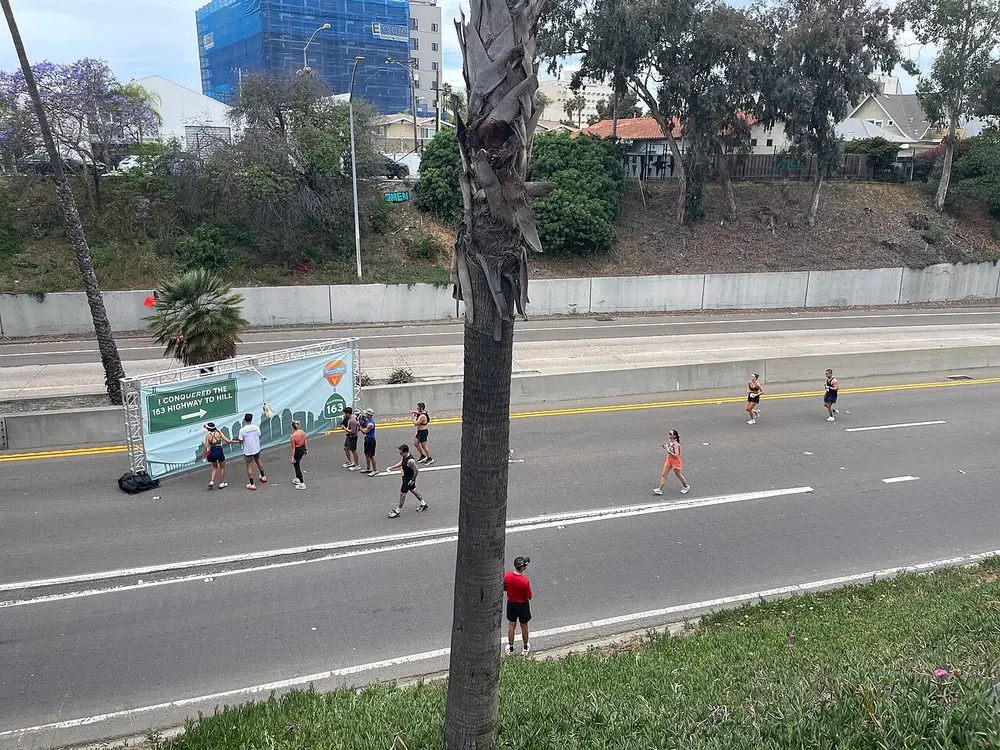
Rock 'n' Roll San Diego Marathon CA163 - Hilltop 2025. Photo: Blervis / Wikimedia Commons, CC0.
Neighbourhoods and the coast
The first half belongs to the city. Residential streets, local business districts and the ordinary fabric of San Diego pass by in sequence, with spectators concentrated at the points where the route crosses familiar ground. It is a course that shows you how people actually live in the city rather than only its postcard views.
Then the route reaches the coast, and the race opens up. The Pacific gives the middle and later miles a wide horizon, cooler air and a sense of scale that the neighbourhood streets cannot match. The transition from urban blocks to ocean is one of the defining experiences of the race.
Bands on every mile
Live music on every mile changes how a marathon feels. A band can lift a tired stretch, break the monotony of a long straight and give the field something to run towards. It can also pull runners faster than planned, especially in the first half when the energy is high and the legs are still fresh.
Use the bands as markers rather than cues to sprint. Let each one give you a small lift, then return to your own rhythm. The runners who enjoy San Diego most are usually the ones who treat the music as atmosphere rather than as a series of starts.
Racing a big field
A large field is part of the San Diego experience, and it shapes the early miles. The opening kilometres can feel crowded, with runners still finding space and pace. Fighting for position wastes energy that will be needed later, so let the first mile unfold and look for a rhythm once the field begins to string out.
The size of the event also means the course is rarely lonely. That is a comfort in the closing miles, when a nearby runner can be the difference between holding pace and slowing down. Use the company without racing it.
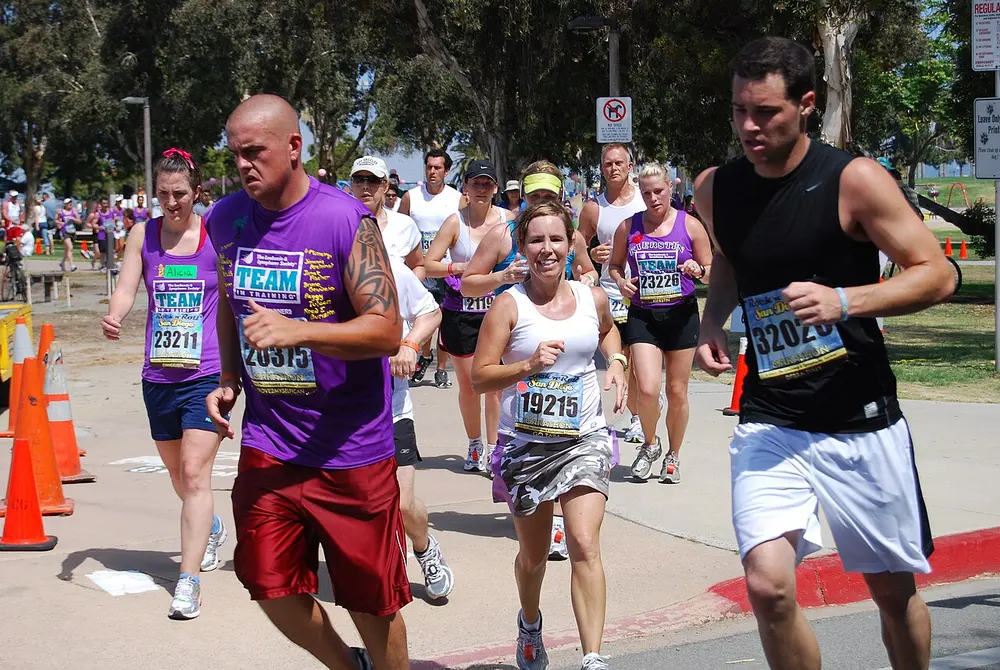
San Diego marathon. Photo: Aaron R. Fulkerson / Wikimedia Commons, CC BY-SA 2.0.
Frequently asked questions
Answers to the questions runners ask before entering, drawn from this race's course guide and the directory's own data — the sources behind them are listed below.
When is the Rock 'n' Roll San Diego Marathon?
The next edition is on Sunday 06 June 2027. It is a June race through the city's neighbourhoods and along the coast.
Is the Rock 'n' Roll San Diego Marathon a hilly course?
Yes. It climbs about 268 metres, with a rolling route through the neighbourhoods and along the coast. There is no single defining climb, but the ground is rarely flat for long.
Is the Rock 'n' Roll San Diego Marathon suitable for a first marathon?
The big field, the music and the coastal scenery make it a supportive debut, and the rolling profile is manageable with some hill training. Start conservatively in the crowded opening miles and do not let the bands pull you faster than your plan.
Why is San Diego called the original Rock 'n' Roll race?
The San Diego event is where the Rock 'n' Roll marathon format began. It combines a large field with live bands on every mile, and that formula shaped the races later staged in other cities.
What is the coastal section like?
The route leaves the neighbourhood streets and runs out along the Pacific coast, where the horizon opens up and the air is cooler. It is one of the scenic highlights of the course and a good place to hold an even rhythm.
Is the Rock 'n' Roll San Diego Marathon a personal-best course?
The rolling terrain and the size of the field make an even, fast effort harder to control, so it is not the most obvious personal-best venue. The course rewards patience more than pure speed.
More marathons in United States
More marathons in Americas
Sources for this page
What each source below is used for on this page, and where to check this race yourself.
- World Athletics — the label calendar and the road-race regulations. Used to check whether the race holds a World Athletics label, and its elite competition details.
- AIMS — the international course-measurement standard behind the 42.195 km distance, and the AIMS race calendar.
- The organizer's own publications — course maps, race handbooks and published results. The date, course character and climbing on this page are compiled from them and re-checked each season.
Where do these facts come from?
Dates, course type, climbing and time limits are compiled from the organizer's publications and re-checked each season; elevation is an estimate of total climbing rather than a survey figure. Always confirm race-day details with the organizer before making plans.
Last reviewed 27 October 2026