
Salt Lake City Marathon
Salt Lake City's marathon begins above the city. The start sits in the Wasatch foothills, where the ground already tilts downhill, and the course drops into the valley before running through the…
By Global Marathon Routes editorial team · Last reviewed 27 October 2026
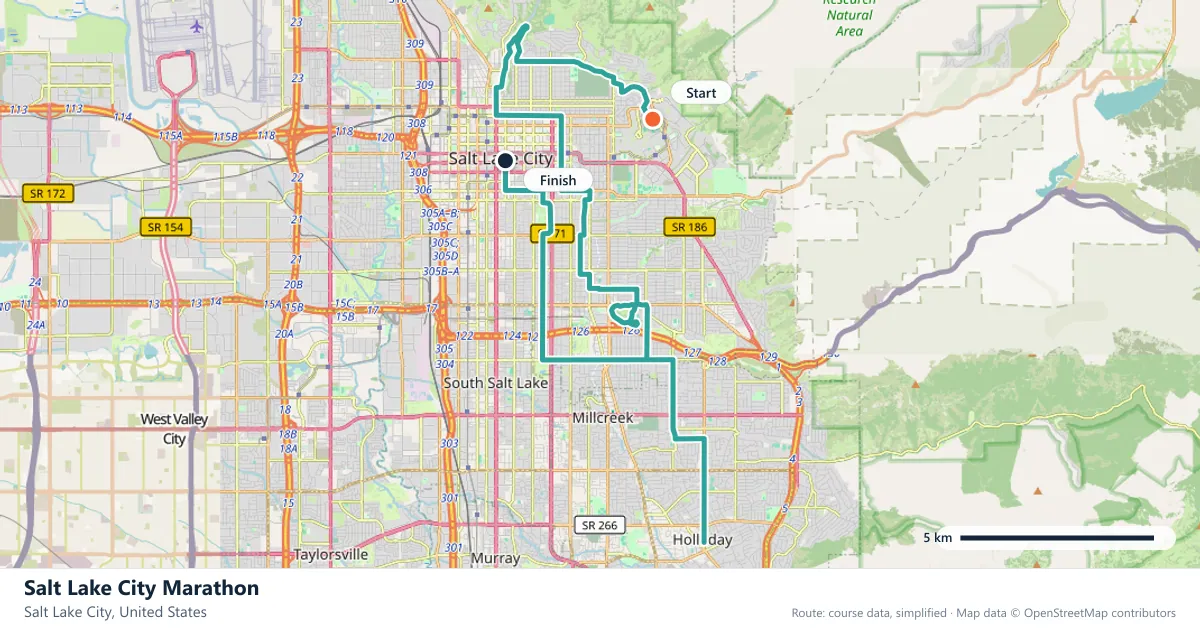
Where does the Salt Lake City Marathon run?
Interactive map
The trace follows the organizer's published course, simplified for the screen: the orange dot is the start, the dark dot the finish. Scroll to zoom, drag to pan.
What is the Salt Lake City Marathon course like?
Starts at altitude in the Wasatch foothills and drops into Salt Lake City, finishing at the Olympic legacy plaza. The downhill opening makes it quick, if the altitude allows.
- Next edition
- 24 April 2027
- Elevation gain
- 278 m
- Profile
- Hilly
- First run
- —
Course guide
Salt Lake City's marathon begins above the city. The start sits in the Wasatch foothills, where the ground already tilts downhill, and the course drops into the valley before running through the streets to the Olympic legacy plaza. The next edition is on Saturday 24 April 2027.
It is a hilly course overall — about 278 metres of climbing — but it opens with a long descent, and that drop is the reason many runners choose it. The counterweight is altitude. The city sits well over a kilometre above sea level and the foothills start higher still, so for most visitors the same pace costs more than it would at home.
The race is a sound choice for a first marathon, provided the preparation includes hills and the arrival allows time to adjust. It is not a flat valley run with a scenic start; the second half keeps rolling, and the thin air does not switch off at the city limits.
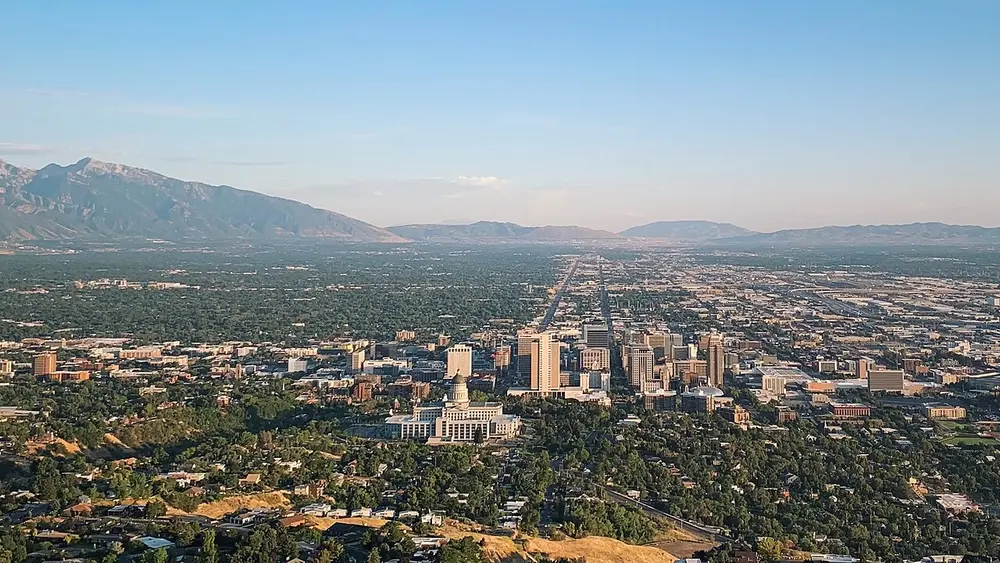
Salt Lake City skyline (2020) from Ensign Peak. Photo: Iansmh98 / Wikimedia Commons, CC BY-SA 4.0.
The course
From the Wasatch foothills the route descends into the valley and then uses city streets to reach the finish at the Olympic legacy plaza. The 278 metres of climbing is spread across the day rather than saved for one pass; the opening drop is the defining gradient, and the later miles roll through the grid rather than settling into a flat run.
The course is a single journey rather than a loop. Runners leave the foothills behind and gradually enter the city, with the Wasatch skyline staying visible above the rooftops. That sense of descent gives the race momentum, but it also means the first half and the second half ask for different things.
The opening descent
The opening miles carry the longest descent of the day, and they are also the most dangerous. A long downhill can make a goal pace feel comfortable when it is not, and the quads absorb the cost quietly. Run the drop with a compact stride and a controlled cadence; let the gradient give you speed without letting it dictate your effort.
The descent is a particular temptation for visitors from lower ground. The legs feel fresh, the air is cool, and the city is spread out below. The runners who pay for it later are usually the ones who raced the first 10 kilometres as if the rest of the course were flat.
Airport, Salt Lake City, Utah, 1950. Photo: Paul F Lindberg / Wikimedia Commons, CC0.
Altitude, not just gradient
Salt Lake City's valley floor is roughly 1,300 metres above sea level, and the foothills start higher. The air is thinner than at coastal sea level, which means a familiar pace produces a higher heart rate and a harder effort. The effect is not dramatic on a single hill, but it accumulates over 42 kilometres.
Arriving early helps, though it is not a substitute for fitness. Runners who live at altitude have an advantage; everyone else should adjust expectations rather than force sea-level splits. Use breathing and perceived effort as the guide, especially on the uphill sections, and accept that the pace you can hold may be slower than the same effort at home.
The Olympic finish
The finish at the Olympic legacy plaza ties the race to Salt Lake City's Winter Olympic history. The 2002 Games left the city with venues and public spaces that still shape its identity, and the plaza gives the marathon a finish with more meaning than a random stretch of asphalt.
As a closing target it works well: the route returns to the city and the foothills are behind you, but the final kilometres are still rolling. Save something for the approach rather than emptying everything on the descent into the valley.
Building a debut around the hills
A first marathon at altitude needs a patient build. Long runs on rolling routes will prepare the legs for the later climbs, and a few sessions with sustained descents will reduce the shock of the opening miles. Include some time at moderate altitude if you can, but do not panic if you cannot; the race is runnable without it, provided you pace honestly.
The other debut lesson is about the start. It is easy to feel strong in the foothills and then discover at 25 kilometres that the day has already been spent. Start slower than your ambition, use the descent to settle rather than to race, and let the middle of the course come to you.
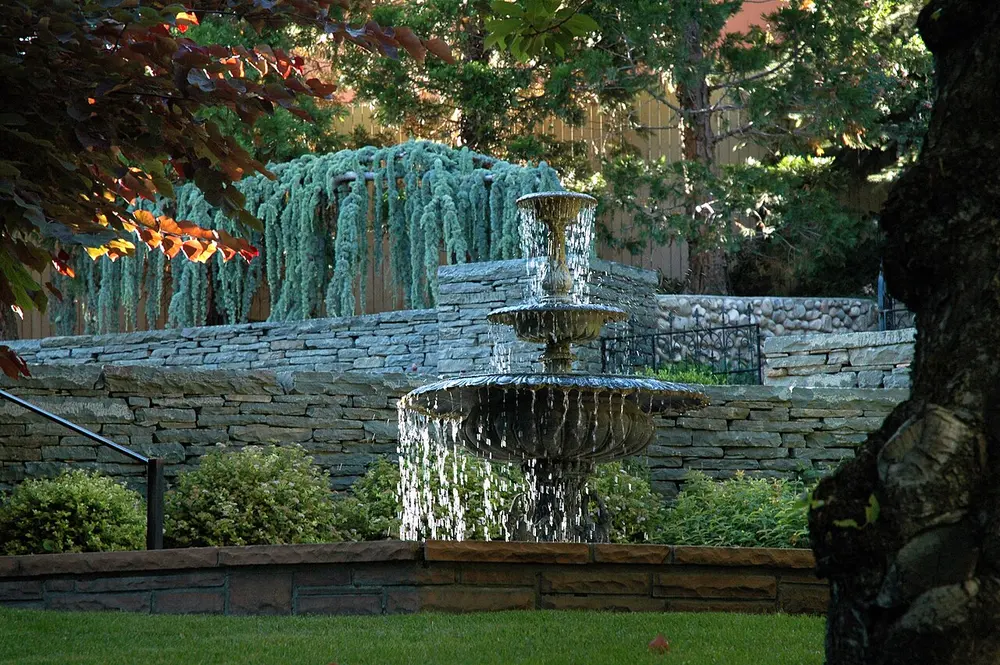
Fountain in a garden, Capitol Hill, Salt Lake City, 2009. Photo: DimiTalen / Wikimedia Commons, CC0.
Frequently asked questions
Answers to the questions runners ask before entering, drawn from this race's course guide and the directory's own data — the sources behind them are listed below.
When is the Salt Lake City Marathon?
The next edition is on Saturday 24 April 2027, a spring race in the Wasatch foothills and the city below.
Is the Salt Lake City Marathon a hilly course?
Yes. It climbs about 278 metres, with a descending opening followed by a rolling second half. The opening miles carry the steepest descent, but the route does not stay flat once it reaches the city.
Is the Salt Lake City Marathon suitable for a first marathon?
The course is a credible debut, with a forgiving downhill start and a clear finish at the Olympic legacy plaza. The caveats are altitude and the later hills, so train on rolling ground and arrive ready for thinner air.
Does altitude make the Salt Lake City Marathon harder?
For most visitors, yes. The city is roughly 1,300 metres above sea level and the start is higher. The same pace feels harder than at sea level, particularly on the climbs, so effort rather than splits should set the pace.
Where does the Salt Lake City Marathon start and finish?
It starts in the Wasatch foothills above the city and finishes at the Olympic legacy plaza. The route is point to point, not a loop.
How should you pace the opening descent?
Conservatively. Let the downhill carry you without overstriding, keep the cadence quick and the stride compact, and resist the urge to bank time. The second half is where that restraint pays off.
More marathons in United States
More marathons in Americas
Sources for this page
What each source below is used for on this page, and where to check this race yourself.
- World Athletics — the label calendar and the road-race regulations. Used to check whether the race holds a World Athletics label, and its elite competition details.
- AIMS — the international course-measurement standard behind the 42.195 km distance, and the AIMS race calendar.
- The organizer's own publications — course maps, race handbooks and published results. The date, course character and climbing on this page are compiled from them and re-checked each season.
Where do these facts come from?
Dates, course type, climbing and time limits are compiled from the organizer's publications and re-checked each season; elevation is an estimate of total climbing rather than a survey figure. Always confirm race-day details with the organizer before making plans.
Last reviewed 27 October 2026