
Sacramento Marathon
Sacramento's marathon is a downstream race. It begins in Folsom, at the edge of the Sierra foothills, and follows the American River into California's capital, with the finish set towards Old…
By Global Marathon Routes editorial team · Last reviewed 27 October 2026
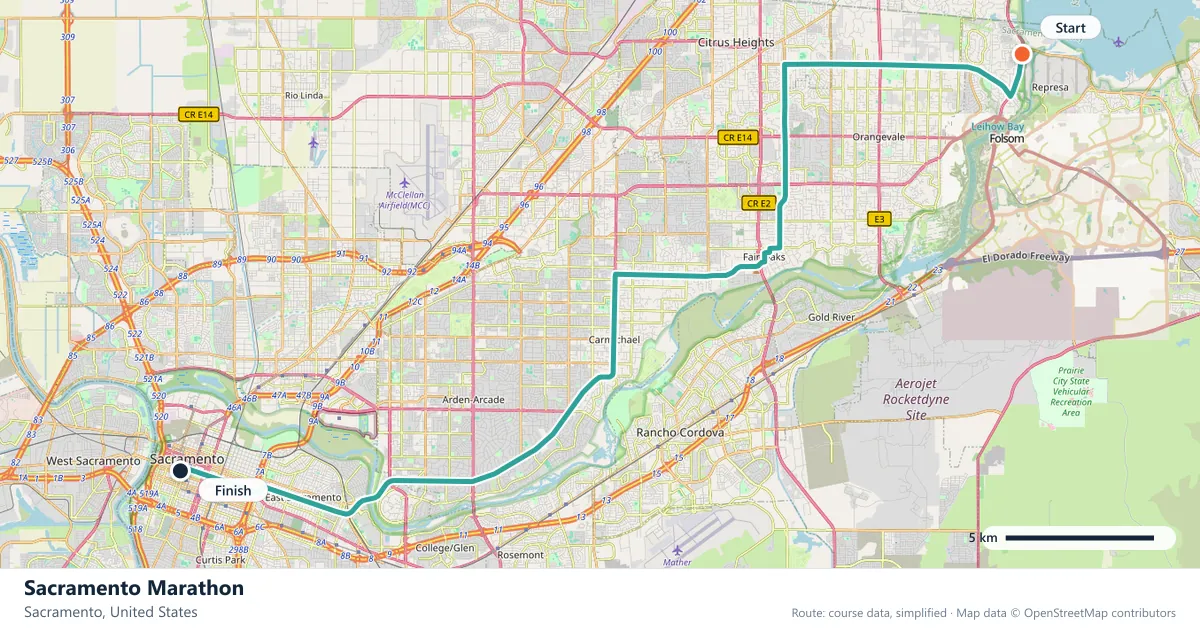
Where does the Sacramento Marathon run?
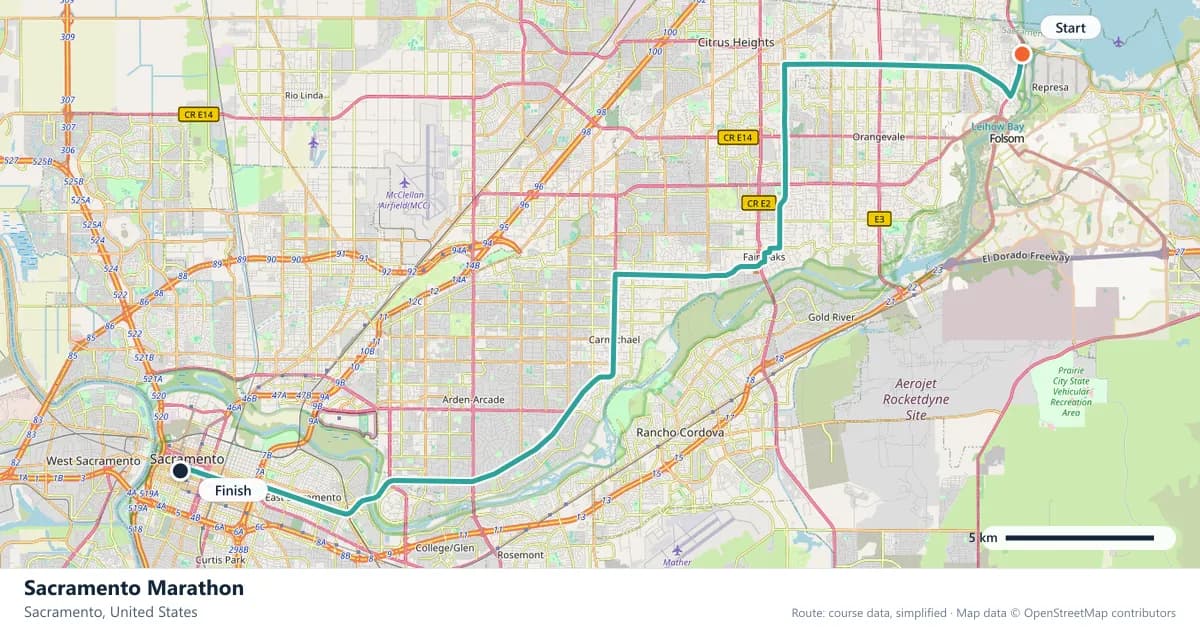
Interactive map
The trace follows the organizer's published course, simplified for the screen: the orange dot is the start, the dark dot the finish. Scroll to zoom, drag to pan.
What is the Sacramento Marathon course like?
A December race on the American River and through California's capital, from Folsom down towards the old town. Net downhill and usually cold, which suits fast running.
- Next edition
- 06 December 2026
- Elevation gain
- 138 m
- Profile
- Undulating
- First run
- —
Course guide
Sacramento's marathon is a downstream race. It begins in Folsom, at the edge of the Sierra foothills, and follows the American River into California's capital, with the finish set towards Old Sacramento. The next edition is on Sunday 06 December 2026.
The course is undulating, with about 138 metres of climbing in total, but its overall direction is downhill: the river does the work, and the short rises interrupt rather than define the day. December in the Central Valley is usually cold, so the race combines two conditions that distance runners tend to welcome — a net descent and cool air.
That makes Sacramento an unusual double: a course quick enough for a personal best and gentle enough for a first marathon. The catch is not the climbing but the descent itself, which can leave the quadriceps reporting for duty long before the finish.
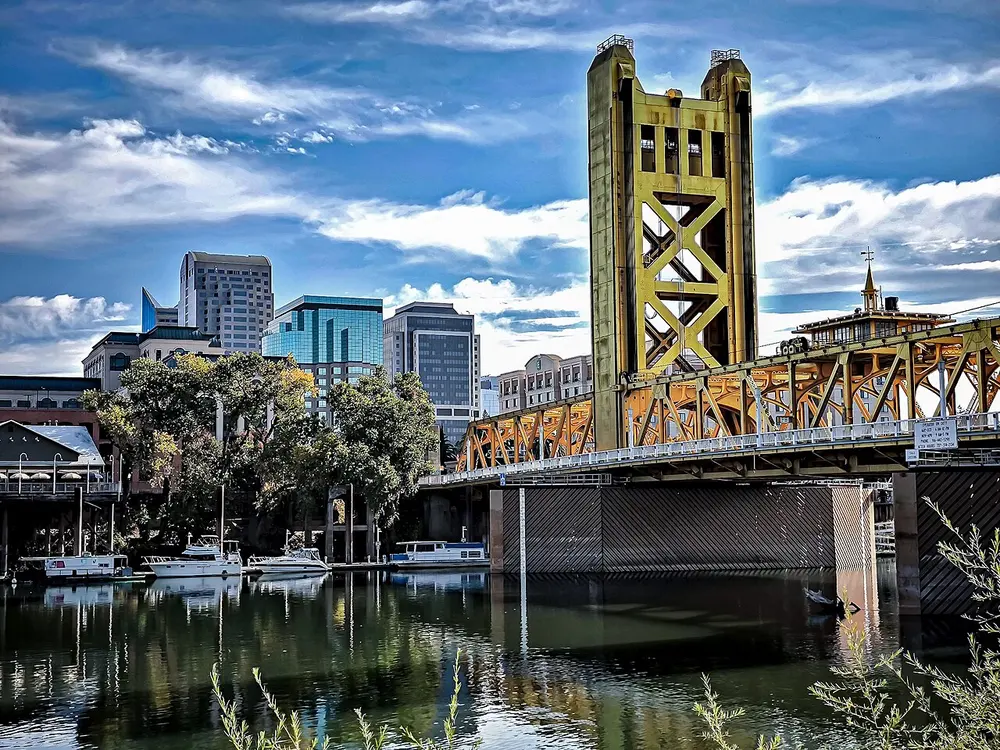
Bridge Sacramento. Photo: Jo Vert / Wikimedia Commons, CC BY-SA 4.0.
The course
Folsom gives the race a clear starting image: a town at the foothills, a river heading west, and a city waiting downstream. The route follows the American River for much of its length, using the corridor as a continuous thread rather than a single scenic interlude. Short rises come and go; none lasts long enough to change the character of the race, but together they account for the 138 metres of gain.
The final approach brings the course into Sacramento proper and towards Old Sacramento, where the riverfront and the old commercial streets give the finish a sense of arrival. This is not a loop that returns to a stadium or a city square. It is a journey from the foothills to the capital, and the river is the road.
A point-to-point day
Because the start and finish sit at opposite ends of the Sacramento area, race morning works differently from a city-centre loop. Runners begin in Folsom and finish near the riverfront in Sacramento, so the day involves a journey as well as a race. Know your start access and your post-finish plan before race weekend, and do not leave either to improvisation.
The reward is a course with a genuine sense of direction. You are not circling a park or repeating the same streets; every kilometre takes you somewhere new, and the city gradually replaces the river corridor. That forward motion is part of why the course feels quick: there is always a next place rather than another lap of the same one.
Ami Bera visits Cal Expo COVID-19 testing site, Sacramento, California (May 11, 2020) 02. Photo: Ami Bera / Wikimedia Commons, Public domain.
Cold-weather racing
December mornings in the Central Valley can be cold and grey, and the river corridor holds that chill. The race has a reputation for cold conditions, which helps fast running but complicates the hours before the start. Plan layers you can shed, a warm hat and gloves, and a dry bag for the finish rather than a heroic single layer that leaves you shivering at the line.
Cold air also changes the way effort feels. You may start too fast because you are not overheating; use the first few kilometres to settle rather than to bank time. The same conditions that make the second half comfortable can make the opening deceptively easy, especially with the river running downhill beside you.
The descent's tax
A net downhill course is not free speed. The repeated drops load the quadriceps, especially if you overstride to chase gravity. Keep your stride compact, let your cadence rise slightly on the descents, and save the aggressive running for the flatter river miles.
Downhill preparation matters. A few long runs with descents will do more for race day than another session on the flat, and they will teach you how your legs behave when the gradient keeps tipping down. The runners who suffer at Sacramento are usually the ones who treated the descent as a gift rather than a skill.
Reading the river
The American River gives the race its rhythm. Long stretches beside the water make it easy to settle into a pace and harder to get distracted by the next landmark. Use those miles to hold an even effort, take your fuel on schedule, and let the kilometres accumulate.
The old-town finish is a strong closing target. After the quiet of the river corridor, the return to the city gives the last miles a different energy. Leave enough for that transition, and the finish will feel like the end of a journey rather than the end of a loop.
Ami Bera visits Mandarins Music Center, Sacramento, California (June 11, 2020) 02. Photo: Ami Bera / Wikimedia Commons, Public domain.
Frequently asked questions
Answers to the questions runners ask before entering, drawn from this race's course guide and the directory's own data — the sources behind them are listed below.
When is the Sacramento Marathon?
The next edition is on Sunday 06 December 2026. It is a December race that runs from Folsom into Sacramento.
Is the Sacramento Marathon flat or hilly?
It is undulating, with about 138 metres of climbing, but the route is net downhill overall. The short rises are outweighed by the descent along the American River. It is not a flat course, though it runs faster than the gain alone suggests.
Is the Sacramento Marathon a good first marathon?
Yes, the course is manageable for a debut. The hills are short, the net downhill is forgiving in the opening miles and the December air is usually cool. The caution is the quad load from the descent, so prepare with some downhill running and start conservatively.
Is the Sacramento Marathon a good personal-best course?
The combination of a net descent, modest climbing and usually cold weather gives it a strong case. The descent makes it easy to go out too fast, so a personal best here depends on controlling the first half rather than simply letting the course carry you.
Where does the Sacramento Marathon start and finish?
It starts in Folsom and finishes towards Old Sacramento, making it a point-to-point race rather than a loop. The American River links the two ends of the course.
Why is the Sacramento Marathon considered quick?
The course drops overall, climbs only about 138 metres and is usually run in cold December conditions. Those factors reduce the physical cost of the distance and make an even rhythm easier to hold.
More marathons in United States
More marathons in Americas
Sources for this page
What each source below is used for on this page, and where to check this race yourself.
- World Athletics — the label calendar and the road-race regulations. Used to check whether the race holds a World Athletics label, and its elite competition details.
- AIMS — the international course-measurement standard behind the 42.195 km distance, and the AIMS race calendar.
- The organizer's own publications — course maps, race handbooks and published results. The date, course character and climbing on this page are compiled from them and re-checked each season.
Where do these facts come from?
Dates, course type, climbing and time limits are compiled from the organizer's publications and re-checked each season; elevation is an estimate of total climbing rather than a survey figure. Always confirm race-day details with the organizer before making plans.
Last reviewed 27 October 2026