
Maine Marathon
This is Portland, Maine, not the Oregon city of the same name. The Maine Marathon sets out from Portland on the Atlantic coast and loops through Falmouth before returning along the Casco Bay…
By Global Marathon Routes editorial team · Last reviewed 27 October 2026
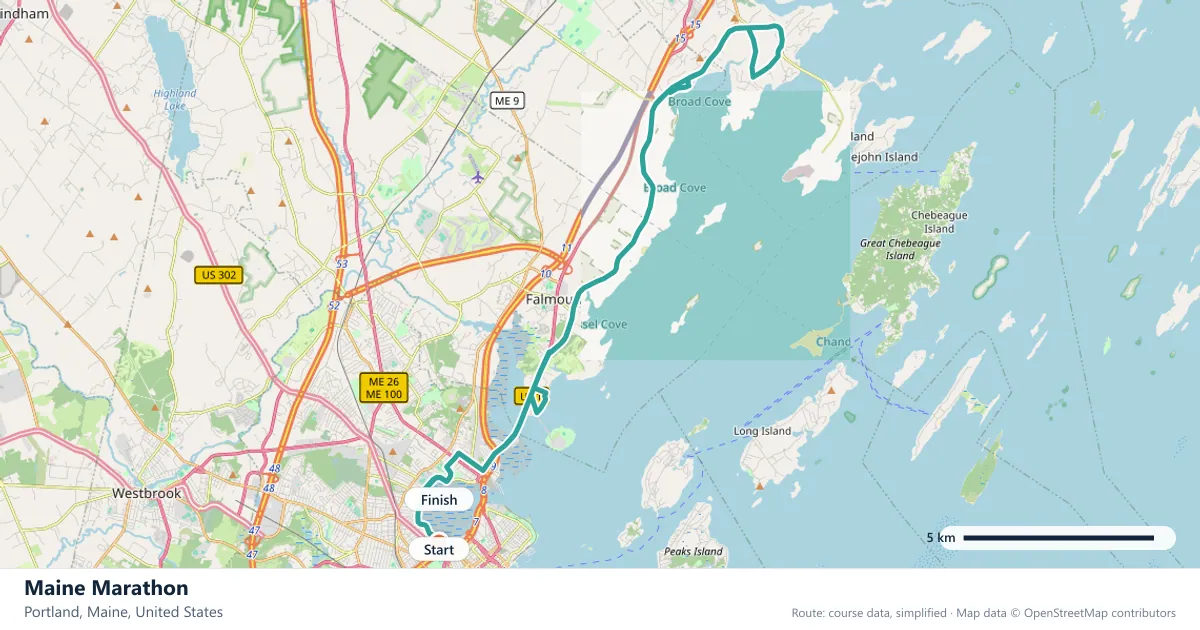
Where does the Maine Marathon run?
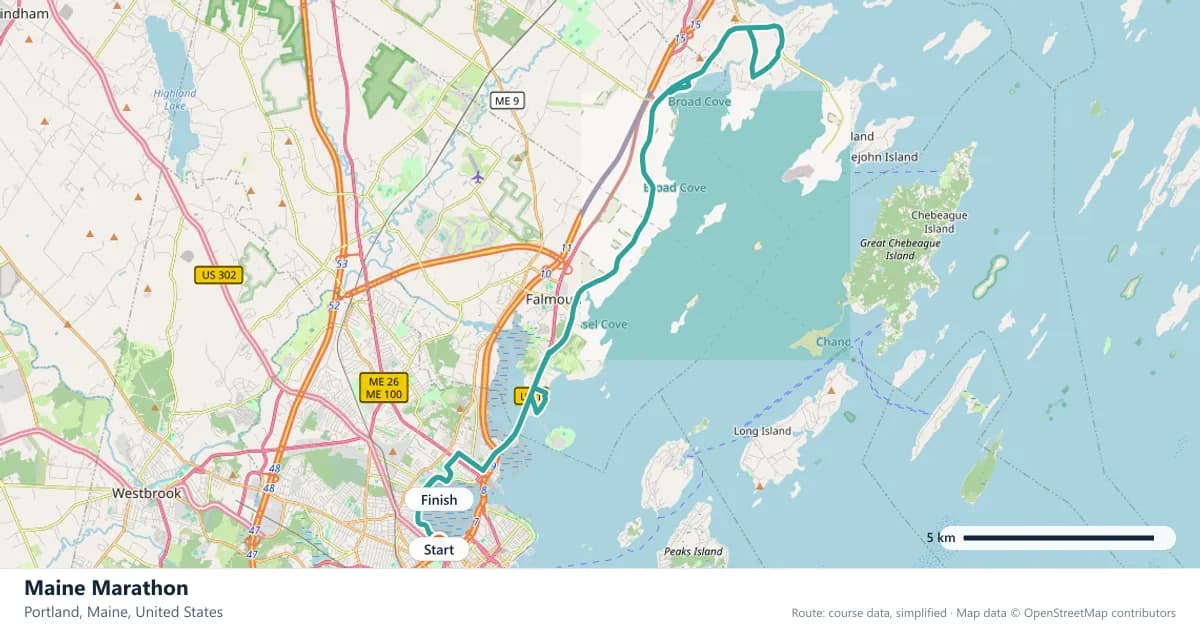
Interactive map
The trace follows the organizer's published course, simplified for the screen: the orange dot is the start, the dark dot the finish. Scroll to zoom, drag to pan.
What is the Maine Marathon course like?
An October marathon out of Portland along the Maine coast, with a loop through Falmouth and the Casco Bay shoreline. Rolling, and timed for the autumn foliage.
- Next edition
- October 2027 (expected)
- Elevation gain
- 271 m
- Profile
- Hilly
- First run
- —
Course guide
This is Portland, Maine, not the Oregon city of the same name. The Maine Marathon sets out from Portland on the Atlantic coast and loops through Falmouth before returning along the Casco Bay shoreline. The edition covered here was held on 4 October 2026, and the course rolls for about 271 metres across a series of short climbs, with the autumn foliage as the backdrop.
The setting is the reason to choose it. Portland is a small, working waterfront city, and the marathon quickly leaves the peninsula behind for the quieter roads of Falmouth and the coves of Casco Bay. The route is coastal without being a flat beach run: the shore is always nearby, but the terrain keeps rising and falling.
It is also a manageable first marathon. The loop format keeps the logistics simple, the climbs are short rather than steep, and the autumn date gives the training a natural finish. The course is not a time-trial, but it is a race that rewards patience and a steady effort.
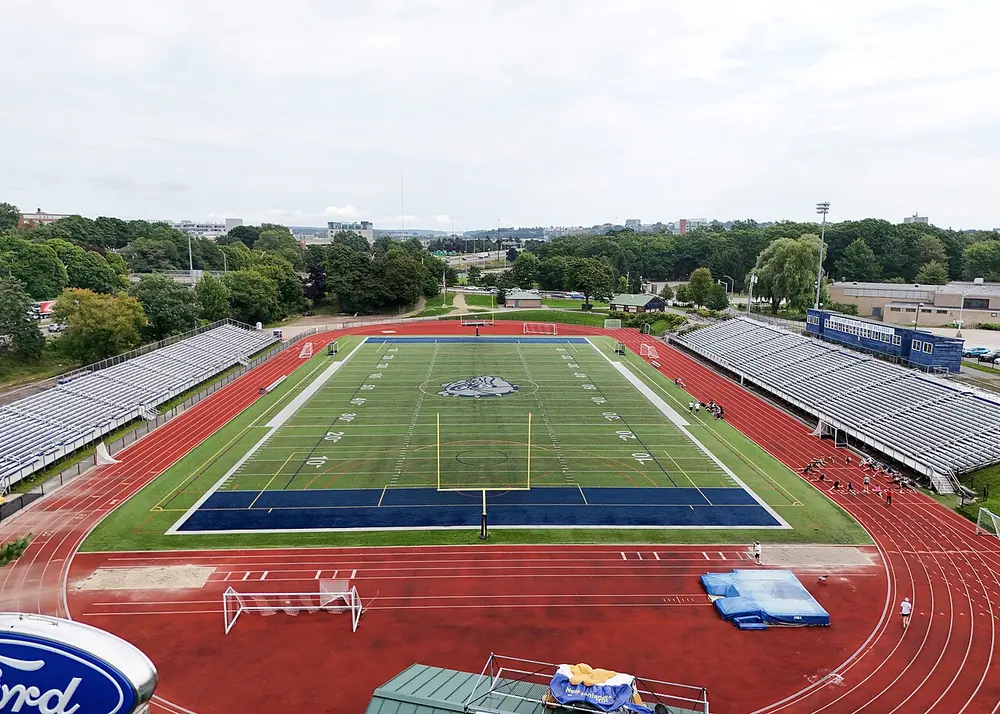
Fitzpatrick Stadium - Portland, Maine. Photo: Quintin Soloviev / Wikimedia Commons, CC BY 4.0.
The course
The race leaves Portland and heads through Falmouth, a town that sits along the coast north of the city. The early miles are the transition: the peninsula's streets give way to suburban roads, the water appears in glimpses, and the course settles into the rolling rhythm that defines the day. The 271 metres of climbing are spread across this landscape in short rises rather than one long ascent.
The Casco Bay shoreline provides the scenic heart of the race. The bay is a maze of islands, coves and inlets, and the road follows its edge closely enough that the water is a constant presence. The shoreline sections are not flat, but they are open and scenic, with long views that make the climbs feel less like work.
The loop closes back at Portland. Because the start and finish are in the same city, the race has a natural symmetry: runners leave the urban peninsula, spend the middle miles in the coastal towns, and return to the place they started.
Falmouth and the shoreline
Falmouth is a coastal town with a long shoreline and a quieter pace than Portland. The marathon uses its roads to move between the water and the inland rises, and the result is a course that alternates between open views and sheltered residential streets. It is a very different experience from a city marathon that never leaves the grid.
The shoreline is the part runners remember. Casco Bay is clear and dotted with islands, and the autumn colours on the surrounding trees make the water look even sharper. The road follows the coast rather than a single beach, which keeps the scenery changing.
Autumn on the Casco
The October date is timed for the foliage, and the race makes the most of it. Maine's autumn colours are short-lived and intense, and the course through Falmouth and along the bay puts them on display. The trees, the water and the older coastal houses give the race a New England character that is hard to replicate elsewhere.
Autumn also means variety in the conditions. The coastal exposure adds another variable, so runners should plan for a range and use layers that can be adjusted as the race goes on. The date is part of the event's identity.
A coastal loop
The loop format suits a coastal marathon. It keeps the start and finish in Portland, avoids the need for a long transfer after the race and gives runners a clear sense of progress: out through Falmouth, along the bay, back to the city.
The loop also gives the second half a familiar shape: the terrain keeps rolling, and the coastal views return before the finish. That helps with pacing, because the second half is not an unknown.
Running the rolls
The Maine Marathon is hilly in the New England sense: no single climb dominates, but the road is rarely level. The 271 metres of gain come in short pitches, and the repeated changes of grade make even pacing a matter of effort rather than exact splits. Runners who try to hold a flat-course pace will feel the accumulation by the second half.
The best approach is to run by feel. Ease on the rises, recover on the descents and keep the cadence quick without forcing the stride. The course rewards runners who stay relaxed through the rolling miles and save something for the return to Portland. The coastal scenery helps; the hills are still real.
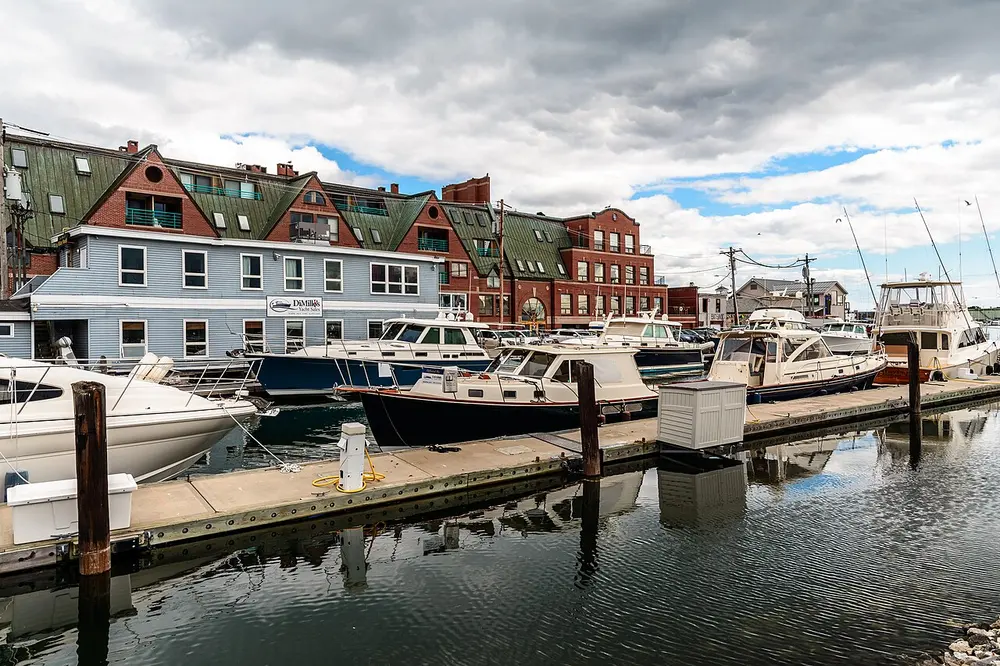
Portland, Maine, USA1. Photo: dconvertini / Wikimedia Commons, CC BY-SA 2.0.
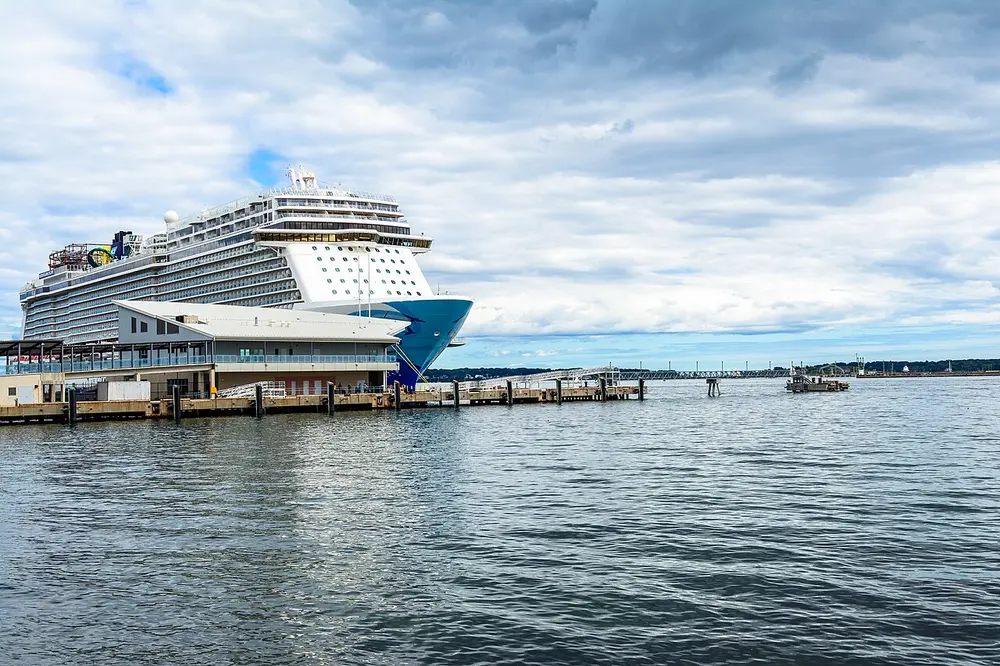
Portland, Maine, USA10. Photo: dconvertini / Wikimedia Commons, CC BY-SA 2.0.
Frequently asked questions
Answers to the questions runners ask before entering, drawn from this race's course guide and the directory's own data — the sources behind them are listed below.
When was the Maine Marathon covered here?
The edition covered here was held on 4 October 2026. It is the Portland, Maine race, not the Portland Marathon in Oregon.
Is the Maine Marathon flat or hilly?
It is hilly, with about 271 metres of climbing. The gain comes in short rises rather than one long ascent, so the course is rolling rather than mountainous.
Is the Maine Marathon good for a first marathon?
Yes. The loop is easy to follow, the climbs are short and the autumn setting is encouraging. The rolling terrain still rewards conservative pacing, especially in the second half.
Where does the Maine Marathon run?
It starts and finishes in Portland, Maine, looping through Falmouth and along the Casco Bay shoreline. The route stays close to the coast and returns to the city.
Why is the race held in October?
The date is timed for the autumn foliage, which is part of the race's identity. The loop through Falmouth and along Casco Bay puts the season on display.
What is the Casco Bay shoreline like?
It is a rolling coastal road with views of the bay, its islands and the autumn trees. The water is a constant presence, but the terrain keeps rising and falling rather than staying flat.
More marathons in United States
More marathons in Americas
Sources for this page
What each source below is used for on this page, and where to check this race yourself.
- World Athletics — the label calendar and the road-race regulations. Used to check whether the race holds a World Athletics label, and its elite competition details.
- AIMS — the international course-measurement standard behind the 42.195 km distance, and the AIMS race calendar.
- The organizer's own publications — course maps, race handbooks and published results. The date, course character and climbing on this page are compiled from them and re-checked each season.
Where do these facts come from?
Dates, course type, climbing and time limits are compiled from the organizer's publications and re-checked each season; elevation is an estimate of total climbing rather than a survey figure. Always confirm race-day details with the organizer before making plans.
Last reviewed 27 October 2026