
Portland Marathon
Portland's marathon is built around a bridge. The route threads through the city's neighbourhoods and bridges before climbing towards the St.
By Global Marathon Routes editorial team · Last reviewed 27 October 2026
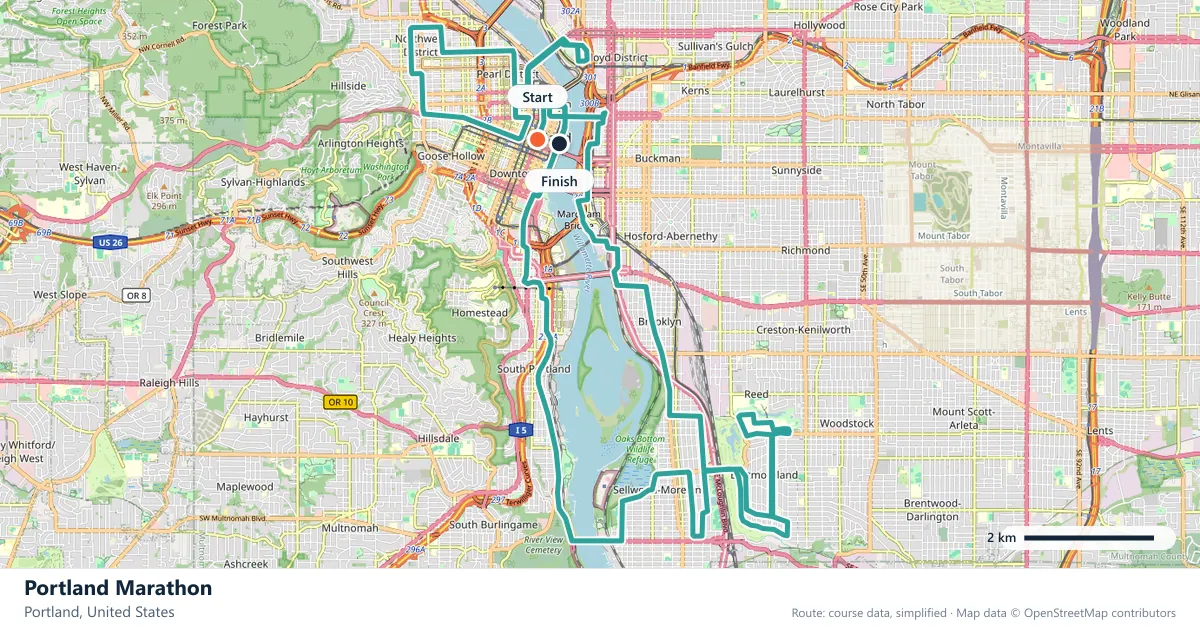
Where does the Portland Marathon run?
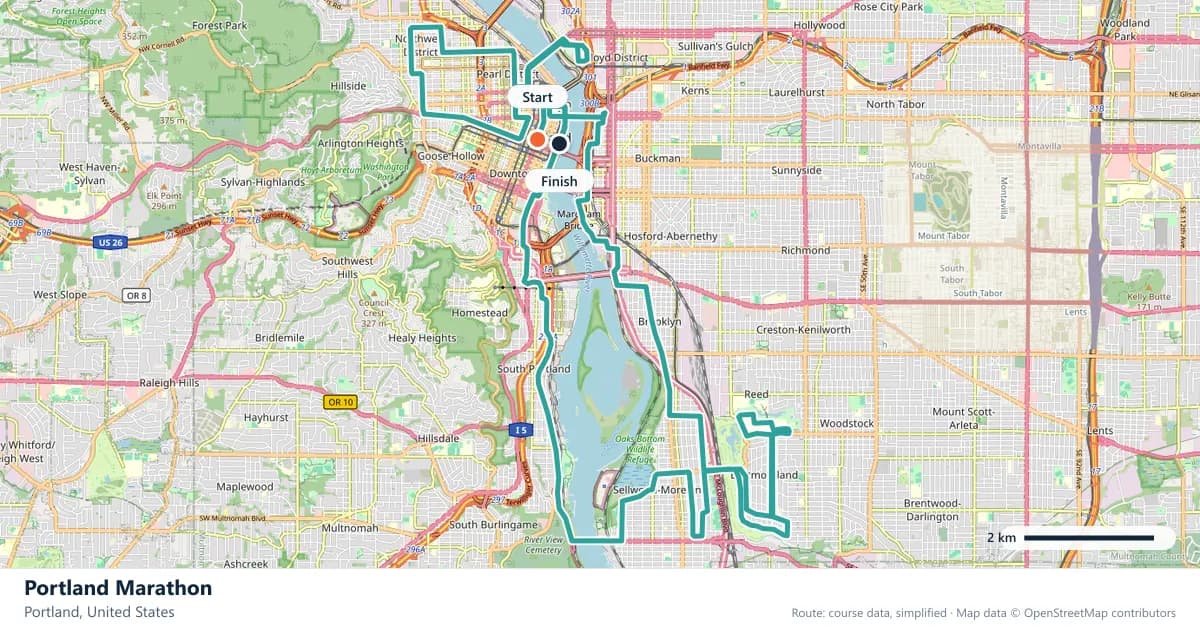
Interactive map
The trace follows the organizer's published course, simplified for the screen: the orange dot is the start, the dark dot the finish. Scroll to zoom, drag to pan.
What is the Portland Marathon course like?
An October marathon through Portland's bridges and neighbourhoods, with a climb up to the St. Johns Bridge and a descent back along the Willamette. Rolling, but quick on the riverfront finish.
- Next edition
- October 2027 (expected)
- Elevation gain
- 290 m
- Profile
- Hilly
- First run
- —
Course guide
Portland's marathon is built around a bridge. The route threads through the city's neighbourhoods and bridges before climbing towards the St. Johns Bridge, then descends back along the Willamette to a riverfront finish. The edition covered here was held on 4 October 2026, and the course climbs about 290 metres, making it a hilly race with an unusually quick ending.
That combination is what makes Portland interesting. A hilly course and a fast finish do not usually belong together, but the St. Johns climb is followed by a long descent and a flat run along the river. The race takes something out of you and then gives a good part of it back.
The city itself is a strong part of the appeal. Portland is a place of bridges, tree-lined streets and riverfront paths, and the marathon uses all three. It is not a course that could be transplanted to another city with a change of signage.
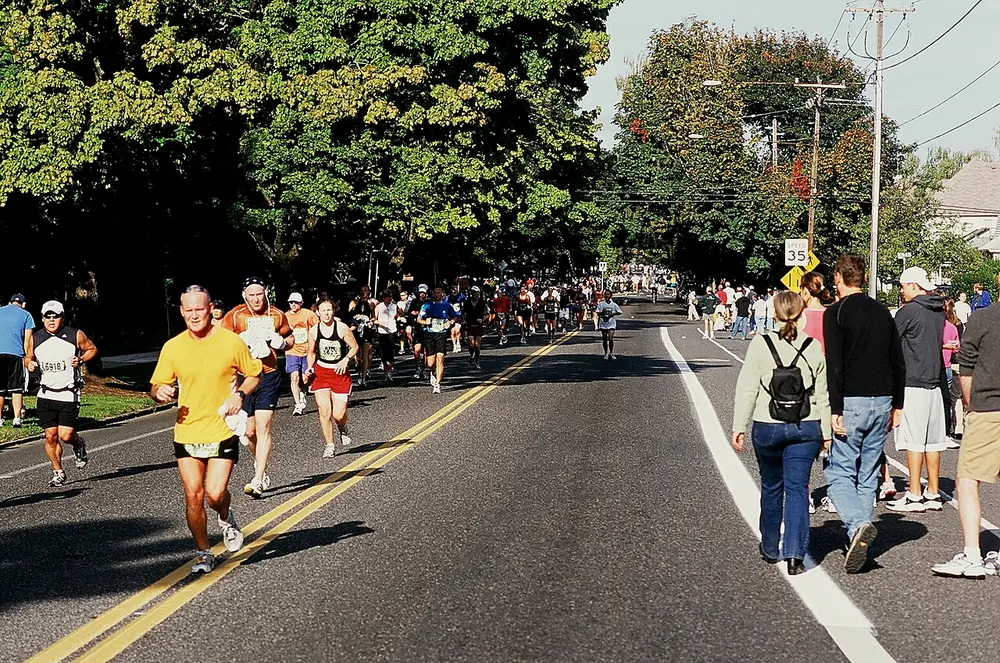
Portland Marathon. Photo: James Cohen from North Beach, San Francisco, U. S. of A. / Wikimedia Commons, CC BY 2.0.
The course
The race moves through a series of distinct Portland set pieces. The early miles are urban, with the city's bridges and neighbourhoods providing the landmarks. The route eventually turns north and climbs towards St. Johns. The final section brings runners back down along the Willamette to the riverfront.
The biggest climb comes on the approach to St. Johns rather than being spread evenly across the route. That means the first half can feel manageable, even quick, before the course asks for its real effort. Runners who use the early miles to bank time usually regret it on the climb.
The descent is the reward. Once the course turns back towards the river, the grade tips downward and the running becomes easier. The final miles along the Willamette are the fastest of the day, and they give the race a finish that feels very different from its hilly middle.
The climb to St. Johns
St. Johns is the defining landmark of the race. The bridge spans the Willamette in the north of the city, with Gothic towers and a long suspension span, and the approach to it is the hardest sustained effort on the course. The climb is not a mountain pass, but it is long enough to demand a plan.
The right plan is patience. Settle into a sustainable rhythm before the grade steepens, keep the effort even and do not chase the runners who surge ahead. The bridge is the reward as much as the challenge: it gives a wide view over the river and the city.
Down the Willamette
The descent back along the Willamette is where the race opens up. The river gives the course a clear direction, the grade works in the runner's favour and the neighbourhoods give way to the waterfront. It is the section where a well-paced race can become a fast one.
The descent also loads the legs. Running downhill for a long stretch is harder on the quadriceps than it feels at the time, and the bill can arrive in the final kilometres. Keep the stride controlled, avoid braking with every step and let the terrain carry you rather than forcing the pace.
The riverfront finish
The riverfront finish is the course's payoff. After the climb and the descent, the race settles onto flat ground beside the Willamette, with the city and its bridges in view. The final miles are quick, and the finish is close enough to pull you through the last kilometre.
For a race with 290 metres of climbing, the finish is unusually fast. That is why Portland can be described as a personal-best course despite the hills: the descent and the flat riverfront give back much of what the climb takes.
Marathon Taverna, Portland, 2016. Photo: Another Believer / Wikimedia Commons, CC BY-SA 3.0.
A Portland race weekend
Portland is a walkable, bridge-oriented city, and the marathon uses that character. The course crosses and follows the river, so the waterfront is the natural place to gather before and after the race. The organiser's instructions are the place to check the start, finish and transport arrangements.
The city's neighbourhoods give the weekend plenty to do. Portland is known for its food, its coffee and its outdoor culture, and the autumn date fits that identity. The race is a good excuse to spend a few days exploring the city rather than arriving on Saturday and leaving on Sunday.
Frequently asked questions
Answers to the questions runners ask before entering, drawn from this race's course guide and the directory's own data — the sources behind them are listed below.
When was the Portland Marathon covered here?
The edition covered here was held on 4 October 2026. It is the Portland Marathon in Oregon, not the Maine race of the same name.
Is the Portland Marathon hilly?
Yes. The course climbs about 290 metres, with the approach to the St. Johns Bridge as the main ascent. The rest of the route rolls, and the final miles along the Willamette are mostly downhill or flat.
Is Portland good for a personal best?
The course is suited to fast times despite the climbing, because the descent and the riverfront finish give back much of the elevation. A personal best depends on pacing the St. Johns climb conservatively and saving energy for the return.
Where does the Portland Marathon run?
The route runs through Portland, Oregon, using the city's bridges and neighbourhoods, climbing towards the St. Johns Bridge and descending along the Willamette to a riverfront finish.
What is the hardest part of the course?
The climb towards St. Johns. It arrives after the opening miles, when the legs are still fresh enough to push, and it is long enough to punish an over-fast start. Steady effort is more important than speed on the ascent.
Why is the finish considered fast?
The final miles run downhill and then flat beside the Willamette. After 290 metres of climbing, the descent gives the legs a break and the riverfront gives them a smooth surface, so the race can finish quicker than the profile suggests.
More marathons in United States
More marathons in Americas
Sources for this page
What each source below is used for on this page, and where to check this race yourself.
- World Athletics — the label calendar and the road-race regulations. Used to check whether the race holds a World Athletics label, and its elite competition details.
- AIMS — the international course-measurement standard behind the 42.195 km distance, and the AIMS race calendar.
- The organizer's own publications — course maps, race handbooks and published results. The date, course character and climbing on this page are compiled from them and re-checked each season.
Where do these facts come from?
Dates, course type, climbing and time limits are compiled from the organizer's publications and re-checked each season; elevation is an estimate of total climbing rather than a survey figure. Always confirm race-day details with the organizer before making plans.
Last reviewed 27 October 2026