
Pittsburgh Marathon
Pittsburgh is a city built on hills and rivers, and its marathon refuses to pretend otherwise. The race on 2 May 2027 crosses the three rivers at the heart of the city and climbs through the…
By Global Marathon Routes editorial team · Last reviewed 27 October 2026
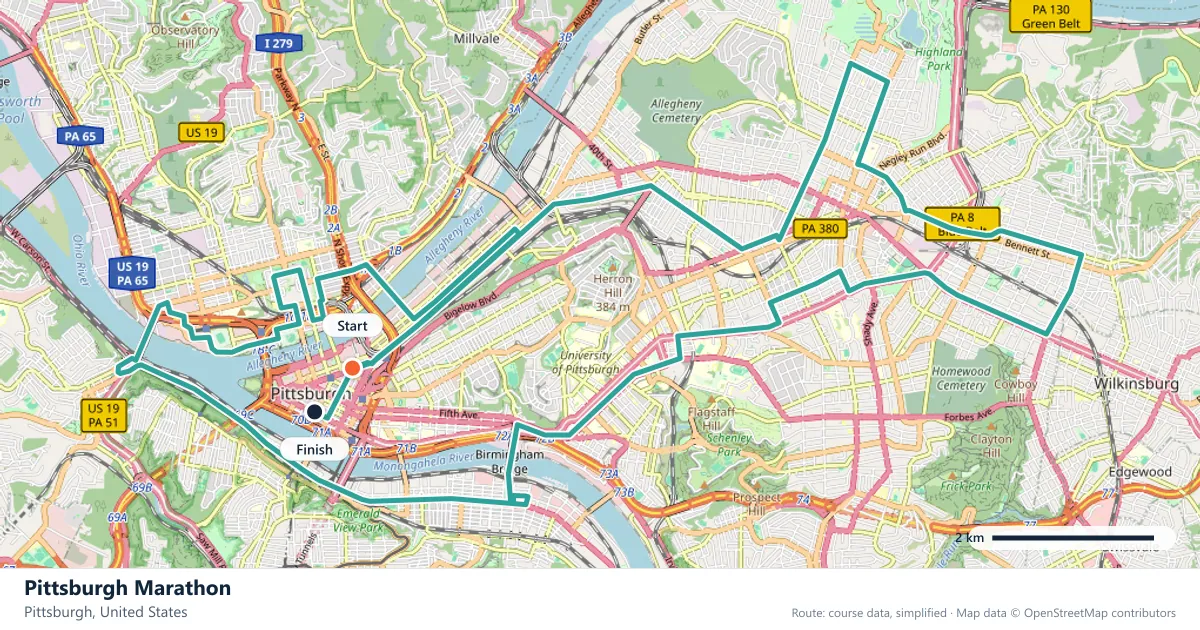
Where does the Pittsburgh Marathon run?
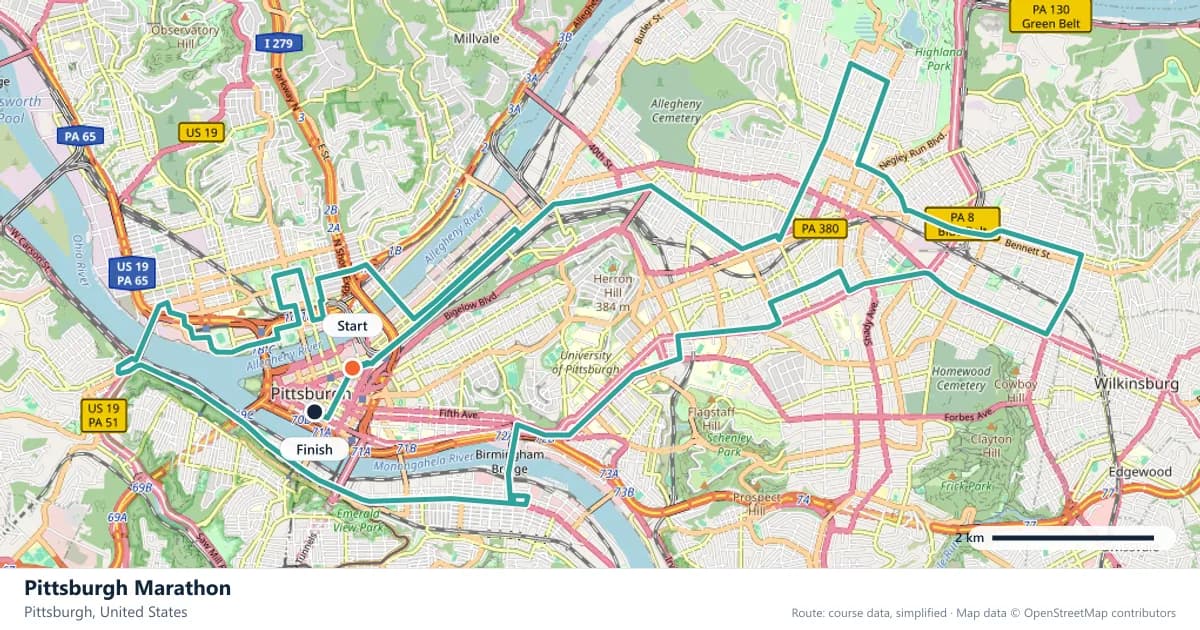
Interactive map
The trace follows the organizer's published course, simplified for the screen: the orange dot is the start, the dark dot the finish. Scroll to zoom, drag to pan.
What is the Pittsburgh Marathon course like?
A May marathon that crosses Pittsburgh's three rivers and climbs through its neighbourhoods. Hilly, honest and one of the bigger American races outside the majors.
- Next edition
- 02 May 2027
- Elevation gain
- 263 m
- Profile
- Hilly
- First run
- —
Course guide
Pittsburgh is a city built on hills and rivers, and its marathon refuses to pretend otherwise. The race on 2 May 2027 crosses the three rivers at the heart of the city and climbs through the neighbourhoods above them, with about 263 metres of gain and a profile that is honestly hilly. It is one of the larger American marathons outside the majors, but it still feels like a race made by and for the city.
The course's logic is geographic. Pittsburgh sits where the Allegheny and Monongahela rivers meet to form the Ohio, and the land rises steeply away from the water on almost every side. The marathon uses the bridges to move between those pieces of land, then uses the neighbourhood streets to add the climbing that gives the race its character.
That makes it a demanding but memorable debut. The hills are not a surprise; they are the point. Runners who train for them and pace them sensibly will find a course that is tough but fair, with a finish that feels earned.
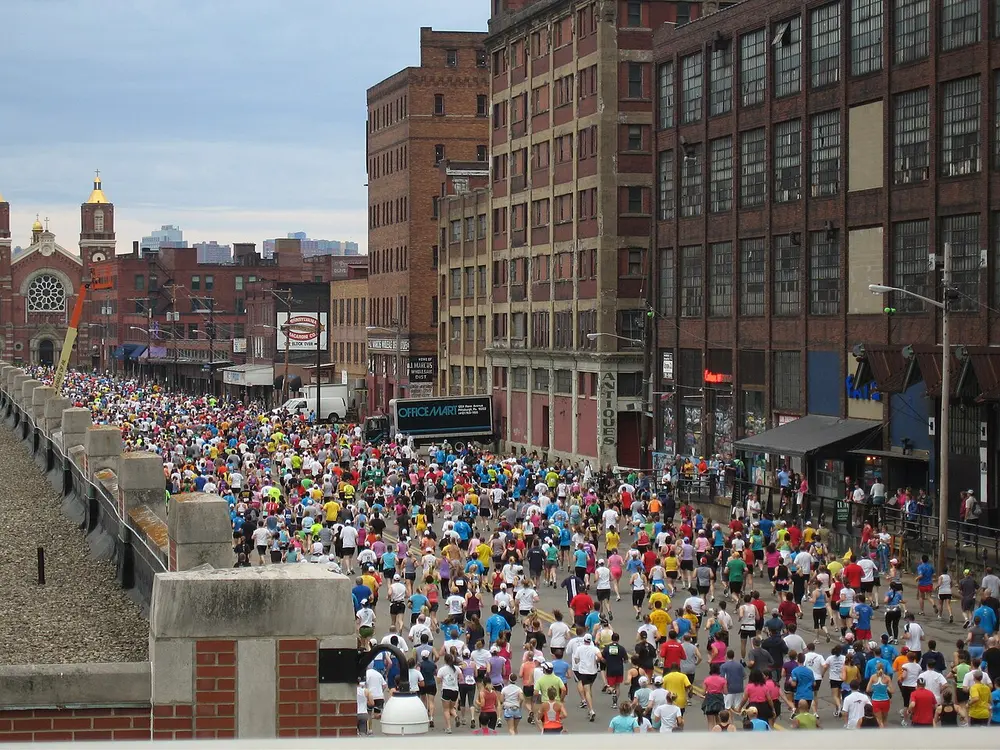
Pittsburgh Marathon. Photo: Desiree N. Williams / Wikimedia Commons, CC BY 2.0.
The course
The race moves through the city's distinct sections rather than looping around a single landmark. The rivers provide the boundaries, the bridges provide the crossings, and the neighbourhoods provide the climbs. The result is a course that changes character repeatedly: waterfront, bridge, residential street, descent, repeat.
The 263 metres of gain are spread across the route in repeated climbs. There is no single mountain pass, but the accumulations are significant, and the descents do not give back everything the climbs take. Runners who try to hold a flat-course pace will find the middle of the race much harder than the elevation total suggests.
The course is also a tour of Pittsburgh's geography. The downtown Golden Triangle, the riverfronts and the hillside neighbourhoods all appear at different points, and the bridges give the race a series of dramatic thresholds. It is not a pretty loop around a park; it is a city race in the fullest sense.
Three rivers
The Allegheny and Monongahela meet at the Point to form the Ohio, and the three rivers define Pittsburgh's shape. The marathon uses that geography as its structure, crossing the water several times and using the bridges as both landmarks and changes of rhythm.
Bridge running is its own skill. The approaches often rise, the decks are exposed, and the far side can feel like a different race. The best approach is to keep the effort even across the bridge and use the descent on the other side to recover rather than to sprint. The rivers are wide enough that the crossings are not trivial, but they are short enough to be managed.
The neighbourhood climbs
The climbs are where Pittsburgh earns its reputation. The streets above the rivers rise in short, steep pitches, and the course uses them to connect one part of the city to another. The 263 metres of gain are not gentle, and the repeated efforts ask for hill strength rather than raw speed.
Training should reflect that. Long runs on rolling terrain, regular hill sessions and practice at running downhill without overstriding will do more for race day than extra flat mileage. The race rewards runners who can climb steadily and recover quickly, not those who attack every rise.
The descents deserve respect too. Pittsburgh's hills are steep enough that running down them fast can leave the legs damaged for the next climb. Keep the stride controlled, stay relaxed and let the grade do the work.
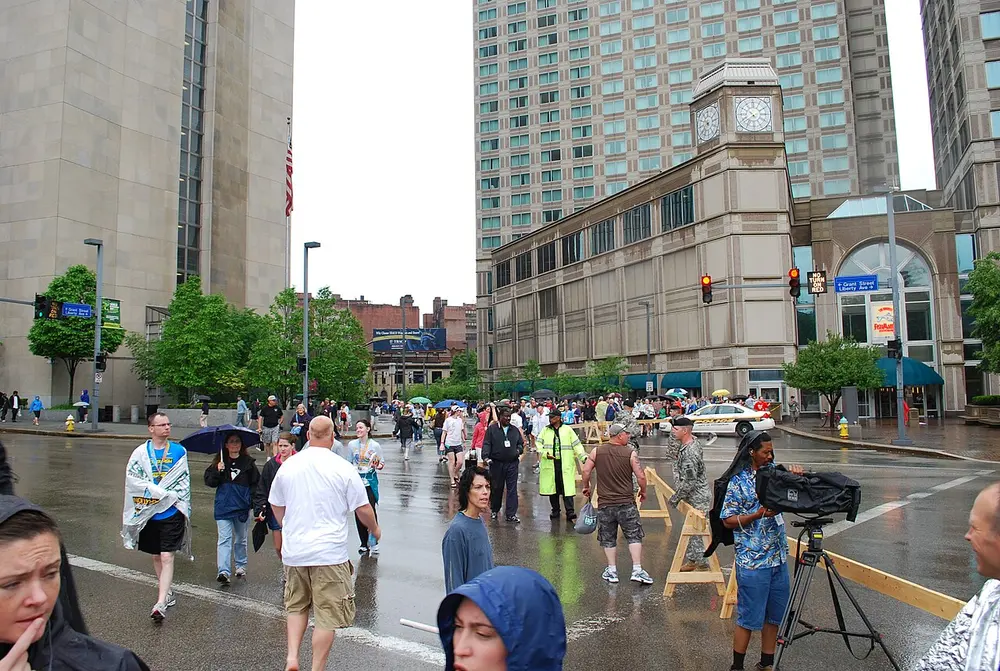
Pittsburgh Marathon 2010 bomb squad 2. Photo: John Marino from Pittsburgh, The fine US of A / Wikimedia Commons, CC BY-SA 2.0.
A big race with a local feel
The Pittsburgh Marathon is large enough to feel like an event, but it has not lost its local identity. The course goes through the places where people live, rather than confining the race to a waterfront promenade, and that gives it a civic feel.
That identity is an advantage on a hilly course. The race belongs to the city's geography rather than a temporary course built for visitors, and the neighbourhood setting makes the climbs feel like part of Pittsburgh rather than obstacles on a generic loop.
May training
A May marathon means a spring build, with the final weeks falling in spring itself. That is a pleasant change from a winter race, but it also means the training has to be completed before the race, not postponed until the weather turns.
The hills should be part of the plan from the start. Pittsburgh's course is not a flat marathon with a few bumps; it is a sustained test of climbing and descending. Build that into the long runs and the race will feel like a confirmation of the training rather than a surprise.
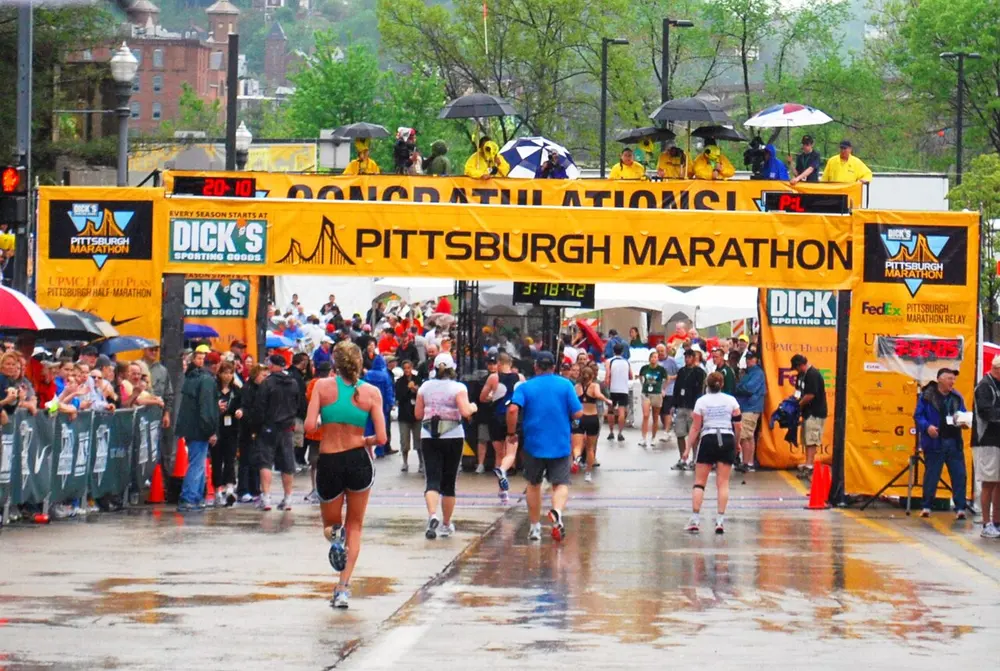
Pittsburgh Marathon Finish Line 2010. Photo: John Marino / Wikimedia Commons, CC0.
Frequently asked questions
Answers to the questions runners ask before entering, drawn from this race's course guide and the directory's own data — the sources behind them are listed below.
When is the Pittsburgh Marathon in 2027?
The next edition is on 2 May 2027. It is a spring race through Pittsburgh, crossing the three rivers and climbing through the city's neighbourhoods.
Is the Pittsburgh Marathon hilly?
Yes. The course climbs about 263 metres, with repeated ascents through the neighbourhoods. It is not a single-mountain course, but the accumulated climbing is significant and shapes the whole race.
Is Pittsburgh a good first marathon?
It can be, if the build includes hills. The course is honest, but the repeated climbs make it more demanding than a flat city marathon. Runners who prepare for the terrain will enjoy it more.
Where does the Pittsburgh Marathon run?
The route crosses the three rivers and winds through several Pittsburgh neighbourhoods. The bridges and the hillside streets are the defining features of the course.
How big is the Pittsburgh Marathon?
It is one of the larger American marathons outside the major series. That means a substantial event atmosphere without the scale of the majors, and a course that still feels connected to the city.
What is the hardest part of the course?
The repeated neighbourhood climbs. Individually they are short, but they accumulate over 263 metres, and the descents do not fully restore what each climb takes. Steady effort and hill training are the best preparation.
More marathons in United States
More marathons in Americas
Sources for this page
What each source below is used for on this page, and where to check this race yourself.
- World Athletics — the label calendar and the road-race regulations. Used to check whether the race holds a World Athletics label, and its elite competition details.
- AIMS — the international course-measurement standard behind the 42.195 km distance, and the AIMS race calendar.
- The organizer's own publications — course maps, race handbooks and published results. The date, course character and climbing on this page are compiled from them and re-checked each season.
Where do these facts come from?
Dates, course type, climbing and time limits are compiled from the organizer's publications and re-checked each season; elevation is an estimate of total climbing rather than a survey figure. Always confirm race-day details with the organizer before making plans.
Last reviewed 27 October 2026