
Twin Cities Marathon
The Twin Cities Marathon is a race between two cities rather than around one. The edition covered here was held on 4 October 2026, starting in Minneapolis and finishing in Saint Paul after a…
By Global Marathon Routes editorial team · Last reviewed 27 October 2026
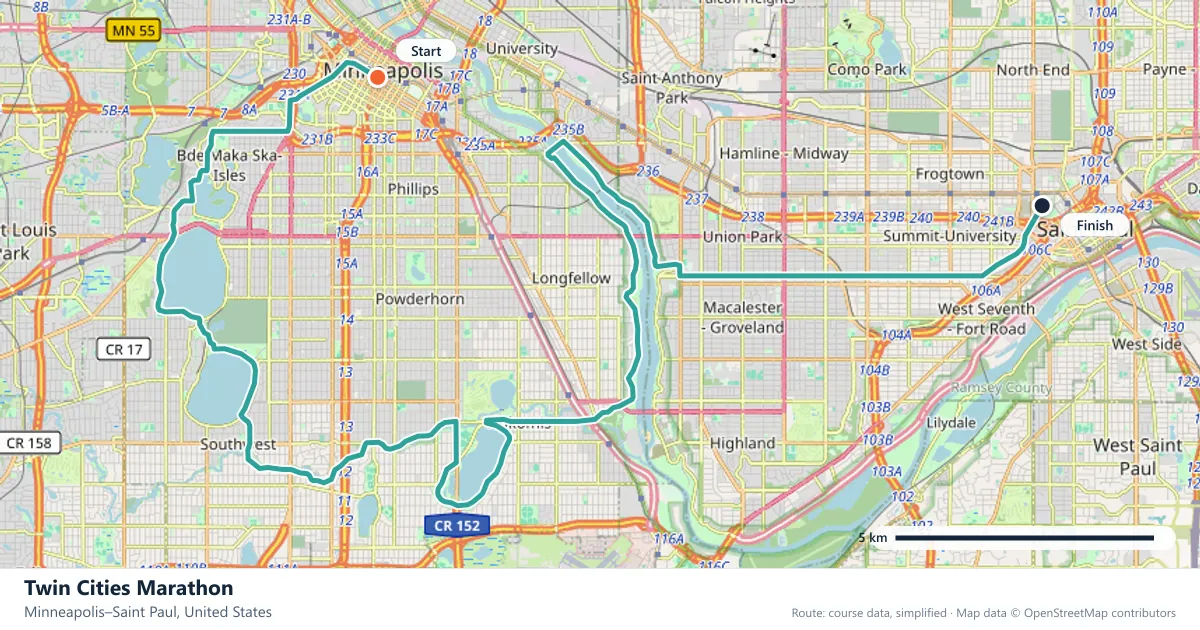
Where does the Twin Cities Marathon run?
Interactive map
The trace follows the organizer's published course, simplified for the screen: the orange dot is the start, the dark dot the finish. Scroll to zoom, drag to pan.
What is the Twin Cities Marathon course like?
A point-to-point between the Twin Cities, past the lakes and down Summit Avenue towards the state capitol. Advertised as the most beautiful urban marathon in America, and it has the autumn colours to back it up.
- Next edition
- October 2027 (expected)
- Elevation gain
- 164 m
- Profile
- Undulating
- First run
- —
Course guide
The Twin Cities Marathon is a race between two cities rather than around one. The edition covered here was held on 4 October 2026, starting in Minneapolis and finishing in Saint Paul after a point-to-point route past the lakes and along Summit Avenue. It is a course that keeps moving, with the state capitol as the final landmark and the Mississippi never far from the story.
The profile is undulating, with about 164 metres of climbing, and the race is advertised as the most beautiful urban marathon in America. October is the reason. The route passes through Minneapolis's lake country and into Saint Paul when the trees are turning, and the autumn colours are part of the experience rather than a backdrop.
It also makes a welcoming first marathon. The climbing is spread across short rises, and the changing scenery helps the miles pass.
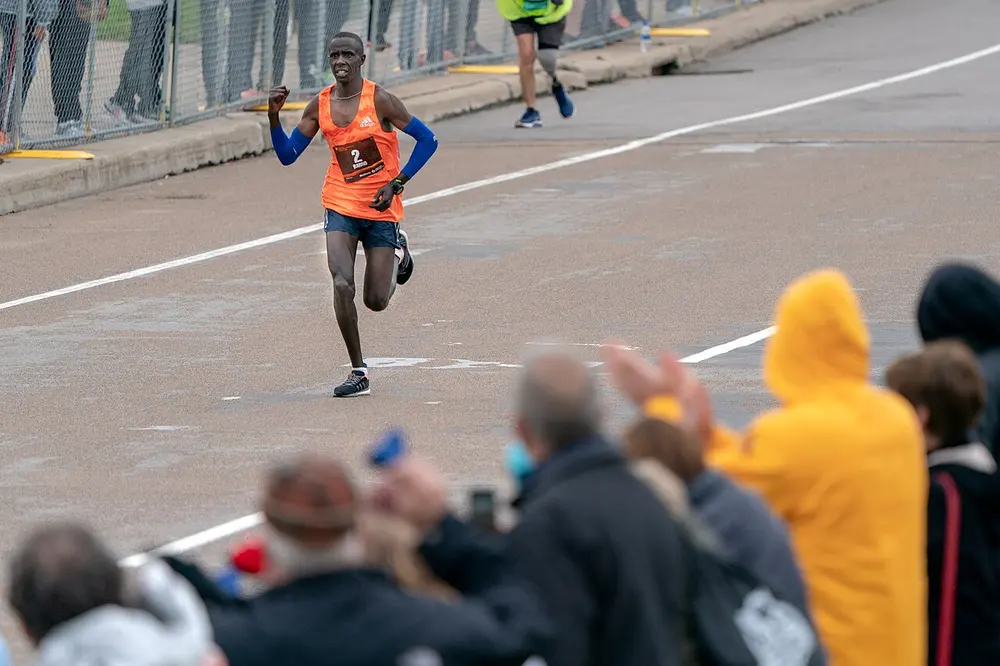
Elisha Barno of Kenya just before winning the Twin Cities Marathon. Photo: Lorie Shaull from Washington, United States / Wikimedia Commons, CC BY-SA 2.0.
The course
The race begins in Minneapolis and works through the city's lake country before turning east towards Saint Paul. The early miles are about water and parkland: the lakes give the route openings and views, and the streets between them provide the short rises that make up most of the day's climbing. It is a rolling start rather than a flat procession.
The second half settles into the approach to Saint Paul. Summit Avenue is the defining stretch, a long boulevard that leads towards the state capitol and the finish. By the time runners reach it, the course has already asked for 164 metres of climbing in small pieces, and the avenue's long, straight run can feel larger than it is.
The point-to-point layout gives the race a sense of travel: the changing neighbourhoods mark the progress from one city to the other, and the finish feels like an arrival rather than a return.
From the lakes to the river
Minneapolis is a city of water. The Chain of Lakes sits within the city, linked by parkways and trails, and the Mississippi runs through the middle of the urban area. The race uses the lakes as its early geography, and that gives the opening miles a relaxed, almost suburban feel despite the size of the event.
The river links the two cities. Minneapolis and Saint Paul grew up along the Mississippi, and the marathon follows that eastward pull from the lake district towards the older streets of Saint Paul.
The two cities have different characters, and the marathon exposes both: Minneapolis is open and water-oriented, Saint Paul hillier and more Victorian.
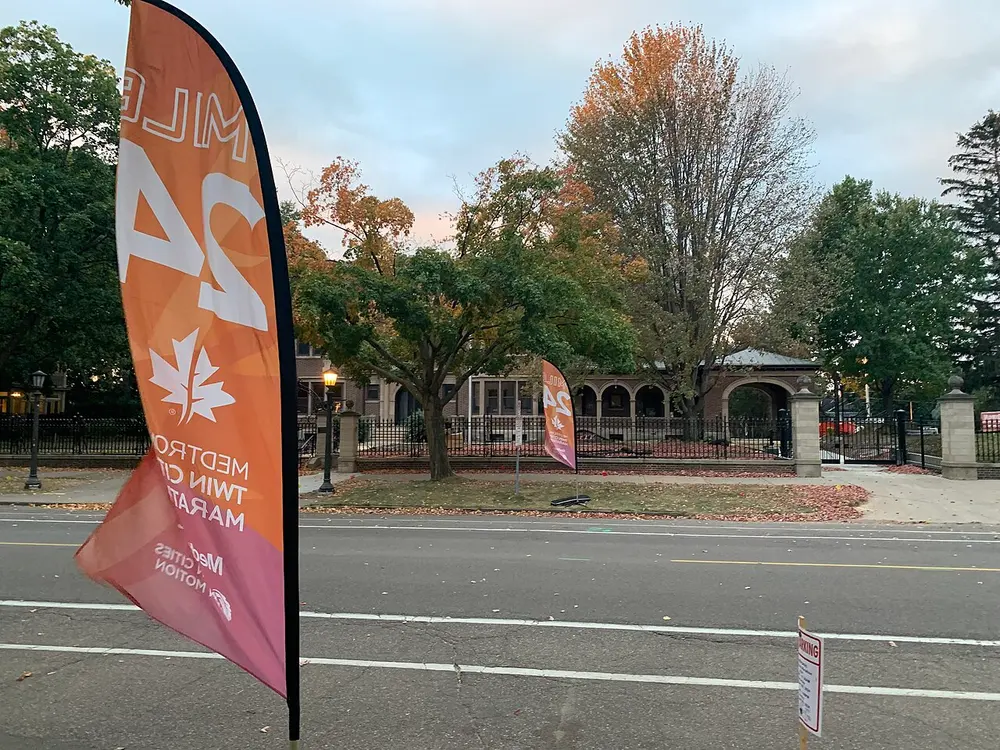
Mile 24 mile marker at the 2024 Twin Cities Marathon. Photo: Aschbren / Wikimedia Commons, CC0.
Summit Avenue and the capitol
Summit Avenue is the race's signature. It runs through Saint Paul's historic residential district, lined with large houses and mature trees, and it runs towards the state capitol. In October, with the leaves turning, it is one of the most photogenic stretches in American marathon running.
The avenue also has a psychological role. It arrives late, when the legs are tired, and it is long enough that runners cannot see the finish from the start of it. The avenue is persistent rather than steep, and it exposes anyone who spent too much in the first half. The capitol dome, when it appears, is the signal that the work is nearly done.
The final approach to the capitol gives the race a civic ending rather than an anonymous one, which suits the point-to-point design.
The autumn stage
The October date is the race's defining choice. Autumn in Minnesota is short and vivid, and the marathon is timed to catch the colour at its best. The lakes, the river bluffs and Summit Avenue all change when the trees turn.
Autumn also brings variety. Race morning can bring a range of conditions, and the difference matters over 42 kilometres. The practical approach is to prepare for a range rather than a single forecast, with layers that can be adjusted and a pace that does not depend on perfect conditions.
A two-city race morning
The point-to-point route means the start and finish are in different cities, so the race morning requires a plan. Runners need to get to Minneapolis for the start and return from Saint Paul afterwards, and the organiser's instructions are the place to check the arrangements. Allow more time than you think for the journey.
The advantage is that the finish has a destination. Families can plan around one finish line, and runners get the sense of having travelled somewhere rather than returning to where they began.
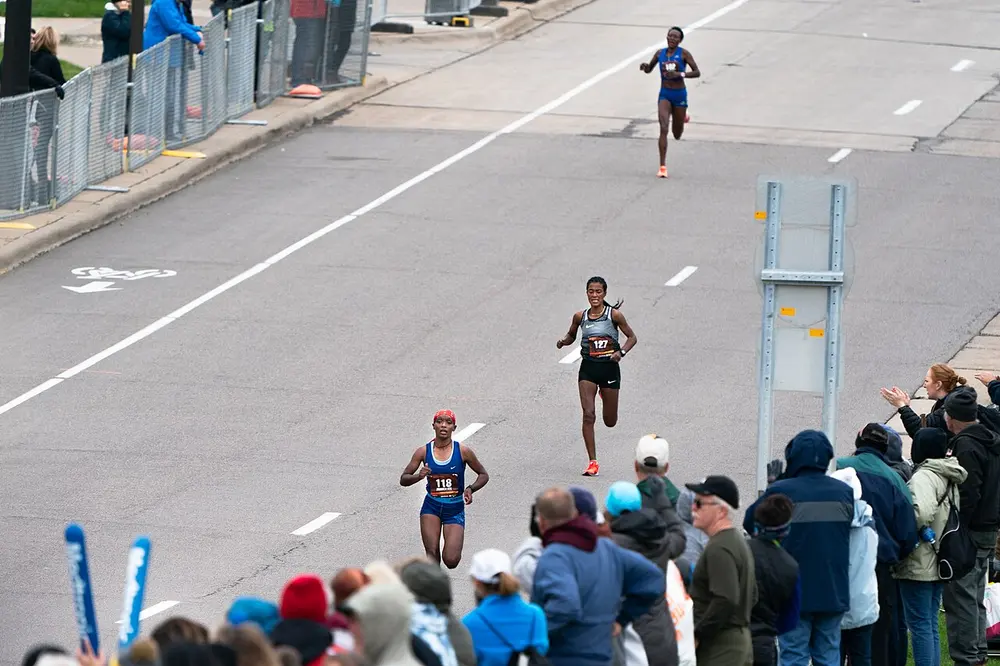
Top three finishers in the Twin Cities Marathon, Sinke Biyadgilign, 2 33 04, Serkalem Abrha,2 33 12,. Photo: Lorie Shaull from Washington, United States / Wikimedia Commons, CC BY-SA 2.0.
Frequently asked questions
Answers to the questions runners ask before entering, drawn from this race's course guide and the directory's own data — the sources behind them are listed below.
When was the Twin Cities Marathon covered here?
The edition covered here was held on 4 October 2026, running from Minneapolis to Saint Paul. The course and the autumn setting are the constants from year to year.
Is the Twin Cities Marathon flat or hilly?
It is undulating, with about 164 metres of climbing. The rises are short rather than steep, but they are frequent enough that even pacing requires attention. Summit Avenue adds a long, straight run towards the finish.
Is the Twin Cities Marathon good for a first marathon?
Yes. The rolling profile is manageable, the route is easy to follow and the scenery gives the miles a purpose. The main practical challenge is the point-to-point logistics, which need planning before race morning.
Where does the Twin Cities Marathon run?
It runs from Minneapolis to Saint Paul in Minnesota, past the lakes and along Summit Avenue towards the state capitol. The route links the two cities rather than looping within one of them.
Why is it called the most beautiful urban marathon in America?
The race is advertised that way, and the October date supports the claim. The route passes the Minneapolis lakes and Summit Avenue when the leaves are turning, and the two cities provide very different kinds of scenery.
What is Summit Avenue like to run?
Summit Avenue is a long boulevard lined with historic houses and trees. It arrives late in the race, when the legs are tired, and it leads towards the state capitol. It is the defining stretch of the course.
More marathons in United States
More marathons in Americas
Sources for this page
What each source below is used for on this page, and where to check this race yourself.
- World Athletics — the label calendar and the road-race regulations. Used to check whether the race holds a World Athletics label, and its elite competition details.
- AIMS — the international course-measurement standard behind the 42.195 km distance, and the AIMS race calendar.
- The organizer's own publications — course maps, race handbooks and published results. The date, course character and climbing on this page are compiled from them and re-checked each season.
Where do these facts come from?
Dates, course type, climbing and time limits are compiled from the organizer's publications and re-checked each season; elevation is an estimate of total climbing rather than a survey figure. Always confirm race-day details with the organizer before making plans.
Last reviewed 27 October 2026