
Milwaukee Marathon
A spring marathon beside Lake Michigan has its own atmosphere. The lakefront is quiet, the parks are just coming back to life, and the city feels like it is shaking off winter.
By Global Marathon Routes editorial team · Last reviewed 27 October 2026
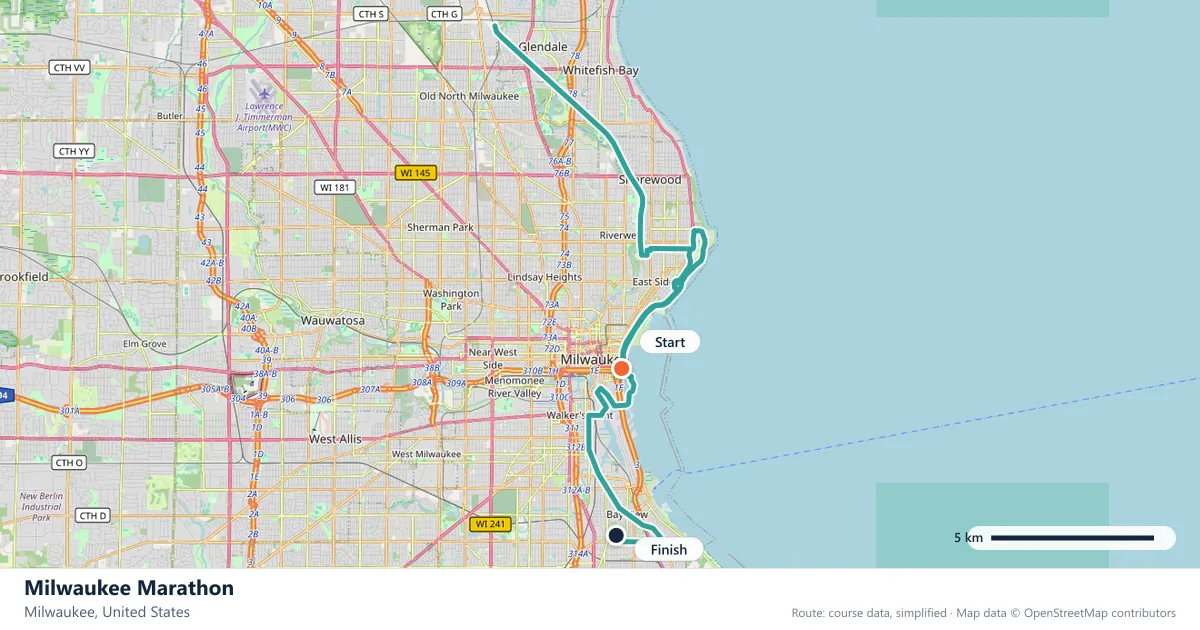
Where does the Milwaukee Marathon run?
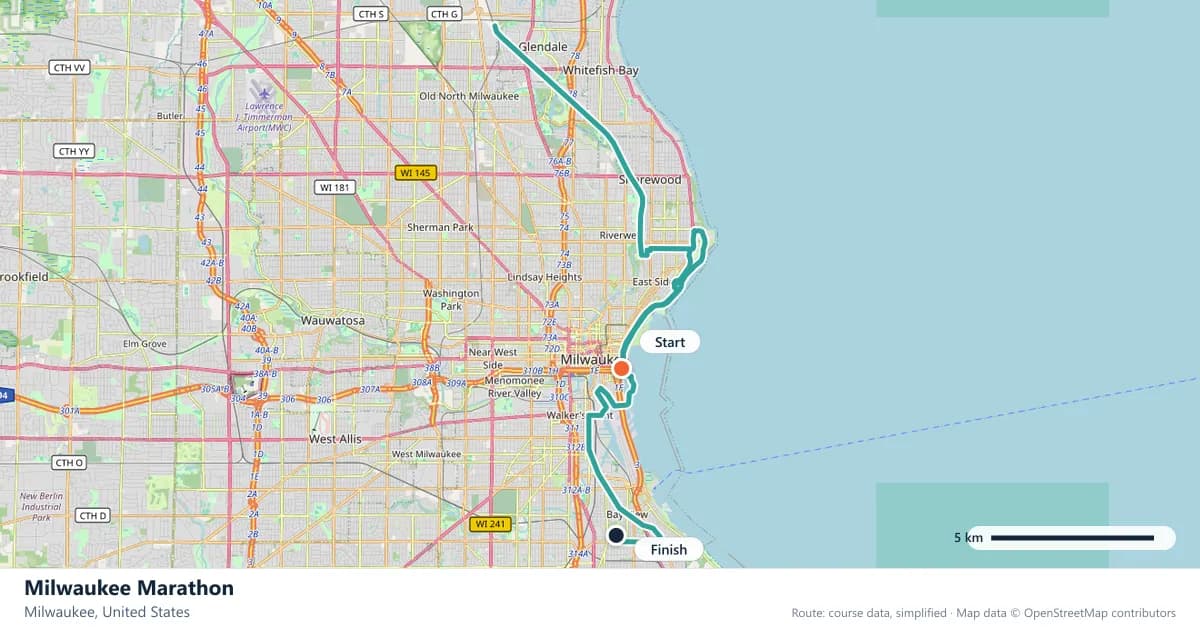
Interactive map
The trace follows the organizer's published course, simplified for the screen: the orange dot is the start, the dark dot the finish. Scroll to zoom, drag to pan.
What is the Milwaukee Marathon course like?
A spring race along Lake Michigan and through Milwaukee's lakefront parks. Flat on the water, rolling as it turns inland, and usually cold enough for fast times.
- Next edition
- 10 April 2027
- Elevation gain
- 143 m
- Profile
- Undulating
- First run
- —
Course guide
A spring marathon beside Lake Michigan has its own atmosphere. The lakefront is quiet, the parks are just coming back to life, and the city feels like it is shaking off winter. The Milwaukee Marathon on 10 April 2027 uses that setting, following the lakefront and its parks before turning inland for the rolling miles that make up the second half.
The course is flat on the water and undulating away from it, with about 143 metres of climbing in total. Milwaukee usually provides cold conditions, which is exactly what a runner chasing a fast time wants. The combination of a level lakeshore and a cool spring morning is the reason this race has a reputation for quick running.
Wisconsin- Marathon - Milwaukee - DPLA - 570ecf085acf9d8e34e43492f5bef37a (page 1). Photo: Post Office Department. Bureau of Facilities. 8/20/1949? / Wikimedia Commons, Public domain.
The course
The race begins with the lake. Milwaukee's shoreline runs north and south along the western edge of Lake Michigan, and the lakefront parks give the course a long, open edge with a flat surface and a steady horizon. These are the fastest miles of the day: little climbing, few sharp turns, and the kind of rhythm that is hard to find in a city centre.
Then the route turns inland. The streets away from the water roll, with short rises replacing the level lakeshore. None of the climbs is long, but they arrive after the flat opening and they keep the legs working. The 143 metres of gain are spread across this inland section rather than concentrated in a single hill, so the course rewards an even effort rather than a specific climbing strategy.
Milwaukee's downtown sits just behind the lakefront, so the city is never far away even when the route turns inland. The course changes character twice: flat and exposed on the water, then rolling and more enclosed.
The lakefront parks
Milwaukee's lakefront is one of the city's great civic assets. A continuous band of parks runs along the water, separating the city from the lake and giving runners a green edge for the opening miles. The parks are open and spacious, with views across the water and enough room for the field to spread out.
That openness is a gift on race morning. It makes the start feel calm rather than cramped, and it gives runners space to find their pace without dodging around corners. It also means the lakefront miles are exposed. On a cold April day, the water can make the air feel sharper, so a windproof layer and gloves are worth considering even if the rest of the city feels mild.
Wisconsin- Marathon - Milwaukee - DPLA - 570ecf085acf9d8e34e43492f5bef37a (page 126). Photo: Post Office Department. Bureau of Facilities. 8/20/1949? / Wikimedia Commons, Public domain.
Where the rolls begin
The inland section is where Milwaukee becomes a different race. After the flat lakeshore, the short climbs feel more significant than their size suggests, and runners who have been holding a fast rhythm on the water may find the change uncomfortable. The right response is to ease into the first few rises rather than attacking them.
The profile also makes pacing a matter of effort rather than splits. A kilometre that includes two short climbs costs more than a flat one at the same pace, and the difference accumulates over the second half. Use the descents to recover, keep the cadence quick on the rises, and do not try to compensate for the slower kilometres by running faster than planned on the flat.
A winter into spring build
An April marathon in Wisconsin means training through winter. That is part of the appeal for runners who prefer cold-weather running, but it also means the build has to be planned around short days and uncertain surfaces. Treadmill sessions and layered long runs are part of the preparation, and the race itself is a reward for getting through the worst of the season.
The payoff is a course that often feels easier than a summer race. Cold air helps the body shed heat, and the flat lakeshore lets runners settle into a rhythm without fighting the terrain. The main risk is underdressing at the start and overcompensating once the race begins.
After the lake
Milwaukee's compact centre and lakefront are easy to reach after the race, and the city makes it simple to find family and friends once the running is done. It is a modest advantage, but it matters after 42 kilometres.
The city itself is worth a day. Milwaukee's lakefront, its downtown streets and its riverfront are all within easy reach of the marathon, and the spring date means the city is emerging from winter rather than at the height of its festival season. That quieter mood suits the race.
Wisconsin- Marathon - Milwaukee - DPLA - 570ecf085acf9d8e34e43492f5bef37a (page 167). Photo: Post Office Department. Bureau of Facilities. 8/20/1949? / Wikimedia Commons, Public domain.
Frequently asked questions
Answers to the questions runners ask before entering, drawn from this race's course guide and the directory's own data — the sources behind them are listed below.
When is the Milwaukee Marathon in 2027?
The next edition is on 10 April 2027. It is a spring race along the Lake Michigan shoreline and through the city's lakefront parks.
Is the Milwaukee Marathon flat or hilly?
It is undulating, with about 143 metres of climbing. The lakefront is flat and fast, while the inland streets add short, rolling rises. There is no sustained climb.
Is Milwaukee good for a personal best?
The flat lakeshore and usually cold conditions make it a strong personal-best candidate. The rolling inland section prevents it from being a pure time-trial course, but the total climbing is modest and the fast miles beside the water give runners a chance to establish a rhythm.
Is Milwaukee a good first marathon?
Yes. The flat lakefront is forgiving, and the rolling section is short enough to manage with sensible pacing. The April date means a winter build, which is the main practical hurdle for a first-timer.
Where does the Milwaukee Marathon run?
The course follows the Lake Michigan shoreline and the lakefront parks before turning inland through the city streets. The lake remains the defining feature of the route even when the course turns away from it.
What is the weather usually like for the race?
The race is usually cold enough for fast times, but April conditions can vary. Plan for a cool start near the water and a possible range through the morning rather than assuming spring warmth.
More marathons in United States
More marathons in Americas
Sources for this page
What each source below is used for on this page, and where to check this race yourself.
- World Athletics — the label calendar and the road-race regulations. Used to check whether the race holds a World Athletics label, and its elite competition details.
- AIMS — the international course-measurement standard behind the 42.195 km distance, and the AIMS race calendar.
- The organizer's own publications — course maps, race handbooks and published results. The date, course character and climbing on this page are compiled from them and re-checked each season.
Where do these facts come from?
Dates, course type, climbing and time limits are compiled from the organizer's publications and re-checked each season; elevation is an estimate of total climbing rather than a survey figure. Always confirm race-day details with the organizer before making plans.
Last reviewed 27 October 2026