
Miami Marathon
Miami in January is not a subtle winter escape. The marathon on 31 January 2027 starts in downtown, crosses the causeways to Miami Beach and comes back across the bay, with the skyline on one side of…
By Global Marathon Routes editorial team · Last reviewed 27 October 2026
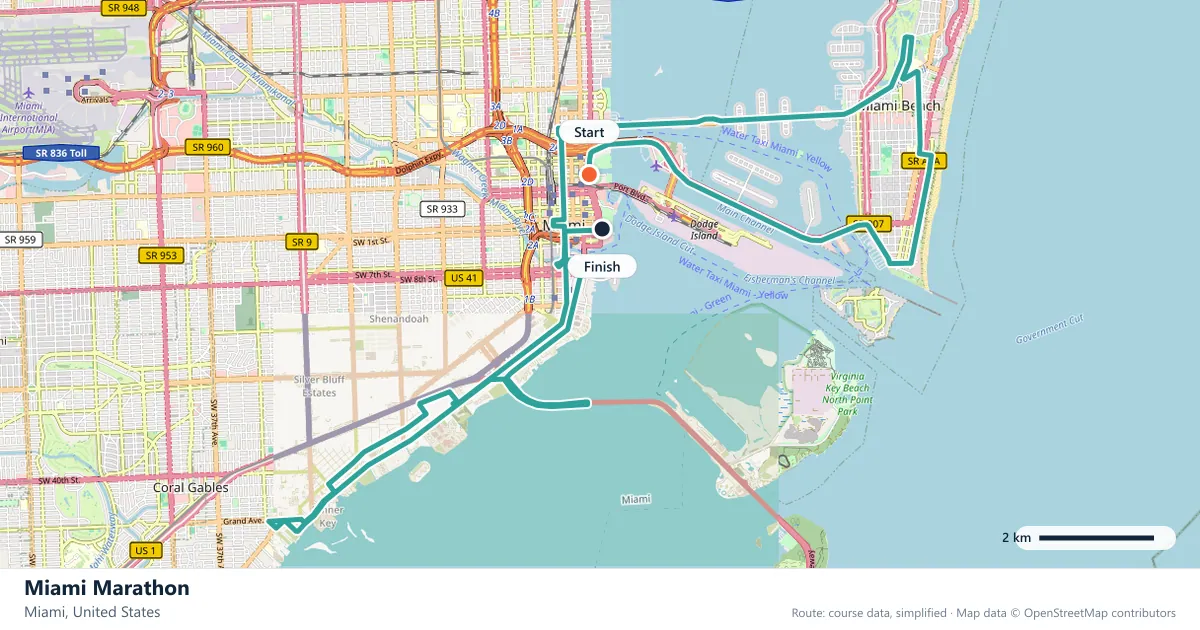
Where does the Miami Marathon run?
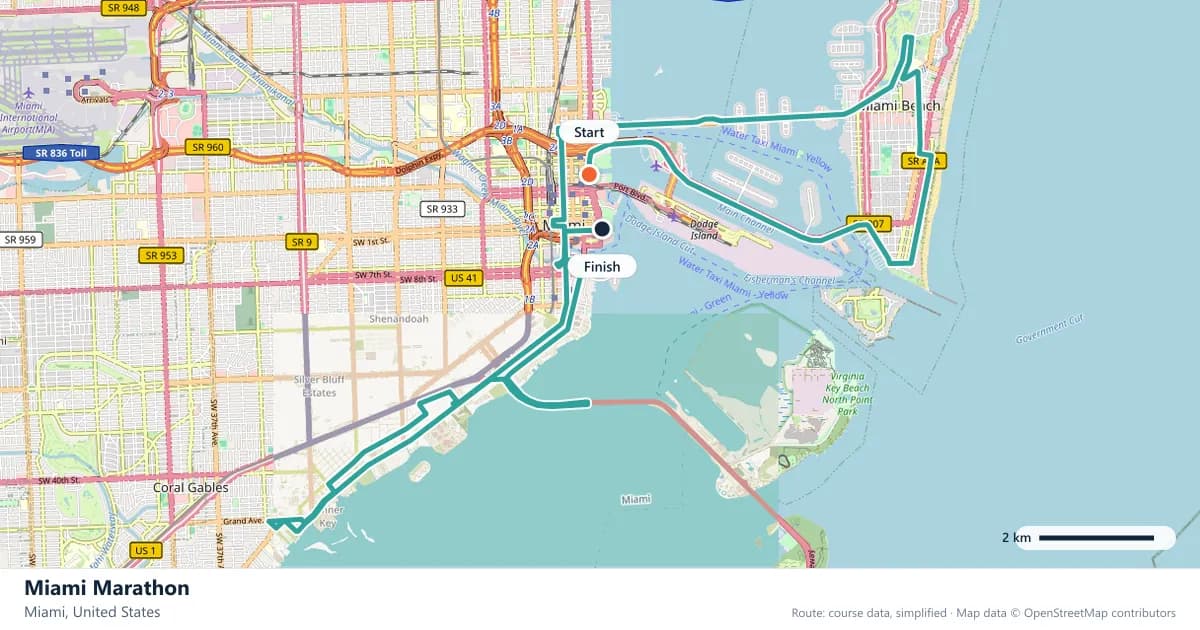
Interactive map
The trace follows the organizer's published course, simplified for the screen: the orange dot is the start, the dark dot the finish. Scroll to zoom, drag to pan.
What is the Miami Marathon course like?
A January race from downtown Miami across the causeways to Miami Beach and back. Flat, warm and breezy, with the skyline and the ocean either side of the bridges.
- Next edition
- 31 January 2027
- Elevation gain
- 90 m
- Profile
- Flat
- First run
- —
Course guide
Miami in January is not a subtle winter escape. The marathon on 31 January 2027 starts in downtown, crosses the causeways to Miami Beach and comes back across the bay, with the skyline on one side of the bridges and the water on the other. The course gains only about 90 metres, and the day is usually warm and breezy.
The race is built around that crossing. Most of the running is at sea level, the climbs are the bridge ramps, and the weather is the real variable. For runners from colder places, the appeal is obvious: a January marathon without the layers. For anyone chasing a time, the challenge is managing warmth and wind rather than elevation.
Miami, Oklahoma 2. Photo: Gorup de Besanez / Wikimedia Commons, CC BY-SA 4.0.
The course
The route begins in downtown Miami and heads for the water. The street grid gives way to the causeways, and each bridge is a short, sharp rise followed by a descent into the next stretch of road. With only 90 metres of gain across the whole marathon, none of these ramps is long, but they are the only hills of consequence and they break the rhythm.
Between the bridges, the course is flat and fast. The bay opens out, the skyline shifts with every crossing, and the running becomes a matter of holding form rather than reading terrain. Miami Beach is the far point of the outward journey; the return brings the city back into view and the finish closer.
The flatness is genuine, but flat does not mean easy. A January marathon in South Florida asks the body to cool itself at the same time as it runs 42 kilometres. The breeze helps, except when it is in your face, and the exposed bridge sections are where that becomes most obvious.
Crossing the causeways
The causeways are the race's defining geography. They connect the mainland to the barrier islands, and their bridges rise just enough to give runners a view over Biscayne Bay. On the way out, the city skyline is behind you and the beach ahead; on the way back, the order reverses. It is a simple, legible course that makes the most of the water.
Bridge running is its own discipline. The climb is short enough that it is tempting to attack it, but a hard surge costs more than it saves. Shorten the stride, keep the effort even, and use the descent to recover rather than to make up time. The same ramp that feels trivial at five kilometres can feel considerably less trivial at 35.
Miami Beach and the return
Miami Beach gives the course its other identity. The beachfront, the hotels and the ocean are a long way from the downtown start, and the change of scenery is a useful psychological marker. Runners who know the city will recognise the shift in architecture and atmosphere; those who do not will still feel the difference between the bay and the open water.
The return is where the race is decided. The skyline grows, the bridges come back, and the breeze may have changed direction. Going out with the wind at your back is a trap if it means coming home into it. Pace the outward crossing conservatively enough that the return is an opportunity rather than a survival exercise.
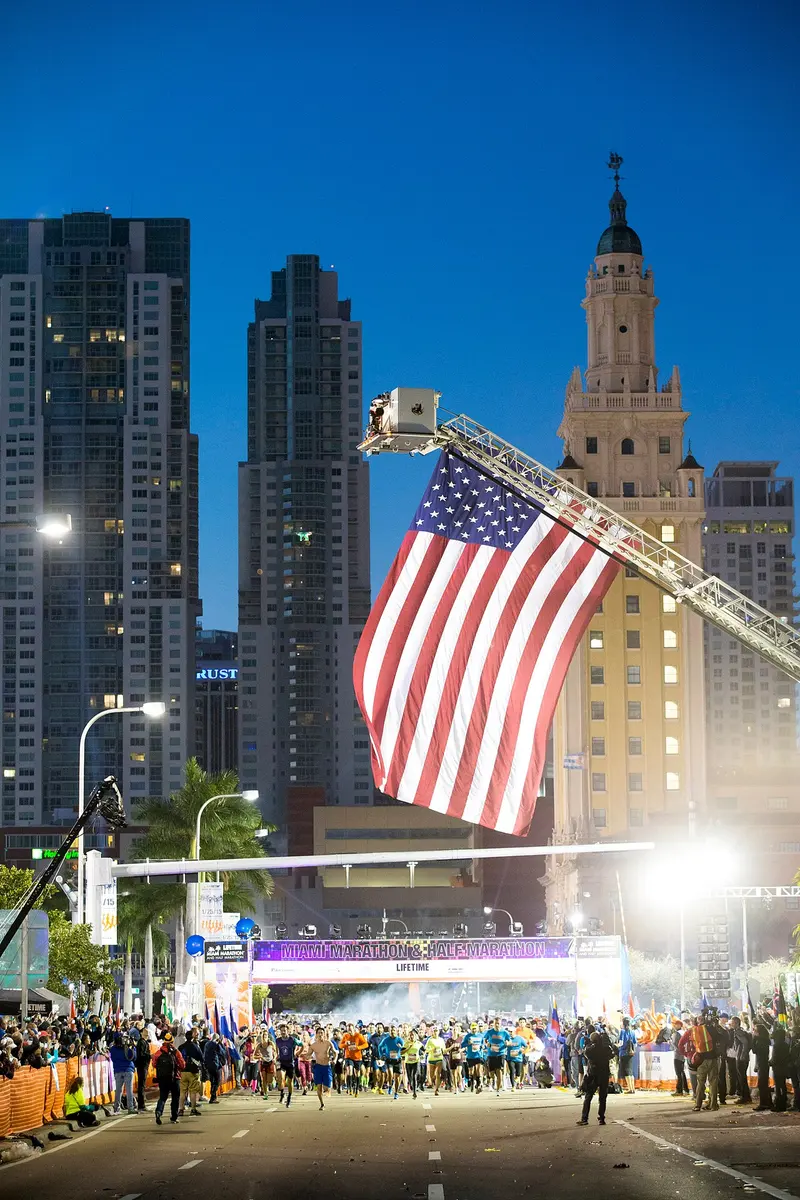
Miami Marathon Start Line. Photo: Klest001 / Wikimedia Commons, CC BY-SA 4.0.
Running warm
Warmth changes the mathematics of a marathon. The same pace costs more, fluid losses rise, and the final miles can unravel quickly if the first half was run on cool-weather habits. The race is in January, so it is not a summer furnace, but it is still South Florida, and the humidity can make the air feel heavier than the thermometer suggests.
The practical response is to start slower than a cool-weather personal best would suggest, drink early and often, and use the breeze when it is helpful. A cap and sunglasses are worth having on the exposed crossings. Runners who train in cold climates should not expect the same pace to feel familiar in Miami, even on a flat course.
A city race split by water
Miami's geography makes race-day logistics different from a single-loop city marathon. The course crosses to Miami Beach and back, so a large part of the race is on the islands while the start is on the mainland. Spectators need a plan for where to stand, and runners should check the organiser's guidance on access and the return from the finish.
The reward is a course that feels like a tour of the bay rather than a loop around a convention centre. Downtown, the causeways, Miami Beach and the skyline all belong to the race, and the water keeps the route oriented. It is a flat marathon with a sense of place, which is a harder combination to find than it sounds.
Frequently asked questions
Answers to the questions runners ask before entering, drawn from this race's course guide and the directory's own data — the sources behind them are listed below.
When is the Miami Marathon in 2027?
The next edition is on 31 January 2027. It starts in downtown Miami, crosses the causeways to Miami Beach and returns to the mainland.
Is the Miami Marathon flat?
Yes. The course climbs about 90 metres in total, with the causeway bridges providing the only notable rises. The rest of the route is at sea level, so it is a flat marathon by any standard.
Is Miami good for a personal best?
The course is flat enough to support a fast time, but the warmth and breeze are real factors. A personal best is possible for runners who pace conservatively and handle the conditions well; it is not a course where a cool-weather pace can simply be copied.
Is Miami a good first marathon?
Yes. The flat profile and the January date make it approachable, and the out-and-back across the bay is easy to understand. The main caution is the warmth, which can make a debut feel harder than the pace suggests.
Where does the Miami Marathon run?
The route starts downtown, crosses the causeways to Miami Beach and returns across the bay to the mainland. The bridges provide the climbs and the views of the skyline and the ocean.
How does the wind affect the race?
Miami is breezy, and the wind can be behind you on one crossing and against you on the other. The return leg can feel much harder into a headwind, so keep something in reserve for it.
More marathons in United States
More marathons in Americas
Sources for this page
What each source below is used for on this page, and where to check this race yourself.
- World Athletics — the label calendar and the road-race regulations. Used to check whether the race holds a World Athletics label, and its elite competition details.
- AIMS — the international course-measurement standard behind the 42.195 km distance, and the AIMS race calendar.
- The organizer's own publications — course maps, race handbooks and published results. The date, course character and climbing on this page are compiled from them and re-checked each season.
Where do these facts come from?
Dates, course type, climbing and time limits are compiled from the organizer's publications and re-checked each season; elevation is an estimate of total climbing rather than a survey figure. Always confirm race-day details with the organizer before making plans.
Last reviewed 27 October 2026