
Madison Marathon
Madison is a city with more shoreline than land in its centre. Downtown sits on an isthmus between Lake Mendota and Lake Monona, the state capitol anchors one end and the University of Wisconsin…
By Global Marathon Routes editorial team · Last reviewed 27 October 2026
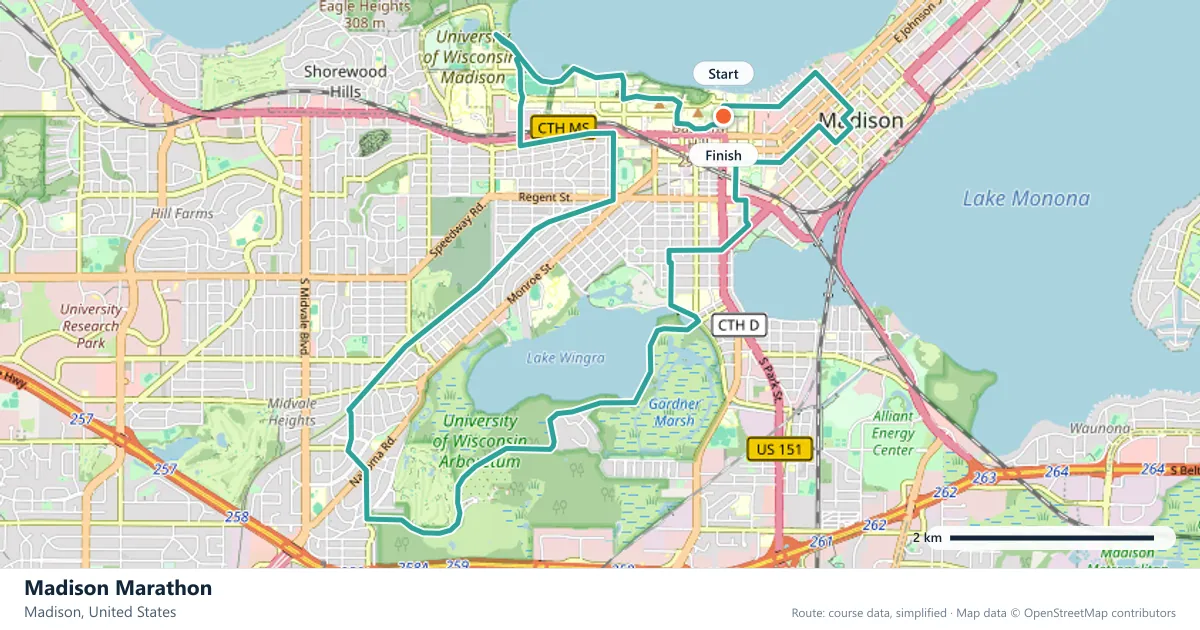
Where does the Madison Marathon run?
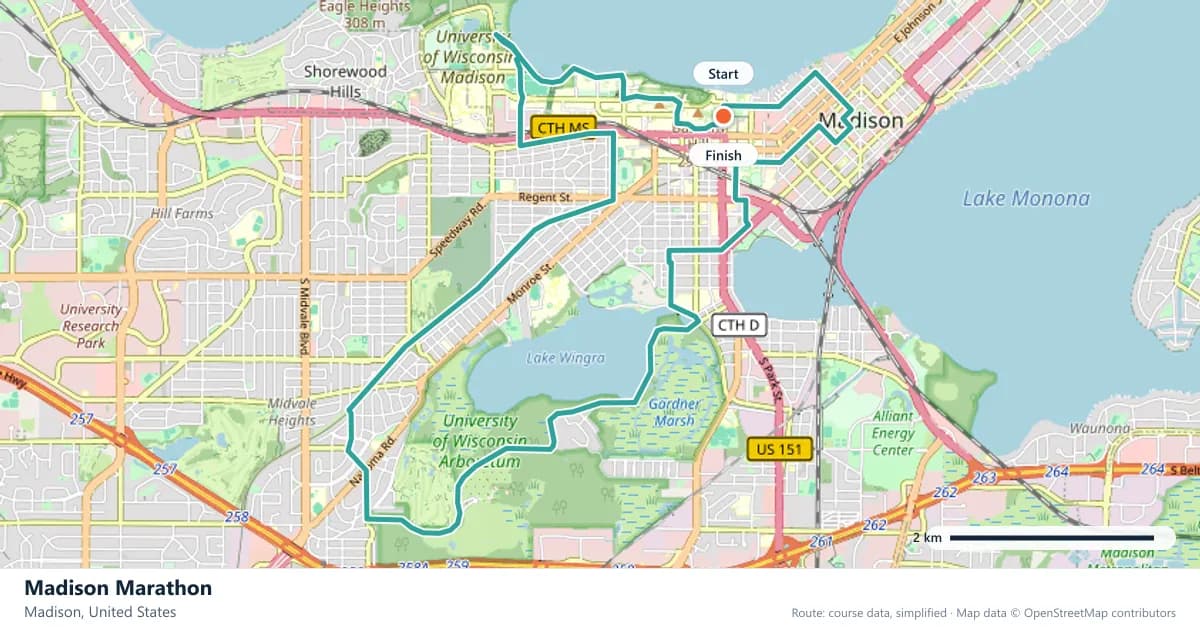
Interactive map
The trace follows the organizer's published course, simplified for the screen: the orange dot is the start, the dark dot the finish. Scroll to zoom, drag to pan.
What is the Madison Marathon course like?
A November marathon in the Wisconsin capital, looping past the capitol and the university campus on the isthmus. Rolling, and usually cold and clear.
- Next edition
- 15 November 2026
- Elevation gain
- 162 m
- Profile
- Undulating
- First run
- —
Course guide
Madison is a city with more shoreline than land in its centre. Downtown sits on an isthmus between Lake Mendota and Lake Monona, the state capitol anchors one end and the University of Wisconsin campus spreads from the other. On 15 November 2026 the Madison Marathon uses that narrow strip as the spine of its course, looping past the capitol and the campus with the lakes never far from view.
The profile is undulating, with about 162 metres of climbing spread across the route, and November in Wisconsin usually means cold, clear conditions. Neither detail is extreme. The rolls are short rather than steep, and the cold is the dry, bracing kind that many runners prefer to a warm autumn day. But both shape how the race should be run: evenly, with layers that can be shed and a pace that does not depend on a flat course.
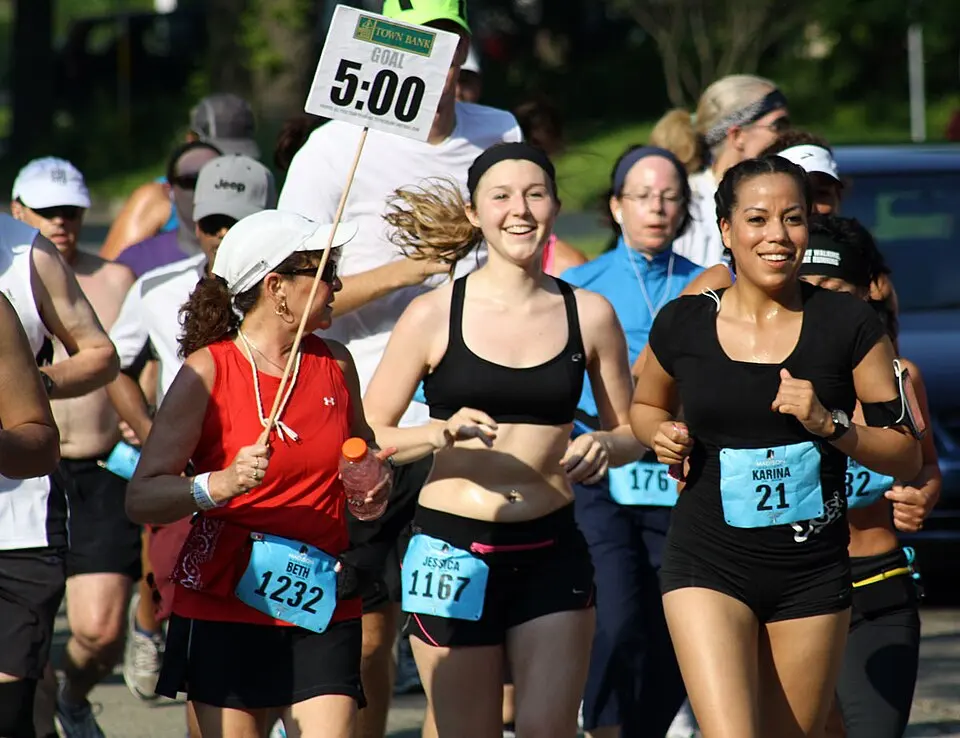
Sports Madison marathon. Photo: Jason Dean / Wikimedia Commons, CC BY 2.0.
The course
The route's centre of gravity is the isthmus. The capitol sits on the crest of the land between the lakes, its white dome a fixed point for runners and spectators, and the university buildings run west along the shore of Mendota. The race moves between those two poles, using downtown streets and campus roads rather than a single waterfront promenade.
What that means for pacing is a course that never settles into a long, flat rhythm. The 162 metres of gain arrive in short rises, the sort that barely register individually but accumulate over 42 kilometres. There is no climb long enough to demand a change of stride, but enough of them to make a metronomic pace feel artificial. Effort-based running works better than fighting for identical splits.
The lakes are the other constant. They open the views on the isthmus and give the course its pale November light, but they also mean the route is exposed in places. On a clear morning that is part of the appeal. It is also a reminder that the weather can reach you where the course turns away from the shelter of the campus buildings.
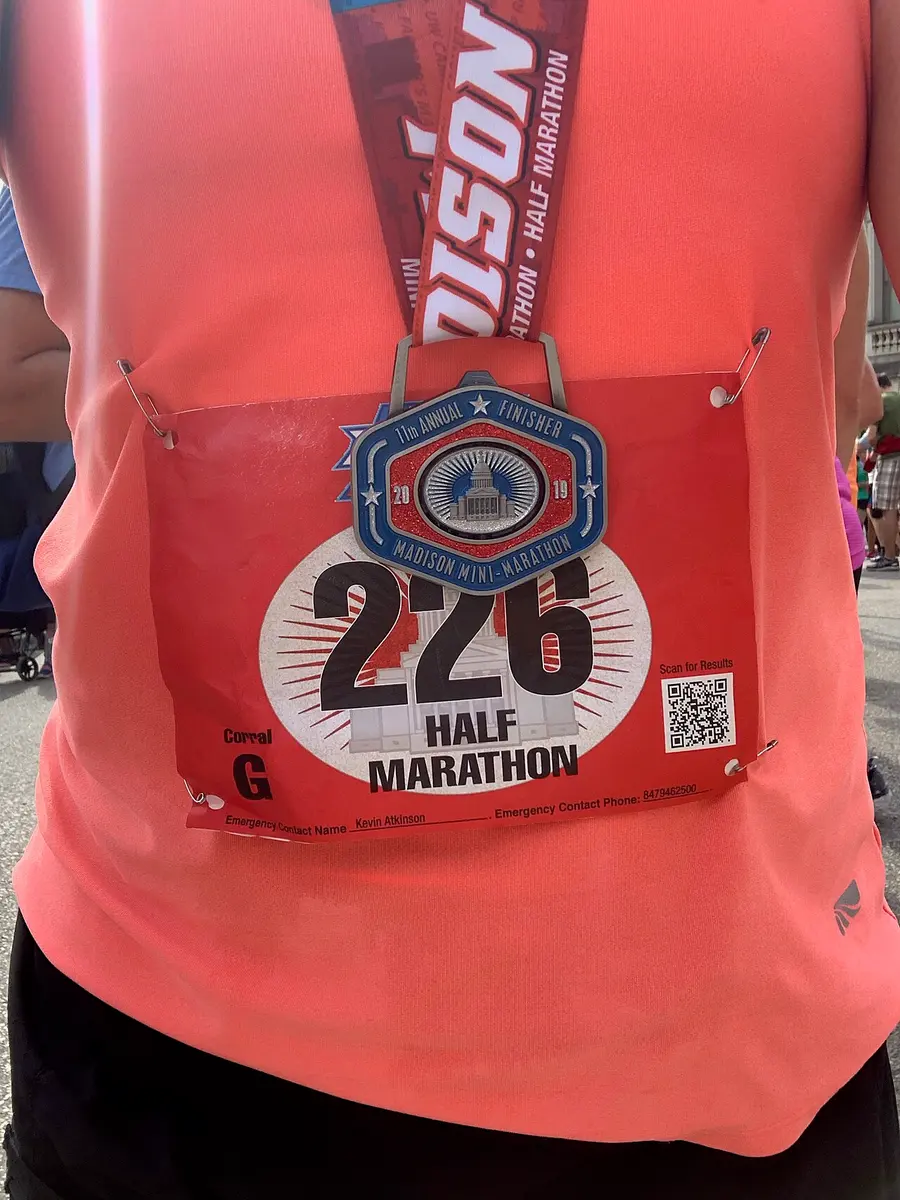
Madison Half Marathon. Photo: Miralex0209 / Wikimedia Commons, CC BY-SA 4.0.
The isthmus and the capitol
The capitol is the obvious landmark, but the university is the reason the isthmus feels alive on a race morning. The campus climbs gently away from Mendota, its older buildings set among trees and terraces, and the student streets give the course a younger, noisier edge than the state buildings alone would provide.
Madison's geography is unusually legible for a marathon. There are no anonymous industrial outskirts to endure and no endless suburban approach. Runners can orient themselves by the capitol dome, the lake surfaces and the university's limestone facades. That legibility helps: when you know roughly where you are, the course feels shorter.
Pacing the rolls
Three things decide a good Madison race: an honest first 10 kilometres, patience on the repeated rises, and a finish that is not left to chance. The opening downtown streets can feel brisk because the field is fresh and the capitol gives the race a natural focal point. That is precisely the moment to hold back.
Treat the rises as a series of small efforts rather than a single hill. Shorten the stride slightly on the way up, keep the shoulders relaxed, and let the descent restore the rhythm. Runners who try to hold even pace by force usually spend the second half recovering rather than racing. The total gain is modest, but 162 metres of small interruptions is a different problem from one long climb.
A cold, clear November
Madison in mid-November is usually cold and clear, which is a better combination for marathon running than it sounds. Clear skies often mean a sharp start, and a sharp start means muscles need longer to feel loose. Build an extra warm-up into the morning rather than relying on the first kilometre.
Layers are the practical answer. A throwaway top that can be discarded once the race settles is more useful than a heavy jacket that stays on for an hour. Gloves are worth having, and so is a plan for the hands once they warm up. The cold also changes fuelling: it is easy to drink less when the air is sharp, so use the calm early kilometres to establish a rhythm rather than waiting for the return to the city.
Race morning in a compact city
Madison's race-day logistics are simpler than those of a major marathon. The course is contained around the capitol, the campus and the isthmus, so most movement is local and the race stays within the same small centre. Check the organiser's instructions for the exact arrangements and closures, and allow more time than you think for the walk to the start.
The compactness helps spectators: a family can see a runner near the capitol, move a short distance and see them again without crossing the city. It feels more personal than the big November races.
Frequently asked questions
Answers to the questions runners ask before entering, drawn from this race's course guide and the directory's own data — the sources behind them are listed below.
When is the Madison Marathon in 2026?
The next edition is on 15 November 2026. It is a late-autumn race through downtown Madison, past the state capitol and the university campus.
Is the Madison Marathon flat or hilly?
It is undulating, with about 162 metres of climbing. The gain comes in short rises rather than one sustained ascent, so there is no single hill to fear, but the repeated changes of grade are enough to affect pacing.
Is Madison a good first marathon?
Yes. The rolling profile is manageable, the course is compact and the November conditions are usually cool. A conservative first half still matters, because the short rises accumulate and the second half is where an over-fast start shows up.
Where does the Madison Marathon run?
The course loops through Madison's isthmus, past the Wisconsin State Capitol and the University of Wisconsin–Madison campus. The city centre sits between Lake Mendota and Lake Monona, and the route stays within that central area rather than heading into the countryside.
What is the weather usually like for the race?
The race is usually held in cold, clear conditions. That can make the start feel sharp, so plan layers and a longer warm-up. It also means the course avoids the warmth that can slow a marathon later in the year.
What is the most distinctive part of the course?
The isthmus setting. The capitol dome, the university buildings and the two lakes form landmarks that are visible from one another, which is unusual for a city marathon and makes the route easy to read.
More marathons in United States
More marathons in Americas
Sources for this page
What each source below is used for on this page, and where to check this race yourself.
- World Athletics — the label calendar and the road-race regulations. Used to check whether the race holds a World Athletics label, and its elite competition details.
- AIMS — the international course-measurement standard behind the 42.195 km distance, and the AIMS race calendar.
- The organizer's own publications — course maps, race handbooks and published results. The date, course character and climbing on this page are compiled from them and re-checked each season.
Where do these facts come from?
Dates, course type, climbing and time limits are compiled from the organizer's publications and re-checked each season; elevation is an estimate of total climbing rather than a survey figure. Always confirm race-day details with the organizer before making plans.
Last reviewed 27 October 2026