
Louisville Marathon
Louisville's marathon is shaped by its parks and its river. The course loops through the city's green spaces and the Churchill Downs district before turning toward the Ohio River for a fast run-in.
By Global Marathon Routes editorial team · Last reviewed 27 October 2026
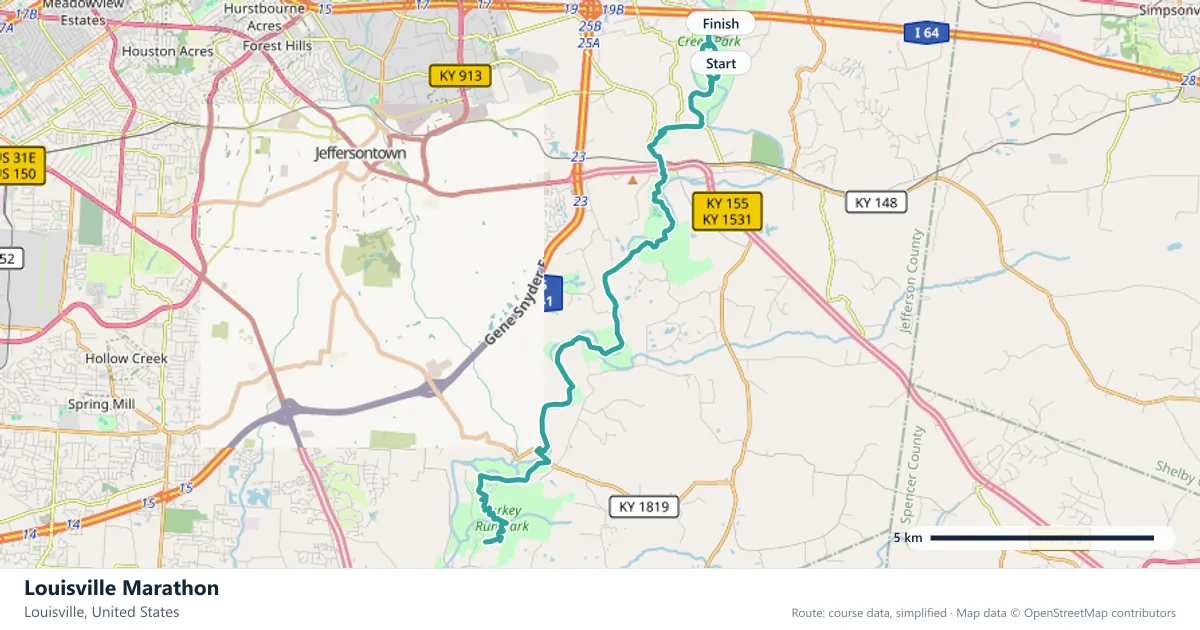
Where does the Louisville Marathon run?
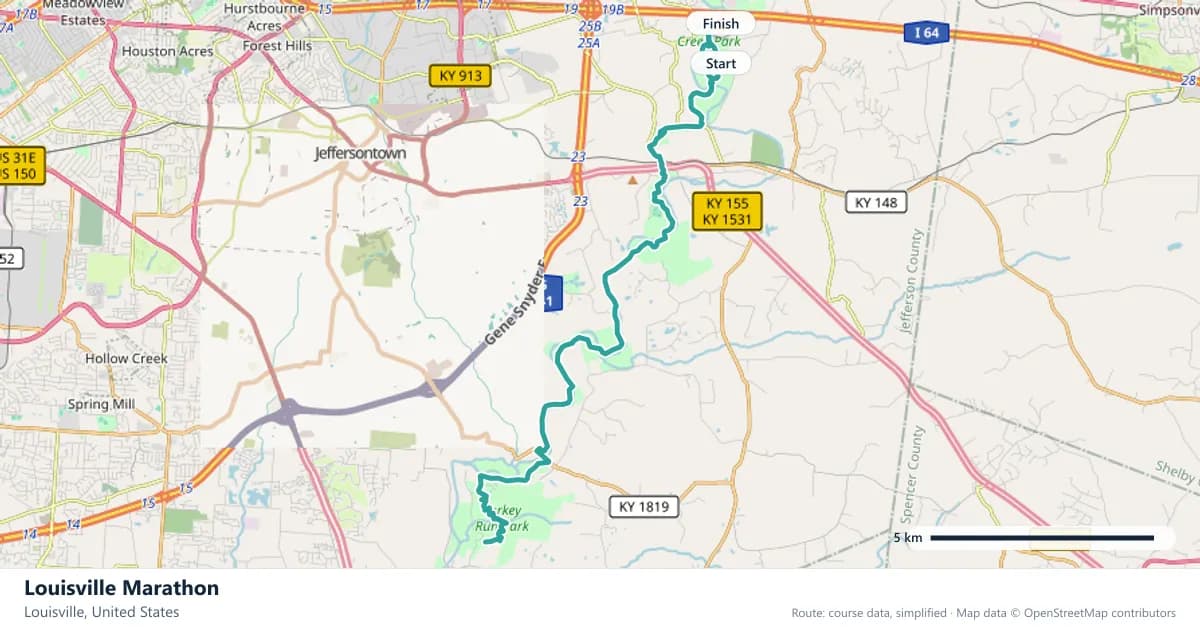
Interactive map
The trace follows the organizer's published course, simplified for the screen: the orange dot is the start, the dark dot the finish. Scroll to zoom, drag to pan.
What is the Louisville Marathon course like?
A November marathon in Kentucky, looping through Louisville's parks and the Churchill Downs district. Hilly in the middle, with a fast run-in beside the Ohio River.
- Next edition
- 01 November 2026
- Elevation gain
- 300 m
- Profile
- Hilly
- First run
- —
Course guide
Louisville's marathon is shaped by its parks and its river. The course loops through the city's green spaces and the Churchill Downs district before turning toward the Ohio River for a fast run-in. Race day is Sunday 01 November 2026, and the race is hilly in the middle, with about 300 metres of climbing, before the closing miles offer some of the quickest running of the day.
That shape gives the marathon a clear narrative. The first half is about patience, the middle is about managing the climbs and the final stretch beside the river is about using whatever is left. Louisville is the largest city in Kentucky, and the course uses its parks and its most famous sporting district to give the race a local identity.
The fast river run-in gives runners a chance to finish strongly, while the parks and neighbourhoods keep the day approachable. A patient runner can chase a personal best here; a first-timer can trade speed for caution. The hills are real, though, and the middle of the course is where the race is decided.
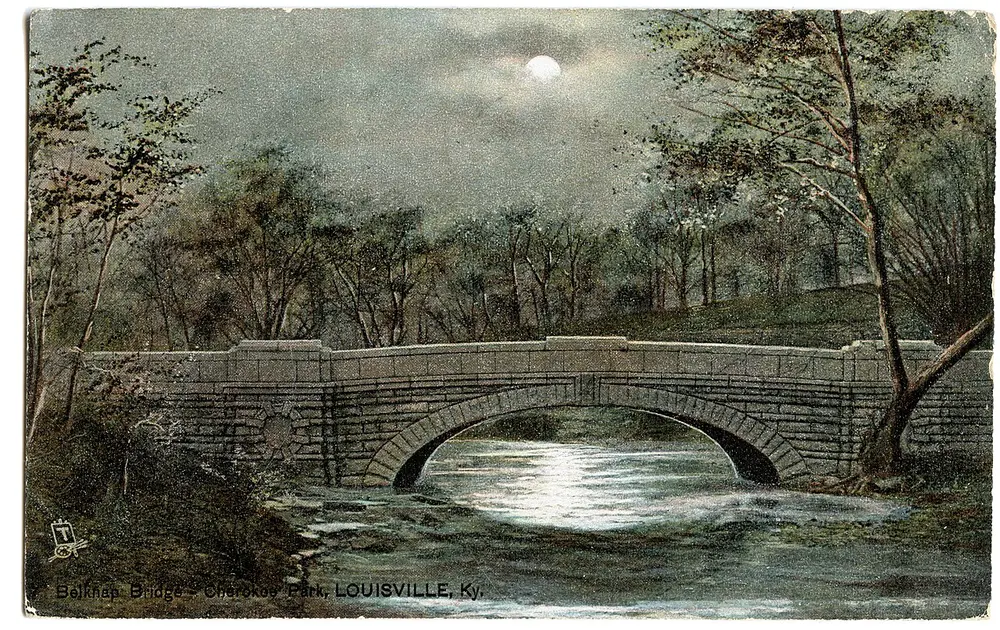
Belknap Bridge, Cherokee Park, Louisville, Ky. Photo: Diane Deaton Street from Louisville, KY, USA / Wikimedia Commons, Public domain.
The course
The race is a loop through Louisville's parks and the Churchill Downs district. The early miles work through the city, then the route settles into the parks, where the trees, the winding roads and the changes of grade give the race a different feel from a downtown grid. The middle of the course carries the climbing, with about 300 metres of ascent spread across the route.
The hills are not a single climb. They come as a series of rises, some short and sharp, others longer drags, and the accumulated effort is what makes Louisville a hilly course. The parks are beautiful, but they are also where the race can slip away if the pace is too ambitious.
After the climbing, the course turns toward the Ohio River. The final stretch is fast, with the river beside the route and the city skyline in view. It is the kind of finish that rewards runners who kept something in reserve, and it gives the race a clear ending after the rolling middle.
Parks, Churchill Downs and the river
Louisville's park system is one of its defining features, and the marathon uses it well. Cherokee Park, with its winding roads and Belknap Bridge, is the kind of green space that makes a city race feel rural for a few kilometres. The trees provide shelter, the ground rolls and the course feels removed from the traffic.
The Churchill Downs district gives the race its most famous reference point. Churchill Downs is home to the Kentucky Derby, and the course passes through the surrounding district. For runners, it is a reminder that Louisville is a city with a deep sporting identity.
The Ohio River is the final act. After the hills, the course reaches the river and the run-in becomes fast and open. The water is wide, the city is close and the finish is ahead. It is a satisfying way to end a race that has spent most of its morning in the parks.
The climbs before the river
The hardest climbing is concentrated in the middle of the course, which means the race has a clear structure: settle in, survive the hills, then run. The danger is treating the first few miles as a warm-up and arriving at the climbs with tired legs.
Runners should hold back before the hills and run them by effort rather than by flat-course splits. The rises are short enough to run strongly, but the repeated efforts add up, and the descents are not always long enough to recover. A steady, conservative approach will leave more for the river.
The fast finish is the reward. Once the course reaches the Ohio River, the terrain flattens and the pace can lift. Runners who have paced the middle well will be able to use the final miles; runners who have raced the hills will be watching the finish from a distance.
Block Communications Louisville Studios. Photo: MrSchimpf / Wikimedia Commons, CC BY-SA 4.0.
November in Kentucky
November is a good time for a marathon in Kentucky. The summer heat has gone, the autumn colours are still in the parks and the race falls at the end of the year's racing season. Conditions can be cool or changeable, but the date gives runners a better chance of comfortable weather than a spring race.
The late-season timing also shapes the training block. The longest runs fall in September and October, when the days are shortening, and the final weeks are about sharpening rather than building. Runners should arrive with the work already done rather than trying to add fitness in November.
Louisville itself rewards a weekend stay: the parks, the river and the Churchill Downs district give the race a sense of place.
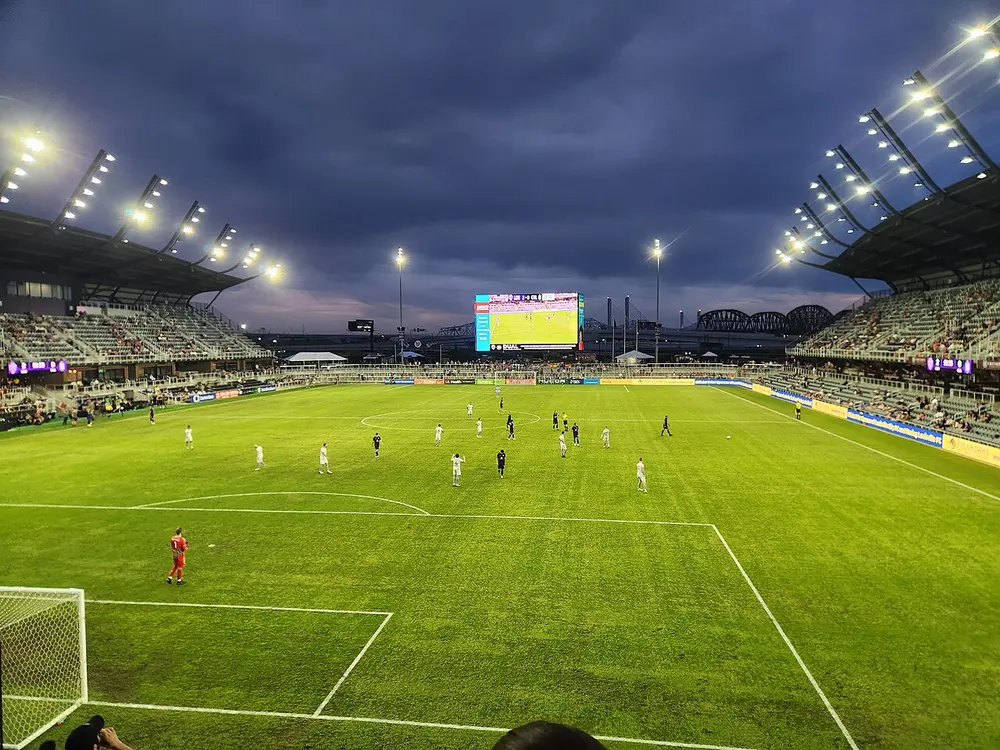
Greenville Triumph V Louisville City 2024. Photo: Bpluke01 / Wikimedia Commons, CC BY-SA 4.0.
Frequently asked questions
Answers to the questions runners ask before entering, drawn from this race's course guide and the directory's own data — the sources behind them are listed below.
When is the Louisville Marathon in 2026?
The race is on Sunday 01 November 2026. It is a late-autumn race held in Louisville, Kentucky.
Is the Louisville Marathon flat or hilly?
It is hilly, with about 300 metres of climbing. The significant rises come in the middle of the course, before the fast run-in beside the Ohio River. The climbing is concentrated rather than spread across the whole route.
Is Louisville good for a personal best?
The course can support a fast time, but it depends on how you handle the middle. The river run-in is quick, and the total climbing is manageable for a patient runner. Runners who race the hills will lose more than they gain.
Is the Louisville Marathon suitable for a first marathon?
Yes. The course is approachable, the parks are forgiving and the fast finish gives first-timers something to look forward to. The middle hills should be respected, and a conservative first half is essential.
Where does the Louisville Marathon run?
It runs on a loop through Louisville's parks and the Churchill Downs district, finishing with a fast stretch beside the Ohio River.
What is the river run-in like?
After the hilly middle, the course turns toward the Ohio River for a fast run-in. It is the quickest part of the race and rewards runners who kept something in reserve.
More marathons in United States
More marathons in Americas
Sources for this page
What each source below is used for on this page, and where to check this race yourself.
- World Athletics — the label calendar and the road-race regulations. Used to check whether the race holds a World Athletics label, and its elite competition details.
- AIMS — the international course-measurement standard behind the 42.195 km distance, and the AIMS race calendar.
- The organizer's own publications — course maps, race handbooks and published results. The date, course character and climbing on this page are compiled from them and re-checked each season.
Where do these facts come from?
Dates, course type, climbing and time limits are compiled from the organizer's publications and re-checked each season; elevation is an estimate of total climbing rather than a survey figure. Always confirm race-day details with the organizer before making plans.
Last reviewed 27 October 2026