
Jacksonville Marathon
Jacksonville is a city of bridges, rivers and long suburban roads, and its marathon reflects that geography.
By Global Marathon Routes editorial team · Last reviewed 27 October 2026
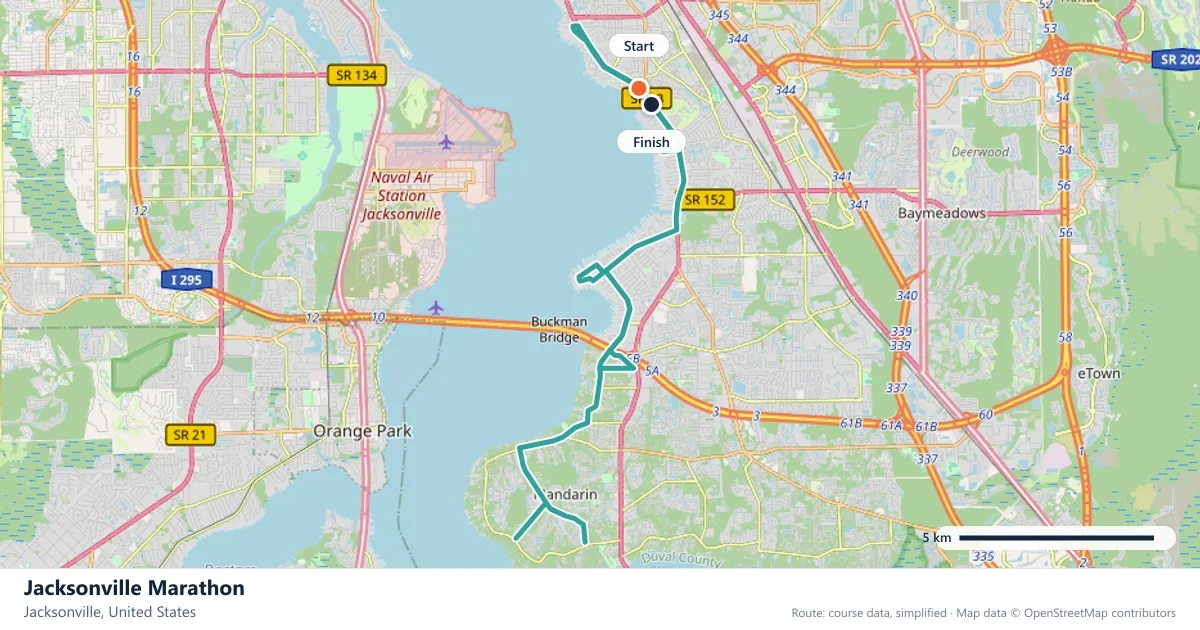
Where does the Jacksonville Marathon run?
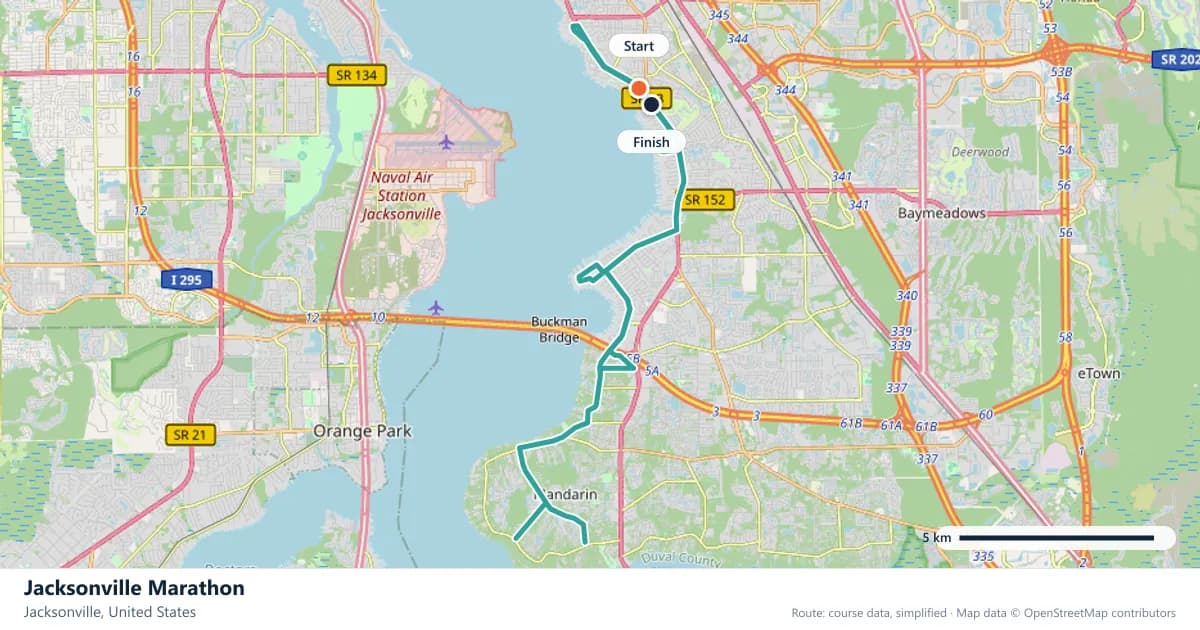
Interactive map
The trace follows the organizer's published course, simplified for the screen: the orange dot is the start, the dark dot the finish. Scroll to zoom, drag to pan.
What is the Jacksonville Marathon course like?
A low-key December marathon on Florida's northeast coast, running through Jacksonville's suburbs and along the Intracoastal Waterway. Almost completely flat.
- Next edition
- 12 December 2026
- Elevation gain
- 43 m
- Profile
- Flat
- First run
- —
Course guide
Jacksonville is a city of bridges, rivers and long suburban roads, and its marathon reflects that geography. The course stays away from the downtown skyline for much of the day, working through the city's suburbs and along the Intracoastal Waterway. It is a low-key December race on Florida's northeast coast, and its appeal is simple: almost no climbing, quiet roads and a fast, honest surface.
The 2026 race is on Saturday 12 December. The course climbs about 43 metres across 42.195 kilometres, which is as close to perfectly flat as a marathon gets. That profile suits runners chasing a personal best, and it also makes the race a gentle introduction for a first marathon. The trade-off is atmosphere: this is a community-scale event, not a city-stopping spectacle.
Jacksonville itself is sprawling, with the St. Johns River cutting through the city and the Intracoastal separating the mainland from the barrier islands. The marathon uses the quieter, flatter side of that geography, and the result is a race that feels more like a long training morning than a major-city production.
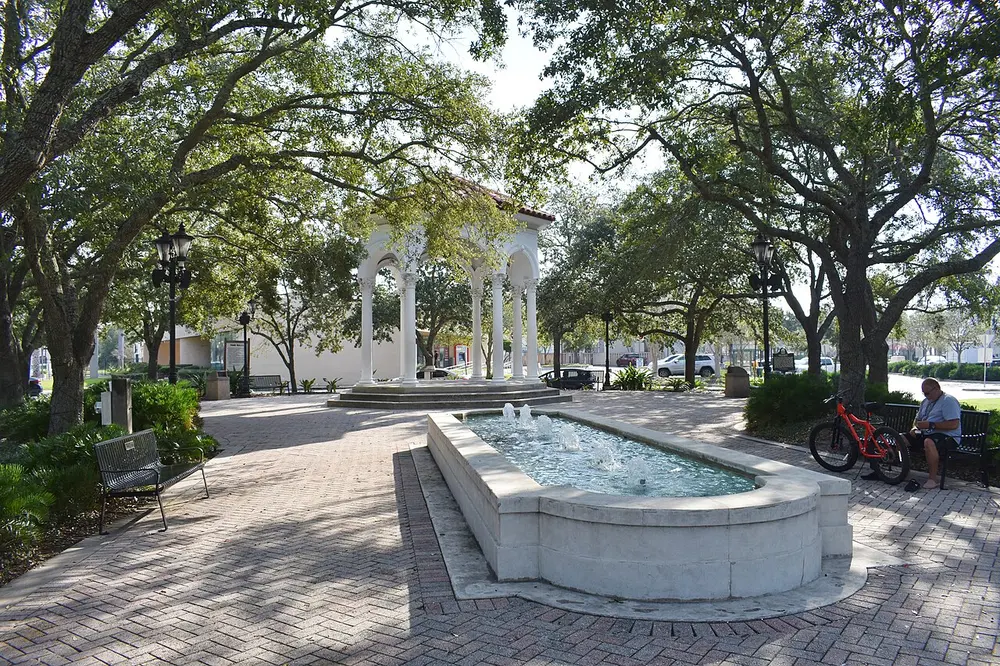
Balis Park (Jacksonville, Florida). Photo: PicoOrdinalo / Wikimedia Commons, CC BY-SA 4.0.
The course
The course is built around Jacksonville's suburban grid and the water. Long stretches run beside the Intracoastal Waterway, where the route is level and the horizon is water and low vegetation, before turning back into residential streets. The changes of direction are frequent enough to keep the race interesting, but the ground beneath them is almost always flat.
The 43 metres of climbing are spread so thinly that they barely register. There is no climb worth preparing for, and the flatness is consistent rather than confined to one section. Runners who train on hills will notice the absence of them; runners who train on flat ground will feel at home.
The suburban setting means the course is exposed in places. The Intracoastal sections are open, with little shade and a wide sky, and the residential streets offer only intermittent cover. That exposure matters more than the elevation profile.
Along the Intracoastal
The Intracoastal Waterway is the race's defining feature. It is a protected channel between the mainland and the barrier islands, and the course uses its edge to give the marathon a watery horizon. The view is calm rather than dramatic: boats, docks, low vegetation and the flat line of the coast.
The waterway sections are also the most repetitive. The scenery changes slowly and the kilometres can blur. Runners should break the stretch into blocks and use landmarks or bridges as checkpoints rather than waiting for the next big view.
The bridges themselves are part of Jacksonville's identity. The city is connected by spans across the river and the Intracoastal, and the course's flat profile keeps the focus on the roads beside the water rather than on a crossing.
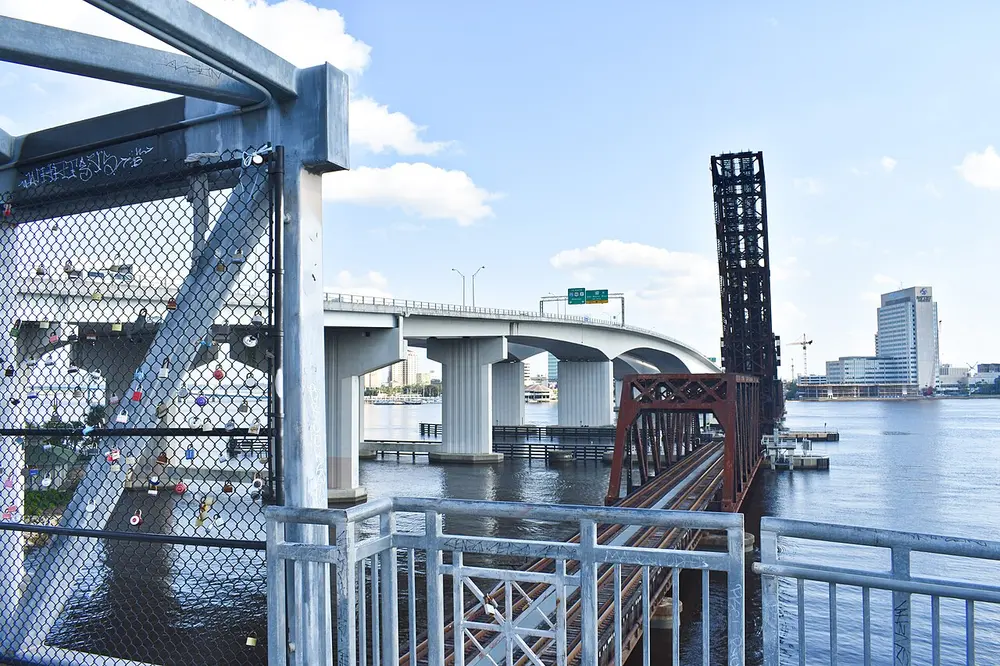
Bridges (Jacksonville, Florida). Photo: PicoOrdinalo / Wikimedia Commons, CC BY-SA 4.0.
A low-key December race
December is an unusual month for a marathon, and Jacksonville's race leans into that. It is the end of the year, the holiday season is underway and the event feels local rather than grand. The atmosphere is community-scale, with less of the production that surrounds a big-city race.
That quiet has practical benefits. The roads are less crowded, the start is calmer and the runners around you are more likely to be running their own race. It also means the later miles are quieter, and runners who rely on crowd support need to find motivation from their own plan.
The December date puts the hardest training weeks in autumn, when the days are shorter and the holidays compete for time. Runners should build the long runs around those constraints and treat the race as the reward for a disciplined autumn rather than trying to cram fitness into December.
Flat miles and quiet roads
With only 43 metres of climbing, Jacksonville is a course where pace discipline decides the result. The opening miles will feel easy, the middle miles will feel easy and the temptation is to run faster than planned. The course will not punish that mistake with a hill; it will wait until the final 10 kilometres.
The flatness also makes the race a good personal-best opportunity. There is no altitude, no meaningful ascent and no technical terrain, so the course gives runners a fair chance to hold a steady rhythm. The limiting factors are the weather, the exposure and the runner's own patience.
For first-timers, the low-key setting is a gift. There is less noise, less weaving and less pressure, and the flat course is forgiving. The race does not offer the lift of a major marathon, but it offers something more useful: room to run your own race.
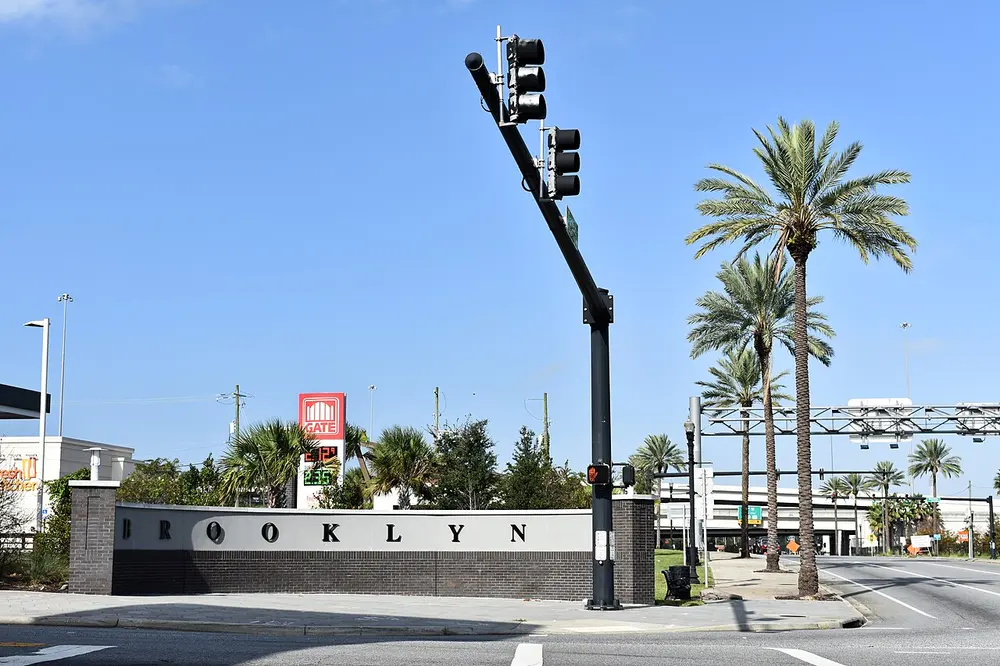
Brooklyn 1 (Jacksonville, Florida). Photo: PicoOrdinalo / Wikimedia Commons, CC BY-SA 4.0.
Frequently asked questions
Answers to the questions runners ask before entering, drawn from this race's course guide and the directory's own data — the sources behind them are listed below.
When is the Jacksonville Marathon in 2026?
The race is on Saturday 12 December 2026. It is a winter race on Florida's northeast coast, at the end of the year rather than in the spring season.
Is the Jacksonville Marathon flat?
Yes. The course climbs about 43 metres in total, with no sustained ascent. The waterway stretches are level, and the suburban roads add only gentle changes of grade.
Is Jacksonville good for a personal best?
The course is suited to fast times. The flat profile, low elevation and straight suburban roads support an even rhythm. Conditions and pacing still decide the result.
Is the Jacksonville Marathon suitable for a first marathon?
Yes. The flat course is forgiving and the low-key event is less intimidating than a major. First-timers should prepare for the quiet later miles and the exposed waterway sections.
Where does the Jacksonville Marathon run?
The race runs through Jacksonville's suburbs and along the Intracoastal Waterway. It stays within the city rather than following the coast.
What is the atmosphere like at the Jacksonville Marathon?
It is a community-scale race with quieter roads and a lower-key atmosphere than a major. That suits runners who prefer space, but the later kilometres will not be carried by spectators.
More marathons in United States
More marathons in Americas
Sources for this page
What each source below is used for on this page, and where to check this race yourself.
- World Athletics — the label calendar and the road-race regulations. Used to check whether the race holds a World Athletics label, and its elite competition details.
- AIMS — the international course-measurement standard behind the 42.195 km distance, and the AIMS race calendar.
- The organizer's own publications — course maps, race handbooks and published results. The date, course character and climbing on this page are compiled from them and re-checked each season.
Where do these facts come from?
Dates, course type, climbing and time limits are compiled from the organizer's publications and re-checked each season; elevation is an estimate of total climbing rather than a survey figure. Always confirm race-day details with the organizer before making plans.
Last reviewed 27 October 2026