
Indianapolis Monumental Marathon
Indianapolis is a city laid out around a circle, and the Monumental Marathon uses that geometry well. The course loops through downtown, passes the Soldiers and Sailors Monument and works out toward…
By Global Marathon Routes editorial team · Last reviewed 27 October 2026
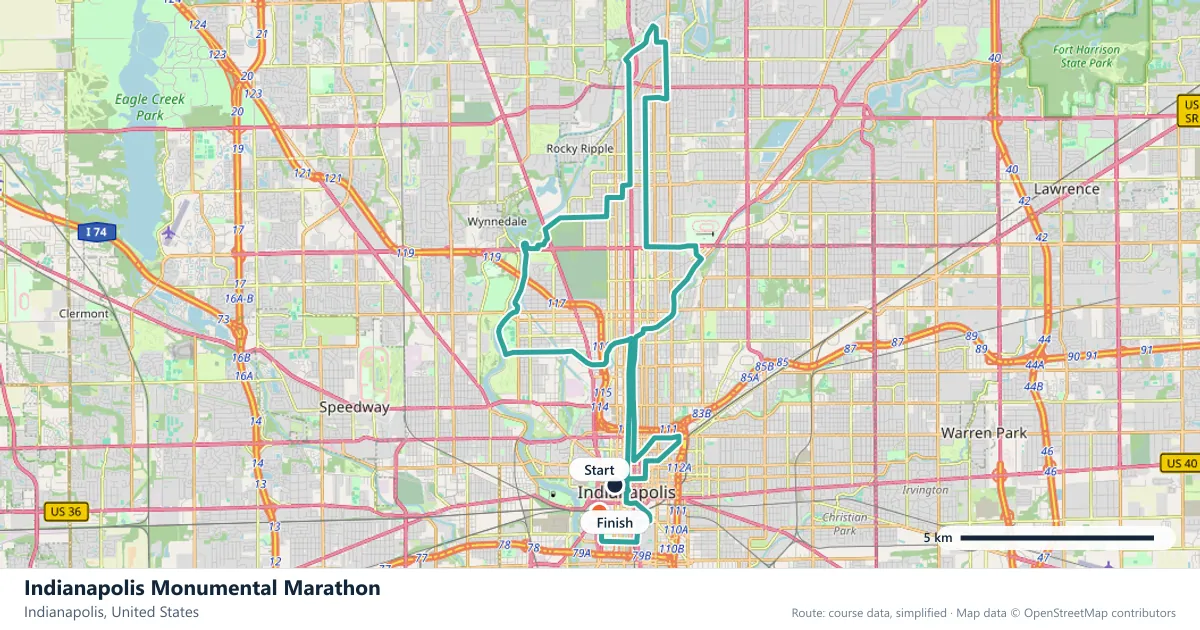
Where does the Indianapolis Monumental Marathon run?
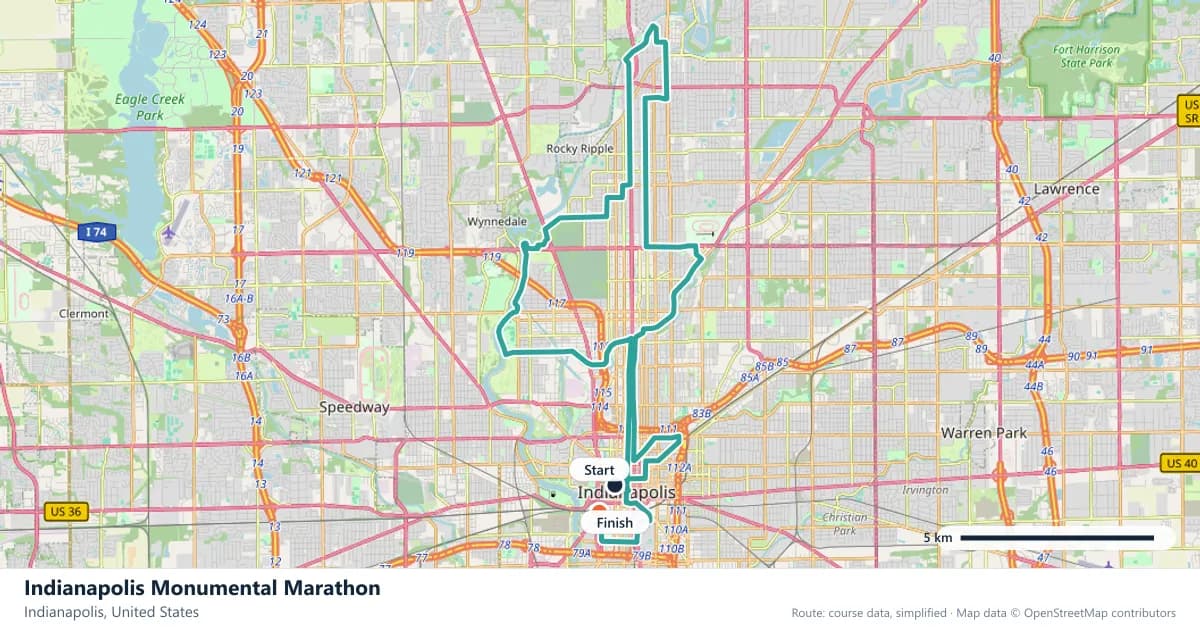
Interactive map
The trace follows the organizer's published course, simplified for the screen: the orange dot is the start, the dark dot the finish. Scroll to zoom, drag to pan.
What is the Indianapolis Monumental Marathon course like?
A flat, late-season city marathon loop through downtown Indianapolis, past the monument and the speedway district. Fast enough to be a serious qualifier course.
- Next edition
- 07 November 2026
- Elevation gain
- 83 m
- Profile
- Flat
- First run
- —
Course guide
Indianapolis is a city laid out around a circle, and the Monumental Marathon uses that geometry well. The course loops through downtown, passes the Soldiers and Sailors Monument and works out toward the speedway district before returning to the centre. It is a city marathon with a clear shape and a flat, fast surface, and the November date gives it a late-season edge.
Race day is Saturday 07 November 2026. The course climbs about 83 metres in total, which is very little for a race of this size, and the flat streets are the reason it has become a serious qualifier course. Runners chasing a personal best or a qualifying time will find the terrain cooperative; runners preparing for a first marathon will find the loop manageable and the city easy to navigate.
The city is not as famous as Chicago or New York, but its downtown is compact, its monument is one of the most recognisable in the Midwest and the speedway district gives the course a landmark no other marathon can claim.

Catedral de tradición escocesa, Indianápolis, Estados Unidos, 2012-10-22, DD 05. Photo: Diego Delso / Wikimedia Commons, CC BY-SA 3.0.
The course
The race is a loop, which keeps the logistics simple and gives the day a clear beginning and end in the city centre. The opening miles work through downtown, with the monument as the anchor and the field still dense, before the route extends outward toward the speedway district.
The 83 metres of climbing are spread thinly across the route. There is no sustained ascent and no single hill that changes the character of the race; the course is flat in the way that matters, with wide streets and long straights that let runners settle into a rhythm. The few rises are short enough to pass almost unnoticed.
The return to downtown is where the loop closes. The course comes back through the city streets, the field compresses again and the finish arrives without another significant climb. The flat profile means the race is decided by pacing and conditioning rather than by how well you handle hills.
Monument and speedway
The Soldiers and Sailors Monument sits at the centre of Indianapolis, and the race uses it as the symbolic heart of the course. The monument is one of the city's defining landmarks, and passing it gives the marathon a sense of place that a generic downtown loop would lack.
The speedway district is the other distinctive section. Indianapolis is synonymous with motor racing, and the course's route through the district gives runners a glimpse of that identity. The area is wide and open, with a scale that can feel different from the dense downtown streets, and it is a useful mental checkpoint in the middle of the race.
Neither landmark turns the course into a sightseeing tour. The marathon is a road race, not a lap of the city's attractions, and the flat streets between the landmarks are where the work is done. But the two anchors give the race a shape that runners remember.
A qualifier's course
The Monumental Marathon has built its reputation on fast times. The flat course, the November date and the city-centre loop make it a natural place to chase a qualifying standard, and the race attracts runners with targets.
For a personal best, the course offers almost everything a runner could ask for. The climbing is minimal, the streets are wide and the finish is in the city rather than at the top of a hill. The only thing the course cannot provide is discipline; with so little to slow you down, an over-fast start is easy to miss until the final kilometres.
The qualifier reputation shapes the atmosphere: this is a working marathon rather than a festival, with a focus on times. Runners who enjoy that seriousness will find it motivating; runners who want a big-city spectacle should adjust their expectations.

Runner finishing the 2023 Indianapolis Monumental Marathon. Photo: Photoguy1212 / Wikimedia Commons, CC BY-SA 4.0.
November in the Circle City
November is a sensible time for a fast marathon in the Midwest. The summer heat is gone, the city is settled into its autumn routine and the race falls before the worst of the winter. Conditions can still be cold or windy, but the date gives runners a better chance of stable weather than a spring race.
The late-season timing also shapes the training block. The longest runs fall in September and October, when the days are shortening but the weather is still workable, and the final weeks are about sharpening rather than building. Arriving at the start line fresh matters more than squeezing in one last big week.
Indianapolis itself is easy to like. The downtown is walkable, the monument gives the city a focal point and the speedway district adds a piece of American culture that is hard to find elsewhere. The marathon is a good excuse to spend a weekend there, even if the main business is the clock.

Indianapolis skyline at night - Sarah Stierch. Photo: Sarah Stierch / Wikimedia Commons, CC BY 4.0.
Frequently asked questions
Answers to the questions runners ask before entering, drawn from this race's course guide and the directory's own data — the sources behind them are listed below.
When is the Indianapolis Monumental Marathon?
The race is on Saturday 07 November 2026, in downtown Indianapolis.
Is the Indianapolis Monumental Marathon flat?
Yes. It climbs about 83 metres across the full distance, with no sustained ascent. The downtown loop and the speedway district are quick, and the profile is why the race is known as a qualifier course.
Is Indianapolis good for a personal best?
The course is suited to fast times. The flat profile and November date are favourable, and the race attracts runners chasing qualifying times. A personal best is not guaranteed, but the course offers a good opportunity.
Is the Indianapolis Monumental Marathon suitable for a first marathon?
Yes. The flat loop is forgiving and the city-centre setting keeps the logistics simple. The main risk is going out too fast on a quick course; start conservatively and race the second half.
Where does the Indianapolis Monumental Marathon run?
The race runs on a loop through downtown Indianapolis, past the monument and out through the speedway district. It stays within the city.
How hilly is the speedway district section?
It is not hilly. The whole course is flat, with only about 83 metres of climbing in total. The speedway district feels open and exposed, but it does not add a meaningful climb.
More marathons in United States
More marathons in Americas
Sources for this page
What each source below is used for on this page, and where to check this race yourself.
- World Athletics — the label calendar and the road-race regulations. Used to check whether the race holds a World Athletics label, and its elite competition details.
- AIMS — the international course-measurement standard behind the 42.195 km distance, and the AIMS race calendar.
- The organizer's own publications — course maps, race handbooks and published results. The date, course character and climbing on this page are compiled from them and re-checked each season.
Where do these facts come from?
Dates, course type, climbing and time limits are compiled from the organizer's publications and re-checked each season; elevation is an estimate of total climbing rather than a survey figure. Always confirm race-day details with the organizer before making plans.
Last reviewed 27 October 2026