
Hartford Marathon
The Hartford Marathon begins at the Connecticut state capitol, which is a dignified way to start a race that spends most of its morning in the suburbs.
By Global Marathon Routes editorial team · Last reviewed 27 October 2026
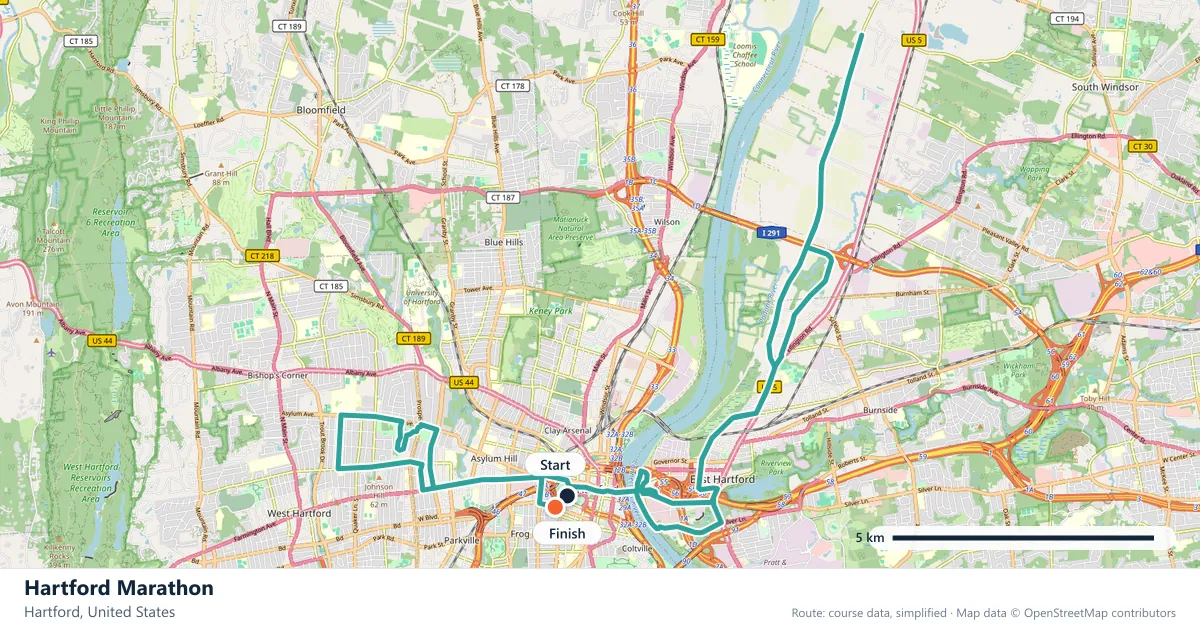
Where does the Hartford Marathon run?
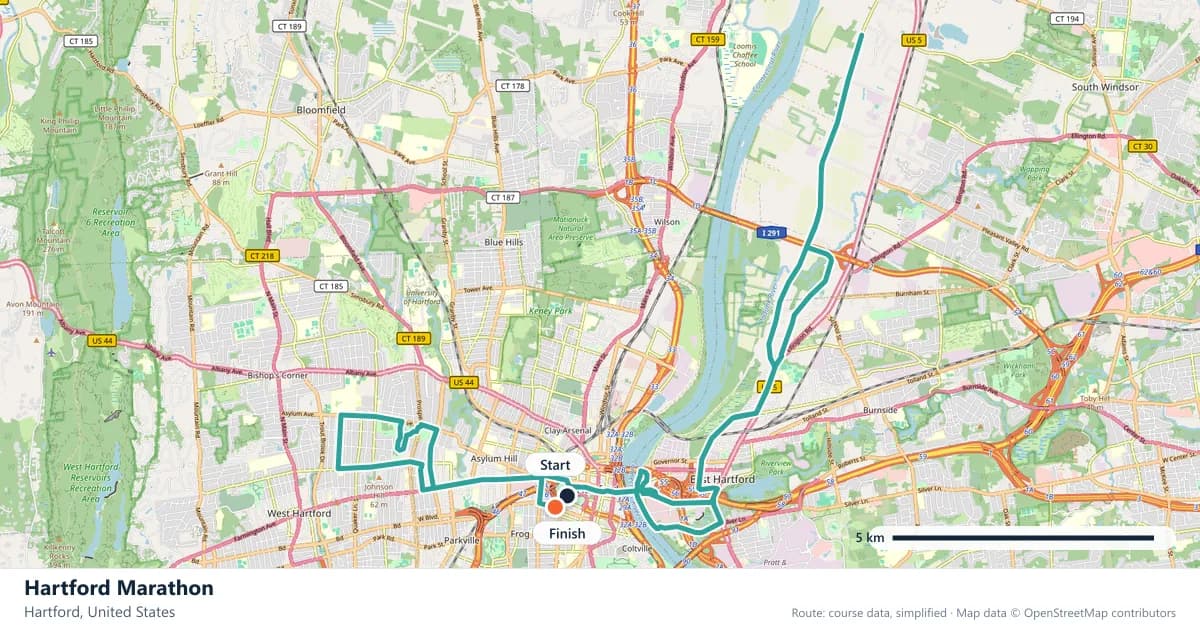
Interactive map
The trace follows the organizer's published course, simplified for the screen: the orange dot is the start, the dark dot the finish. Scroll to zoom, drag to pan.
What is the Hartford Marathon course like?
An October race in New England, starting at the state capitol and running out through Hartford's suburbs. Fast, tree-lined and usually cool.
- Next edition
- October 2027 (expected)
- Elevation gain
- 193 m
- Profile
- Undulating
- First run
- —
Course guide
The Hartford Marathon begins at the Connecticut state capitol, which is a dignified way to start a race that spends most of its morning in the suburbs. The gold dome is the backdrop for the opening metres, then the course turns away from the centre and works through the tree-lined streets that make Hartford feel more like a large town than a capital city.
The 2026 edition was held on Saturday 10 October. There are about 193 metres of climbing, spread across short rises, but the course has a reputation for being quick. Hartford is a New England race in the autumn, which usually means cool conditions, fallen leaves and a race that rewards fast running without the scale of a major.
Runners chasing a personal best get a fast, rolling course and a date that avoids the heat; runners preparing for a first marathon get a manageable city race with a straightforward start and a route that never turns into a mountain. The trade-off is that the course is not flat, and the constant changes of grade ask for discipline.
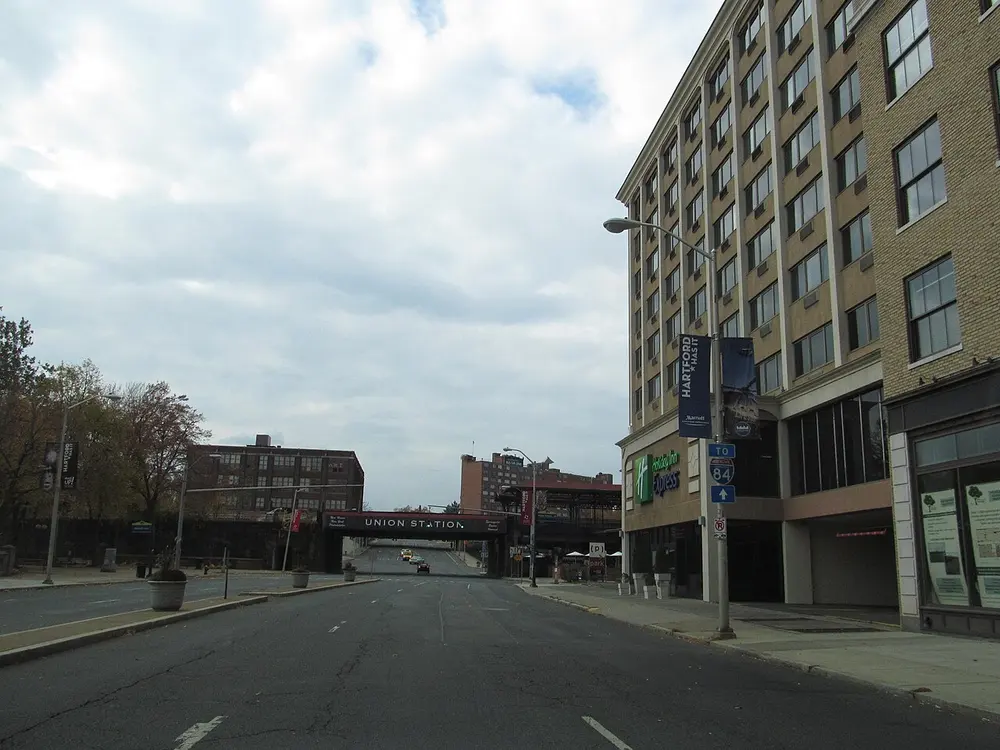
Hartford, Connecticut. Photo: Dougtone / Wikimedia Commons, CC BY-SA 2.0.
The course
The start at the capitol gives the race a formal, urban opening. The first kilometres are among the most built-up of the day, with the field still dense and the pace still settling, before the route moves outward into the residential suburbs. The change is gradual: the blocks become more spread out, the trees take over from the buildings and the race finds its rhythm.
The 193 metres of climbing are spread across the route rather than concentrated in one climb. None of the rises is long, but the ground is rarely completely level, and the accumulated effort is easy to underestimate. The course is fast because the climbs are short, not because the terrain is flat.
The suburban section is the heart of the race. The streets are quieter, the turns come more often and the tree cover changes the light. It is a pleasant place to run, but it is also where the field can lose its rhythm if the pace is allowed to drift on every small rise.
From the capitol to the suburbs
Hartford is one of New England's older cities, and the capitol building is its most recognisable landmark. The race uses that building as the anchor for the start, then heads into the neighbourhoods that surround the centre. The route is not a tour of the city's sights; it is a city marathon that uses the streets people live on.
The suburbs give the race its character. Leafy, residential and quieter than the downtown opening, they provide the kind of long, shaded stretches that make October racing feel different from a summer city marathon. The tree cover is also a reminder that the course is not a straight line: the route turns, bends and changes direction as it works through the neighbourhoods.
The finish is in Hartford, so the day stays within the city rather than becoming a point-to-point journey. That keeps the logistics simple and gives supporters a clear sense of where the race begins and ends.
A New England autumn
October in New England is the reason many runners choose Hartford. The trees are turning, the air is usually cool and the race falls at a time when the summer training block is still in the legs. It is a classic autumn marathon setting, with the added appeal of a city that does not feel overwhelmed by the event.
Cool weather is an advantage, but it can also disguise effort. The opening miles can feel easier than they should, and the first half can pass at a pace that is not sustainable. Runners who have trained through a warm summer often find that the first cool race of the autumn is deceptively quick.
The date also means the race sits late in the season. The final long runs belong in September, and the last few weeks should be about sharpening rather than building. Arriving fresh matters more than squeezing in one more big session.
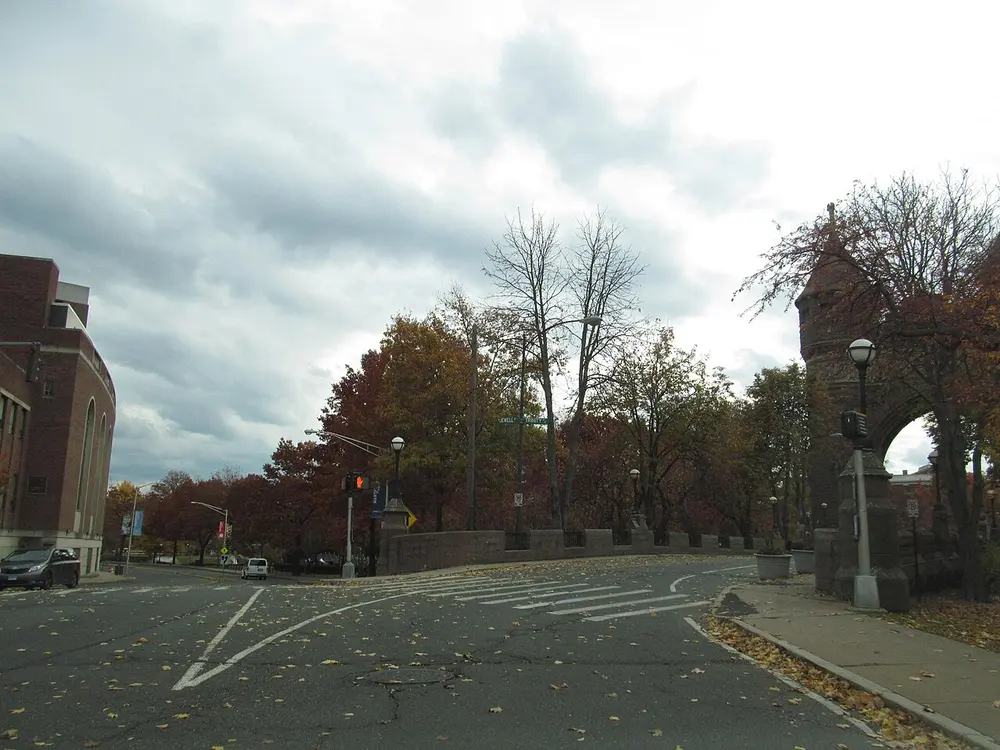
Hartford, Connecticut (photo 2). Photo: Dougtone / Wikimedia Commons, CC BY-SA 2.0.
Rolling, not flat
The most useful way to think about Hartford is that it is quick but not flat. The 193 metres of climbing are modest for a marathon, but they arrive in short, repeated rises, and the course never allows a long, metronomic stretch. Even effort is more reliable than even pace.
That matters most in the middle of the race. The suburban streets can feel comfortable, and the temptation is to chase the pace on the descents and then fight the next rise. A better approach is to hold a steady effort, let the pace vary with the terrain and save the faster running for the final miles.
The fast reputation is deserved, but it is a reputation built on the shortness of the climbs rather than their absence. Runners who prepare on rolling roads will recognise the rhythm; runners who only train on flat ground may find the constant changes more tiring than the total gain suggests.
Frequently asked questions
Answers to the questions runners ask before entering, drawn from this race's course guide and the directory's own data — the sources behind them are listed below.
When is the Hartford Marathon?
The 2026 edition was held on Saturday 10 October 2026, in Hartford, Connecticut.
Is the Hartford Marathon flat?
It is undulating rather than flat, with about 193 metres of climbing in short rises. It is still quick, and there is no sustained climb, but the rolling ground is constant enough to reward even pacing.
Is Hartford good for a personal best?
The course is suited to fast times. The modest climbing, cool October date and quick suburban streets support fast running. A patient first half will give you the best chance.
Is the Hartford Marathon suitable for a first marathon?
Yes. The course is not punishing, the race is manageable and the start at the state capitol is straightforward. First-timers should start conservatively and resist chasing the fast early miles.
Where is the Hartford Marathon run?
The race is run in Hartford, Connecticut, starting at the state capitol and continuing through the city's suburbs. It stays within the Hartford area.
What is the atmosphere like at the Hartford Marathon?
It is a New England autumn race rather than a major: tree-lined streets, cool conditions and a course that feels local. The quieter suburban miles suit runners who can pace themselves without a wall of crowd noise.
More marathons in United States
More marathons in Americas
Sources for this page
What each source below is used for on this page, and where to check this race yourself.
- World Athletics — the label calendar and the road-race regulations. Used to check whether the race holds a World Athletics label, and its elite competition details.
- AIMS — the international course-measurement standard behind the 42.195 km distance, and the AIMS race calendar.
- The organizer's own publications — course maps, race handbooks and published results. The date, course character and climbing on this page are compiled from them and re-checked each season.
Where do these facts come from?
Dates, course type, climbing and time limits are compiled from the organizer's publications and re-checked each season; elevation is an estimate of total climbing rather than a survey figure. Always confirm race-day details with the organizer before making plans.
Last reviewed 27 October 2026