
El Paso Marathon
El Paso is a city defined by two horizons. The Franklin Mountains rise along one edge, the Rio Grande and the Mexican border along another, and the desert opens beyond both.
By Global Marathon Routes editorial team · Last reviewed 27 October 2026
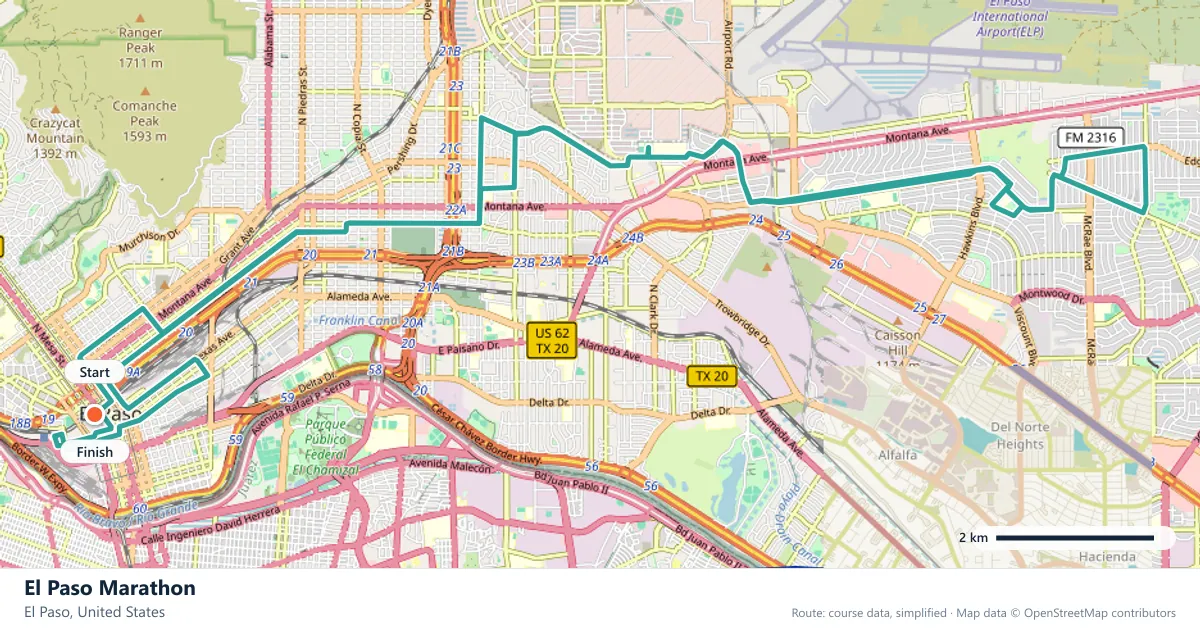
Where does the El Paso Marathon run?
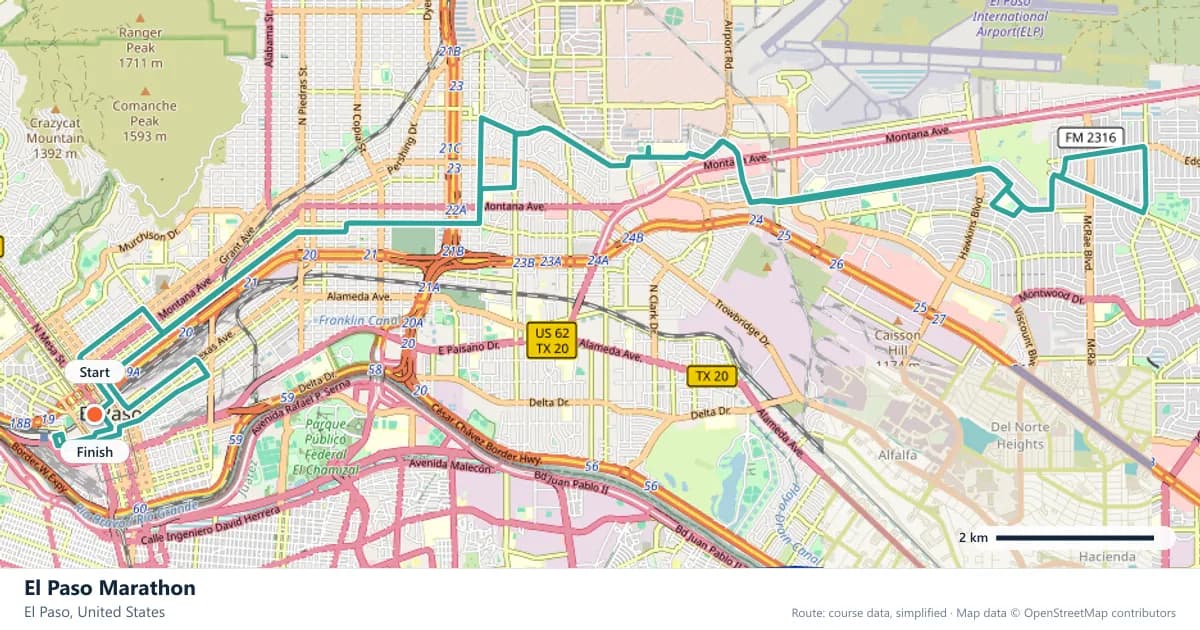
Interactive map
The trace follows the organizer's published course, simplified for the screen: the orange dot is the start, the dark dot the finish. Scroll to zoom, drag to pan.
What is the El Paso Marathon course like?
A February marathon in far west Texas, running through the city with the Franklin Mountains on one side and Mexico on the other. Gently rolling and reliably dry.
- Next edition
- 28 February 2027
- Elevation gain
- 147 m
- Profile
- Undulating
- First run
- —
Course guide
El Paso is a city defined by two horizons. The Franklin Mountains rise along one edge, the Rio Grande and the Mexican border along another, and the desert opens beyond both. The marathon uses the streets in between, so the landscape is visible all morning without ever becoming the course.
The 2027 race is set for Sunday 28 February. The route stays inside the city and rolls gently, with about 147 metres of climbing spread across the 42.195 kilometres. El Paso is a desert city, and the race is reliably dry; the combination of dry air, short rises and a late-winter date gives it a character quite different from the humid eastern races that dominate the American calendar.
The race is an approachable one. It is a first-marathon course rather than a specialist time trial, and it does not climb into the mountains that frame it. That makes it a good introduction to marathon distance in a part of the country that many runners never see.
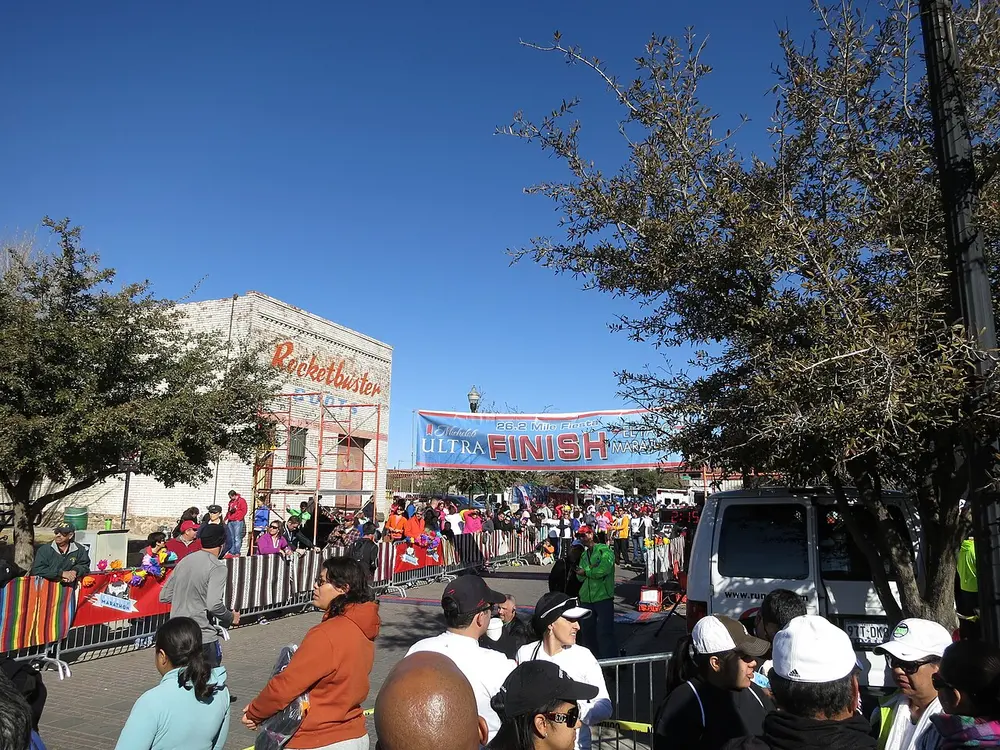
El Paso Marathon Finish. Photo: John Mccone / Wikimedia Commons, CC BY-SA 4.0.
The course
The race works through El Paso's city streets, with the Franklin Mountains as a constant backdrop and the border never far from the imagination. The course is urban rather than scenic in the tourist sense: it uses the roads that make up the city, crosses neighbourhoods and passes through the flat, built-up ground between the mountains and the river.
The 147 metres of climbing come in short rises rather than one sustained ascent. It is rolling ground, but gently so, and the course never asks for a real hill effort. The challenge is the accumulation: small rise after small rise, with the dry air making each one feel a little more work than the elevation profile suggests.
The route stays within the city, which keeps the logistics manageable and means the terrain never turns into a mountain trail. It also means the race is exposed. The surrounding terrain is open, and the sun and wind can reach the streets even when the mountains look close enough to touch.
Desert air and mountain views
The Franklin Mountains are the race's most distinctive feature even though the course does not climb them. They sit above the city and give runners a fixed reference when the streets blur. The border is the other constant: Mexico lies across the Rio Grande, and the city's identity is shaped by that proximity.
El Paso's desert climate means thirst can lag behind fluid loss. Drink to a schedule rather than waiting to feel thirsty, and practise taking fluids on the move before race day.
The openness cuts both ways. There is little shade on some stretches, and the wind can be a factor on a February morning. Runners who are used to tree-lined city marathons will notice the difference.
A border-city marathon
El Paso's running scene is shaped by its geography. The city sits at the western tip of Texas, where the state meets New Mexico and Mexico, and the Franklin Mountains divide the city's neighbourhoods from the desert beyond. The marathon is a local event with an international setting, and it feels rooted in the place rather than imported from a bigger circuit.
That local character is part of the appeal. The race does not have the scale of a coastal major, and the course is not designed around landmarks. What it offers is a straightforward city marathon in a distinctive corner of the country, with mountain views and a dry, late-winter date that fits an early-season build.
For runners travelling to El Paso, the city's position makes it a natural stop between the desert Southwest and the borderlands. The race stays within the city, so the day is simple: start, run the streets, finish.
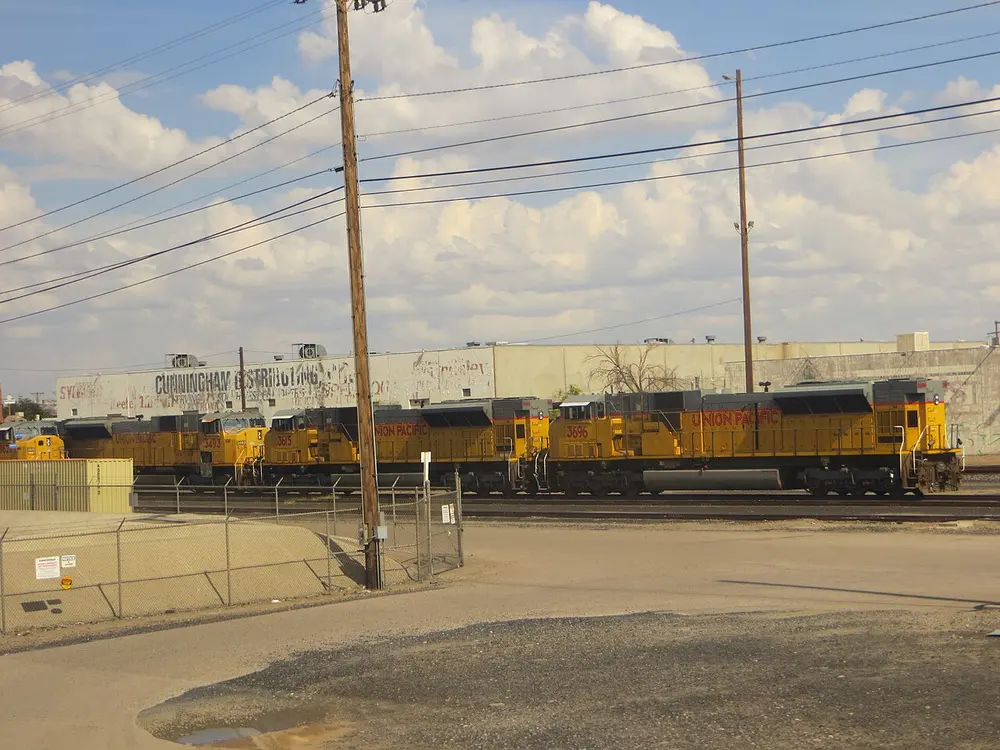
20140908 45 Union Pacific Railroad, El Paso, Texas. Photo: David Wilson / Wikimedia Commons, CC BY 2.0.
February in the desert
Late February is a sensible time to race in far west Texas: the summer heat is still months away, and the race avoids the heart of winter. That does not mean conditions are guaranteed; a February morning can be cold, windy or unseasonably warm, and the race's dry reputation is not a promise of perfect weather.
The training block for a February marathon runs through the winter, which is a mixed blessing. Runners in cold climates get a break from summer heat, but the long runs can be disrupted by snow and ice. Having a flexible plan matters more than following a rigid schedule.
The course's rolling profile is the other thing to respect. The 147 metres are modest, but they are constant, and the dry air makes even pacing harder than it looks. A conservative first half and an even effort through the rises will leave you in better shape for the final kilometres than a fast start.

Central El Paso pano from Murcheson Park. Photo: Dicklyon / Wikimedia Commons, CC BY-SA 4.0.
Frequently asked questions
Answers to the questions runners ask before entering, drawn from this race's course guide and the directory's own data — the sources behind them are listed below.
When is the El Paso Marathon in 2027?
The race is on Sunday 28 February 2027, in far west Texas.
Is the El Paso Marathon flat?
No. It is undulating, with about 147 metres of climbing in short rises. There is no sustained ascent, but the rolling ground is continuous enough to reward even effort rather than a fixed pace.
Is the El Paso Marathon suitable for a first marathon?
Yes. The course is modest, the climbing is gentle and the race stays within the city. The dry air is the main thing to prepare for, so practise drinking on the move during the build.
Is El Paso a good course for a personal best?
It is not a personal-best course in the way a flat city marathon is. The rolling ground and dry air add friction, and the race is better suited to a controlled first marathon than to chasing a fast time.
Where does the El Paso Marathon run?
The race runs through the streets of El Paso in far west Texas, with the Franklin Mountains on one side and Mexico on the other. The course stays within the city rather than climbing into the mountains.
What is the weather like at the El Paso Marathon?
The race is held in late February and has a reputation for dry conditions. Conditions can still vary, so check the forecast in race week and plan for a range of conditions on a dry, exposed course.
More marathons in United States
More marathons in Americas
Sources for this page
What each source below is used for on this page, and where to check this race yourself.
- World Athletics — the label calendar and the road-race regulations. Used to check whether the race holds a World Athletics label, and its elite competition details.
- AIMS — the international course-measurement standard behind the 42.195 km distance, and the AIMS race calendar.
- The organizer's own publications — course maps, race handbooks and published results. The date, course character and climbing on this page are compiled from them and re-checked each season.
Where do these facts come from?
Dates, course type, climbing and time limits are compiled from the organizer's publications and re-checked each season; elevation is an estimate of total climbing rather than a survey figure. Always confirm race-day details with the organizer before making plans.
Last reviewed 27 October 2026