
Des Moines Marathon
Des Moines does not feel like a state capital when the marathon is in town. The race works through the downtown streets, but within a few kilometres the office blocks give way to the Des Moines River…
By Global Marathon Routes editorial team · Last reviewed 27 October 2026
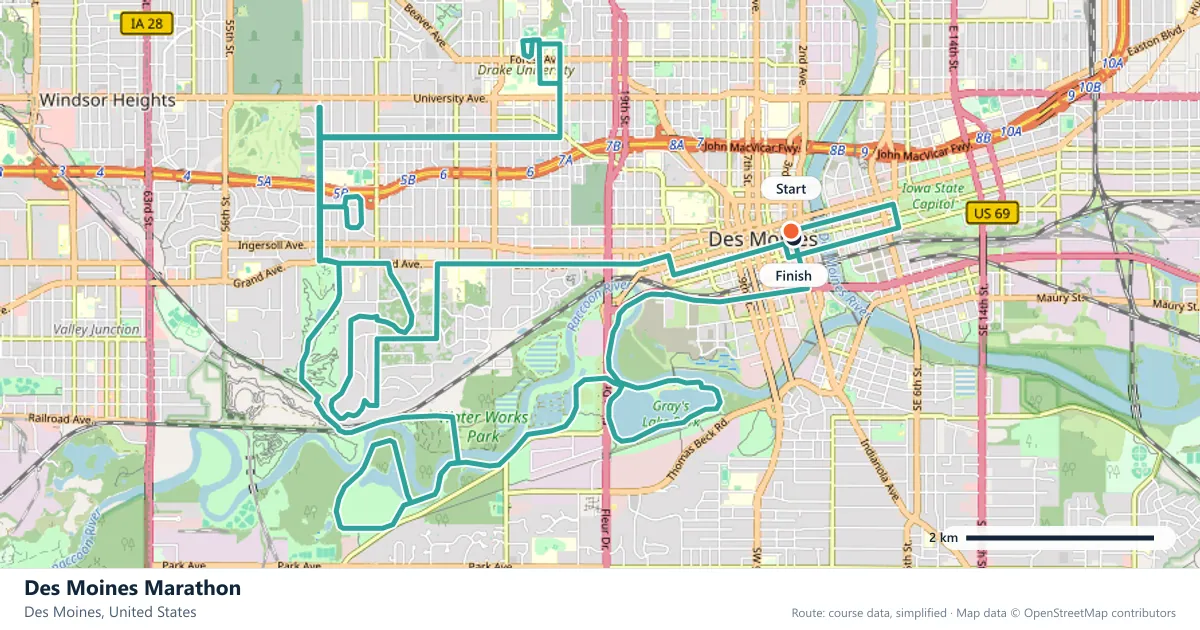
Where does the Des Moines Marathon run?
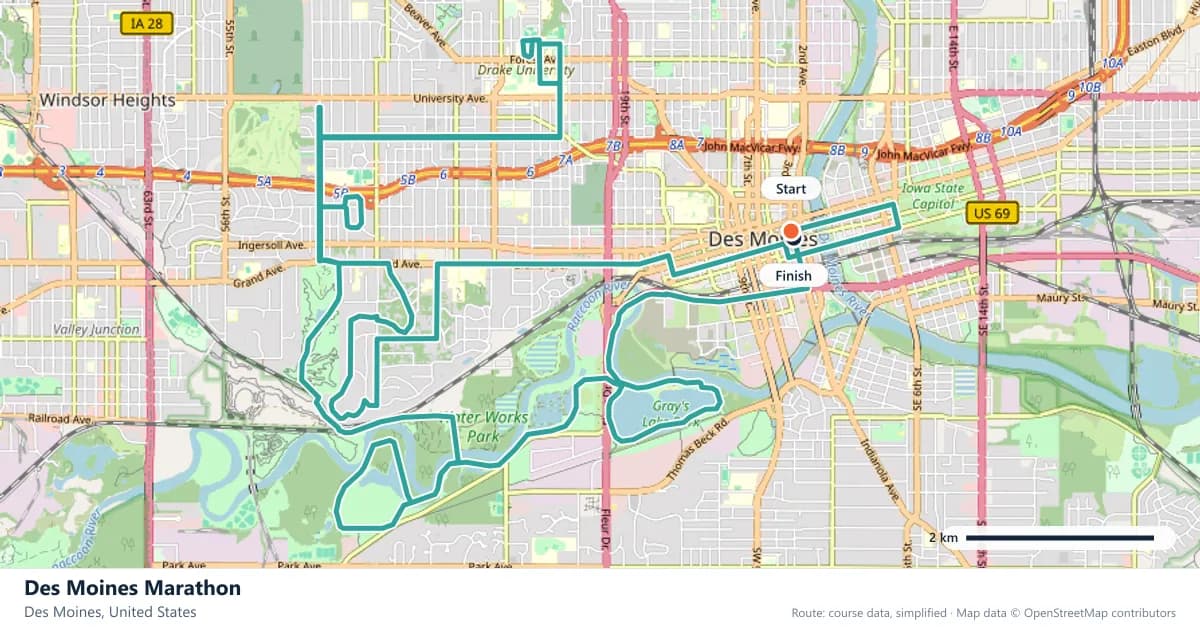
Interactive map
The trace follows the organizer's published course, simplified for the screen: the orange dot is the start, the dark dot the finish. Scroll to zoom, drag to pan.
What is the Des Moines Marathon course like?
An autumn race through downtown Des Moines and the trails along the Des Moines River. Rolling but quick, with a small-town feel for a state capital.
- Next edition
- October 2027 (expected)
- Elevation gain
- 204 m
- Profile
- Undulating
- First run
- —
Course guide
Des Moines does not feel like a state capital when the marathon is in town. The race works through the downtown streets, but within a few kilometres the office blocks give way to the Des Moines River corridor, where the route picks up the trail network and follows the water out of the traffic. Iowa's capital is compact enough to hold both halves of that contrast in a single morning.
The race returns in October 2027. The course rolls rather than lies flat, and the total climb is around 204 metres, but the rises are short and the riverside miles are gentle. That mix has given the race a reputation for quick times without making it a processional loop. It is also an approachable place for a first marathon: the day has a small-town feel for a state capital, and the trail sections keep the field away from the worst of the city traffic.
The river is the thread that ties the race together. The Des Moines and Raccoon rivers meet downtown, and the trail system that follows them offers long stretches of car-free running inside a capital city.
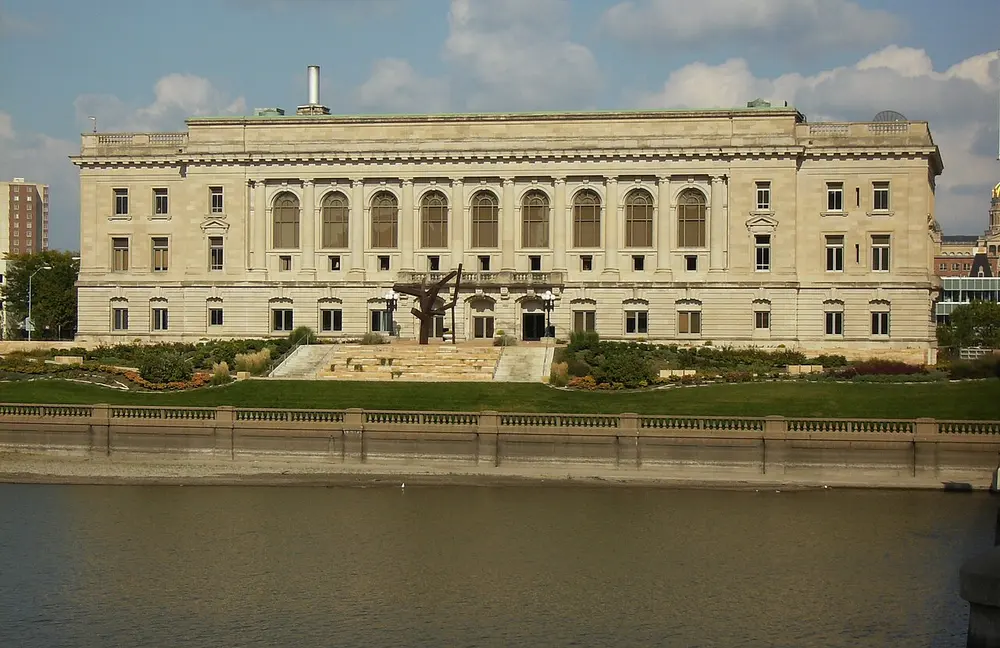
Des Moines City Hall. Photo: The original uploader was Iowahwyman at English Wikipedia . / Wikimedia Commons, CC BY-SA 3.0.
The course
The route works through downtown before joining the river trails. The opening kilometres are urban and busy, with turns and surface changes that ask for attention; then the course settles onto the trail and the rhythm changes. The trail is not a remote country path — the city is visible across the water and the route crosses back into the street grid — but it feels quieter than the opening miles.
The 204 metres of climbing are spread across the whole route rather than gathered into one hill. Short rises follow each other, and the trail undulations arrive when the legs are already working. There is no climb long enough to justify a specific hill block, but there is enough rolling ground to reward runners who pace by effort and let the pace move a little on the rises.
The downtown transitions are the part to know before race day. Moving between trail and street changes surface and noise, and the field can compress where the route rejoins the city grid.
Downtown and the river trail
The river trail is the most distinctive part of the race, and it is also the most forgiving. The path follows the water, away from stop-start traffic, and the broad views across the river make the middle miles feel more open than a city course normally does. On a windy morning the exposed stretches beside the water can feel harder than the elevation profile suggests, so protect your rhythm rather than fighting the gusts.
The later miles change the character again. The trail hands back to streets, the field tightens, and the last few kilometres ask for the kind of patience that the quiet river miles may have let you forget. Runners who have spent the middle of the race sightseeing often find that the city section arrives sooner than expected.
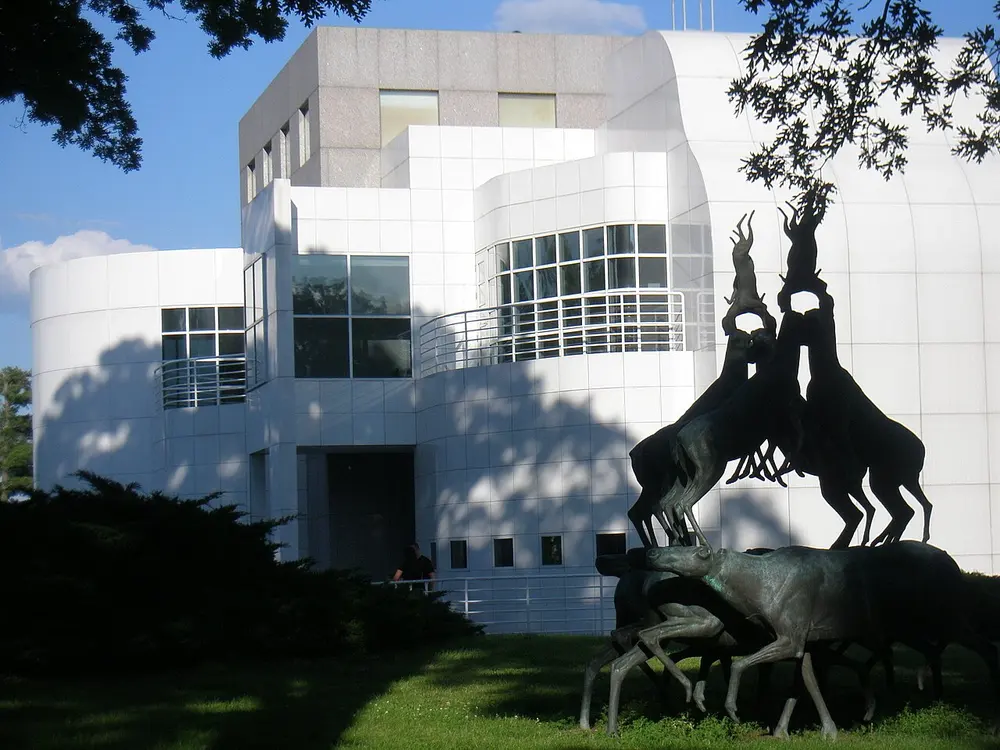
Des Moines 106. Photo: Des Moines Guy / Wikimedia Commons, CC BY-SA 3.0.
A state capital with a small-race feel
Des Moines is the seat of Iowa's government, and the capitol dome is part of the city's skyline. Yet the marathon does not carry the scale or the crowding of a coastal major. The city's downtown is walkable, the river corridor is close at hand, and the race feels as if it belongs to the people who live there rather than to a television audience.
That atmosphere is a practical advantage. A smaller event means less queueing, less weaving in the first mile and a calmer start. It also means quieter later miles, so runners who need crowds should plan to generate their own momentum. The reward is a race that feels personal, with the capital's landmarks as a backdrop rather than a stage set.
Iowa's autumn is part of the appeal: the race falls in mid-October, when the trees along the river are turning. Conditions still vary, so check the forecast rather than assuming a cool morning.
October pacing
A 204-metre rolling course is not a mountain, but it is enough to make even splits difficult if you run the first half by feel alone. The opening downtown miles can be quick, and the trail is gentle enough that the pace can creep up without any obvious signal. Set a ceiling for the first 10 kilometres and stay under it.
The river miles are where the race can be won or lost. They are quiet, flat and easy to overspeed; they are also where the accumulated climbing of the day starts to tell. Use the descents to recover rather than to make up time, and take the short rises at a controlled effort.
The race also sits at the end of the year's racing, so arrive with the training block complete rather than adding a late long run in race week. The course rewards freshness and patience.
Frequently asked questions
Answers to the questions runners ask before entering, drawn from this race's course guide and the directory's own data — the sources behind them are listed below.
When is the Des Moines Marathon in 2026?
The race is expected in October 2027, in the middle of Iowa's autumn.
Is the Des Moines Marathon flat?
No. It is undulating, with about 204 metres of climbing across the route. The riverside trail sections are close to level, but the course as a whole rolls enough that even effort is more useful than a fixed pace.
Is Des Moines good for a personal best?
The course is suited to fast times. The climbing is modest and the trail miles are quick. A personal best still depends on conditions and pacing, but the route gives you a fair chance.
Is the Des Moines Marathon suitable for a first marathon?
Yes. The race has a small-city feel, the trails are forgiving and the field is manageable. First-timers should respect the rolling ground and avoid chasing the quick opening miles through downtown.
Where does the Des Moines Marathon run?
The route goes through downtown Des Moines and then follows the trails along the Des Moines River. It stays within the city, using the river corridor as its main artery.
What is the atmosphere like at the Des Moines Marathon?
It feels like a community race in a state capital: compact, friendly and less frantic than a major. The trade-off is quieter late miles, which suit runners who are comfortable pacing themselves.
More marathons in United States
More marathons in Americas
Sources for this page
What each source below is used for on this page, and where to check this race yourself.
- World Athletics — the label calendar and the road-race regulations. Used to check whether the race holds a World Athletics label, and its elite competition details.
- AIMS — the international course-measurement standard behind the 42.195 km distance, and the AIMS race calendar.
- The organizer's own publications — course maps, race handbooks and published results. The date, course character and climbing on this page are compiled from them and re-checked each season.
Where do these facts come from?
Dates, course type, climbing and time limits are compiled from the organizer's publications and re-checked each season; elevation is an estimate of total climbing rather than a survey figure. Always confirm race-day details with the organizer before making plans.
Last reviewed 27 October 2026