
Dallas Marathon
The Dallas Marathon circles White Rock Lake before heading through the city's eastern neighbourhoods. The next edition is on 13 December 2026, with about 235 metres of climbing.
By Global Marathon Routes editorial team · Last reviewed 27 October 2026
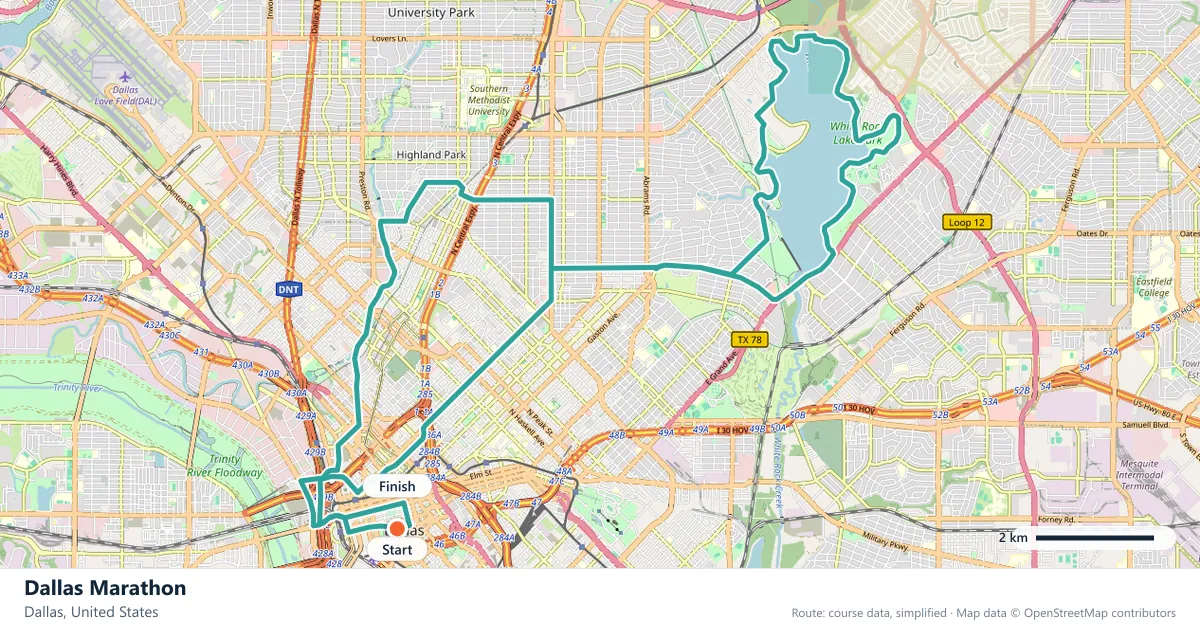
Where does the Dallas Marathon run?
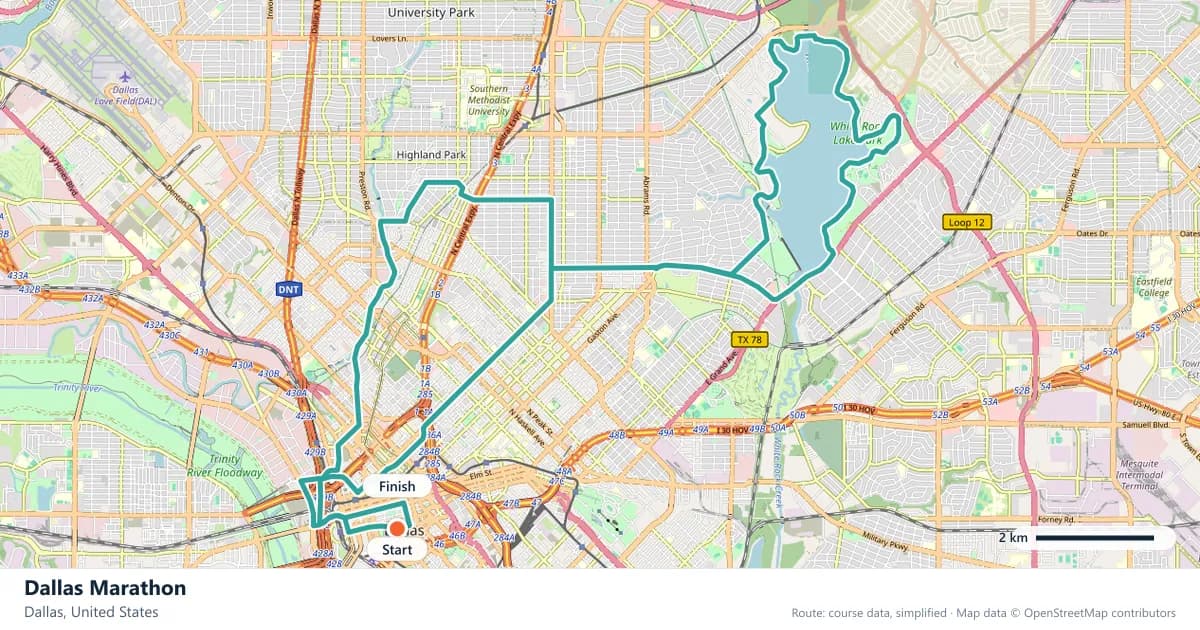
Interactive map
The trace follows the organizer's published course, simplified for the screen: the orange dot is the start, the dark dot the finish. Scroll to zoom, drag to pan.
What is the Dallas Marathon course like?
A December marathon around White Rock Lake and through the city's eastern neighbourhoods. Rolling, with the lake section the scenic part of the day.
- Next edition
- 13 December 2026
- Elevation gain
- 235 m
- Profile
- Undulating
- First run
- —
Course guide
The Dallas Marathon circles White Rock Lake before heading through the city's eastern neighbourhoods. The next edition is on 13 December 2026, with about 235 metres of climbing. The lake is the scenic centrepiece, but the rolling ground is the real character of the race.
It is a December marathon that closes the year rather than opening it. The course stays close to the lake and the eastern side of town, and the profile asks for patience without offering a single dramatic climb. That makes it a race for steady effort and a controlled finish.
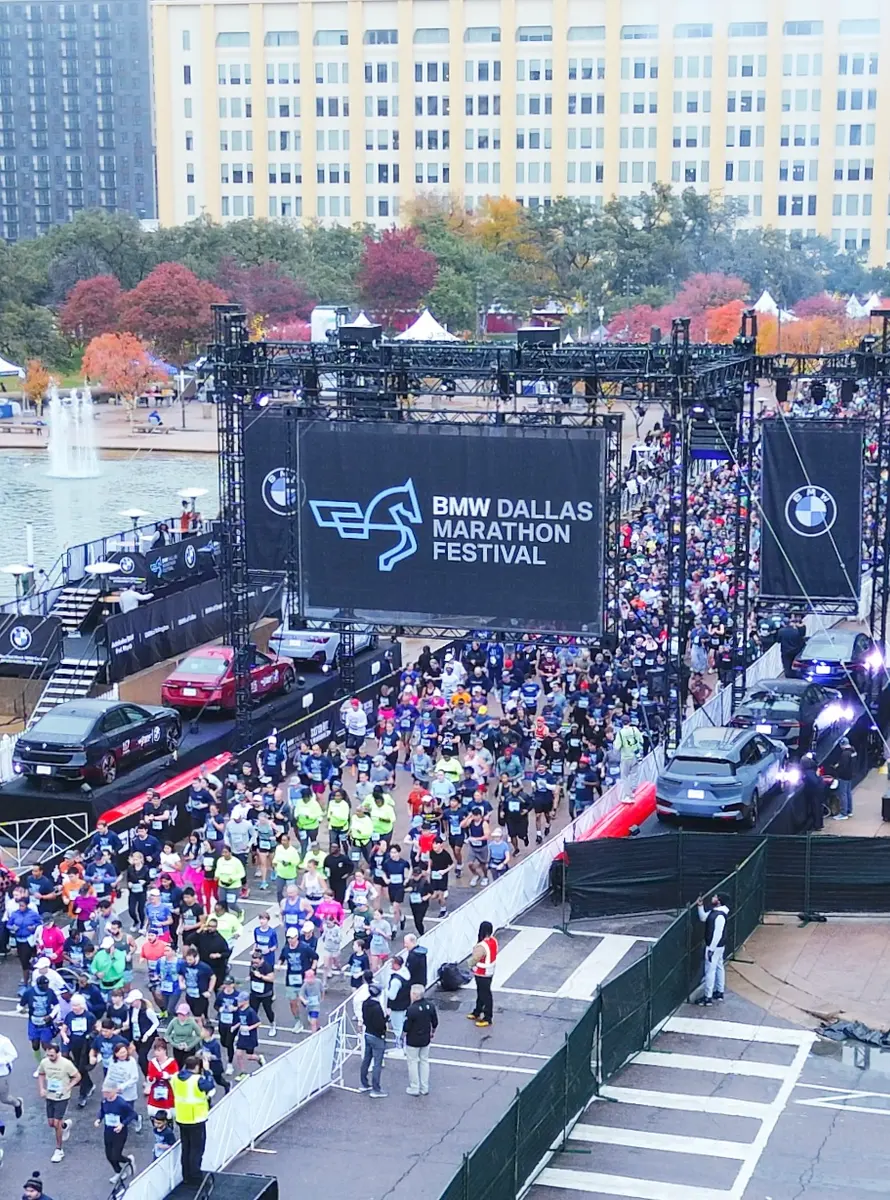
BMW Dallas Marathon. Photo: FeaturingDallas / Wikimedia Commons, CC BY 4.0.
The course
The route uses White Rock Lake as its anchor, with water beside the road and the eastern neighbourhoods filling out the loop. The lakeside miles are the most open and memorable part of the morning.
About 235 metres of climbing is spread through the course in short rises, with no sustained ascent. The undulation is constant enough that tired legs notice the accumulation. Runners who treat the course as flat because no hill is named tend to find the second half harder than expected.
The loop format keeps the logistics simple, with the start and finish in the same place and the route returning through familiar streets. It also means the course can feel repetitive in the later miles, when the scenery and the effort both settle into a rhythm.
White Rock Lake
White Rock Lake sits in east Dallas, a broad body of water surrounded by parkland and residential streets. The marathon uses the lake as its visual centrepiece: the water opens the view, the skyline appears in the distance and the shoreline gives the race a softer edge than the surrounding city.
The lake section is where the course feels most like an escape from the grid. The road follows the water, the horizon opens and the miles pass with a little less friction. It is also where pacing can drift, because the scenery and the flat-feeling shoreline invite a faster rhythm.
Runners should enjoy the lake without treating it as a free section. The rolling ground returns after the water, and the accumulated effort of the first half will still be there. The best approach is to hold a steady effort through the park and save the faster running for when it is earned.
East Dallas and the run home
The eastern neighbourhoods give the race its local texture. The streets are residential and the route moves through parts of Dallas that visitors rarely see. The contrast with the downtown skyline is part of the appeal.
The return through the eastern streets brings the course back into the grid, with short rises and changes of direction replacing the open lakeside miles. This is where the 235 metres of climbing is felt most clearly. The climbs are not long, but they are frequent, and they arrive when the legs have already spent a lot of energy.
The finish closes the loop. After the lake and the neighbourhoods, the return to the finish gives the race a sense of completion. It is not a dramatic finish, but it is a satisfying one after a morning of rolling streets.

Bus Station in Downtown Dallas. Photo: EricMiller214 / Wikimedia Commons, CC BY-SA 3.0.
Getting the lake day right
- The rolling miles. No single hill needs preparation, but about 235 metres of climbing spread over the route adds up. Hold even effort on each rise.
- The lake section. It is the scenic highlight and a place where pacing can drift. Enjoy it without slowing the rhythm.
- The neighbourhood transitions. Shoreline, residential streets and connecting roads all demand attention, even when the field is spread out.
- The late-season date. A December marathon closes the year. Arrive with the training done and treat the race as the culmination of the block rather than a fitness test.
Frequently asked questions
Answers to the questions runners ask before entering, drawn from this race's course guide and the directory's own data — the sources behind them are listed below.
When is the Dallas Marathon?
The 2026 edition is on 13 December. It is a December race, and the organiser publishes the start arrangements and race-weekend details closer to the event.
Is the Dallas Marathon a flat course?
No. It is undulating, with about 235 metres of climbing spread across the route. The rises are short and there is no sustained climb, but the rolling ground is continuous enough that it should not be treated as flat.
Is it suitable for a first marathon?
It can work as a first marathon. The loop format, lake scenery and single-city logistics all help, and there is no major climb. First-timers should still pace conservatively, because the rolling miles are felt late.
Is it a good course for a personal best?
It is not a course built for fast times. The undulating profile makes an even pace hard, and the short rises cost more than the elevation total suggests. Runners chasing a time should look for flatter ground.
Where is the marathon run?
The race is run in Dallas, Texas, around White Rock Lake and through the city's eastern neighbourhoods. The lake is the scenic centrepiece, with the rest of the course filling in the surrounding streets.
What is the most scenic part of the course?
The White Rock Lake section is the highlight. The water opens the view, the parkland frames the road and the downtown skyline sits in the distance. It is the part of the race most runners remember.
More marathons in United States
More marathons in Americas
Sources for this page
What each source below is used for on this page, and where to check this race yourself.
- World Athletics — the label calendar and the road-race regulations. Used to check whether the race holds a World Athletics label, and its elite competition details.
- AIMS — the international course-measurement standard behind the 42.195 km distance, and the AIMS race calendar.
- The organizer's own publications — course maps, race handbooks and published results. The date, course character and climbing on this page are compiled from them and re-checked each season.
Where do these facts come from?
Dates, course type, climbing and time limits are compiled from the organizer's publications and re-checked each season; elevation is an estimate of total climbing rather than a survey figure. Always confirm race-day details with the organizer before making plans.
Last reviewed 27 October 2026