
Cleveland Marathon
The Cleveland Marathon runs beside Lake Erie before turning inland through the city's west-side neighbourhoods. The next edition is on 16 May 2027, and the course climbs about 164 metres.
By Global Marathon Routes editorial team · Last reviewed 27 October 2026
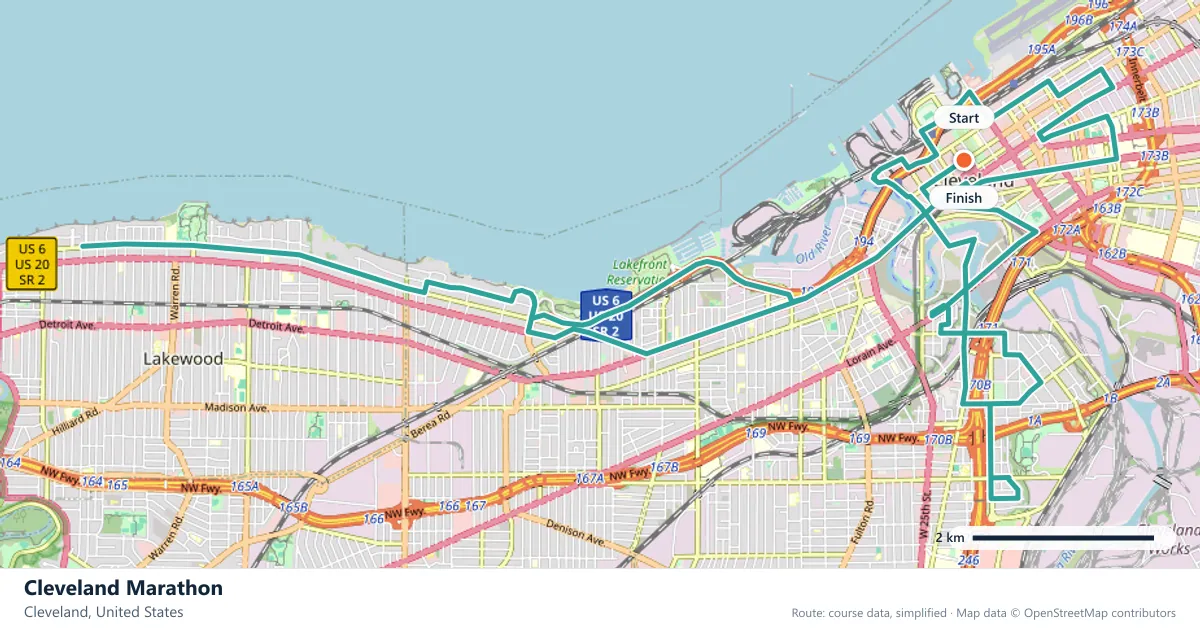
Where does the Cleveland Marathon run?
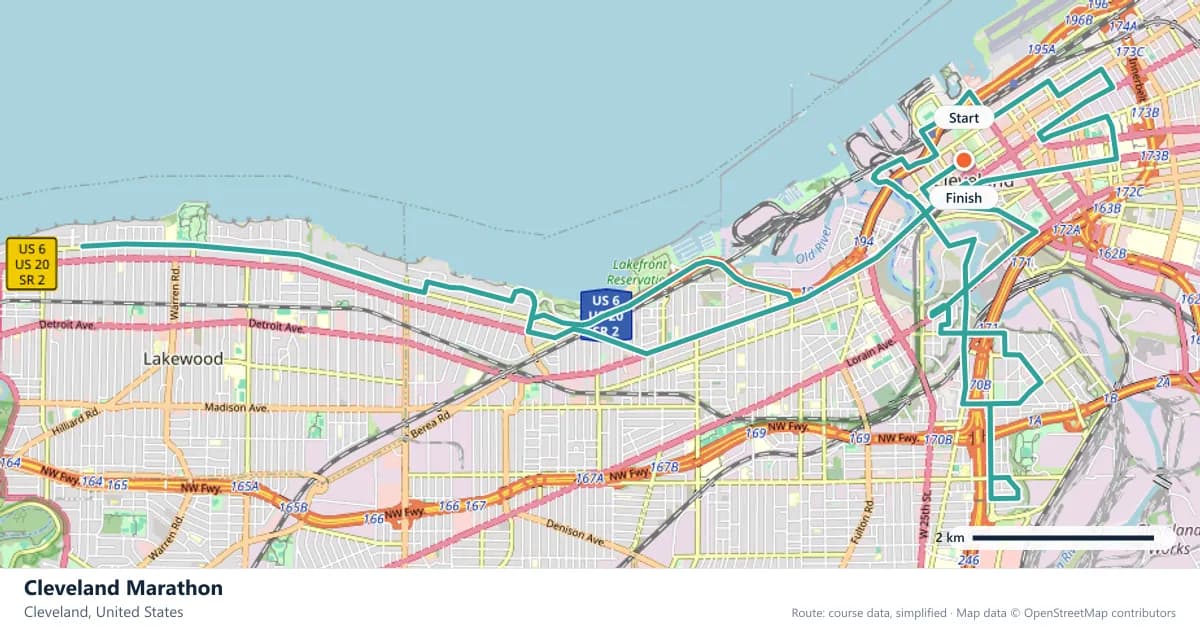
Interactive map
The trace follows the organizer's published course, simplified for the screen: the orange dot is the start, the dark dot the finish. Scroll to zoom, drag to pan.
What is the Cleveland Marathon course like?
A May marathon along the Lake Erie shoreline and through Cleveland's west-side neighbourhoods. Flat and quick on the lakefront, with a few rises as the course turns inland.
- Next edition
- 16 May 2027
- Elevation gain
- 164 m
- Profile
- Undulating
- First run
- —
Course guide
The Cleveland Marathon runs beside Lake Erie before turning inland through the city's west-side neighbourhoods. The next edition is on 16 May 2027, and the course climbs about 164 metres. It is a race with two personalities: open and quick along the water, then gently rolling as it moves away from the shore.
That mix gives Cleveland a useful balance. The lakefront is flat enough to settle into a rhythm and quick enough for a fast first half, while the inland streets add just enough climbing to keep the race honest. The course is undulating rather than flat, but it is not a hill marathon.
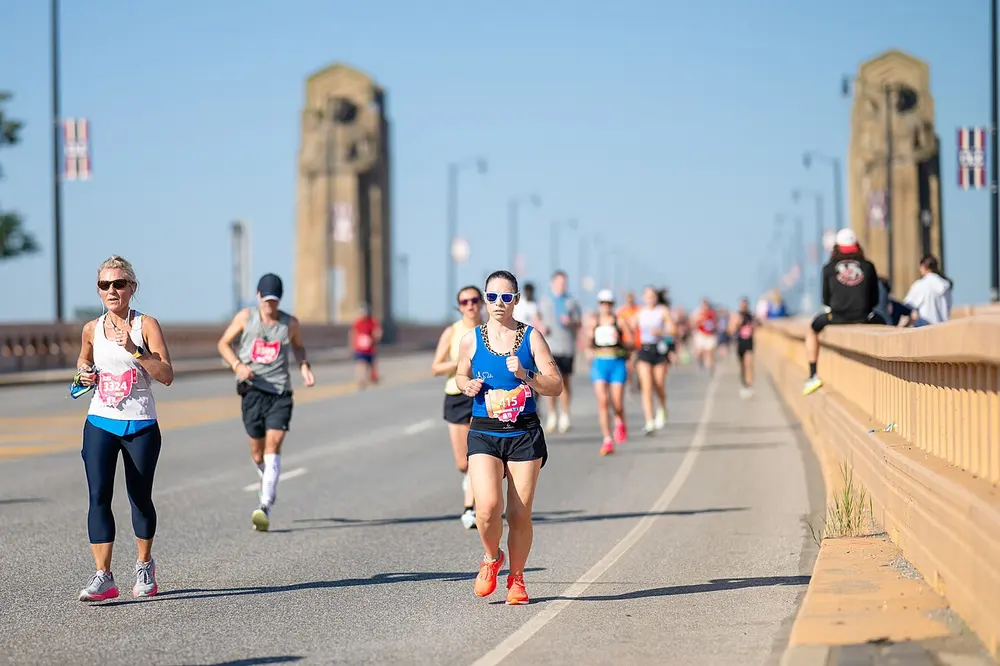
2024 Cleveland Marathon. Photo: Erik Drost / Wikimedia Commons, CC BY 2.0.
The course
The lakefront miles follow the shoreline, where the profile is nearly level and the pace comes easily. Open water and long sightlines make this the quickest stretch of the day. Runners who have done their pacing homework can use it to build a rhythm without over-reaching.
When the route turns inland, a handful of short rises appear through the west-side neighbourhoods. None is long, but together they account for the 164 metres of climbing and break the rhythm. Runners who take them at even effort can keep the climbs from dictating the rest of the race.
The course returns towards the city for the finish, and the change from residential streets gives the final miles a lift. The new scenery is useful late in a race, when the legs are tired and the mind needs a new cue.
The lakefront miles
Lake Erie is Cleveland's great open space, and the marathon uses it as the race's fast section. The water gives the course a horizon, the shoreline gives it a long flat run, and the city's skyline sits behind the route rather than blocking the view.
The lake can temper the morning. A May race beside the water often feels more comfortable than an inland course, and that is an advantage for anyone chasing a time. It is not a guarantee of perfect conditions, but it makes the fast miles more manageable.
The lakefront is also where the race feels most exposed. Wind off the water can be a help or a hindrance, and the open ground offers little shelter. Runners should be ready to adjust their effort rather than forcing a pace the conditions will not allow.
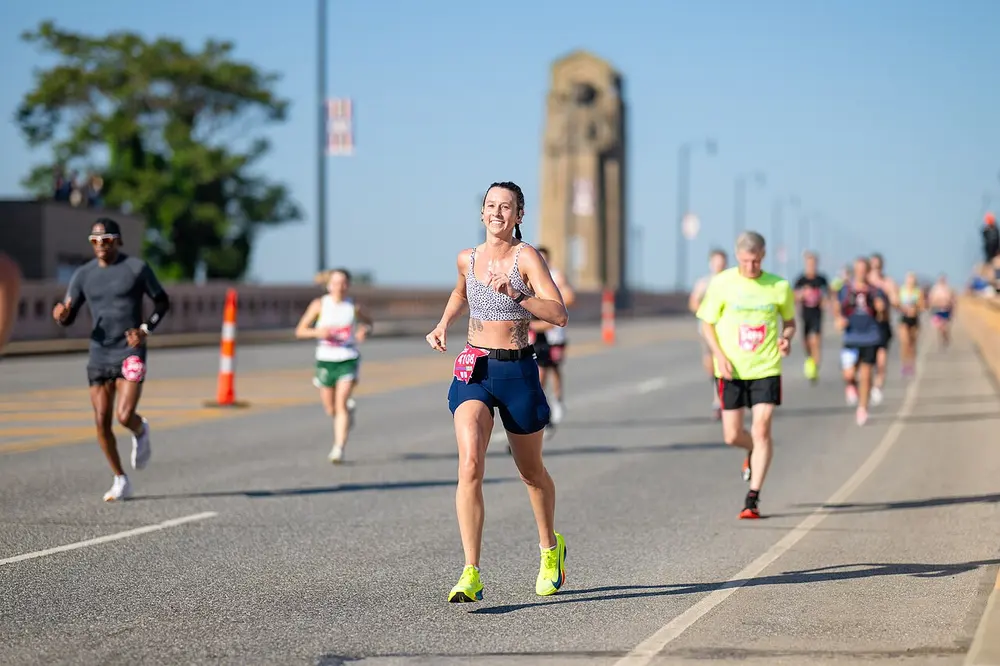
2024 Cleveland Marathon (photo 2). Photo: Erik Drost / Wikimedia Commons, CC BY 2.0.
Into the west side
Cleveland's west side is a patchwork of older neighbourhoods, each with its own centre and its own streets. The marathon's inland section moves through that patchwork, where the ground rises gently away from the lake.
The climbing here is modest but constant enough to be felt. It is the kind of terrain that rewards runners who have practised on rolling roads rather than only on flat ground. The rises are short, so the task is to stay relaxed and keep the cadence steady rather than charging each one.
The neighbourhoods also give the race a local texture. This is not a course that stays on a waterfront promenade for 42 km; it moves through the city where people live. Runners who enjoy seeing a place rather than just a route will find the inland miles rewarding.

2024 Cleveland Marathon (photo 3). Photo: Erik Drost / Wikimedia Commons, CC BY 2.0.
Using the lakefront
- The quick lakefront. Flat shoreline miles invite a fast start. Check the watch rather than trusting the legs.
- The inland rises. The course turns away from the lake into the west-side neighbourhoods, where short climbs break the rhythm. Run them at even effort.
- The modest total gain. At about 164 metres, the course does not need a hill block, but a completely flat training plan will leave you underprepared.
- The May date. Conditions beside Lake Erie can vary. Check the forecast in race week and plan for a range.
Frequently asked questions
Answers to the questions runners ask before entering, drawn from this race's course guide and the directory's own data — the sources behind them are listed below.
When is the Cleveland Marathon?
The 2027 edition is on 16 May. It is a May race on Lake Erie, and the organiser publishes the start arrangements and race-weekend details closer to the event.
Is the Cleveland Marathon a flat course?
It is undulating rather than flat. The lakefront is level and quick, but the course gains about 164 metres, with short rises as it turns inland. Nothing requires a specialised hill programme, but the rolling ground is real.
Is it a good race for a personal best?
The flat lakefront and the modest overall gain make it a sensible personal-best course. The inland rises are the main complication: run them at even effort and the faster ground beside the lake will do the rest.
Is it suitable for a first marathon?
Yes. The climbing is limited, the lakefront is forgiving and the mix of shoreline and neighbourhood running keeps the race interesting. The main discipline is not treating the flat first half as a substitute for pacing.
Where is the marathon run?
The race is run in Cleveland, Ohio, along the Lake Erie shoreline and through the city's west-side neighbourhoods. The move between open waterfront and residential streets gives the course its flat-then-rolling character.
What is the fastest part of the course?
The lakefront is the quickest stretch. It is nearly level, open and easy to pace, with long views across the water. The inland streets are slower and more rolling, so the fast running comes early.
More marathons in United States
More marathons in Americas
Sources for this page
What each source below is used for on this page, and where to check this race yourself.
- World Athletics — the label calendar and the road-race regulations. Used to check whether the race holds a World Athletics label, and its elite competition details.
- AIMS — the international course-measurement standard behind the 42.195 km distance, and the AIMS race calendar.
- The organizer's own publications — course maps, race handbooks and published results. The date, course character and climbing on this page are compiled from them and re-checked each season.
Where do these facts come from?
Dates, course type, climbing and time limits are compiled from the organizer's publications and re-checked each season; elevation is an estimate of total climbing rather than a survey figure. Always confirm race-day details with the organizer before making plans.
Last reviewed 27 October 2026