
Cincinnati Flying Pig Marathon
Two river crossings, a flat spell in Kentucky and a hilly return through Cincinnati: the Flying Pig Marathon packs a lot into its 42.195 km.
By Global Marathon Routes editorial team · Last reviewed 27 October 2026
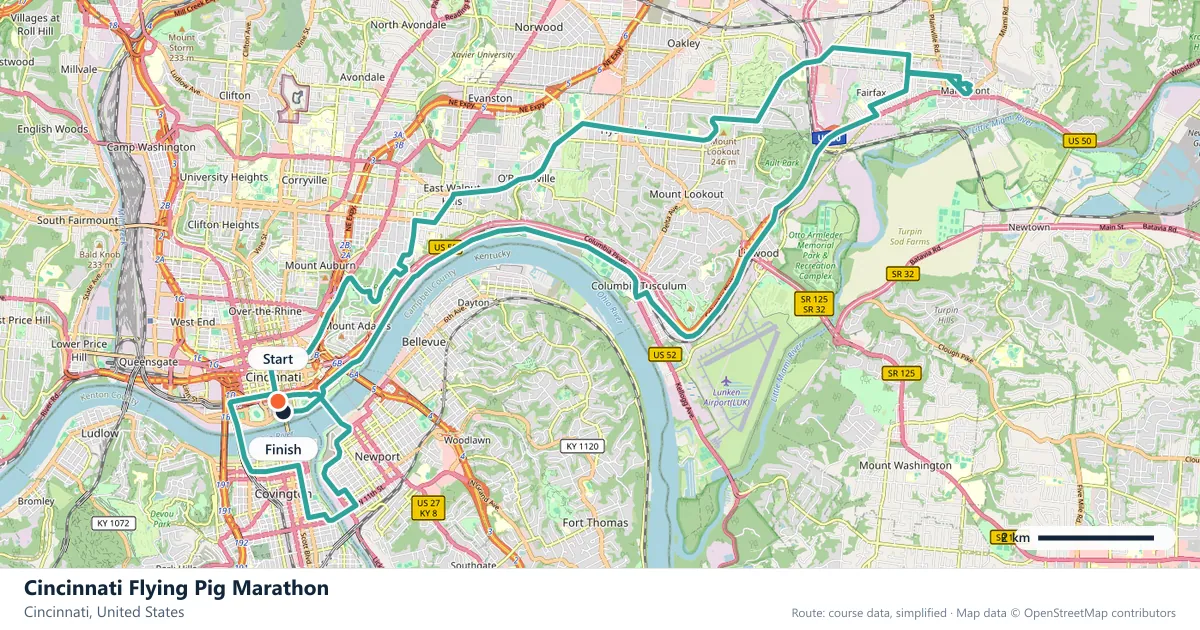
Where does the Cincinnati Flying Pig Marathon run?
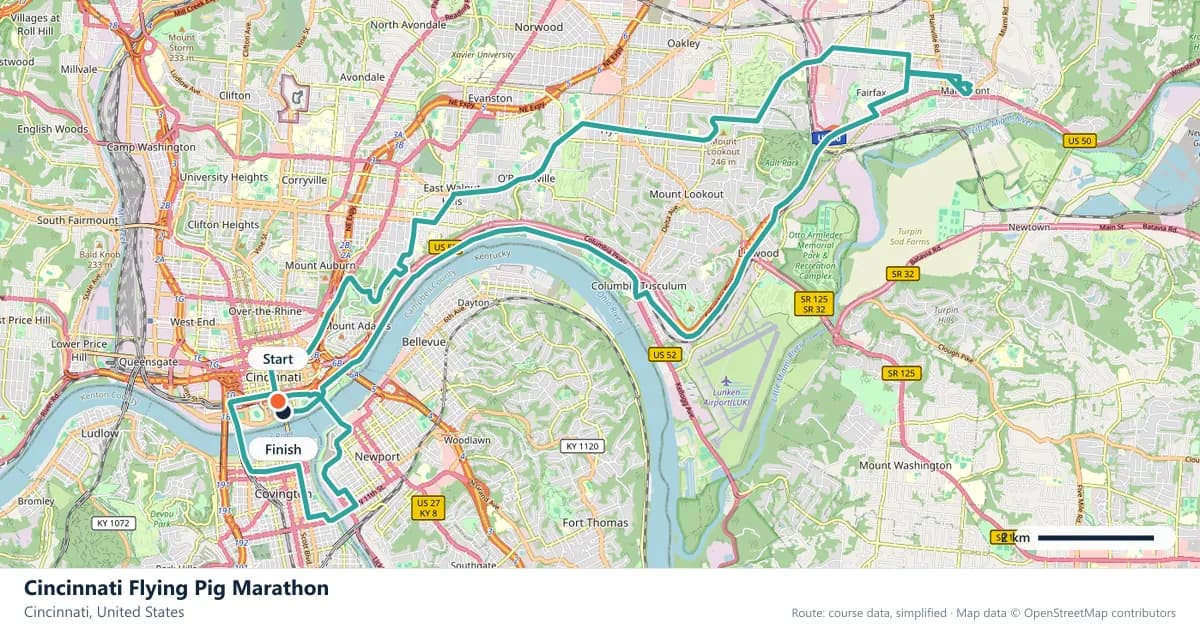
Interactive map
The trace follows the organizer's published course, simplified for the screen: the orange dot is the start, the dark dot the finish. Scroll to zoom, drag to pan.
What is the Cincinnati Flying Pig Marathon course like?
A May marathon that crosses the Ohio into Kentucky and back, climbing through Cincinnati's hills on the return. Famous for its organisation and its pig-themed support.
- Next edition
- 02 May 2027
- Elevation gain
- 302 m
- Profile
- Hilly
- First run
- —
Course guide
Two river crossings, a flat spell in Kentucky and a hilly return through Cincinnati: the Flying Pig Marathon packs a lot into its 42.195 km. The next edition is scheduled for 02 May 2027, with about 302 metres of climbing, most of it in the second half.
The race is known for its organisation and its pig-themed support, but the course is more demanding than the spring calendar's flat city marathons suggest. It is a hilly marathon that rewards patience, and the river crossing gives the day a shape no ordinary city loop can match.
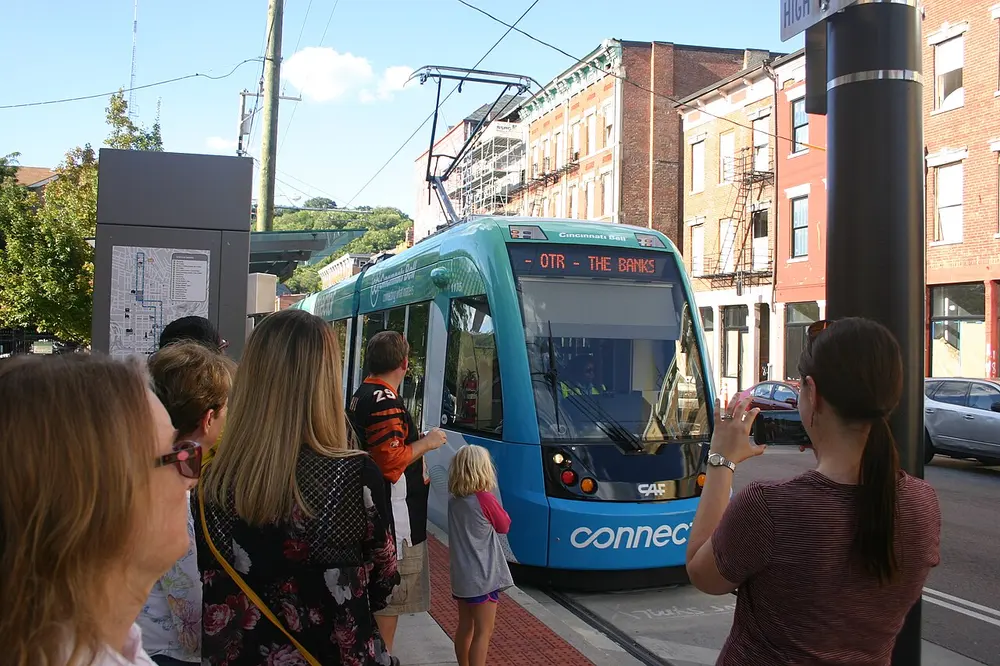
Cincinnati-bell-connector station-12-findlay-market-race 09-11. Photo: RickDikeman / Wikimedia Commons, CC0.
The course
The route leaves Cincinnati, crosses into Kentucky and later recrosses into Ohio. The Kentucky miles are the flatter, quicker part and give the field room to settle. The river gives the day its shape: Cincinnati on one side, Kentucky on the other, and two crossings in between.
Back in Ohio, the course climbs through Cincinnati's hills. The climbs are short but frequent, and the 302 metres of gain arrives when the legs are tired. It reads as hilly rather than rolling, and the return is the real race.
The course is a city marathon in the fullest sense. It uses the river bridges, the streets of two states and the hills that rise above the Ohio basin. Runners get a tour of a region rather than a loop around a single downtown.
Across the Ohio
The Ohio River is the defining feature of Cincinnati's geography, and crossing it is the defining feature of the race. The river separates Cincinnati from Kentucky, and the bridges that carry runners across are the same links that connect the city to Covington and Newport on the southern bank.
The Kentucky section has a different character from the Ohio miles. The ground is flatter and the field has room to find its rhythm. Runners who use this section to settle rather than to bank time tend to be the ones who cope with the return.
The crossing also changes the sense of scale. Cincinnati's skyline looks different from the Kentucky side, and the return over the bridge gives the second half a clear starting point. It is a psychological marker as much as a geographical one.

Cincinnati Panorama of 1848 (definitive). Photo: Charles H. Fontayne (1814–1901) and William Southgate Porter (1822–1889) / Wikimedia Commons, Public domain.
The hills on the return
Cincinnati is built on hills above the river, and the marathon's second half uses them. The climbs are short but frequent, and they arrive after the flatter Kentucky miles have encouraged a faster rhythm. That contrast is the course's real challenge: the legs are asked to change gear just when they have settled.
The hills are not long enough to require a mountaineering approach, but they are relentless enough to reward hill training. Long runs on rolling roads, strength work and practice at running uphill at an even effort are more useful than flat speed alone. The return is where a patient first half pays off.
The neighbourhoods on the hills give the race its character. Cincinnati's hillside streets are older and narrower than the downtown grid, and the climbing is broken by turns and changes of view. Runners who know the city will recognise the geography; visitors get a sense of how much of Cincinnati sits above the river.
Pigs, volunteers and the race's character
The Flying Pig is known for its atmosphere. The pig theme runs through the event, from the branding to the support on the course, and the volunteers are a large part of why runners speak well of it. On a hilly course, that support matters: a lift from the roadside can carry you up the next rise.
The organisation is another asset for a first marathon. A race that handles the logistics well allows a debutant to focus on the running rather than on where to go or what happens next. The hilly second half is the caveat, but the support makes the day feel less lonely.
The name and the theme give the race a personality that many city marathons lack. It is a serious sporting event with a sense of humour, and that combination is part of why runners return to it.
Gilbert Avenue Marathon Sign, Walnut Hills, Cincinnati, OH. Photo: Warren LeMay from Cincinnati, OH, United States / Wikimedia Commons, CC0.
Race-day decisions
- The second half. Most of the climbing comes on the return through Cincinnati, so the race is decided after halfway.
- The river crossing. Crossing into Kentucky and back is the defining feature of the route and breaks the rhythm in a way a normal city loop does not.
- Early pace on the flat. The Kentucky miles are the easiest running of the day. Banking time there will cost you on the hills.
- The support. The pig-themed crowds and volunteers are part of the race's reputation. Use them on the climbs, where a lift matters most.
Frequently asked questions
Answers to the questions runners ask before entering, drawn from this race's course guide and the directory's own data — the sources behind them are listed below.
When is the Cincinnati Flying Pig Marathon?
The 2027 edition is scheduled for 2 May. The race is held in May, and the organiser publishes the start arrangements and race-weekend details closer to the event.
Is the Flying Pig Marathon a hilly course?
Yes. It climbs about 302 metres, mostly on the return through Cincinnati's hills after the course recrosses the Ohio. The individual hills are short, but they keep coming, so hill-specific training is worthwhile.
Is it suitable for a first marathon?
It can work as a first marathon because the organisation and crowd support are genuine assets. The hilly second half is the caveat: train on inclines, start conservatively and use the atmosphere rather than fighting it.
Is it a good course for a personal best?
The flat Kentucky miles are quick, but the return climbs make it harder than a pan-flat city race. Runners chasing a time can still do well with a patient first half, but the course does not hand out fast times.
Where is the race run?
The race starts in Cincinnati, crosses the Ohio into Kentucky and returns to Cincinnati for the second half. The river crossing, rather than a single landmark, gives the course its shape.
Why is it called the Flying Pig?
The Flying Pig is the race's name and its theme. The event is known for pig-themed support and a playful identity, which sits alongside a serious, hilly marathon course.
More marathons in United States
More marathons in Americas
Sources for this page
What each source below is used for on this page, and where to check this race yourself.
- World Athletics — the label calendar and the road-race regulations. Used to check whether the race holds a World Athletics label, and its elite competition details.
- AIMS — the international course-measurement standard behind the 42.195 km distance, and the AIMS race calendar.
- The organizer's own publications — course maps, race handbooks and published results. The date, course character and climbing on this page are compiled from them and re-checked each season.
Where do these facts come from?
Dates, course type, climbing and time limits are compiled from the organizer's publications and re-checked each season; elevation is an estimate of total climbing rather than a survey figure. Always confirm race-day details with the organizer before making plans.
Last reviewed 27 October 2026