
Buffalo Marathon
Late May brings the Buffalo Marathon to the shore of Lake Erie, where the course loops through the city's waterfront and parks. The next edition is on 30 May 2027.
By Global Marathon Routes editorial team · Last reviewed 27 October 2026
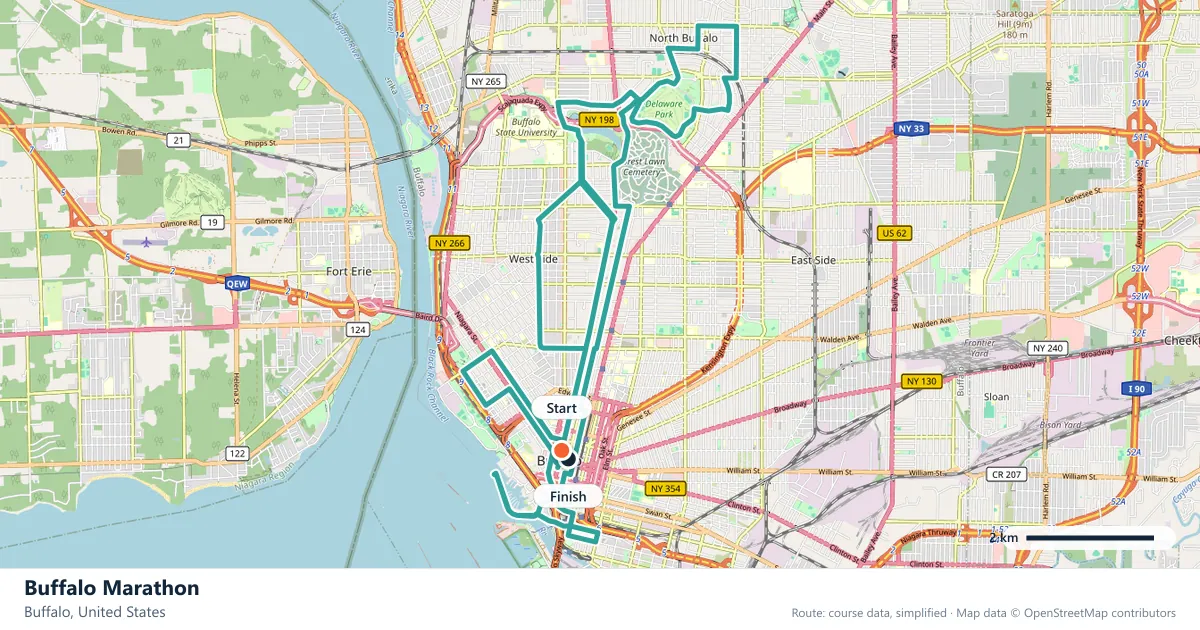
Where does the Buffalo Marathon run?
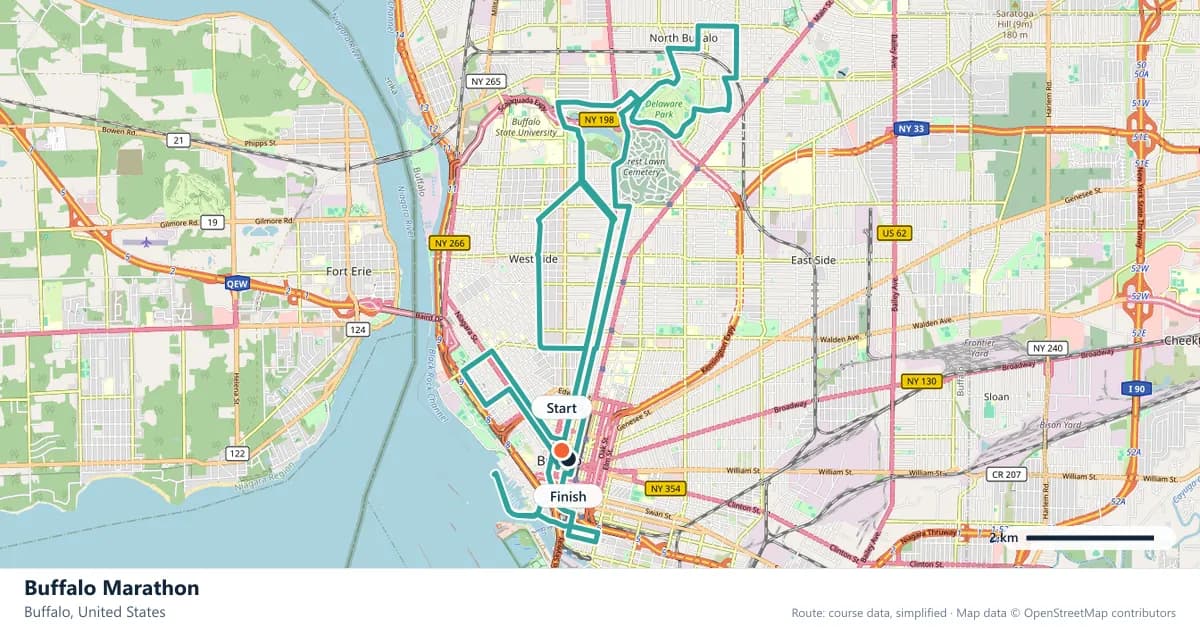
Interactive map
The trace follows the organizer's published course, simplified for the screen: the orange dot is the start, the dark dot the finish. Scroll to zoom, drag to pan.
What is the Buffalo Marathon course like?
A May marathon on Lake Erie, looping through Buffalo's waterfront and parks. Flat and quick, with cool lake air for most of the race.
- Next edition
- 30 May 2027
- Elevation gain
- 160 m
- Profile
- Undulating
- First run
- —
Course guide
Late May brings the Buffalo Marathon to the shore of Lake Erie, where the course loops through the city's waterfront and parks. The next edition is on 30 May 2027. Quick and close to flat, with cool lake air for most of the race, it is a race that gives a time-chaser a fair surface without the scale of a major.
Buffalo's setting does much of the work. The lake keeps the air cool, the parks break up the urban miles, and the waterfront gives the race a sense of openness. The profile is undulating, with roughly 160 metres of gain, but the rises are gentle enough that they should not disturb a steady pace.
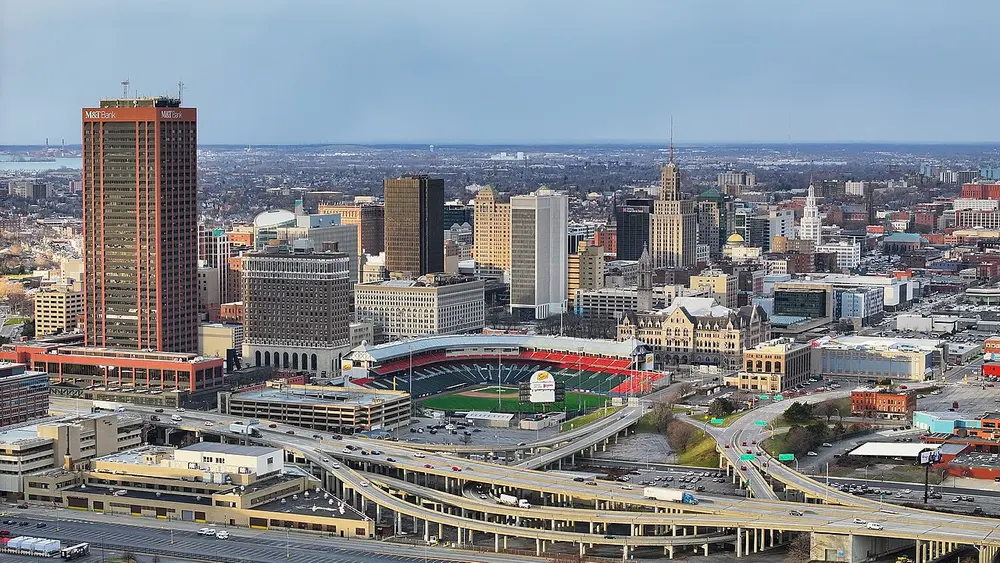
Buffalo, NY skyline. Photo: Quintin Soloviev / Wikimedia Commons, CC BY 4.0.
The course
The race is a loop through Buffalo, passing the waterfront and the parks before returning through the city. The gain is around 160 metres, enough to keep the course from being a pure time trial but not enough to call it hilly. Most of the climbing comes in short, soft rises rather than sustained drags.
The course's shape suits a steady rhythm. There is no single climb to prepare for and no long descent to recover on, so the day is decided by how well you hold your effort across the gentle changes of grade. Runners who use the flat stretches wisely and stay relaxed on the rises tend to finish strongly.
The city is compact enough that the loop does not feel like a tour of anonymous suburbs. Buffalo's streets have a distinct character, from the lakefront to the older neighbourhoods, and the race moves between them without losing a sense of place.
Lake Erie and the waterfront
Lake Erie is the course's climate system as well as its backdrop. The cool air off the water is a genuine advantage in late May. It helps keep effort under control in the later stages and makes the fast sections feel less expensive.
The waterfront is also the most open part of the route. Long sightlines across the water and the sky above the lake give the race a sense of space that a city-centre loop lacks. On a clear morning, the lake is a reminder of why Buffalo's running scene is tied to the shore.
The lake is not always calm, though, and the exposure works both ways. A breeze can make the open miles feel harder, and the waterfront can be cooler than the streets inland. Runners should plan for a range rather than a single forecast.

Buffalo December 2024 01 (Buffalo Metro Rail on Main Street). Photo: Michael Barera / Wikimedia Commons, CC BY-SA 4.0.
Parks, neighbourhoods and the city
Buffalo is one of the American cities shaped by Frederick Law Olmsted's park system, and the marathon's route through green space is part of its identity. The parks provide shade, open space and a change of scenery from the grid. They also break the race into sections, which helps on a long morning.
Between the parks, the course passes through neighbourhoods with a strong local feel. Buffalo's residential streets are not as dense as those of a larger metropolis, and the race can feel quiet in the stretches between support zones. That is a feature for runners who prefer space, but it puts more emphasis on self-pacing.
The city's waterfront and its older industrial landmarks sit alongside the route's softer green sections. The contrast is part of the appeal: a marathon that shows both the lake and the neighbourhoods rather than confining runners to a single redeveloped strip.

Buffalo December 2024 02 (Buffalo Metro Rail on Main Street). Photo: Michael Barera / Wikimedia Commons, CC BY-SA 4.0.
Holding the fast day together
- A fast, forgiving profile. With about 160 metres of climbing, the course is quick but not completely flat. The gentle rises should be run on effort, not ignored.
- The early pace. Cool lake air and a flat-feeling course make it easy to go out too fast. The first 10 km should feel controlled.
- A steady rhythm. The short rises are easy to ignore; run them by effort so the undulation does not accumulate unnoticed.
- The late-spring date. The race sits at the end of May, when conditions can vary. Check the forecast in race week and plan for a range.
Frequently asked questions
Answers to the questions runners ask before entering, drawn from this race's course guide and the directory's own data — the sources behind them are listed below.
When is the Buffalo Marathon?
The 2027 edition is on 30 May. It is a late-May race on Lake Erie, and the organiser publishes the start arrangements and race-weekend details closer to the event.
Is the Buffalo Marathon a flat or hilly course?
It is undulating, with about 160 metres of climbing. The profile is close enough to flat to be quick, but the short rises keep it from being a pure time trial. Most runners will find it more forgiving than a hilly city marathon.
Is it a good race for a personal best?
The close-to-flat profile and the cool lake air make it a sensible place to chase a time. The gentle undulation is manageable, and the fast stretches beside the water give you room to settle. A personal best is never guaranteed, but the course gives you a fair chance.
Is it suitable for a first marathon?
The modest climbing and the forgiving profile make it a manageable first marathon. The main risk is going out too fast on the flat, cool waterfront. Start conservatively and use the parks and neighbourhoods to hold your rhythm.
Where is the marathon run?
It is run in Buffalo, New York, on a loop through the city's waterfront and parks. The course stays close to Lake Erie and loops back through the city.
Why is the Buffalo Marathon considered fast?
The course has only about 160 metres of climbing and is undulating rather than hilly. The cool lake air also helps keep effort under control. Together, those factors make it a good course for a steady, quick marathon.
More marathons in United States
More marathons in Americas
Sources for this page
What each source below is used for on this page, and where to check this race yourself.
- World Athletics — the label calendar and the road-race regulations. Used to check whether the race holds a World Athletics label, and its elite competition details.
- AIMS — the international course-measurement standard behind the 42.195 km distance, and the AIMS race calendar.
- The organizer's own publications — course maps, race handbooks and published results. The date, course character and climbing on this page are compiled from them and re-checked each season.
Where do these facts come from?
Dates, course type, climbing and time limits are compiled from the organizer's publications and re-checked each season; elevation is an estimate of total climbing rather than a survey figure. Always confirm race-day details with the organizer before making plans.
Last reviewed 27 October 2026