
Baltimore Marathon
The Baltimore Marathon begins at the Ravens' stadium and spends the morning climbing through the city.
By Global Marathon Routes editorial team · Last reviewed 27 October 2026
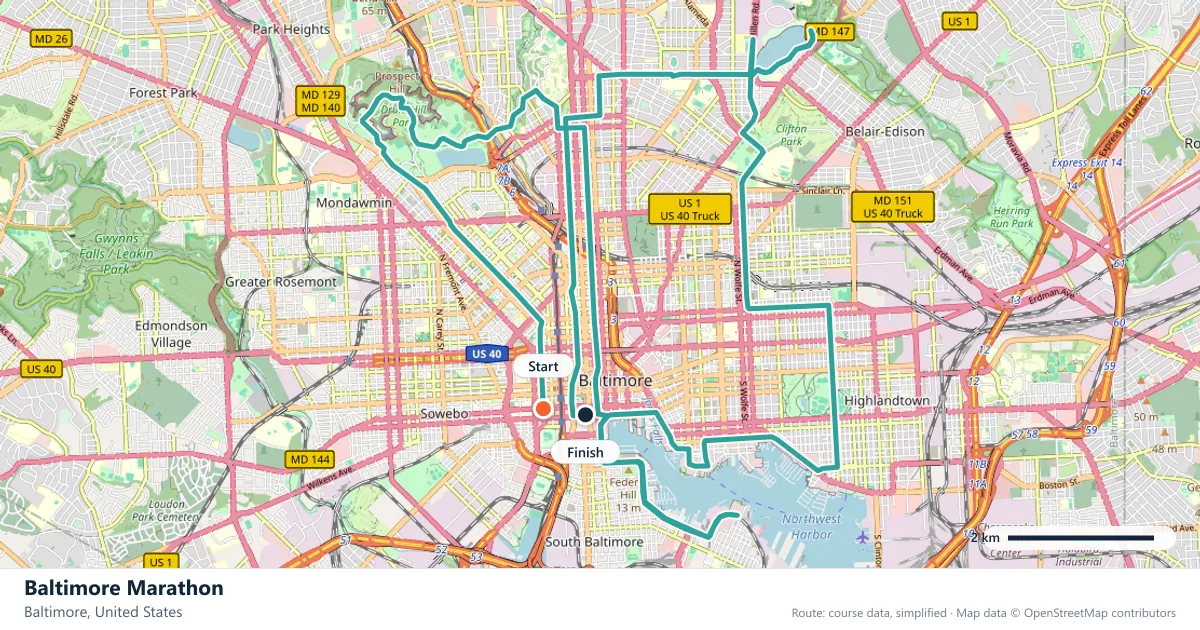
Where does the Baltimore Marathon run?
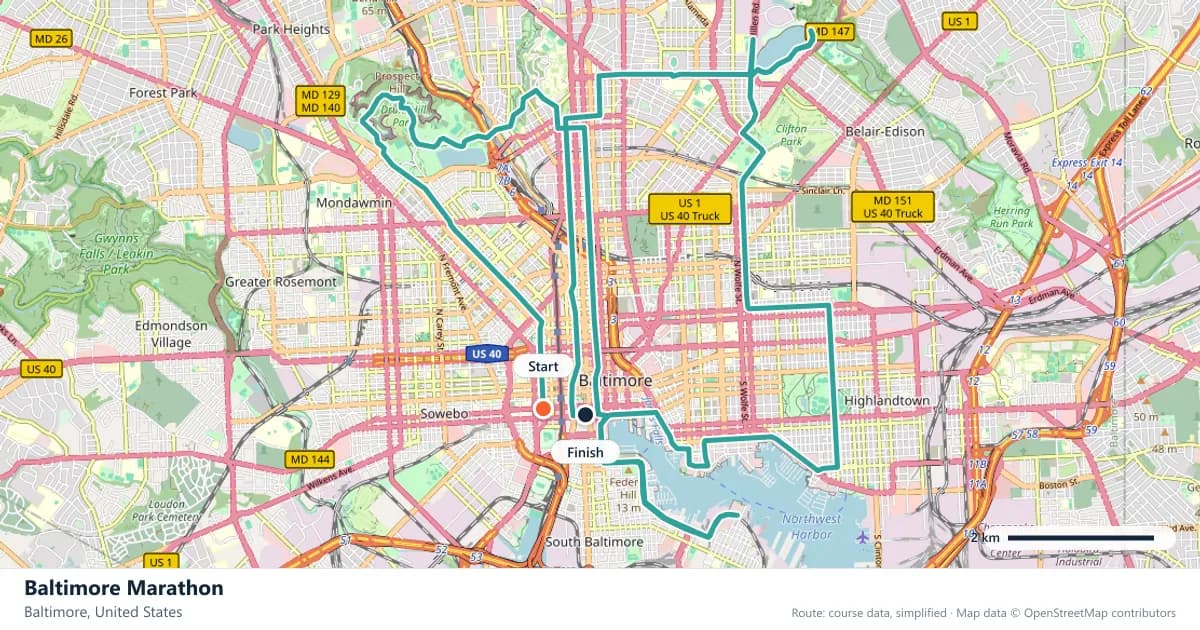
Interactive map
The trace follows the organizer's published course, simplified for the screen: the orange dot is the start, the dark dot the finish. Scroll to zoom, drag to pan.
What is the Baltimore Marathon course like?
An October race that starts at the Ravens' stadium and climbs through Baltimore's neighbourhoods, past the harbour and the inner city. Hillier than most American city marathons.
- Next edition
- October 2027 (expected)
- Elevation gain
- 316 m
- Profile
- Hilly
- First run
- —
Course guide
The Baltimore Marathon begins at the Ravens' stadium and spends the morning climbing through the city. The edition covered here is the 2026 race, run on 17 October 2026, and it packs about 316 metres of ascent into 42.195 km — hillier than most American city marathons, with the harbour and the inner city as the backdrop.
Baltimore's course is a portrait of the city rather than a loop around a single district. It moves from the stadium area through residential neighbourhoods, past the harbour and into the inner city, and the terrain changes with the scenery. The hills are constant enough that the race feels rolling from early on, and they are the defining feature rather than an inconvenience.
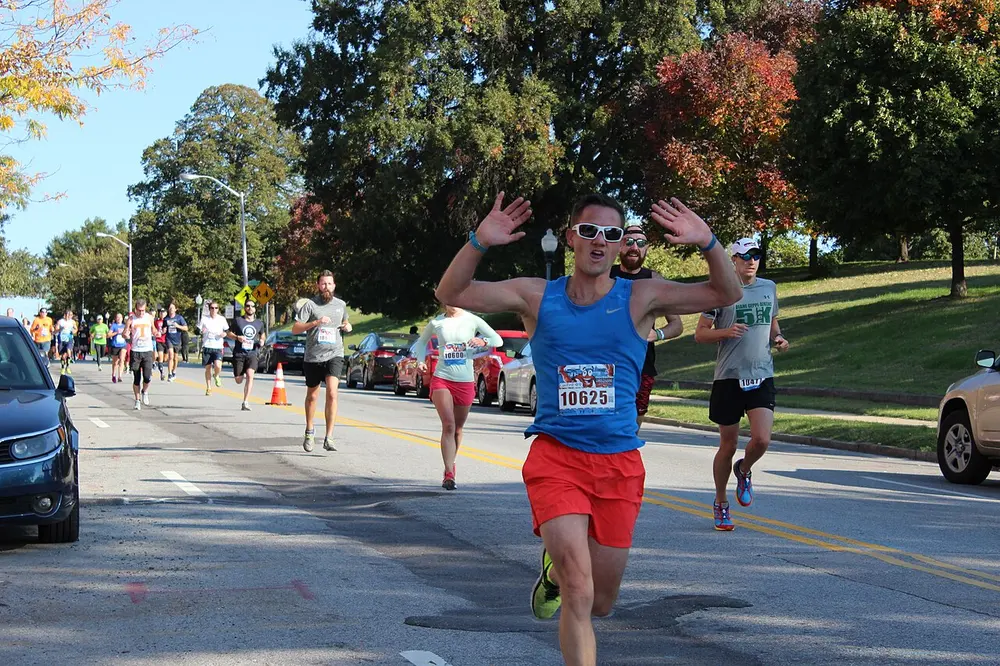
Runners on Patterson Park Avenue during the 2015 Marathon. Photo: Chrissymad / Wikimedia Commons, CC BY-SA 4.0.
The course
The route starts at the Ravens' stadium, works through Baltimore's neighbourhoods, passes the harbour and the inner city, and keeps climbing along the way. The 316 metres are spread across the whole course, so there is no long flat stretch in which to settle. Runners should expect a rolling profile and a race that rewards strength more than pure speed.
The climbs come as short, repeated efforts rather than one long ascent. That pattern suits runners who stay relaxed on the rises and use the descents to recover, but it punishes anyone who attacks the early hills. With the terrain spread across the city, the race also asks for attention to turns and changes of direction.
The city setting gives the day a city-marathon atmosphere without losing the feel of a local race: neighbourhood streets, changing scenery and a route that keeps revealing another side of Baltimore.
From the stadium into the neighbourhoods
The Ravens' stadium sits on the south edge of downtown, close to the waterfront, and the early miles take runners away from the open stadium area into the city's rowhouse neighbourhoods. Baltimore is a city of brick terraces and narrow streets, and the course uses them to create a very different texture from the broad boulevards of a typical marathon.
Patterson Park, in the east of the city, is one of the landmarks the race passes. The park is a local gathering place, and the avenue beside it gives the marathon one of its more recognisable stretches. The surrounding streets are flat in places and gently rising in others, so the race never settles into a single rhythm.
For runners from out of town, this section is a reminder that Baltimore's reputation as a harbour city oversimplifies it. The marathon spends more time in the neighbourhoods than on the waterfront, and the climbing comes from the city's inland topography rather than from a single scenic hill.
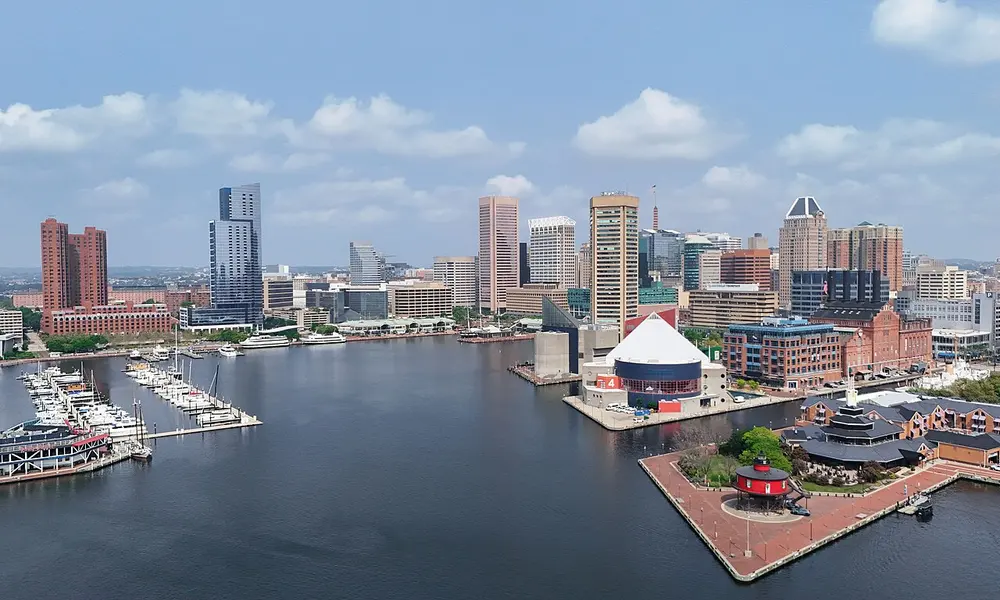
Baltimore, Maryland skyline. Photo: Quintin Soloviev / Wikimedia Commons, CC BY 4.0.
The harbour and the inner city
The harbour gives the course its most open views and its most familiar postcard image. The Inner Harbor is the centre of the city's tourist map, and the marathon uses the waterfront as a contrast to the enclosed residential streets. The change of scene is welcome, but it also exposes runners to whatever breeze comes off the water.
The inner city brings the course back into denser streets and more frequent turns. This is where the accumulated climbing starts to be felt, and where the race's hillier-than-average character becomes clear. The descents are short, the flats are rarely long, and the effort of holding a rhythm becomes a mental as well as a physical task.
The final miles bring the course back through the city, with the finish as the reward for a morning spent moving between neighbourhoods and water. It is not a course that offers one dramatic final climb; it offers a long series of smaller ones that add up to a hard day.
Reading the course
- Rolling terrain throughout. The 316 metres are not concentrated in one climb, so there is no easy section to bank time on.
- Early ambition. The first climbs feel short, which encourages over-running. Keep the effort controlled and let the course come back to you.
- Turns in the city. The route passes the harbour and the inner city, so expect changes of direction and tighter running in places.
- A realistic target. The course is hillier than most American city marathons. Build your goal around that rather than a flat-course split.
Frequently asked questions
Answers to the questions runners ask before entering, drawn from this race's course guide and the directory's own data — the sources behind them are listed below.
When is the Baltimore Marathon?
The edition covered here is the 2026 race, run on 17 October 2026. It is an October race, and the organiser publishes the start arrangements and race-weekend details closer to the event.
Is the Baltimore Marathon a flat or hilly course?
It is hilly, with about 316 metres of climbing. The course is hillier than most American city marathons, and the climbs are spread across the route rather than concentrated in one long ascent.
Is the Baltimore Marathon suitable for a first marathon?
It can work as a first marathon if you prepare for rolling terrain. The course is relentless rather than extreme, and the constant changes of gradient make it a harder debut than a flat city race. Hill work in training makes a real difference.
Is it a personal-best course?
The hills make even pacing difficult, and the course is not built for fast times. Runners chasing a personal best should expect the rolling ground to cost more than the elevation total suggests.
Where does the marathon start?
The race starts at the Ravens' stadium. From there the route climbs through the city's neighbourhoods and passes the harbour and the inner city before returning to the centre.
What makes the course difficult?
The difficulty is cumulative. About 316 metres of climbing arrives in short, repeated rises, and there are few long flat stretches to recover on. Runners who go out too hard on the early hills tend to pay for it later.
More marathons in United States
More marathons in Americas
Sources for this page
What each source below is used for on this page, and where to check this race yourself.
- World Athletics — the label calendar and the road-race regulations. Used to check whether the race holds a World Athletics label, and its elite competition details.
- AIMS — the international course-measurement standard behind the 42.195 km distance, and the AIMS race calendar.
- The organizer's own publications — course maps, race handbooks and published results. The date, course character and climbing on this page are compiled from them and re-checked each season.
Where do these facts come from?
Dates, course type, climbing and time limits are compiled from the organizer's publications and re-checked each season; elevation is an estimate of total climbing rather than a survey figure. Always confirm race-day details with the organizer before making plans.
Last reviewed 27 October 2026