
Atlanta Marathon
Atlanta is a city of ridges, and its marathon makes no attempt to hide them. The 2027 edition is on 7 March, and the course climbs through the city's neighbourhoods for nearly 500 metres of total…
By Global Marathon Routes editorial team · Last reviewed 27 October 2026
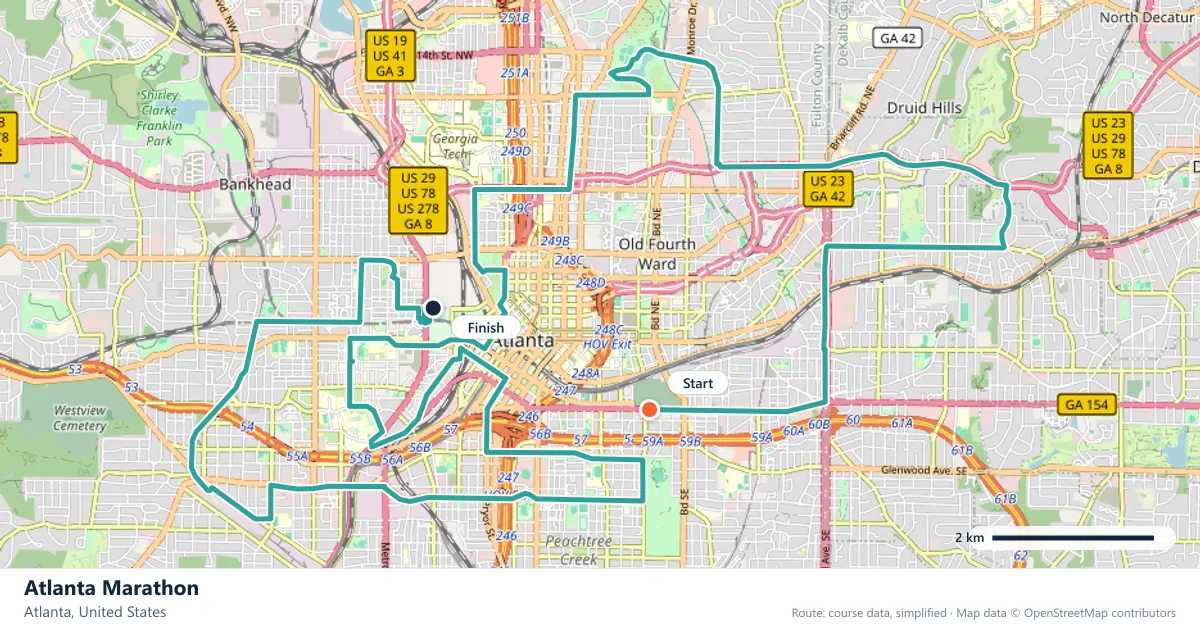
Where does the Atlanta Marathon run?
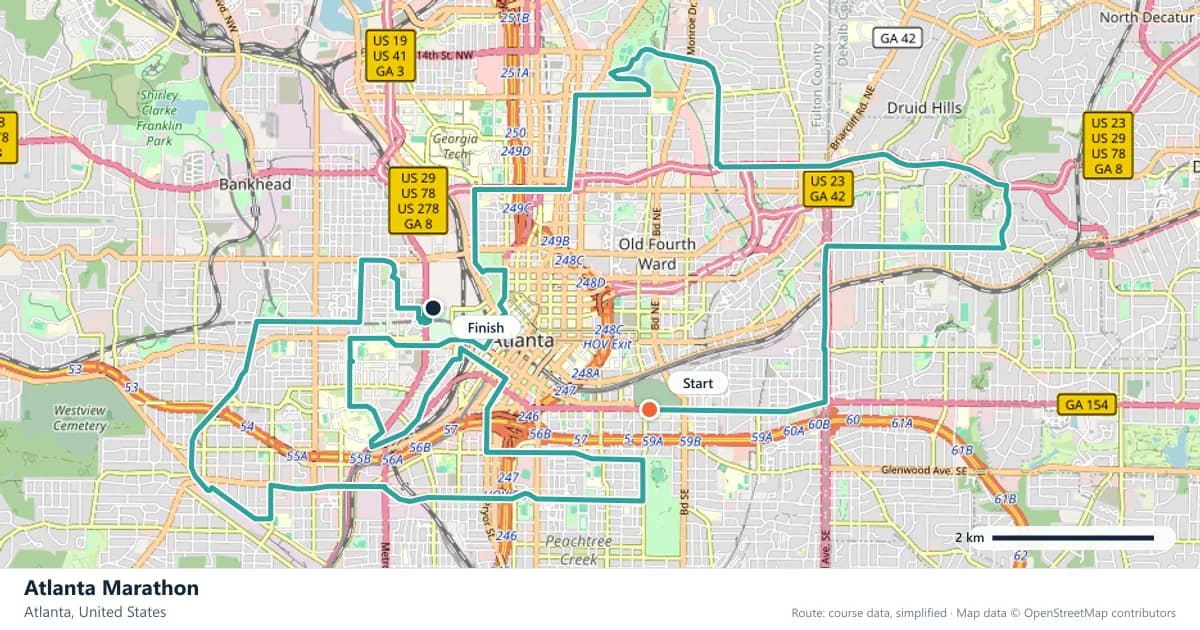
Interactive map
The trace follows the organizer's published course, simplified for the screen: the orange dot is the start, the dark dot the finish. Scroll to zoom, drag to pan.
What is the Atlanta Marathon course like?
A spring marathon in the hills, climbing through Atlanta's neighbourhoods with nearly 500 metres of gain. Not a course to chase a personal best on.
- Next edition
- 07 March 2027
- Elevation gain
- 465 m
- Profile
- Hilly
- First run
- —
Course guide
Atlanta is a city of ridges, and its marathon makes no attempt to hide them. The 2027 edition is on 7 March, and the course climbs through the city's neighbourhoods for nearly 500 metres of total ascent. The profile is hilly — about 465 metres — spread across dozens of short rises rather than one signature climb.
That shape gives the race its character. Atlanta does not offer a single wall to fear or a single descent to recover on; it offers a long sequence of changes in gradient, with the city's tree cover closing in around the road. Runners who prepare for rolling ground tend to enjoy it. Runners who arrive expecting a flat city tour tend to remember the second half.
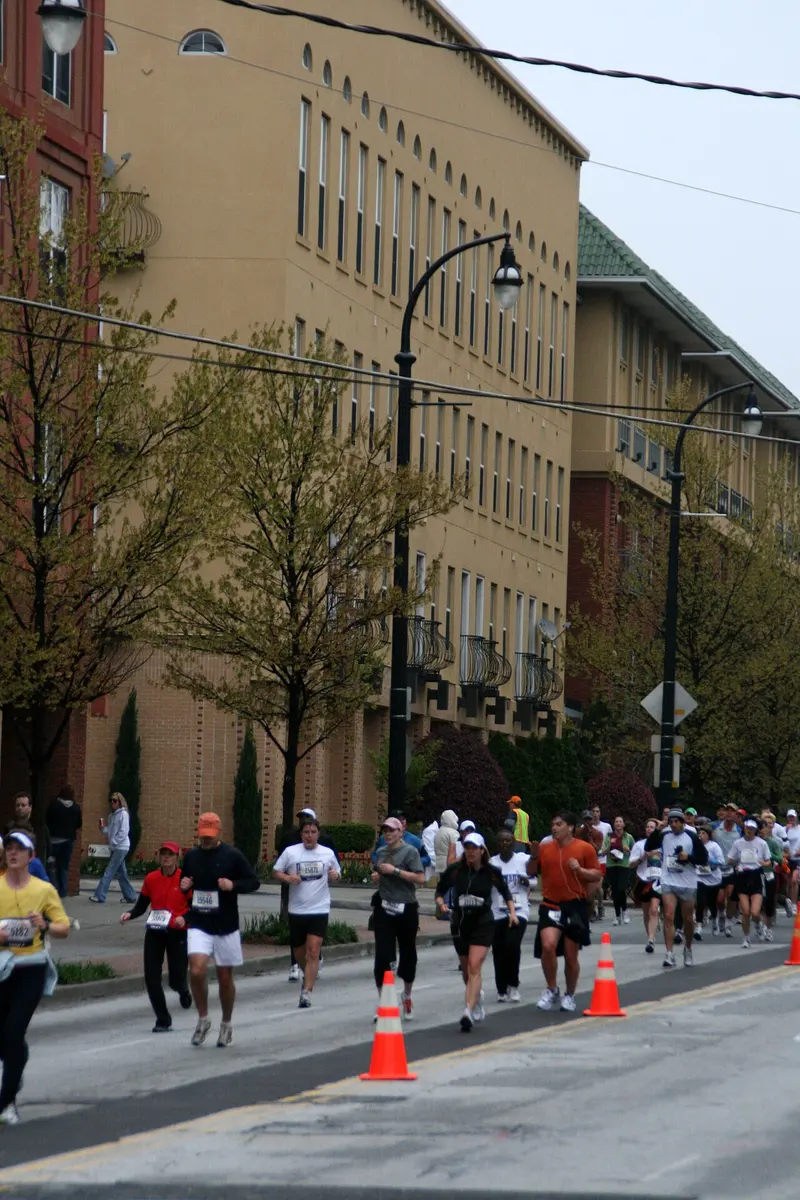
ING Atlanta Half Marathon. Photo: John Trainor / Wikimedia Commons, CC BY 2.0.
The course
The route threads through Atlanta's residential neighbourhoods, and the terrain does the organising. There is no long climb to point to; instead the course rises and falls repeatedly, with the 465 metres distributed across the full distance. The result is a course of many small efforts, each manageable on its own, which together decide how the last 10 km feel.
Because the climbing is spread out, patience matters more than strength on any single hill. The first half can feel surprisingly comfortable while the legs are fresh, but the accumulated ascent tends to collect its debt late. The descents are not free speed either: they arrive between the climbs and are best used to recover rather than to make up time.
The urban setting adds its own demands. The course turns through neighbourhoods rather than running long straight boulevards, so rhythm comes and goes. In a city known for its tree canopy, the route also feels enclosed for long stretches, which can make the miles pass without the visual cues a skyline would provide.
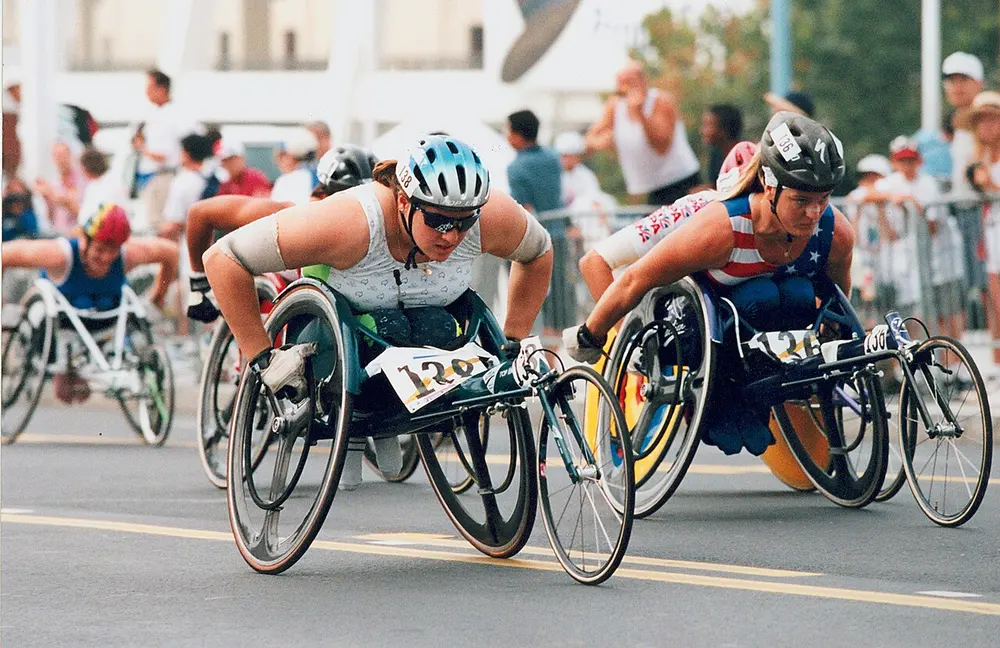
78 ACPS Atlanta 1996 Track Louise Sauvage. Photo: John Sherwell / Wikimedia Commons, CC BY-SA 3.0.
Why the hills keep coming
Atlanta grew along a ridge, and the streets that follow it spill into a landscape of creeks, ravines and wooded slopes. That geography is why the marathon feels so consistently undulating. The city is not built on a plain with a few isolated hills; it is built on folded ground, and a route through its neighbourhoods inherits the folds.
For training, that means a flat programme is poor preparation. Long runs on rolling roads, tempo work with some gradient, and practice at changing pace without panicking are more useful than pure track speed. The race rewards runners who can hold an even effort rather than an even pace, because the pace will move whether you want it to or not.
It also helps to know that the climbs are short. None of them is likely to last more than a few minutes, so the task is not to grind up a mountain but to avoid over-running each rise. Treat every uphill as a place to stay relaxed and every downhill as a place to let the legs turn over.
Spring in the city in a forest
Early March puts the race at the front edge of spring in north Georgia. The city's parks and streets are beginning to green up, and the tree canopy that gives Atlanta its nickname is part of the race's visual identity. The urban forest also means shade, which is welcome whenever the morning turns warmer than expected.
The date sits before the heat of a Southern summer, but it is still a spring race in a variable climate. Runners should check the forecast in the final week and plan for more than one condition. Arm sleeves and a light layer are easier to shed than a bad first hour is to undo.
Atlanta's running culture is another reason the race feels lively. The city has a large running community, and the marathon draws on neighbourhoods that know how to support a race. That atmosphere is a real asset on a hilly course, where a lift from the roadside can be worth more than a fast split.
Where the race is decided
- The accumulated climb. About 465 metres of ascent is a serious total for a city marathon, even when it is split into short rises. Do not dismiss the early hills because they feel easy.
- The opening half. Fresh legs make climbing feel cheaper than it is. Run the first 10 km conservatively and let the course come to you.
- The descents. Downhills are recovery, not free speed. Charging them costs quadriceps that you will want for the final climbs.
- Your goal. The terrain makes a fast time a hard target. Set your race around effort and finish strength rather than a flat-course split.
Frequently asked questions
Answers to the questions runners ask before entering, drawn from this race's course guide and the directory's own data — the sources behind them are listed below.
When is the Atlanta Marathon?
The next edition is on 07 March 2027. It is an early-spring race, and the organiser publishes the start arrangements and race-weekend details closer to the event.
Is the Atlanta Marathon a flat or hilly course?
It is hilly. The course gains about 465 metres through repeated climbs, with no single long ascent but very little flat running. The hills are spread through the city's neighbourhoods rather than concentrated in one section.
Is the Atlanta Marathon suitable for a first marathon?
It can work as a first marathon for a runner who trains on rolling terrain and paces conservatively. The course is honest rather than extreme, but the constant climbing makes it a harder debut than a flat city race. Build long runs on hills before you commit.
Is it a personal-best course?
The 465 metres of climbing and the almost complete absence of flat running make a personal best difficult. Runners chasing a time should expect the hills to cost more than the elevation total suggests, especially in the second half.
Where is the marathon run?
The race is run in Atlanta, Georgia, through the city's residential neighbourhoods. The course uses the local terrain rather than avoiding it, so the climbing is a defining part of the route.
Why is the race so hilly?
Atlanta is built on ridges and rolling ground, and the marathon follows the shape of the city. The course accumulates about 465 metres in short, repeated rises, which is why hill-specific training matters more here than flat-course speed work.
More marathons in United States
More marathons in Americas
Sources for this page
What each source below is used for on this page, and where to check this race yourself.
- World Athletics — the label calendar and the road-race regulations. Used to check whether the race holds a World Athletics label, and its elite competition details.
- AIMS — the international course-measurement standard behind the 42.195 km distance, and the AIMS race calendar.
- The organizer's own publications — course maps, race handbooks and published results. The date, course character and climbing on this page are compiled from them and re-checked each season.
Where do these facts come from?
Dates, course type, climbing and time limits are compiled from the organizer's publications and re-checked each season; elevation is an estimate of total climbing rather than a survey figure. Always confirm race-day details with the organizer before making plans.
Last reviewed 27 October 2026