
Duke City Marathon
Albuquerque is a high-desert city with a mountain range along its eastern edge and a river running through the middle, and the Duke City Marathon uses both parts of that setting.
By Global Marathon Routes editorial team · Last reviewed 27 October 2026
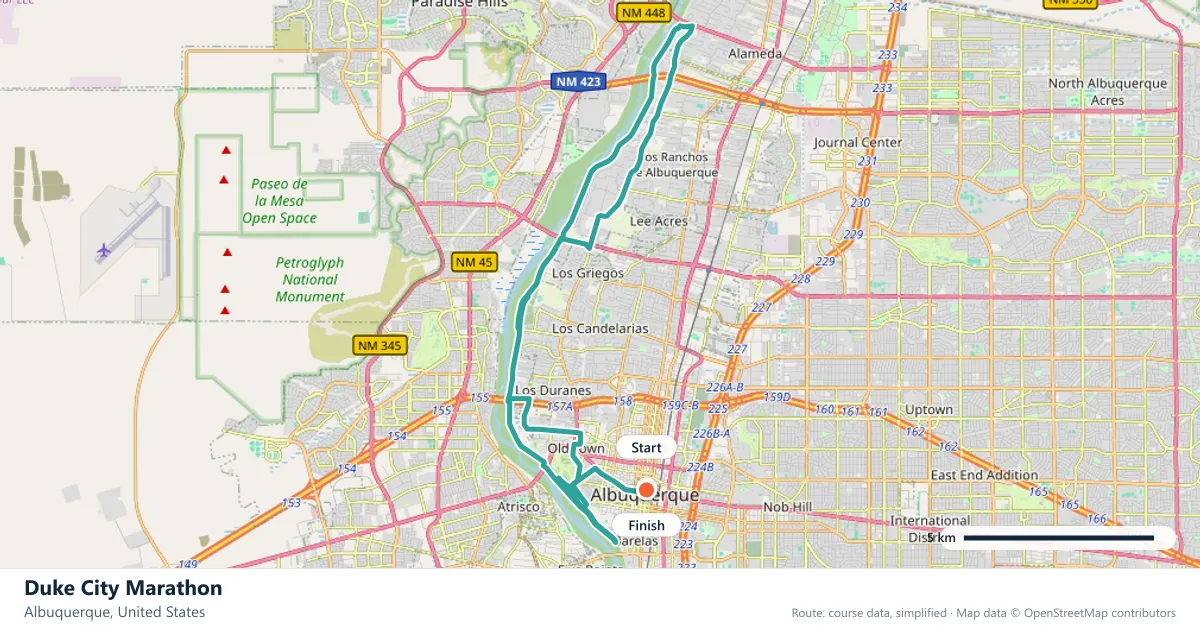
Where does the Duke City Marathon run?
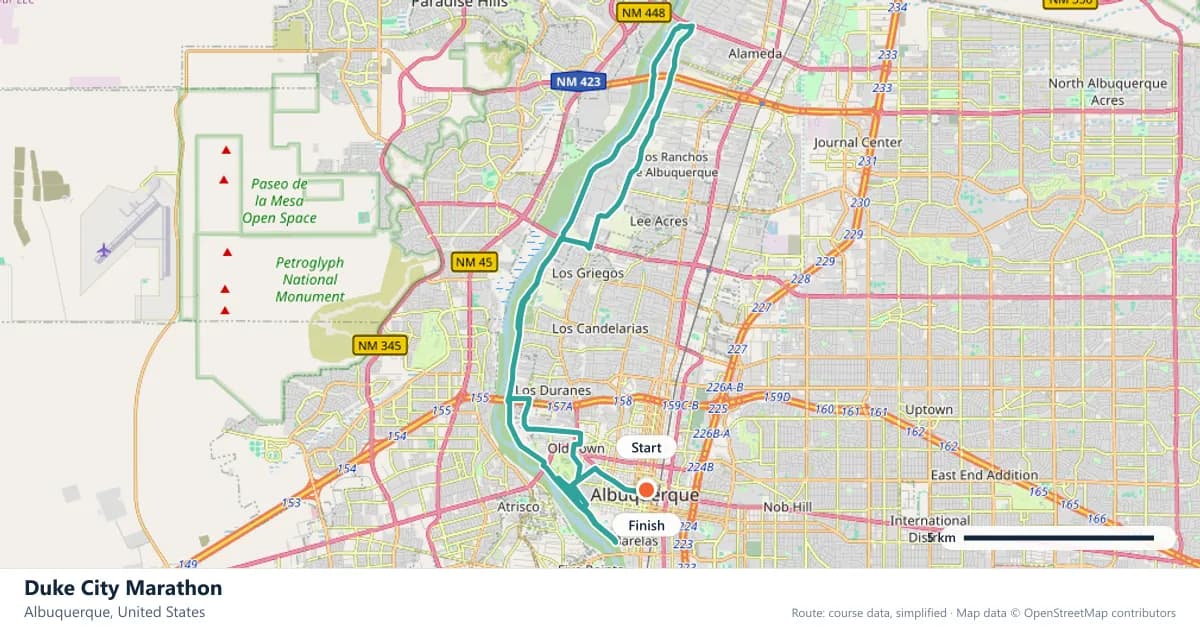
Interactive map
The trace follows the organizer's published course, simplified for the screen: the orange dot is the start, the dark dot the finish. Scroll to zoom, drag to pan.
What is the Duke City Marathon course like?
A flat October marathon along the Rio Grande in Albuquerque, at around 1,500 metres of altitude. Small, fast and usually run under clear desert skies.
- Next edition
- October 2027 (expected)
- Elevation gain
- 37 m
- Profile
- Flat
- First run
- —
Course guide
Albuquerque is a high-desert city with a mountain range along its eastern edge and a river running through the middle, and the Duke City Marathon uses both parts of that setting. The next edition is expected in October 2027. The course stays close to the Rio Grande, the Sandias fill the horizon, and the race keeps the low-key feel of a small event rather than a big-city production.
What makes it unusual is the mismatch between the map and the effort. The course is flat — about 37 metres of climbing across 42.195 km — yet Albuquerque sits at roughly 1,500 metres above sea level. There is no hill to blame when the pace starts to feel expensive. The thin air is the day's real terrain.

Duke Ellington Circle Marathon 2022 jeh. Photo: Jim.henderson / Wikimedia Commons, CC BY-SA 4.0.
The course
The route follows the Rio Grande corridor for much of its length, using the riverside green belt and the city streets that connect it to the rest of town. The bosque, the band of cottonwoods that traces the river, gives the course a leafy edge that the surrounding desert does not have. Away from the water the city opens out, and the Sandia Mountains return to view.
The profile is flat in the literal sense. Total ascent is only about 37 metres, so there is no sustained climb and no descent long enough to recover on. What the course asks for instead is rhythm: the flat kilometres pass quickly, and the turns between the river and the city can interrupt a good stride if you let them. With a small field, there is room to run your own pace almost from the start.
The atmosphere is quiet by American marathon standards. That is part of the appeal, but it also means the race cannot carry you through a bad patch. Runners who have trained to hold a pace alone will settle in more easily than those who rely on a dense pack.
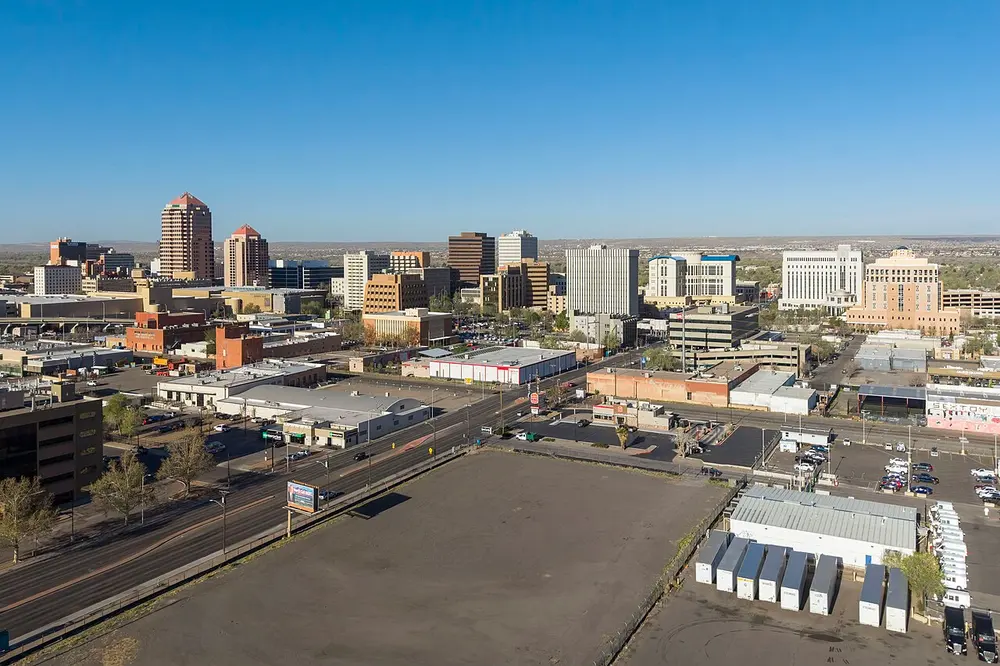
Albuquerque, New Mexico. Photo: Quintin Soloviev / Wikimedia Commons, CC BY 4.0.
Altitude, effort and the desert sky
Albuquerque's altitude is the first thing visitors notice, whether they are walking up a flight of stairs or warming up on race morning. At around 1,500 metres the air is thinner, so a familiar pace costs more than it does at home. The effect is not dramatic enough to stop a well-trained runner, but it is large enough to turn an ambitious goal into a difficult day.
The race is usually run under clear desert skies. Clear skies in October mean bright sun and dry air, and both put extra weight on hydration. Drink before you feel thirsty, and do not wait until the second half, when the sun is higher and the effort is greater. A hat and sunglasses are practical rather than decorative.
The sensible approach is to pace by effort for the first half. Let the first 10 km feel almost too easy, then settle into the rhythm the altitude allows. Runners who try to hold a sea-level pace from the gun often discover the cost around 25 km, when the flat course offers no downhill to hide on.
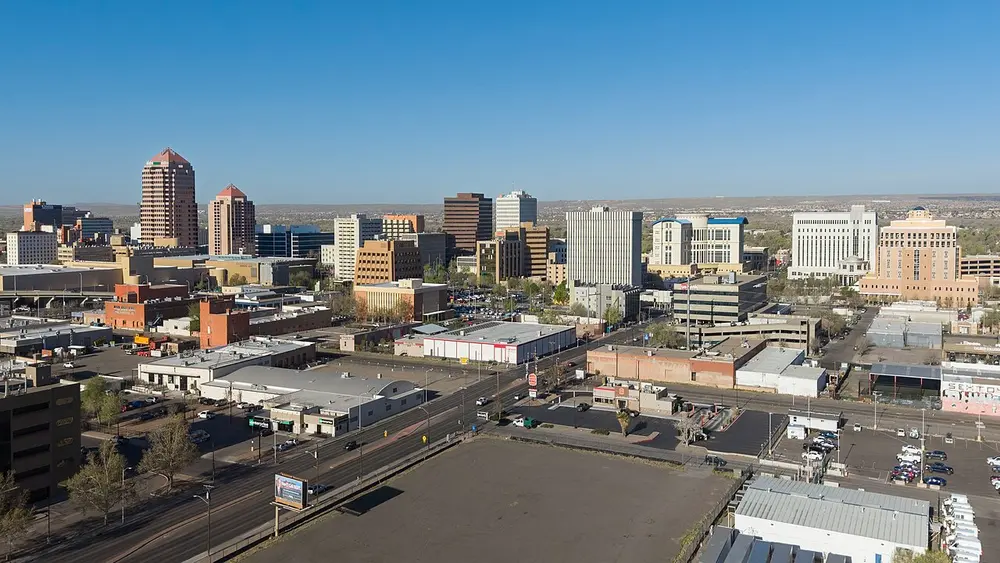
Albuquerque, New Mexico skyline. Photo: Quintin Soloviev / Wikimedia Commons, CC BY 4.0.
A small race with fast intentions
The flat profile gives the Duke City Marathon its reputation as a place to chase a time. Without a climb to interrupt the rhythm, the course rewards even splits and a patient first half. That is why runners looking for a personal best are drawn to it, despite the altitude.
The name comes from Albuquerque's long-standing nickname, and the race has the feel of a local event rather than a national spectacle. The upside is space on the course and a straightforward morning. The downside is that there are fewer runners to pace with and less crowd noise to lift a tired patch. For a time trial in good company, that is a fair trade.
The city itself is worth a day beyond the race. Old Town, the river bosque and the drive into the Sandias give the trip a shape that a loop around an exhibition centre rarely does. The marathon is the centre of the weekend, but the setting is the reason many runners come back.
What the desert asks
- The altitude. At roughly 1,500 metres, the air is thinner than at sea level. Start easier than your goal pace and let the effort settle before you commit.
- The first 10 km. A flat course with clear skies invites over-optimism. The opening kilometres should feel controlled, not fast.
- Sun and dry air. Clear desert weather is pleasant to race in, but it dehydrates quietly. Use the early stations and carry what you need.
- The quiet stretches. A small field thins quickly. Know your splits and be ready to run your own race.
Frequently asked questions
Answers to the questions runners ask before entering, drawn from this race's course guide and the directory's own data — the sources behind them are listed below.
When is the Duke City Marathon?
The 2026 edition is on 18 October. It is an October race in the New Mexico autumn, with the start arrangements published by the organiser closer to the event.
Is the Duke City Marathon a flat course?
Yes. The full course climbs only about 37 metres, so there is no sustained ascent and no hill that requires specific preparation. It is flat in the usual sense of the word, with the altitude providing the difficulty instead.
Is it a good race for a personal best?
The flat, fast profile gives it a fair claim as a personal-best course. Runners who arrive fit and pace the first half sensibly can run well here. The altitude is the variable to respect, especially if you are travelling from lower ground.
Is it a good first marathon?
It is not the most forgiving introduction to the distance. The course itself is simple, but 1,500 metres of altitude adds a demand that first-timers may not expect, and the small field offers little cover. A runner who has trained at altitude or is willing to pace conservatively can still enjoy it.
Where is the race run?
The race is based in Albuquerque, New Mexico, with the course following the Rio Grande corridor and the surrounding city streets. The Sandia Mountains sit to the east of the city and are visible for much of the morning.
Why is it called the Duke City Marathon?
Duke City is Albuquerque's long-standing nickname, and the race takes its name from it. The event is also known simply as the Duke City Marathon.
More marathons in United States
More marathons in Americas
Sources for this page
What each source below is used for on this page, and where to check this race yourself.
- World Athletics — the label calendar and the road-race regulations. Used to check whether the race holds a World Athletics label, and its elite competition details.
- AIMS — the international course-measurement standard behind the 42.195 km distance, and the AIMS race calendar.
- The organizer's own publications — course maps, race handbooks and published results. The date, course character and climbing on this page are compiled from them and re-checked each season.
Where do these facts come from?
Dates, course type, climbing and time limits are compiled from the organizer's publications and re-checked each season; elevation is an estimate of total climbing rather than a survey figure. Always confirm race-day details with the organizer before making plans.
Last reviewed 27 October 2026