
Biwako Marathon
The Biwako Marathon keeps one thing in view for almost the entire race: water. It leaves Otsu on 14 March 2027 and follows the shore of Lake Biwa, with the lake on one side and the mountains of Shiga…
By Global Marathon Routes editorial team · Last reviewed 27 October 2026
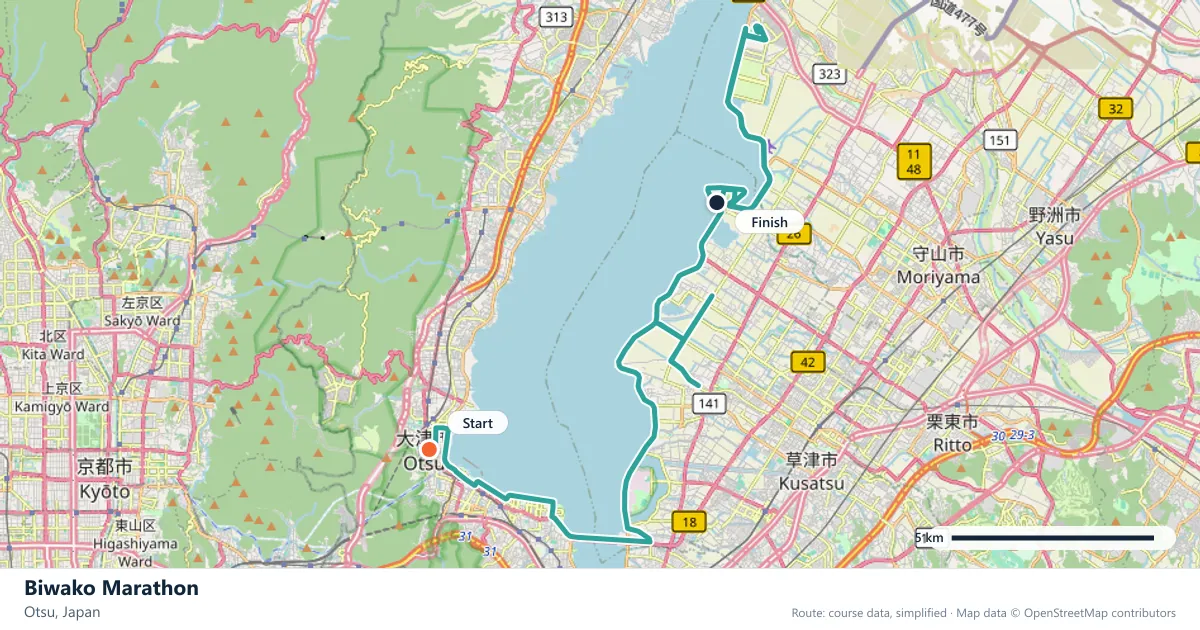
Where does the Biwako Marathon run?
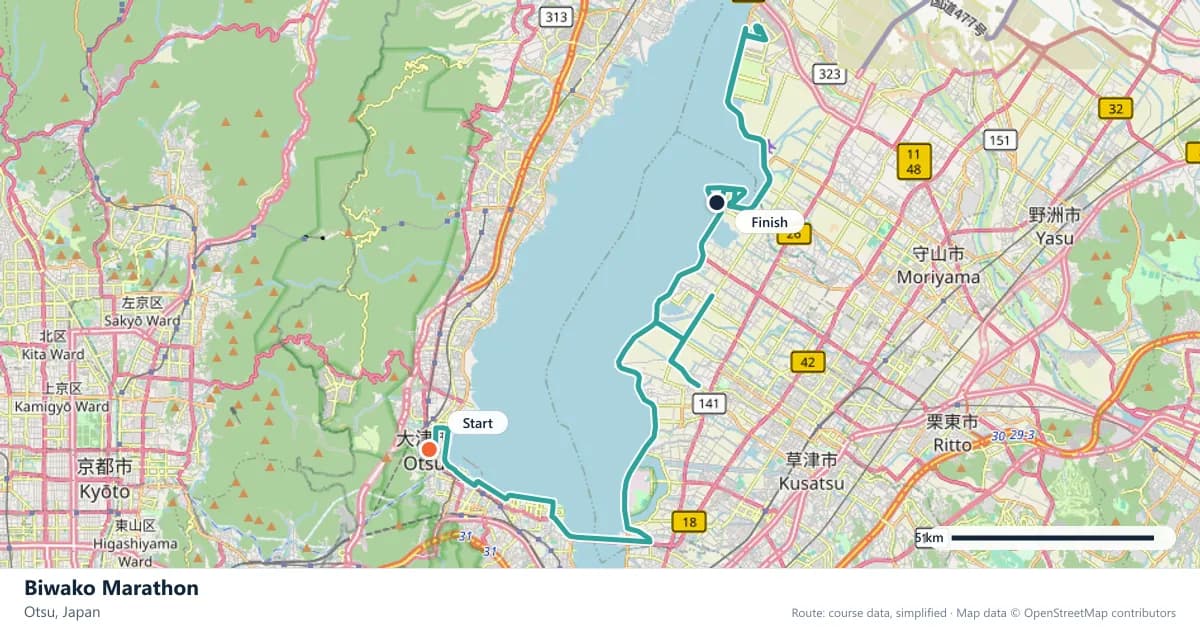
Interactive map
The trace follows the organizer's published course, simplified for the screen: the orange dot is the start, the dark dot the finish. Scroll to zoom, drag to pan.
What is the Biwako Marathon course like?
Runs along the shore of Lake Biwa out of Otsu, with the water on one side and the mountains on the other. Flat, quiet and a very Japanese kind of race day.
- Next edition
- 14 March 2027
- Elevation gain
- 95 m
- Profile
- Flat
- First run
- —
Course guide
The Biwako Marathon keeps one thing in view for almost the entire race: water. It leaves Otsu on 14 March 2027 and follows the shore of Lake Biwa, with the lake on one side and the mountains of Shiga on the other. The route climbs only about 95 metres, and the atmosphere is quiet in the way a Japanese regional race can be.
Otsu is the capital of Shiga Prefecture, and Lake Biwa is the largest lake in Japan. The race uses that geography directly rather than inventing a city loop. There are no skyscrapers or castle crowds here, just a shoreline road, a well-ordered field and long views across the water. It is a race for runners who want to run, not to sightsee.
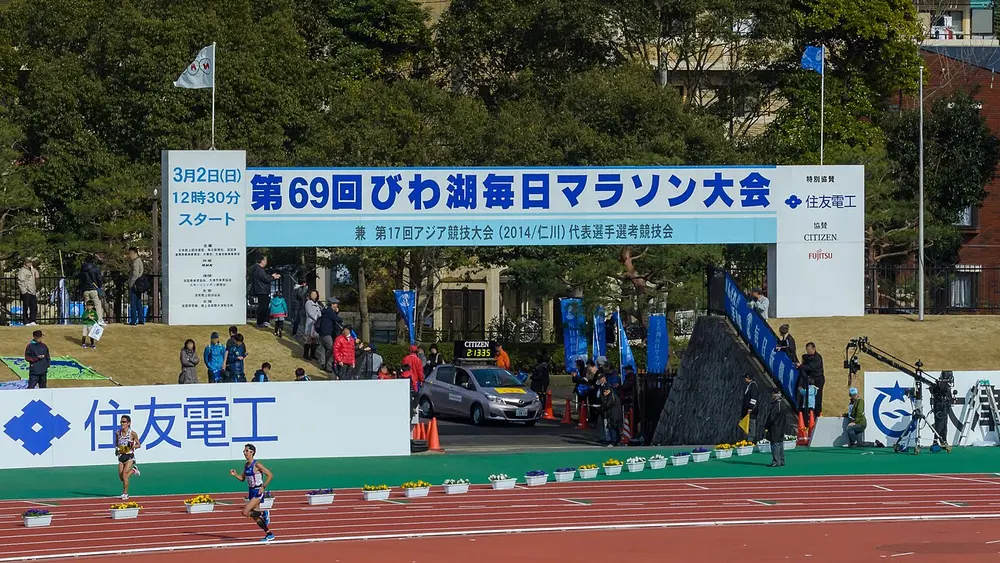
Matathon Gate of the 69th Biwako Mainichi Marathon. Photo: Degueulasse / Wikimedia Commons, CC BY-SA 3.0.
The course
The route runs along the shore of Lake Biwa out of Otsu, with the water on one side and the mountains on the other. The setting is the course's defining feature: a ribbon of road squeezed between lake and hills, with few urban distractions and a lot of horizon.
At about 95 metres of climbing, the profile is flat by marathon standards. There is no sustained ascent, and the lakeside road keeps the grade consistent over long stretches. That consistency is the race's gift and its test. It allows an even rhythm, but it offers no natural brake, and an ambitious opening can carry a long way before it is exposed.
| Race fact | Detail |
|---|---|
| Date | 14 March 2027 |
| Profile | Flat |
| Elevation gain | About 95 m |
| Setting | Lake Biwa shoreline out of Otsu |
Lake Biwa as a running partner
The lake is not scenery in the background. It shapes the route, the light and the sense of distance. On a clear morning the far shore is visible across the water, and the mountains above it give the course a frame that changes slowly as the race progresses.
For much of the race, the water is the only thing on one side and the hills are the only thing on the other. That simplicity is useful. Without constant turns and landmark changes, the mind can settle into the work, and the kilometres can pass in the rhythm of the shoreline rather than in a series of distractions.
A March date in Otsu
The race is held on 14 March 2027, in the early Japanese spring. The date sits in a season when the lake and the mountains are emerging from winter, and the morning can carry a mix of conditions rather than one settled pattern.
Even splits by the water
The relative flatness makes the Biwako Marathon a good place to run by feel and by plan. There is little to interrupt a target pace, and the long lakeside stretches allow a runner to lock into a rhythm and stay there. That is why the course is suited to fast times, and why it rewards discipline more than strength.
The danger is that the same flatness makes a fast start feel comfortable. The first few kilometres can slip by at a pace the second half will not support, and the absence of hills means there is no obvious early warning. A conservative opening, with the halfway point treated as the real beginning of the race, is the safer way to use the course.

Satoru Sasaki at 2014 Biwako Mainichi Marathon. Photo: Degueulasse / Wikimedia Commons, CC BY-SA 4.0.
Otsu, Kyoto and the quiet
Otsu sits on the southern shore of Lake Biwa and is easily reached by rail from Kyoto, which makes it a practical base for runners who want a quieter race than the big-city marathons of the Kansai region. The city is compact, the shoreline is close, and the race morning does not have the scale of an urban mega-event.
That quiet is part of the appeal. The field is spread along the lake, the support is local, and there are long stretches where the only sound is the rhythm of feet on the road.
Lakeside discipline
- No natural brake. About 95 metres of climbing means the course never slows you down by itself. Hold back early and let the flat kilometres work for you.
- Open shoreline. The road follows the water and offers little shelter. Dress for the day and be ready for a changeable spring morning.
- Quiet stretches. With fewer crowds, you have to supply your own energy. Break the race into sections and use the landscape as a marker.
- The lake view. It is easy to drift while looking across the water. Keep an eye on your splits as well as the horizon.
- Staying in Kyoto. Otsu is a short rail ride from Kyoto, but race-morning trains and station crowds still need planning.
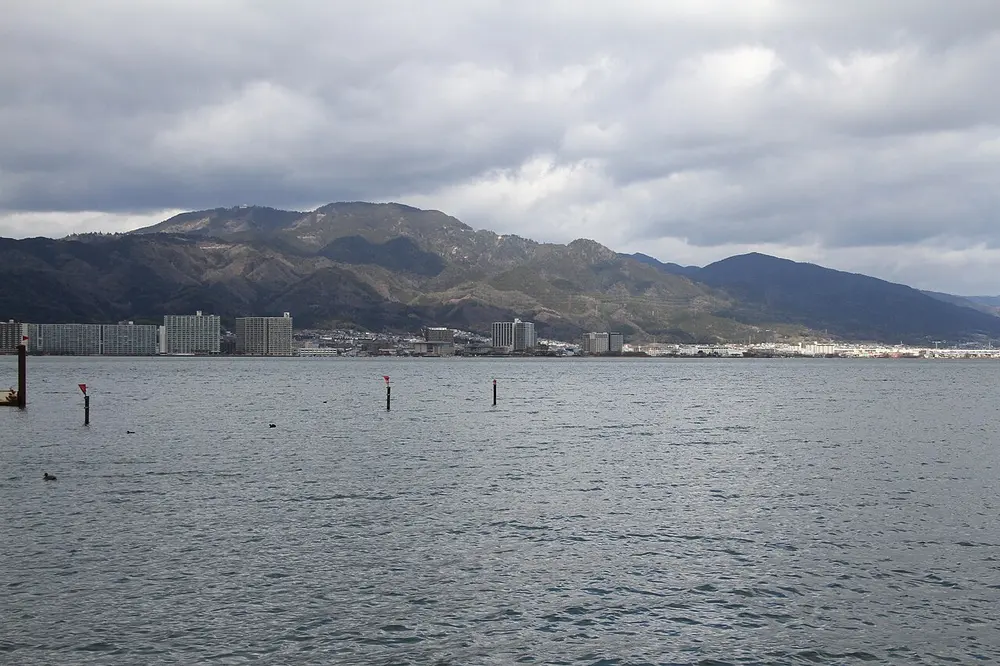
OTSU bords du lac vue1. Photo: Hyppolyte de Saint-Rambert / Wikimedia Commons, CC BY-SA 4.0.
Frequently asked questions
Answers to the questions runners ask before entering, drawn from this race's course guide and the directory's own data — the sources behind them are listed below.
When is the Biwako Marathon in 2027?
The race is on 14 March 2027. It is held in early spring on the shore of Lake Biwa.
Is the Biwako Marathon a flat course?
Yes. It climbs about 95 metres over the full distance, with no sustained ascent. The lakeside road is consistent, and the profile is flat by marathon standards.
Is the Biwako Marathon good for a personal best?
The course is suited to fast times. The flat profile, long lakeside stretches and consistent grade make even pacing achievable. A personal best still depends on the day, but the terrain gives a well-prepared runner a fair chance.
What is the atmosphere like at the Biwako Marathon?
It is quiet and local. The field spreads along the lake, support is concentrated around the towns on the route, and there are long stretches where you hear only the runners around you. Runners who thrive on big-city noise should adjust their expectations; the calm suits those who prefer to work alone.
Where is the Biwako Marathon run?
It runs along the shore of Lake Biwa out of Otsu in Shiga Prefecture, Japan, with the water on one side and the mountains on the other.
What does Biwako mean?
Biwako is the Japanese name for Lake Biwa. The marathon takes its name from the lake whose shoreline it follows, not from a district of Otsu.
More marathons in Japan
More marathons in Asia
Sources for this page
What each source below is used for on this page, and where to check this race yourself.
- World Athletics — the label calendar and the road-race regulations. Used to check whether the race holds a World Athletics label, and its elite competition details.
- AIMS — the international course-measurement standard behind the 42.195 km distance, and the AIMS race calendar.
- The organizer's own publications — course maps, race handbooks and published results. The date, course character and climbing on this page are compiled from them and re-checked each season.
Where do these facts come from?
Dates, course type, climbing and time limits are compiled from the organizer's publications and re-checked each season; elevation is an estimate of total climbing rather than a survey figure. Always confirm race-day details with the organizer before making plans.
Last reviewed 27 October 2026