
Shanghai Marathon
China's flagship marathon is also one of its most straightforward courses. The Shanghai Marathon runs on both sides of the Huangpu, passes the Bund and the former French concession, and climbs only…
By Global Marathon Routes editorial team · Last reviewed 27 October 2026
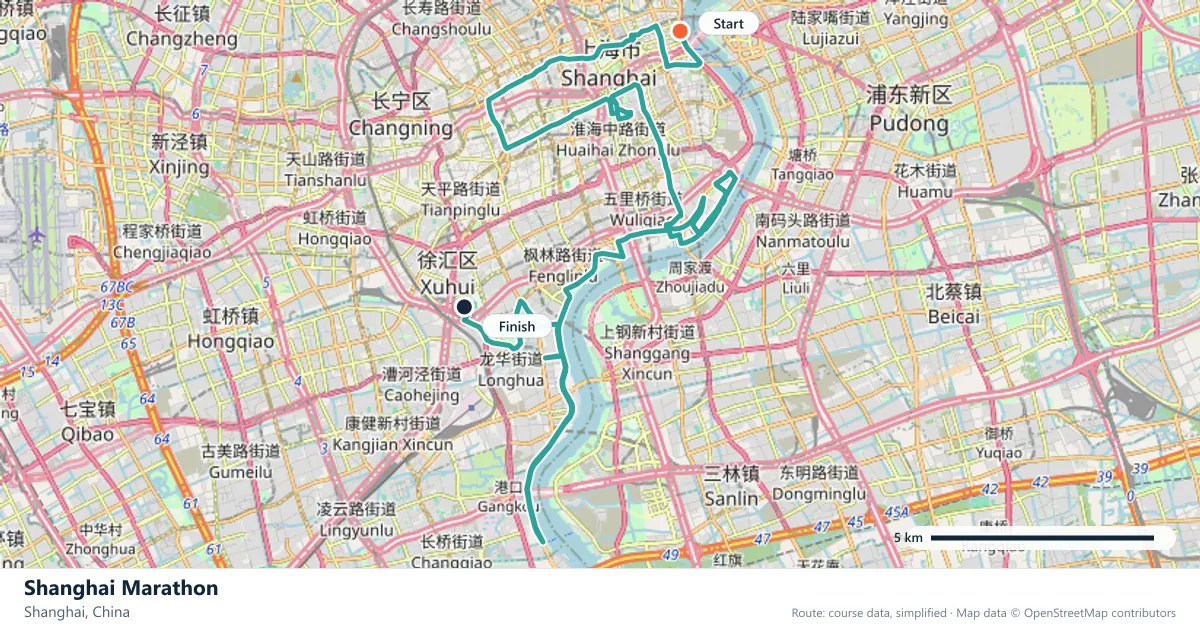
Where does the Shanghai Marathon run?
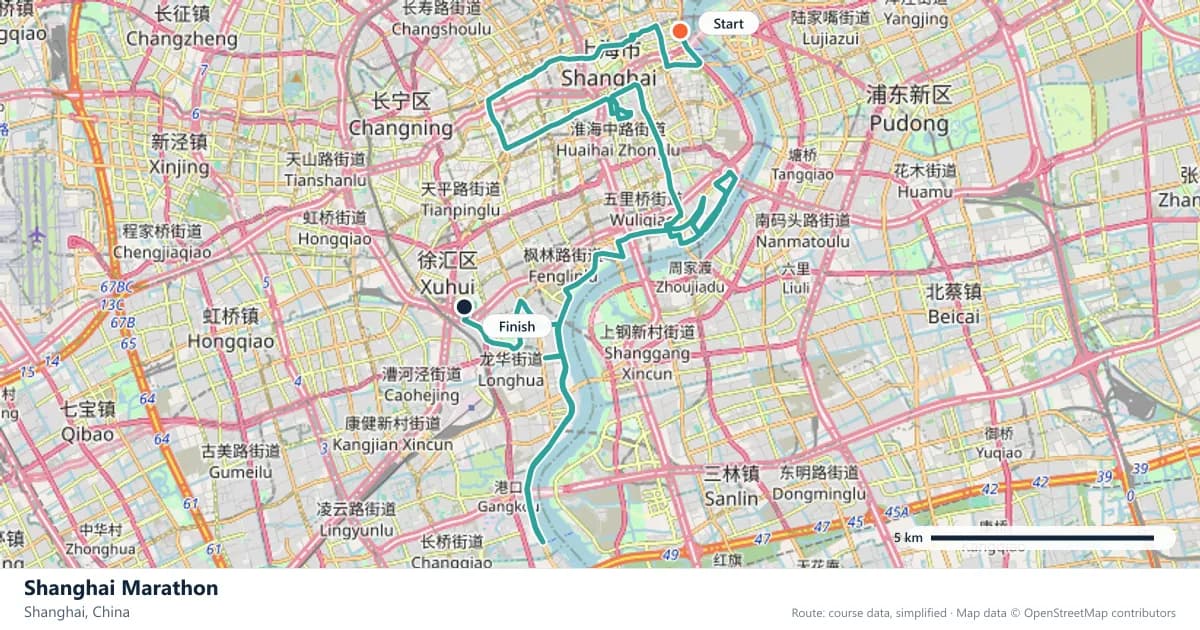
Interactive map
The trace follows the organizer's published course, simplified for the screen: the orange dot is the start, the dark dot the finish. Scroll to zoom, drag to pan.
What is the Shanghai Marathon course like?
China's flagship marathon, run in December on both sides of the Huangpu, past the Bund and the former French concession. Flat, fast and heavily oversubscribed.
- Next edition
- 06 December 2026
- Elevation gain
- 75 m
- Profile
- Flat
- First run
- —
Course guide
China's flagship marathon is also one of its most straightforward courses. The Shanghai Marathon runs on both sides of the Huangpu, passes the Bund and the former French concession, and climbs only about 75 metres over 42.195 kilometres. The next edition is on 6 December 2026, and the race carries a World Athletics Platinum Label.
The flatness is the point. Shanghai is a city of wide boulevards, river crossings and dense waterfronts, and the marathon uses all three without ever asking the legs to climb. The harder obstacle is getting a place: the race is heavily oversubscribed, and the entry is often settled long before race weekend.
Pyongyang Marathon - Shanghai departure. Photo: Uri Tours / Wikimedia Commons, CC BY-SA 2.0.
The course
The route crosses both sides of the Huangpu and passes the Bund and the former French concession. Those areas give the race its contrast: the waterfront skyline on one bank and older, tree-lined streets on the other. The course is flat throughout, with about 75 metres of climbing in total, and there is no sustained ascent anywhere on the route.
That profile makes the marathon a rhythm exercise. The wide roads accommodate a large field, the river crossings break the route into distinct chapters, and the landmarks arrive often enough to keep the attention occupied. Nothing on the course demands a change of gear; the day is decided by how well you hold the pace you choose.
Two banks, two cities
The Huangpu is the hinge of the race. Crossing it changes the view, the road and the atmosphere, and each bank has a different relationship with the water. The Bund side is formal and waterfront-facing; the former French concession side is greener, with narrower streets and a residential feel.
Those transitions are the most interesting parts of the course, but they are also where rhythm can slip. Runners should treat each crossing as a chance to reset: check the effort, take fluids if needed and settle back into the plan rather than chasing the change of scene.
The Bund and the plane trees
The Bund is Shanghai's signature waterfront, a long promenade of historic buildings facing the river. The marathon uses it as one of the race's great set pieces, and it is the point where the city's scale is most obvious. Across the water, the skyline of Pudong provides the contrast that makes the Bund famous.
The former French concession provides the other half of the picture. Its streets are lined with plane trees, and the canopy gives the race a softer, more intimate stretch after the exposure of the waterfront. Together, the two areas make Shanghai a sightseeing marathon that also happens to be fast.
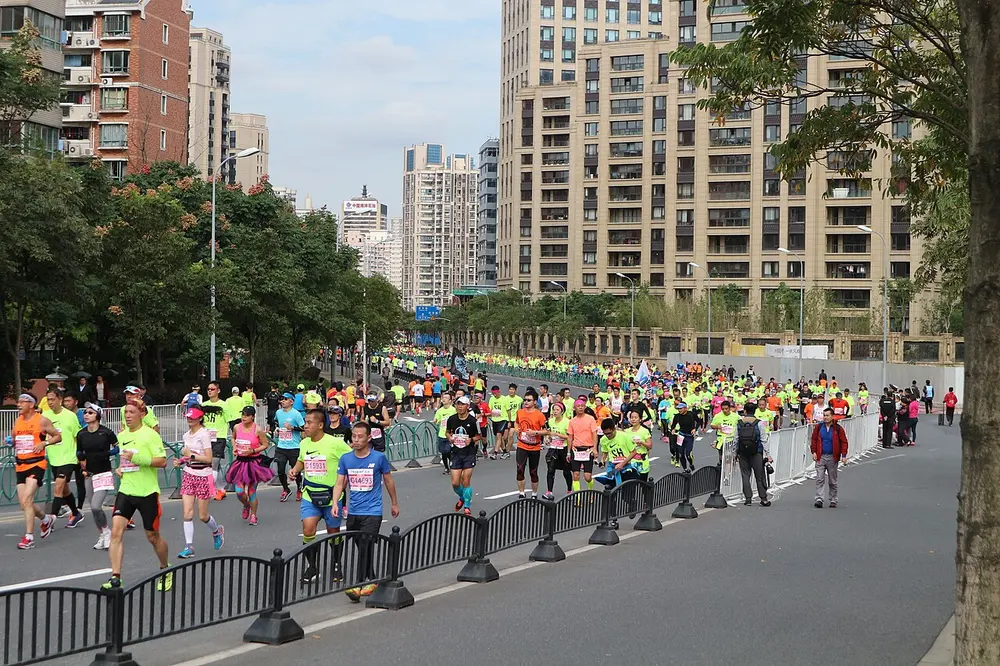
Shanghai International Marathon 2016. Photo: 中日韩越的汉字 / Wikimedia Commons, CC BY-SA 4.0.
Flat ground, fast times
With about 75 metres of climbing, Shanghai is a natural personal-best course. The flat profile suits runners who have trained for even pacing, and the city setting provides enough distraction to keep the middle kilometres from dragging. The Platinum Label reflects the standard of the event and the depth of its organisation.
It is equally approachable as a first marathon. There are no hills to drain the legs early, the roads are wide and the route is easy to understand. The caveat is the same for everyone: a flat course does not force restraint, so the first half can quietly become too fast. The best debut is the one that starts slower than it feels necessary.
The entry is the hard part
Shanghai's marathon is heavily oversubscribed, which makes the entry the first real challenge of the campaign. The course is not the obstacle; the number of runners who want to run it is. Anyone planning a trip around the race should settle the entry before booking flights and hotels.
The organiser's published process is the place to confirm categories and deadlines. There is no shortcut around the demand, and the practical advice is simple: treat the entry as part of the training plan and give it a date, not an intention.
December in Shanghai
The race is held in December, which places it in winter and gives the event a different feel from the autumn marathons elsewhere in China. The city is still busy, the waterfront is still dramatic and the flat course remains fast. Conditions can vary, so a clothing plan that covers a range is more useful than a single forecast.
The December date also makes the race a late-season target. Runners coming off an autumn marathon have time to recover and rebuild; runners targeting a spring race can use Shanghai as a fast, well-organised stepping stone. Either way, the course rewards consistency rather than a last-minute change of plan.

Justice Richard Bernstein in Shanghai 01. Photo: U.S. Consulate General Shanghai 美国驻上海总领事馆 / Wikimedia Commons, Public domain.
Frequently asked questions
Answers to the questions runners ask before entering, drawn from this race's course guide and the directory's own data — the sources behind them are listed below.
When is the Shanghai Marathon?
The race is on 6 December 2026. It is a winter race and one of the flagship events on the Chinese calendar.
Is the Shanghai Marathon a flat course?
Yes. It climbs about 75 metres over 42.195 kilometres, with no sustained ascent. The course is flat and fast, and the wide roads support a large field.
Where does the course run?
The route uses both sides of the Huangpu and passes the Bund and the former French concession. The river crossings divide the race into distinct chapters.
Is Shanghai a good race for a personal best?
The flat profile and fast city course make it a strong candidate for a personal best. The main risk is starting too quickly because the course never forces you to slow down.
Is it a good first marathon?
The terrain is friendly for a first attempt: flat roads, no sustained climbs and a straightforward route. The entry is the bigger hurdle, and the size of the event means conservative pacing matters.
Does the Shanghai Marathon hold a World Athletics label?
Yes. The race carries a World Athletics Platinum Label.
More marathons in China
More marathons in Asia
Sources for this page
What each source below is used for on this page, and where to check this race yourself.
- World Athletics — the label calendar and the road-race regulations. Used to check whether the race holds a World Athletics label, and its elite competition details.
- AIMS — the international course-measurement standard behind the 42.195 km distance, and the AIMS race calendar.
- The organizer's own publications — course maps, race handbooks and published results. The date, course character and climbing on this page are compiled from them and re-checked each season.
“A World Athletics Label denotes a full application of the Competition and Technical Rules in, at a minimum, the elite component of the competition. Labels also denote superior standards in event organisation, safety and runner experience, support from public authorities to the event and a financial commitment to anti-doping.”
Where do these facts come from?
Dates, course type, climbing and time limits are compiled from the organizer's publications and re-checked each season; elevation is an estimate of total climbing rather than a survey figure. Always confirm race-day details with the organizer before making plans.
Last reviewed 27 October 2026