
Interactive course map
aid stations: 18 · landmarks: 8Official course map
Open full size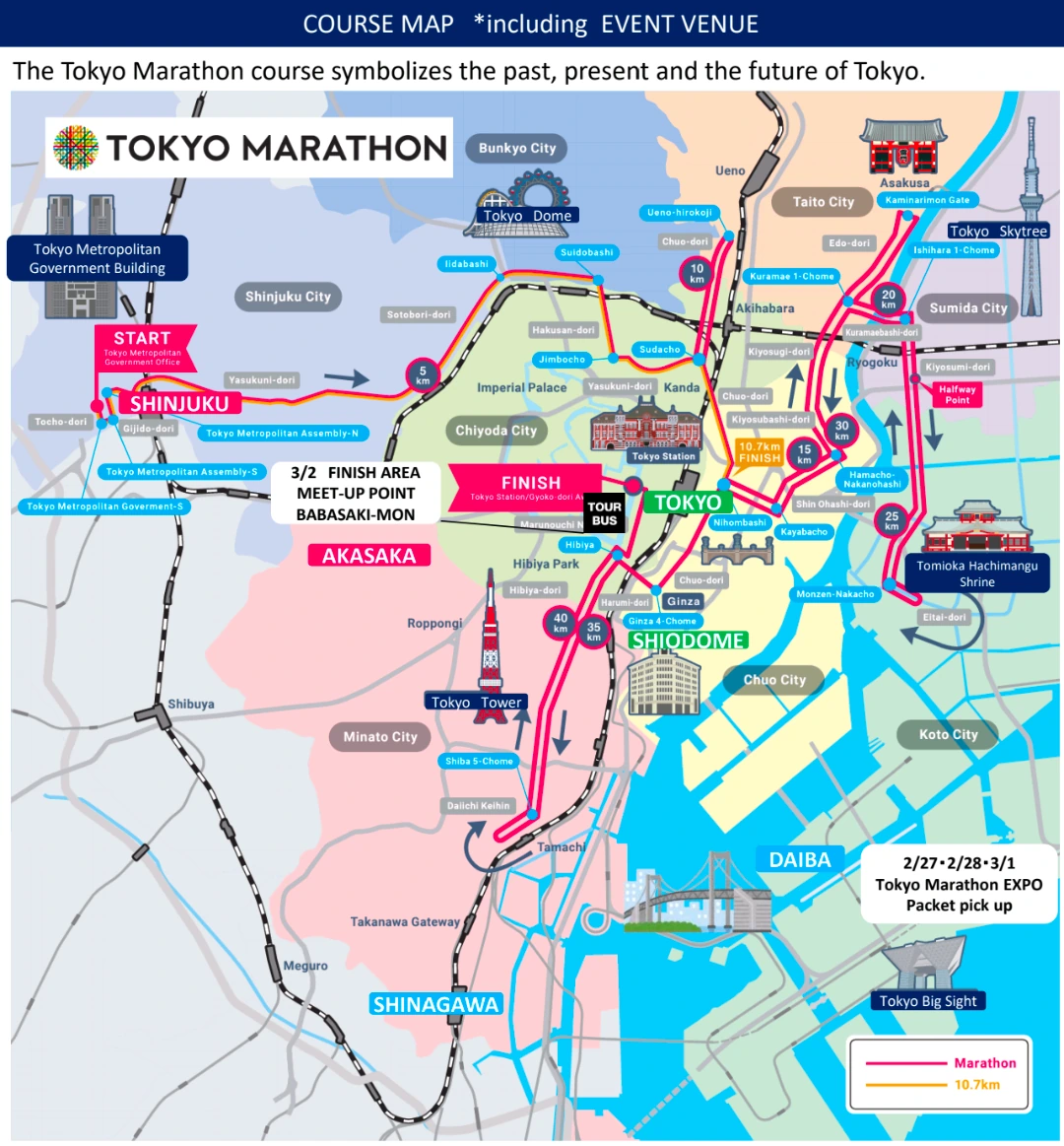
Race facts
Tokyo MarathonLandmarks along the way
- StartTokyo Metropolitan Government
- 2 kmShinjuku
- 7 kmTokyo Dome
- 13 kmNihonbashi
- 19 kmKaminarimon, Asakusa
- 24 kmTomioka Hachimangu
- 34 kmGinza
- FinishTokyo Station
Aid stations and timing points
Major stations modelled on the published course maps, plus the half marathon split. Real races place stations closer together, so treat the spacing as indicative.
Course guide
Tokyo has been part of the Abbott World Marathon Majors since 2013 and is the only Asian race in the series. The course is flat, fast and precisely organised, with a start in Shinjuku and a finish beside Tokyo Station.
The course
The race leaves the Tokyo Metropolitan Government building in Shinjuku and heads east through the city, passing Nihonbashi and continuing towards Asakusa, where the route runs past the Kaminarimon gate of Senso-ji temple. From there it turns south and back west, passing through Ginza and the business districts before finishing on Gyoko-dori in front of Tokyo Station.
The profile is close to pancake flat, with only bridge approaches and gentle ramps breaking the rhythm. That makes it one of the best majors for a personal best.
| Section | KM | Character |
|---|---|---|
| Shinjuku | 0 to 8 | Wide roads, downhill start |
| Nihonbashi and Kanda | 8 to 15 | Flat, dense city, good support |
| Asakusa | 15 to 20 | Temple district, turnarounds |
| Ginza and Tsukiji | 20 to 32 | Flat, exposed, sharp turns |
| Tokyo Station | 32 to 42.195 | Flat run to the finish |
Aid stations and the half split
Aid stations are frequent and stocked with water, sports drinks and fruit, plus the famously well organised private support along the route. The half marathon split falls in the Ginza section. Gels appear in the second half and medical points are placed at the major turns.
What to watch for
- Turnarounds. The course has several out and back sections, and the tight turns cost more time than the flat profile suggests.
- Cold starts. March mornings are often 3 to 8 °C with a wind between the buildings.
- Cut-off times. Tokyo enforces strict checkpoint cut-offs, which matter if you are aiming to finish rather than race.
- Entry odds. Domestic and international ballots are extremely oversubscribed.
Records
| Category | Time | Athlete | Year |
|---|---|---|---|
| Men's course record | 2:03:37 | Tadese Takele | 2026 |
| Women's course record | 2:14:29 | Brigid Kosgei | 2026 |
Practical notes
- Race day: first Sunday of March. The next edition is scheduled for 7 March 2027.
- Entry: ballot for both domestic and international runners, plus charity and semi elite entry.
- Getting there: the start at the Tokyo Metropolitan Government building is served by Tochomae and Shinjuku stations. The finish near Tokyo Station is served by Tokyo and Otemachi stations.
- Weather: typically 3 to 13 °C, dry, with a chance of strong wind.
Frequently asked questions
Quick answers to what runners ask most about this race. Every figure is checked against the official sources listed below.
When is the Tokyo Marathon held?
The Tokyo Marathon is held on the first Sunday of March. The next edition is scheduled for 7 March 2027. Tokyo has been part of the Abbott World Marathon Majors since 2013 and is the only Asian race in the series.
How do you enter the Tokyo Marathon?
Entry is by ballot, with separate pools for domestic and international runners, plus charity places and a small semi elite field. Both ballots are heavily oversubscribed, so most applicants need several attempts or a charity place. Check the official site for the current entry window.
Is the Tokyo Marathon course fast?
Yes. The profile is close to pancake flat, with only bridge approaches and gentle ramps breaking the rhythm, which is why Tokyo is a popular target for a personal best. The cost is the turnarounds: the out and back sections contain tight corners that slow you more than the flat profile suggests.
Where does the Tokyo Marathon start and finish?
It starts at the Tokyo Metropolitan Government building in Shinjuku and finishes on Gyoko-dori in front of Tokyo Station. The start is served by Tochomae and Shinjuku stations; the finish is served by Tokyo and Otemachi stations.
What is the weather like on race day?
Early March in Tokyo is cool and usually dry, typically 3 to 13 °C, with mornings often at 3 to 8 °C and a cold wind funnelling between the buildings. It is good running weather provided you plan for the wait in the start pen.
Are there cut-off times?
Yes. Tokyo enforces checkpoints along the course with strict cut-off times, which matter most if you are aiming to finish rather than race. The published limits are tightened each year, so confirm them on the official site.
About this guide
Compiled by the site's editorial team from public race-organizer publications, course maps and results, then re-checked against the official race site before publishing. Course traces on the map follow the organizer's published course, simplified for the screen.
By
Global Marathon Routes editorial team
- Published
- Last updated
Checked against the official sources listed on this page.
Sources for this guide
Facts, dates and records on this page are taken from the primary sources below. Always confirm race-day details with the organizer.
Related links
Encyclopaedia entries for this race and the organizer's own site: history, records and background reading beyond this guide.