
Nagoya Women's Marathon
The Nagoya Women's Marathon is the world's largest women's marathon, and it finishes indoors. The next edition is on 14 March 2027, with an elite field running alongside a mass race and a city course…
By Global Marathon Routes editorial team · Last reviewed 27 October 2026
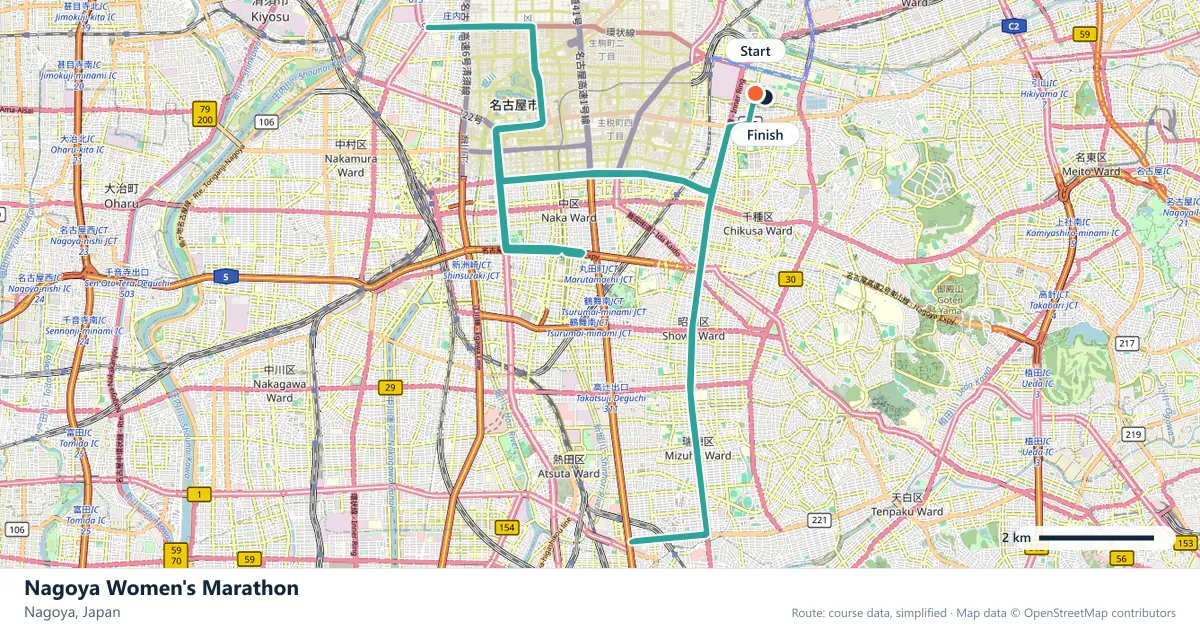
Where does the Nagoya Women's Marathon run?
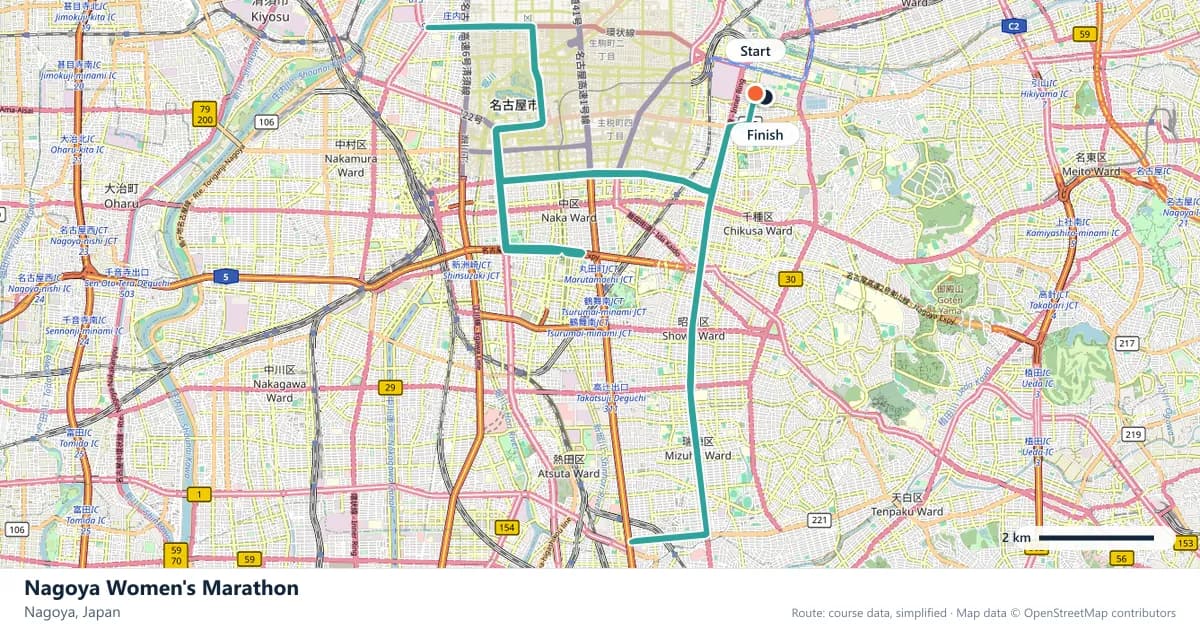
Interactive map
The trace follows the organizer's published course, simplified for the screen: the orange dot is the start, the dark dot the finish. Scroll to zoom, drag to pan.
What is the Nagoya Women's Marathon course like?
The world's largest women's marathon, run in March with an elite field alongside a mass race. A city course through Nagoya that finishes inside the Vantelin Dome.
- Next edition
- 14 March 2027
- Elevation gain
- 125 m
- Profile
- Undulating
- First run
- —
Course guide
The Nagoya Women's Marathon is the world's largest women's marathon, and it finishes indoors. The next edition is on 14 March 2027, with an elite field running alongside a mass race and a city course that ends inside the Vantelin Dome. The profile is undulating, with about 125 metres of climbing.
That combination makes Nagoya unusual. The front of the race is serious and deep, while the mass event is large and welcoming. The course is gentle enough for a first marathon and quick enough for a personal best, and the dome finish gives the day a finale that no ordinary city marathon can match.
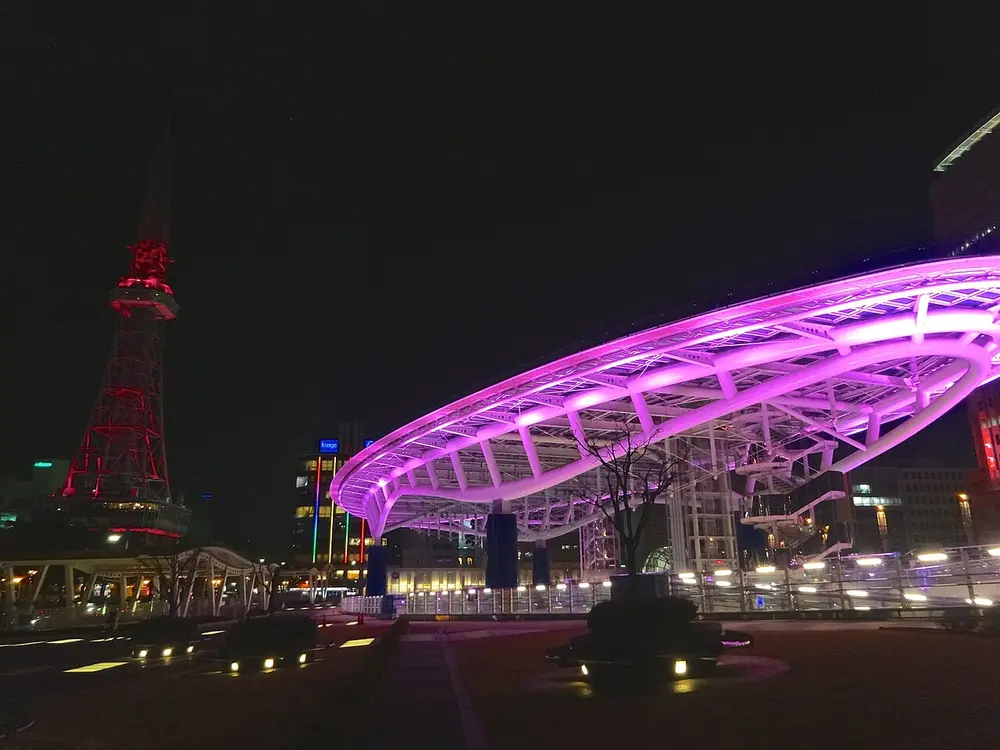
Nagoya TV tower and Oasis21 illumination for Nagoya Womens Marathon. Photo: KKPCW / Wikimedia Commons, CC BY-SA 4.0.
The course
The route is a city course through Nagoya, passing through the urban grid before turning towards the Vantelin Dome. The dome ending is the race's signature: runners enter a stadium and complete the marathon indoors.
The profile is not flat: around 125 metres of climbing is spread across 42.195 kilometres in short rises, and the roads are generally wide enough for the field to settle. It rewards patience rather than a specific hill workout. The elite presence shapes the atmosphere more than the terrain, so settle into your own rhythm before halfway.
The dome finish
Finishing inside the Vantelin Dome is the reason many runners choose Nagoya. The final approach takes the race off the street and into a stadium, and the last metres are run in an enclosed, echoing arena rather than on an open road. It is a rare finish for a marathon and a memorable one.
The dome also changes the way the final kilometres feel. The noise builds, the light changes and the sense of occasion carries runners through the last effort. Save a little for the entrance; the finish is worth arriving at with something left.
Elite field, mass race
Nagoya pairs an elite women's field with a mass event, and the two races share the same course. The elite runners at the front are chasing times and places; the mass field is chasing finishes, personal bests and the experience of a major women's marathon.
That mix gives the race a dual identity. The presence of the elite field raises the standard and the atmosphere, but it can also tempt mass runners to start too quickly. The leaders' pace is not a pacing plan for the rest of the field. Run your own race and let the front go.

Nagoya Women's Marathon 2020 Fushimi Station 20200307. Photo: 円周率3パーセント / Wikimedia Commons, CC BY-SA 4.0.
March in Nagoya
The race is held in March, at the start of spring. The date gives the marathon a different feel from the autumn races that dominate the Japanese calendar, and it makes the training block a winter project for many runners.
Spring weather can vary, so the clothing plan should cover a range. The city course offers plenty of support and the dome finish provides a fixed endpoint, but the conditions on the street still shape the day. Prepare for change rather than assuming a single forecast.
The city course
Nagoya is a large, orderly city, and the marathon uses its main streets rather than a scenic loop. The route passes through the urban grid, with wide roads and a steady stream of spectators. It is not a waterfront course or a mountain course; it is a city marathon in the traditional sense.
That straightforwardness is part of the appeal. The course is easy to follow, the field has room to move and the finish is a clear target. Runners who want a big-city race with a distinctive ending will find Nagoya delivers both.
A fast course with a friendly face
About 125 metres of climbing is modest for a city marathon, and the short rises are easy to manage with even pacing. The course is quick enough to support a personal best, and the mass race is welcoming enough for a first attempt. The elite field adds depth without changing the character of the route.
As the world's largest women's marathon, it has a scale and atmosphere that few events can match. The dome finish is the memory that stays.
Nagoya Women's Marathon Myoondori 20180310. Photo: 円周率3パーセント / Wikimedia Commons, CC BY-SA 4.0.
Frequently asked questions
Answers to the questions runners ask before entering, drawn from this race's course guide and the directory's own data — the sources behind them are listed below.
When is the Nagoya Women's Marathon?
The race is on 14 March 2027. It is a March race that combines an elite women's field with a mass event.
Is the Nagoya Women's Marathon flat?
Not quite. It is undulating, with about 125 metres of climbing over 42.195 kilometres. The rises are short and the roads are wide, so it feels quicker than the total suggests, but it is not completely flat.
Where does the race finish?
The marathon finishes inside the Vantelin Dome. The final approach leaves the city streets and completes the race indoors.
Is it only for women?
Yes. It is a women's marathon, with an elite field running alongside the mass race.
Is Nagoya suitable for a first marathon or a personal best?
The gentle profile and large mass field make a first attempt manageable, while the same features give a personal-best bid a fair chance. Discipline in the first half still matters.
What is the atmosphere like?
The race is the world's largest women's marathon, so the mass field is enormous. The elite field adds a serious front end, and the dome finish gives the day a distinctive finale.
More marathons in Japan
More marathons in Asia
Sources for this page
What each source below is used for on this page, and where to check this race yourself.
- World Athletics — the label calendar and the road-race regulations. Used to check whether the race holds a World Athletics label, and its elite competition details.
- AIMS — the international course-measurement standard behind the 42.195 km distance, and the AIMS race calendar.
- The organizer's own publications — course maps, race handbooks and published results. The date, course character and climbing on this page are compiled from them and re-checked each season.
Where do these facts come from?
Dates, course type, climbing and time limits are compiled from the organizer's publications and re-checked each season; elevation is an estimate of total climbing rather than a survey figure. Always confirm race-day details with the organizer before making plans.
Last reviewed 27 October 2026