
Seoul Marathon
The Seoul Marathon is Korea's oldest and fastest marathon, and its course is built to prove the second point.
By Global Marathon Routes editorial team · Last reviewed 27 October 2026
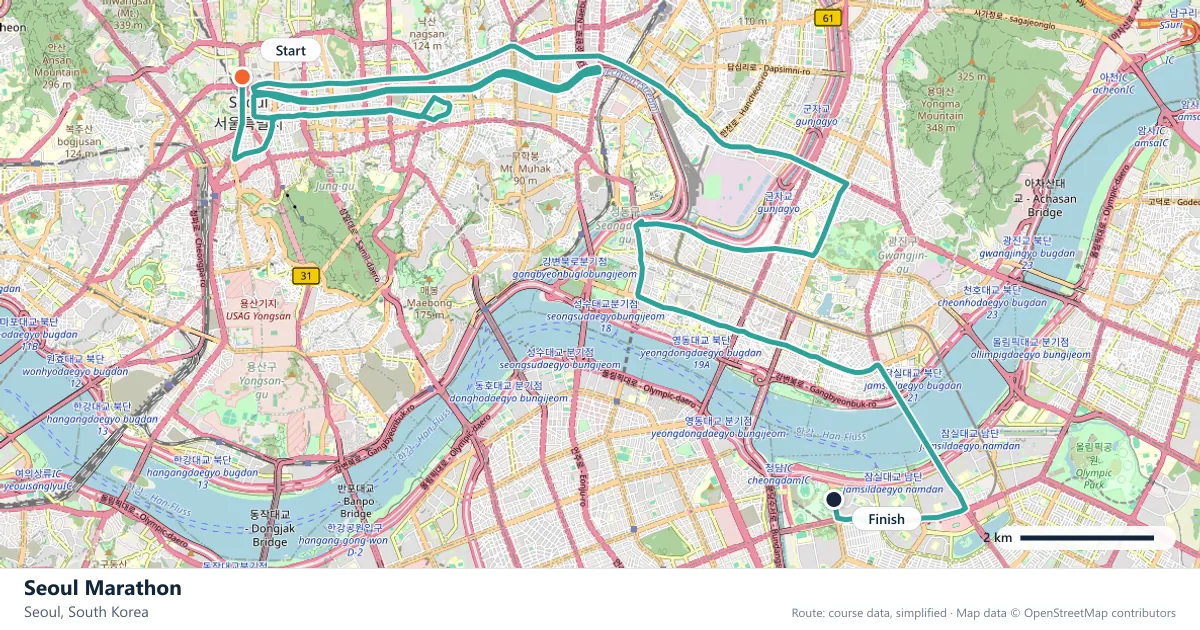
Where does the Seoul Marathon run?
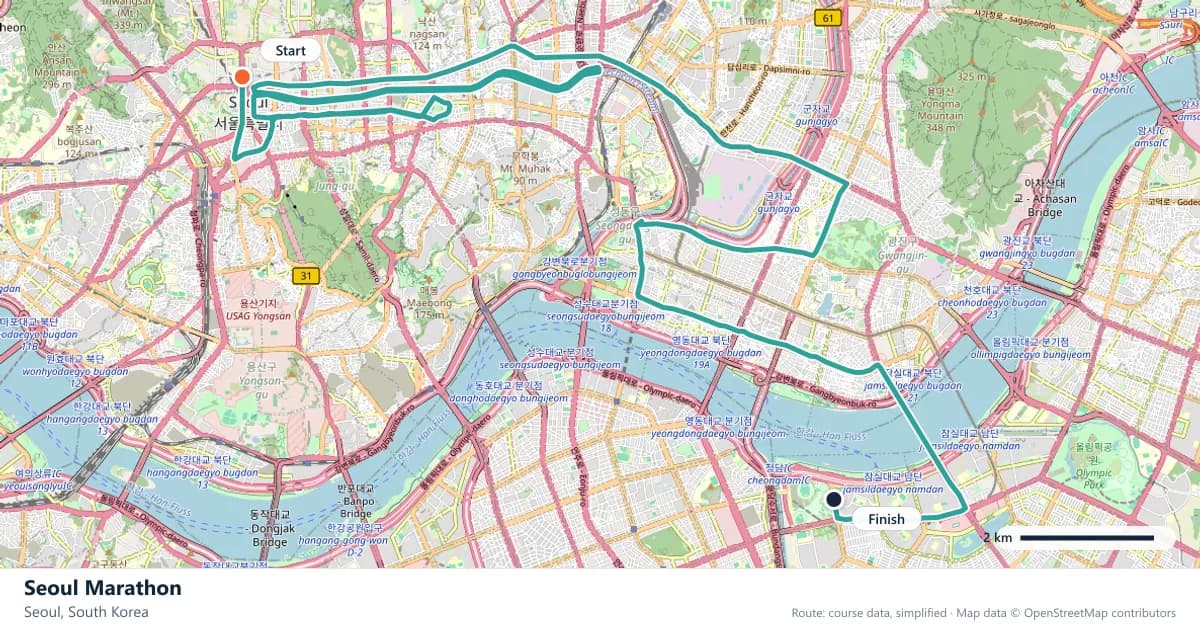
Interactive map
The trace follows the organizer's published course, simplified for the screen: the orange dot is the start, the dark dot the finish. Scroll to zoom, drag to pan.
What is the Seoul Marathon course like?
Korea's oldest and fastest marathon, run along the Han river in March from Gwanghwamun to the Olympic Stadium. Flat, wide and built for fast times.
- Next edition
- 21 March 2027
- Elevation gain
- 93 m
- Profile
- Flat
- First run
- —
Course guide
The Seoul Marathon is Korea's oldest and fastest marathon, and its course is built to prove the second point. The 2027 edition is on 21 March, running from Gwanghwamun along the Han river to the Olympic Stadium. It holds a World Athletics Platinum Label, climbs about 93 metres and is designed for fast, uninterrupted running.
The route is a point-to-point line across the city rather than a loop. The start sits in the historic centre, the Han provides the long spine of the race, and the finish arrives at an Olympic venue. For runners, the appeal is simple: wide roads, a flat profile and a course that lets a steady pace do the work.
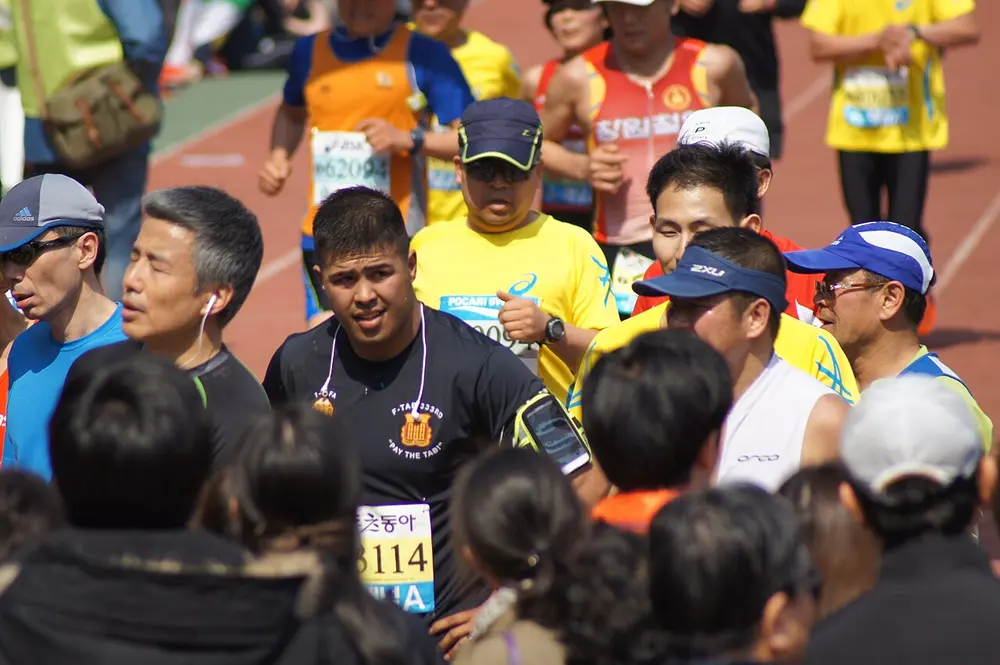
Leisure – Steel team runs Seoul International Marathon 140316-A-ME210. Photo: Capt. Kelly Pickett / Wikimedia Commons, Public domain.
The course
The race starts at Gwanghwamun and follows the Han river before finishing at the Olympic Stadium. The river is the spine of the course, giving long, flat, uninterrupted stretches and a clear sense of direction. The opening kilometres are more urban and more enclosed, while the riverside section opens the route up.
The profile climbs only about 93 metres, with no sustained ascents. Wide roads allow the field to spread out, and the point-to-point layout removes the repetition of an out-and-back. The result is a course that rewards even pacing and makes it easy to settle into a rhythm early, provided you are disciplined enough not to chase the runners around you.
| Race fact | Detail |
|---|---|
| Date | 21 March 2027 |
| Profile | Flat |
| Elevation gain | About 93 m |
| Label | World Athletics Platinum Label |
| Layout | Gwanghwamun to the Olympic Stadium, along the Han river |
The Han river corridor
The Han is the defining feature of the race. Once the course reaches the river, the buildings thin out, the road opens, and the marathon becomes a long, rhythmic run beside the water. The riverbank is wide and flat, and the route follows it for long enough that the middle of the race can feel almost meditative.
That is both the attraction and the risk. The corridor is fast, but it is also repetitive, and the lack of turns and climbs can make it difficult to judge effort. Runners who rely on landmarks to break up a race will need a different strategy here. Splits, fuelling and a fixed mental routine matter more than scenery in the long riverside kilometres.
A point-to-point race
The start and finish are at different points, which changes the logistics of the day. Gwanghwamun and the Olympic Stadium are both well connected, but the journey between them is not part of the race, and the return after the finish needs planning. Runners should decide in advance how they will get back to their accommodation and where they will meet anyone supporting them.
The point-to-point shape also affects pacing. There is no second pass at the start, no loop back through familiar streets and no easy way to compare the opening and closing kilometres. The course is a line, and the only way to run it well is to commit to a pace that can be held from the first kilometre to the last.
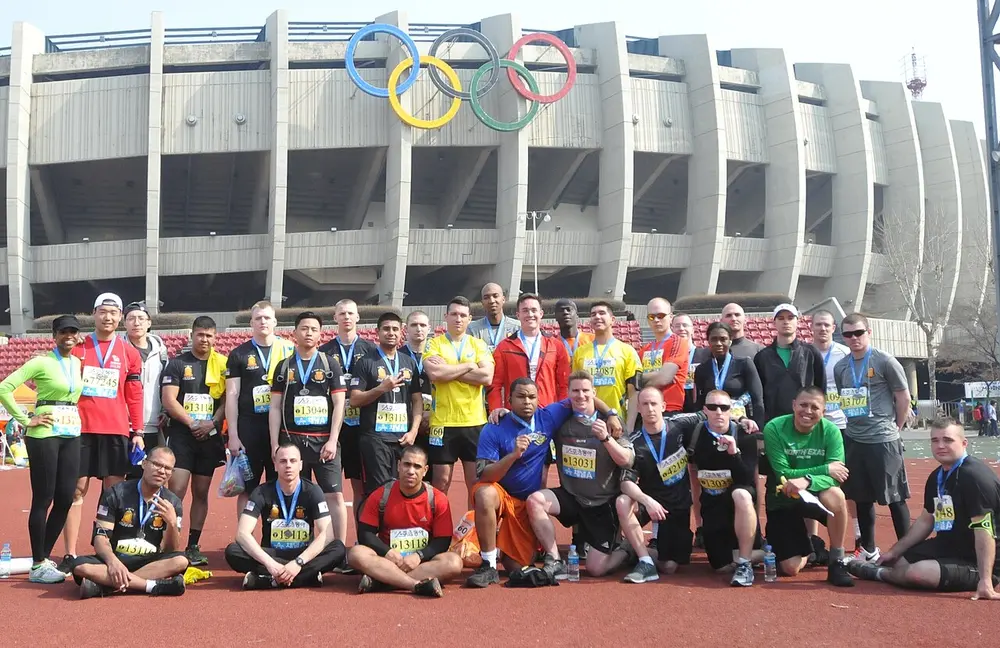
Leisure – Steel team runs Seoul International Marathon 140316-A-TN121. Photo: Capt. Kelly Pickett / Wikimedia Commons, Public domain.
Fast times and first marathons
The Seoul Marathon is a serious personal-best course. The flat profile, wide roads and long riverside stretches give fast runners exactly what they need: space, consistency and very little to interrupt the rhythm. The Platinum Label reflects the race's standing, and the course itself is a fair test of a well-made training block.
It is also a manageable first marathon. The absence of hills removes the most common source of early fatigue, and the wide roads mean a debutant is not constantly trapped in a crowd. The risk is the opposite of a hilly race: the course feels easy for too long, and the second half arrives before the runner has adjusted. A conservative first half is still the right plan.
Flat-course discipline
- Fast early kilometres. A flat, wide course invites a quick start. Hold your target pace rather than following the runners around you.
- The riverside corridor. The long stretches along the Han are where the race is decided. Stay focused when the scenery becomes repetitive.
- Point-to-point logistics. The start and finish are in different parts of the city. Organise your return journey in advance.
- March layers. A spring morning can change through the day, so plan clothing for a range rather than a single condition.
- The stadium finish. The race ends at the Olympic Stadium, so the final kilometres have a clear destination after the long river corridor.
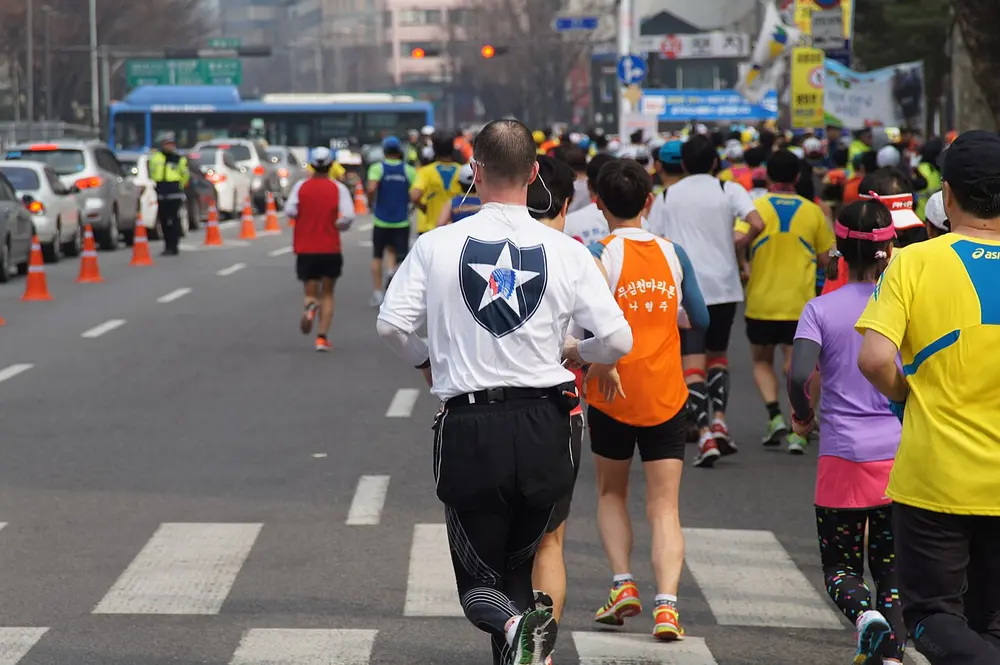
Leisure – Steel team runs Seoul International Marathon 140316-A-ME210 (photo 2). Photo: Capt. Kelly Pickett / Wikimedia Commons, Public domain.
Frequently asked questions
Answers to the questions runners ask before entering, drawn from this race's course guide and the directory's own data — the sources behind them are listed below.
When is the Seoul Marathon in 2027?
The race is on 21 March 2027. It is a spring marathon, starting at Gwanghwamun and finishing at the Olympic Stadium.
Is the Seoul Marathon a flat course?
Yes. It climbs about 93 metres over the full distance, with no sustained ascent. The riverside roads are wide and the profile is flat, which is why the race is associated with fast times.
Is the Seoul Marathon good for a personal best?
Yes. The course is flat, wide and point-to-point, with long stretches that suit an even rhythm. The main risks are starting too quickly and losing concentration on the repetitive river corridor.
Is the Seoul Marathon suitable for a first marathon?
Yes. The flat profile, wide roads and lack of sustained climbing make it a manageable debut. The point-to-point layout requires some planning, and the long riverside section can feel monotonous, but the course itself is not punishing.
Where does the Seoul Marathon start and finish?
It starts at Gwanghwamun and finishes at the Olympic Stadium, following the Han river between the two. The start and finish are at different points, so the return journey needs planning.
What label does the Seoul Marathon hold?
It holds a World Athletics Platinum Label.
What makes the Seoul Marathon fast?
The course has about 93 metres of climbing, wide roads and a long, flat river corridor. The point-to-point layout removes the repetition of an out-and-back, and the lack of sustained climbs allows runners to hold a steady pace.
More marathons in Asia
Sources for this page
What each source below is used for on this page, and where to check this race yourself.
- World Athletics — the label calendar and the road-race regulations. Used to check whether the race holds a World Athletics label, and its elite competition details.
- AIMS — the international course-measurement standard behind the 42.195 km distance, and the AIMS race calendar.
- The organizer's own publications — course maps, race handbooks and published results. The date, course character and climbing on this page are compiled from them and re-checked each season.
“A World Athletics Label denotes a full application of the Competition and Technical Rules in, at a minimum, the elite component of the competition. Labels also denote superior standards in event organisation, safety and runner experience, support from public authorities to the event and a financial commitment to anti-doping.”
Where do these facts come from?
Dates, course type, climbing and time limits are compiled from the organizer's publications and re-checked each season; elevation is an estimate of total climbing rather than a survey figure. Always confirm race-day details with the organizer before making plans.
Last reviewed 27 October 2026