
Xiamen Marathon
Xiamen's marathon has a simple selling point: for most of its 42.195 kilometres, the sea is beside you.
By Global Marathon Routes editorial team · Last reviewed 27 October 2026
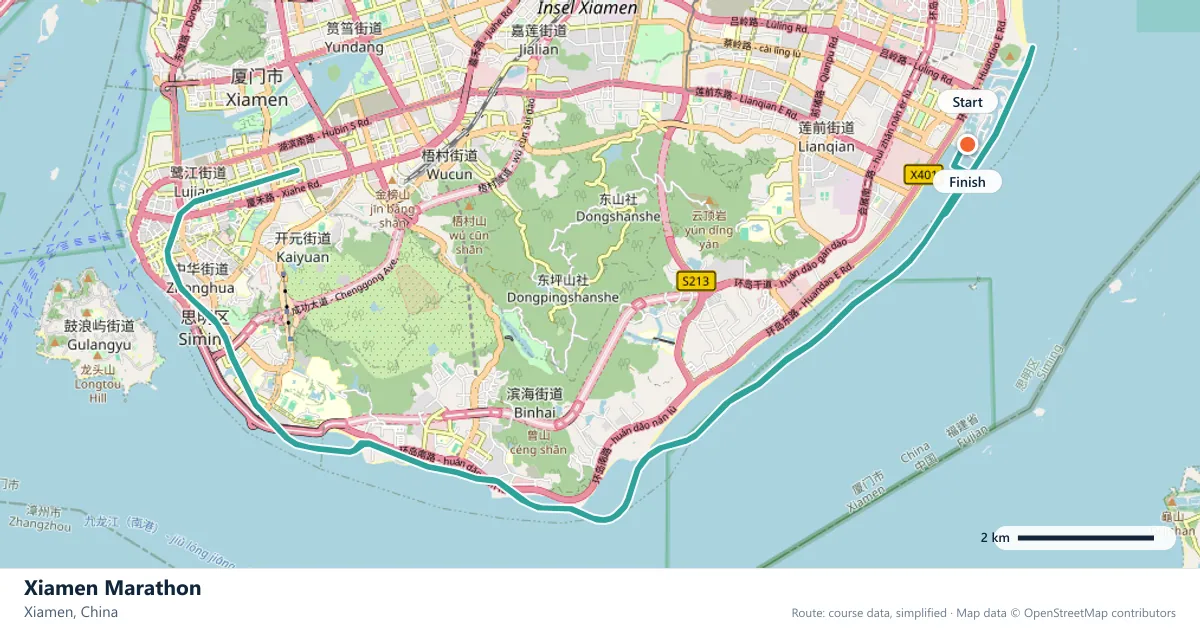
Where does the Xiamen Marathon run?
Interactive map
The trace follows the organizer's published course, simplified for the screen: the orange dot is the start, the dark dot the finish. Scroll to zoom, drag to pan.
What is the Xiamen Marathon course like?
A January race on the Fujian coast, run along the island ring road with sea views for most of the way. Rolling, warm and one of China's faster fields.
- Next edition
- January 2027 (expected)
- Elevation gain
- 323 m
- Profile
- Hilly
- First run
- —
Course guide
Xiamen's marathon has a simple selling point: for most of its 42.195 kilometres, the sea is beside you. The route follows the island ring road along the Fujian coast, with sea views for most of the way, and the race is expected to return in January 2027. It carries a World Athletics Platinum Label.
The profile is the surprise. Xiamen is not the pancake-flat coastal race that the setting suggests: it climbs about 323 metres, and the rises come in rolling sequence. The January date is warm by Chinese winter standards, the field is one of the country's faster ones, and the combination makes the race a genuine test of pacing rather than a simple seaside procession.
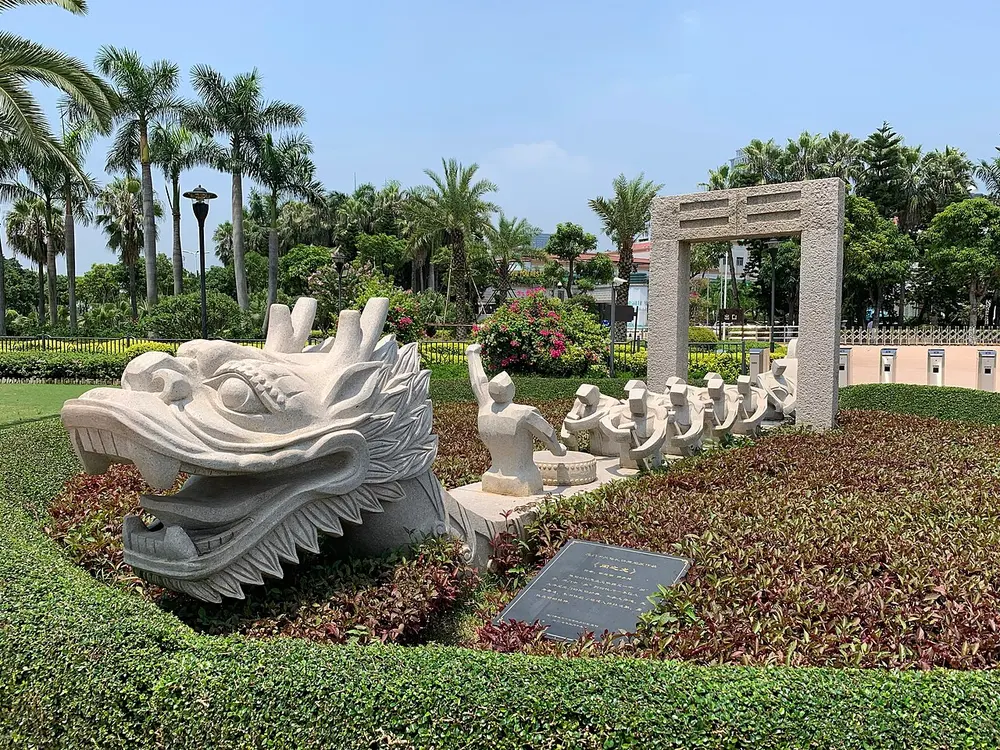
Dragon sculpture at Bailuzhou Park, Xiamen. Photo: Slyronit / Wikimedia Commons, CC BY-SA 4.0.
The course
The route follows the island ring road, with sea views for most of the way. The coastal setting gives the race its identity, and the road provides long, continuous stretches rather than a tight loop. The city sits behind the course, and the water stays in view for long periods.
The profile is hilly, with about 323 metres of climbing. That is not a mountain course, but it is substantially more than a flat riverfront route, and the rises repeat. There is no single climb that defines the race; instead, the road rolls along the coast, asking for steady effort rather than a single surge.
The island ring road
Xiamen is an island city, and the ring road is its coastal spine. The marathon uses that road as the backbone of the course, which means long views, open horizons and a route that feels like a journey around the edge of the city rather than a tour through it.
That geography also makes the race easy to follow. The sea is a constant reference point, and the course's changes of direction are tied to the coastline. Runners who prefer a simple, readable route will appreciate the clarity; those who like constant turns and city detail will find the second half more varied.
Sea views and exposed running
A coastal road offers little protection. The sea is beautiful, but it also means the race is exposed to the day's conditions in a way that a sheltered city loop is not. Xiamen's warmth is part of that exposure, and the open road gives the sun and the humidity room to work.
The practical response is to treat the coast as a place to conserve. Take fluids early, keep the effort steady and avoid the temptation to chase the view. The sea will still be there in the second half; the energy you spend early will not come back.
Rollers on the coast
About 323 metres of climbing is spread across the route in short rises. None of them is severe, but they arrive often enough to interrupt a flat rhythm. Runners who try to hold a flat-course pace up every rise will accumulate fatigue long before the finish.
The better approach is to run by effort: ease on the ups, use the downs to recover and keep the flat stretches controlled. The fast field will make this harder, because there is always someone running quicker. Let them go. The coast is a long place, and the second half rewards the patient.

Cactii at Botanical Garden, Xiamen. Photo: Slyronit / Wikimedia Commons, CC BY-SA 4.0.
A warm January race
January in Xiamen is warm, which is one of the things that makes the race distinctive. While much of China is in the depths of winter, the Fujian coast offers a milder racing day. That is welcome for spectators and useful for runners who train through colder months, but it changes the fuelling and pacing plan.
The heat is not the only variable. The coastal road is exposed, the course rolls and the field is fast. A warm day on a rolling coast is more demanding than the same temperature on a shaded city course. Start conservatively, carry fluids and adjust the target if the conditions ask for it.
The field and the clock
Xiamen attracts one of China's faster fields, and the race has a reputation for quick times. The Platinum Label reflects the event's standing, and the rolling coastal road gives strong runners a chance to run fast when the weather cooperates.
For everyone else, the field is both an asset and a trap. It creates groups to run with and a sense of occasion, but it also encourages a pace that belongs to someone else. The course is quick enough to reward ambition, provided the ambition is saved for the second half.
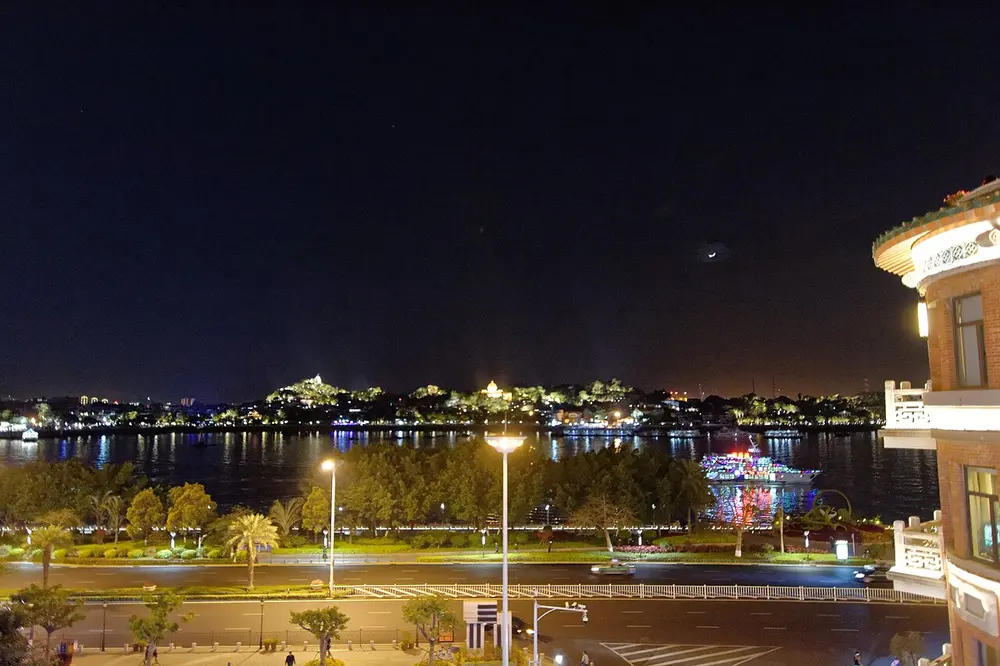
Gulangyu Island from Zhongshan Road, Xiamen. Photo: Slyronit / Wikimedia Commons, CC BY-SA 4.0.
Frequently asked questions
Answers to the questions runners ask before entering, drawn from this race's course guide and the directory's own data — the sources behind them are listed below.
When is the Xiamen Marathon?
The next edition is expected in January 2027. The exact date is still provisional, so confirm it before booking travel.
Is the Xiamen Marathon flat?
No. It is hilly, with about 323 metres of climbing. The course rolls along the coastal road rather than climbing one sustained hill, but the rises are repeated.
Where does the course run?
The route follows the island ring road along the Fujian coast, with sea views for most of the way. The city of Xiamen sits behind the course.
Is Xiamen a good race for a personal best?
The race attracts a fast field and the coastal road can produce quick times. The rolling profile and warm January conditions mean the pace has to be managed carefully, so a personal best is possible rather than guaranteed.
Is it suitable for a first marathon?
The terrain is manageable and the coastal setting is welcoming, but the warmth and the repeated rollers make it harder than a flat winter race. First-timers should plan conservatively and expect the conditions to shape the day.
Does the race hold a World Athletics label?
Yes. The Xiamen Marathon carries a World Athletics Platinum Label.
More marathons in China
More marathons in Asia
Sources for this page
What each source below is used for on this page, and where to check this race yourself.
- World Athletics — the label calendar and the road-race regulations. Used to check whether the race holds a World Athletics label, and its elite competition details.
- AIMS — the international course-measurement standard behind the 42.195 km distance, and the AIMS race calendar.
- The organizer's own publications — course maps, race handbooks and published results. The date, course character and climbing on this page are compiled from them and re-checked each season.
“A World Athletics Label denotes a full application of the Competition and Technical Rules in, at a minimum, the elite component of the competition. Labels also denote superior standards in event organisation, safety and runner experience, support from public authorities to the event and a financial commitment to anti-doping.”
Where do these facts come from?
Dates, course type, climbing and time limits are compiled from the organizer's publications and re-checked each season; elevation is an estimate of total climbing rather than a survey figure. Always confirm race-day details with the organizer before making plans.
Last reviewed 27 October 2026