
Nanjing Marathon
A flat marathon can feel like a formality. Nanjing's does not. The route threads through the old capital past its city walls, the Ming tombs and avenues of plane trees, and the scenery gives the…
By Global Marathon Routes editorial team · Last reviewed 27 October 2026
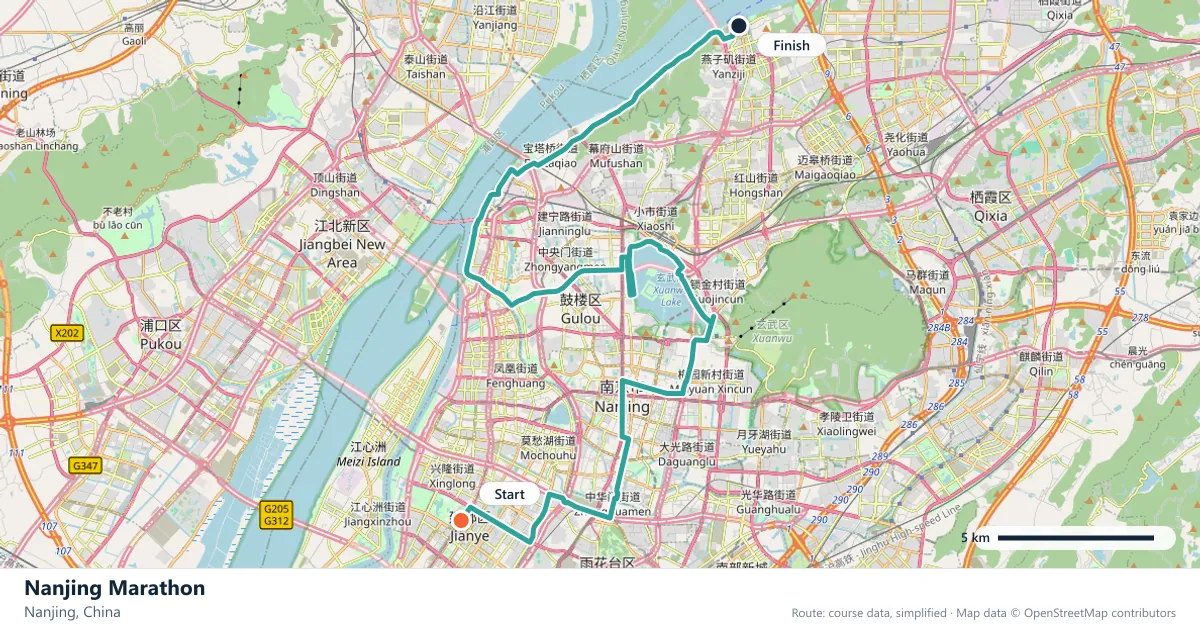
Where does the Nanjing Marathon run?
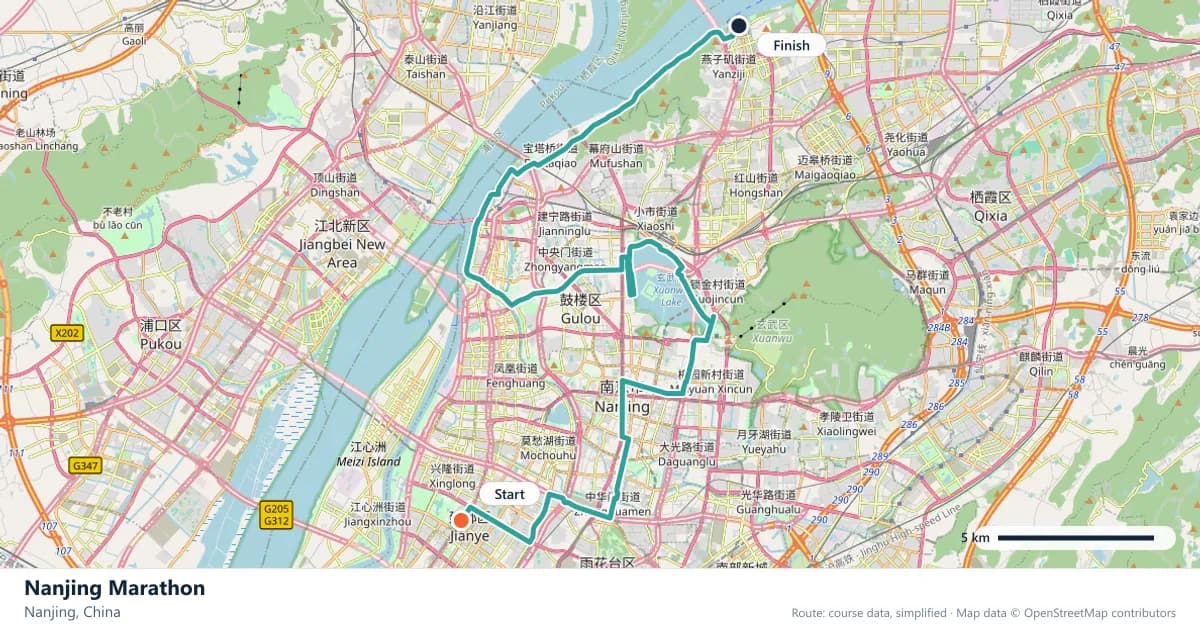
Interactive map
The trace follows the organizer's published course, simplified for the screen: the orange dot is the start, the dark dot the finish. Scroll to zoom, drag to pan.
What is the Nanjing Marathon course like?
A late-autumn marathon through the old capital, past the city walls, the Ming tombs and the plane-tree avenues. Almost dead flat, with a large and fast field.
- Next edition
- 22 November 2026
- Elevation gain
- 57 m
- Profile
- Flat
- First run
- —
Course guide
A flat marathon can feel like a formality. Nanjing's does not. The route threads through the old capital past its city walls, the Ming tombs and avenues of plane trees, and the scenery gives the kilometres a rhythm that the profile never will. The 2026 edition is on 22 November, and the course climbs only about 57 metres across 42.195 kilometres.
That combination — almost dead flat, visually rich and run in late autumn — has made Nanjing one of China's quicker city marathons. The field is large and fast, the race carries a World Athletics Elite Label, and the route is built for runners who can hold a pace rather than respond to hills.
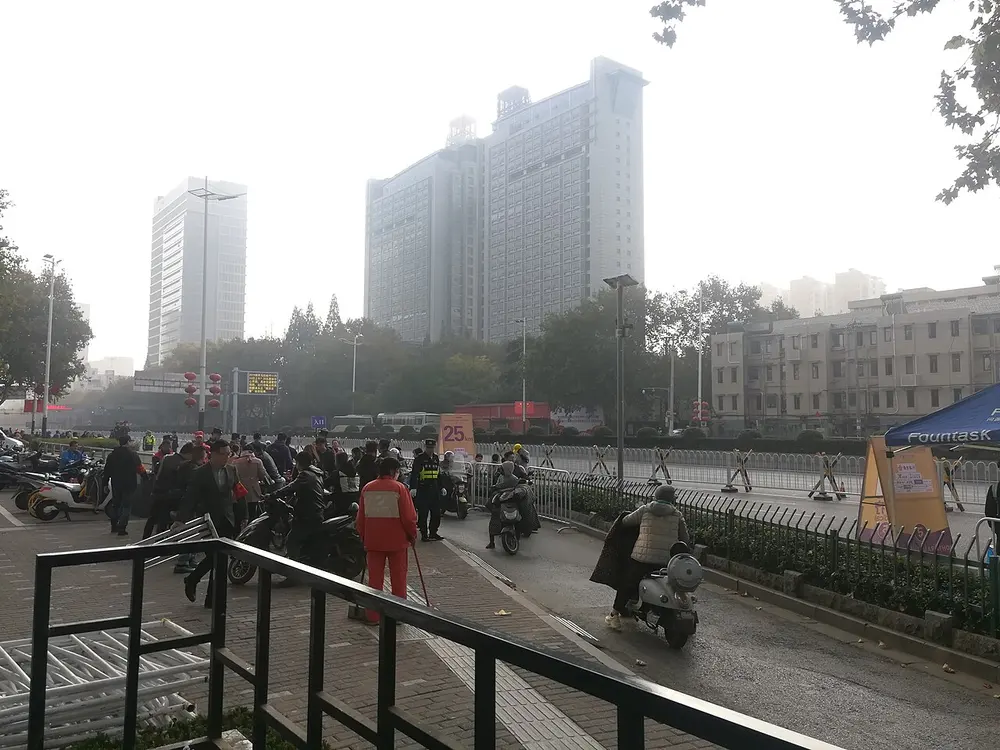
2019 Marathon, Nanjing - Xinmofanmalu Qingshicun. Photo: Leiem / Wikimedia Commons, CC BY-SA 4.0.
The course
The route passes the old city walls, the Ming tombs and the plane-tree avenues for which Nanjing is known. These are not incidental backdrops: the walls and avenues give the course long, shaded perspectives, and the tomb area introduces a greener, quieter stretch. The landmarks arrive in sequence, which makes the race easier to break down than a grid of anonymous streets.
The profile is almost dead flat: roughly 57 metres of climbing in total. There are no sustained ascents, no steep descents and no technical corners worth planning for. The challenge is rhythm. On ground this even, a fast start is easy to hide and hard to recover from.
| Race fact | Detail |
|---|---|
| Date | 22 November 2026 |
| City | Nanjing, China |
| Profile | Flat |
| Elevation gain | About 57 m |
| Label | World Athletics Elite Label |
| Course | City streets past the old walls, Ming tombs and plane-tree avenues |
The old walls and the plane trees
Nanjing's city wall is one of the most extensive surviving urban walls in China, and the marathon uses it as a landmark rather than an obstacle. The route runs past sections of the wall and through streets where the scale of the old capital is still legible. The plane trees add a second layer: their canopy closes over several of the avenues, giving the race a shaded, tunnelled feel.
The Ming tombs lie outside the dense centre, and that part of the course feels different: greener, quieter and more open. It is also where the flatness is most welcome. Runners who have spent the early kilometres managing the crowd can settle here, find a group and let the course carry them.
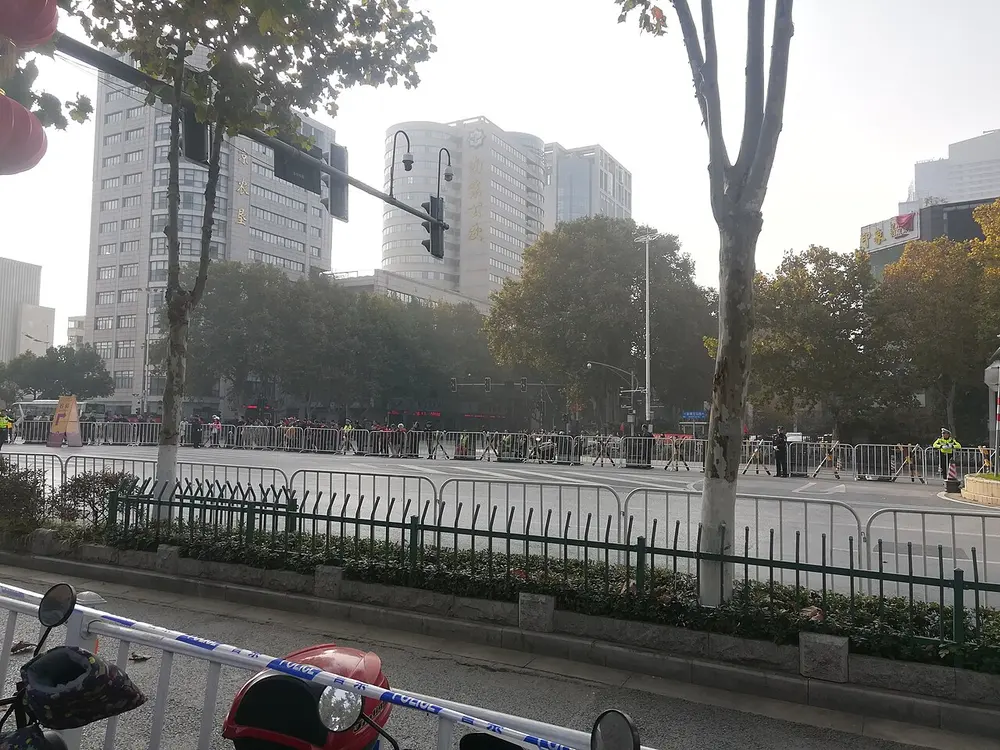
2019 Marathon, Nanjing - Xuanwu Lake Tunnel. Photo: Leiem / Wikimedia Commons, CC BY-SA 4.0.
A field built for speed
Nanjing's marathon attracts a large and fast field, and that changes the character of the day. There are always runners ahead of you running quicker than your plan, and on a flat course there is no hill to bring them back. The result is a race that rewards self-control more than competitiveness.
The Elite Label reflects the standard of the event. For the mass runner, the practical effect is density: the opening kilometres are busy, the pace is brisk and the temptation to follow the people around you is strong. Let them go. The second half of a flat marathon is where the field comes back together, and the runners who started conservatively are usually the ones moving forward.
Pacing when there is nothing to blame
With 57 metres of climbing, a marathon in Nanjing leaves nowhere to hide. There is no hill that justifies a slow kilometre and no descent that gives one back. Every split is a choice, and the course will not correct a mistake.
That makes the middle 10 kilometres the most important part of the race. Settle into a pace you can repeat, check the watch at each marker and resist the urge to bank time while the legs are fresh. The plane-tree avenues are flat, the walls are flat and the finish is flat; the only variable is how evenly you can run.
Late autumn in Nanjing
The race sits in late November, and the season is part of the appeal. The course is flat and the field is fast, so the day is built for a long, steady effort.
November weather can vary, so plan for a range rather than a single forecast. The flat course makes clothing decisions unusually important: there is no climb to warm you up and no descent to cool you down. What you wear at the start is what you will race in.

2019 Marathon, Nanjing - Xuanwuhusuidao stop. Photo: Leiem / Wikimedia Commons, CC BY-SA 4.0.
Frequently asked questions
Answers to the questions runners ask before entering, drawn from this race's course guide and the directory's own data — the sources behind them are listed below.
When is the Nanjing Marathon?
The race is on 22 November 2026. It is a late-autumn race through the old capital.
Is the Nanjing Marathon a flat course?
Yes. It climbs only about 57 metres over 42.195 kilometres, which is close to dead flat. There are no sustained climbs, so pacing rather than hill strength decides the day.
What landmarks does the course pass?
The route passes the old city walls, the Ming tombs and the city's plane-tree avenues. The walls and trees give the course its shaded perspectives, while the tomb area opens into greener surroundings.
Is Nanjing a good race for a personal best?
The flat profile and fast field make it a strong choice for a time attempt. The risk is going out too quickly with the runners around you; run your own splits and the course gives you a fair chance.
Is it suitable for a first marathon?
The race is not built around first-timers. The flat course and fast field make pacing the real challenge, so a debut would need a very conservative start.
What does the Elite Label mean?
The race holds a World Athletics Elite Label. The label reflects the event's standard and organisation within the World Athletics road-racing system.
More marathons in China
More marathons in Asia
Sources for this page
What each source below is used for on this page, and where to check this race yourself.
- World Athletics — the label calendar and the road-race regulations. Used to check whether the race holds a World Athletics label, and its elite competition details.
- AIMS — the international course-measurement standard behind the 42.195 km distance, and the AIMS race calendar.
- The organizer's own publications — course maps, race handbooks and published results. The date, course character and climbing on this page are compiled from them and re-checked each season.
“A World Athletics Label denotes a full application of the Competition and Technical Rules in, at a minimum, the elite component of the competition. Labels also denote superior standards in event organisation, safety and runner experience, support from public authorities to the event and a financial commitment to anti-doping.”
Where do these facts come from?
Dates, course type, climbing and time limits are compiled from the organizer's publications and re-checked each season; elevation is an estimate of total climbing rather than a survey figure. Always confirm race-day details with the organizer before making plans.
Last reviewed 27 October 2026