
Beijing Marathon
The Beijing Marathon starts at Tiananmen and heads north, and the first thing that strikes most runners is the width of the road.
By Global Marathon Routes editorial team · Last reviewed 27 October 2026
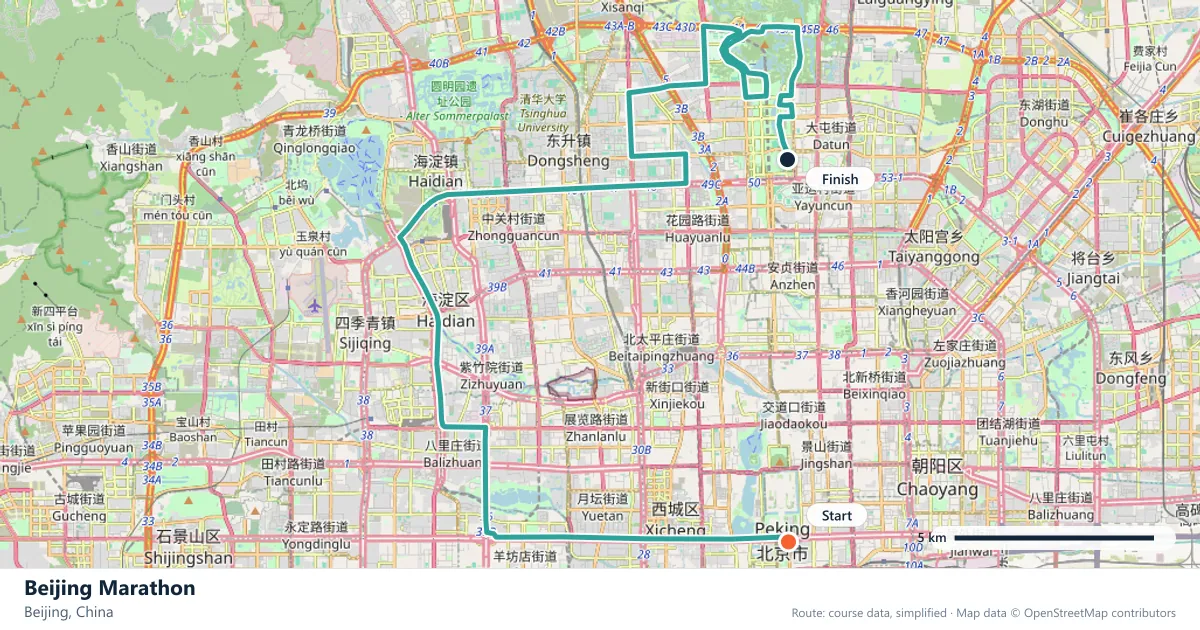
Where does the Beijing Marathon run?
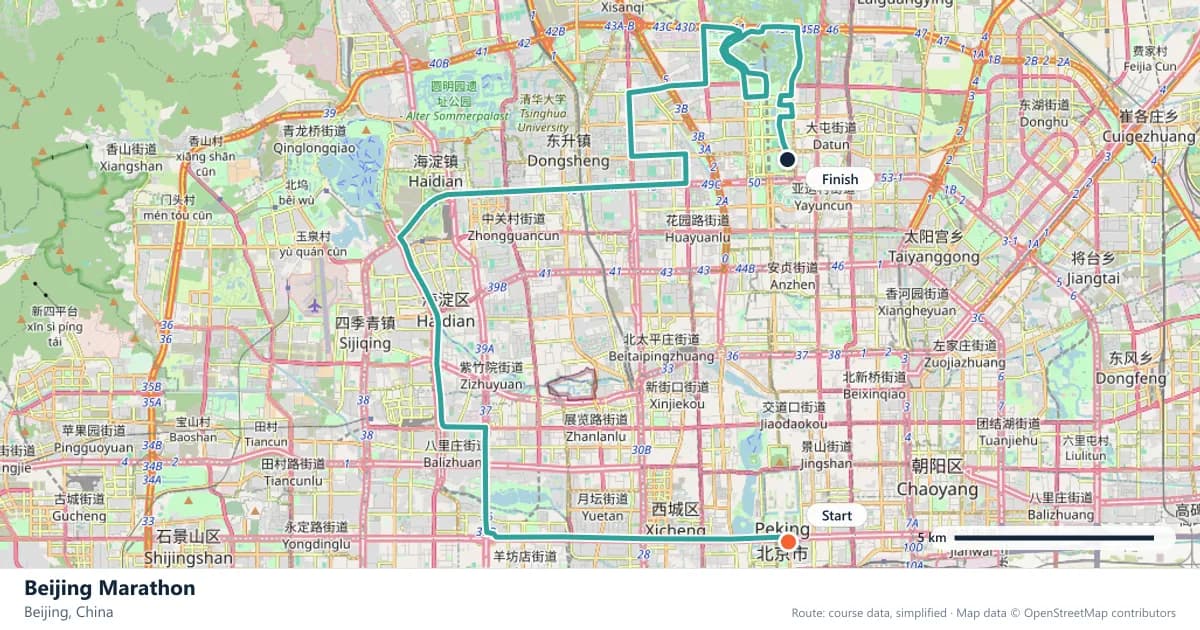
Interactive map
The trace follows the organizer's published course, simplified for the screen: the orange dot is the start, the dark dot the finish. Scroll to zoom, drag to pan.
What is the Beijing Marathon course like?
The Chinese capital's marathon, run in October from Tiananmen towards the Olympic park and the city's northern avenues. Wide roads, cool autumn air and a huge domestic field.
- Next edition
- October 2027 (expected)
- Elevation gain
- 100 m
- Profile
- Undulating
- First run
- —
Course guide
The Beijing Marathon starts at Tiananmen and heads north, and the first thing that strikes most runners is the width of the road. This is a capital-city race built on boulevards, with a field large enough to fill them. The next edition is expected in October 2027, and it carries a World Athletics Gold Label, about 100 metres of climbing and a reputation for quick autumn running.
The course is undulating on paper. In practice, 100 metres spread across 42.195 kilometres feels close to flat, and the cool October air does the rest. What makes Beijing distinctive is not the profile but the scale: a huge domestic field, wide northern avenues and an Olympic park that gives the second half a very different backdrop from the city-centre start.

Beijing, China, 1912 slnsw. Photo: Unknown photographer / Wikimedia Commons, Public domain.
The course
The race begins at Tiananmen and moves north through the capital towards the Olympic park and the city's northern avenues. The roads are wide, the climbs are gentle, and the route is designed to keep a very large field moving. There are no sustained ascents and no technical sections; the work is done by the distance and the pace you choose.
The 100 metres of gain is spread across the route in soft rises. That is enough to keep the course from being a pure time trial, but not enough to demand a hill-specific build. The important feature is the road width: on a course this broad, runners can find space even when the field is dense, and the rhythm of the day is set by the openings rather than by the climbs.
The opening kilometres
The start at Tiananmen puts the field in the middle of the capital from the first stride, and the opening kilometres are busy. A huge domestic field means crowded road, even on wide avenues, and the first task is to find a line rather than a pace. Runners who spend the first five kilometres weaving will pay for the extra effort later.
The cool autumn air helps here. It is easier to stay patient when the conditions are not adding to the load, and the wide roads eventually open up. Treat the opening as a procession you have to manage: keep the effort easy, let the faster starters go and wait for the field to stretch before settling into your target rhythm.
North to the Olympic park
The second half moves away from the city centre and towards the Olympic park and the northern avenues. The backdrop changes from the dense streets of the start to the open spaces and modern venues of the Olympic park. It is a different kind of Beijing, and the change of scene is useful when the legs start to tire.
This part of the course is also where the gentle undulations become noticeable. The rises are short, but they arrive in sequence, and the long avenues offer little distraction from the effort. Use the Olympic park as a marker and the northern avenues as the place to hold form rather than chase time.
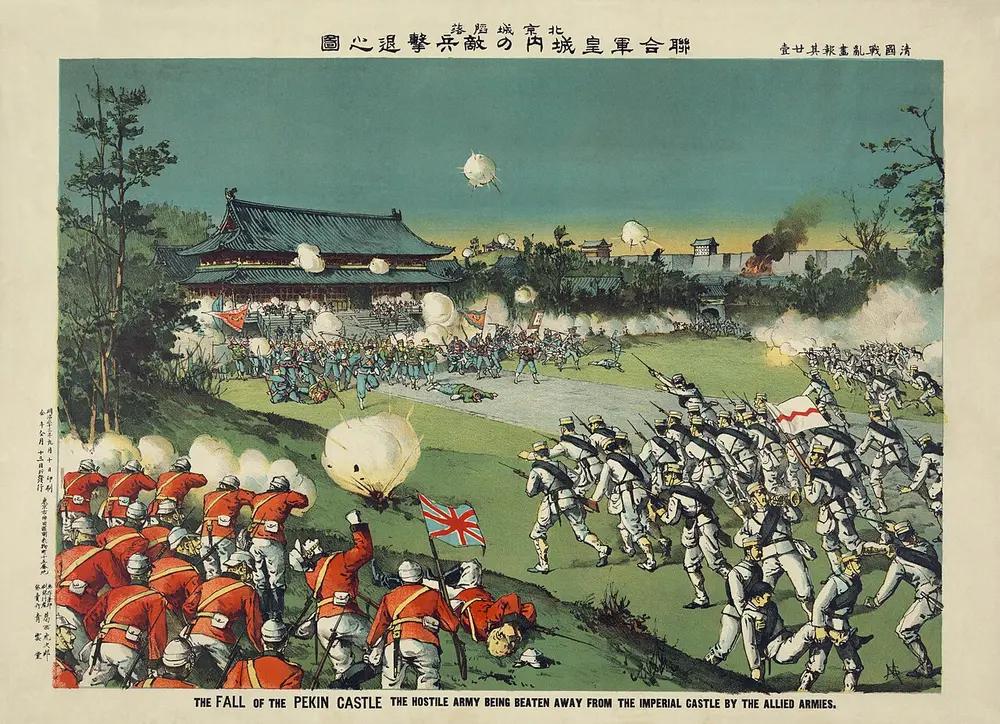
Beijing Castle Boxer Rebellion 1900 FINAL. Photo: Kasai Torajirō / Wikimedia Commons, Public domain.
When a hundred metres feels like nothing
A hundred metres of climbing over a marathon is a rounding error for most runners, and Beijing's profile behaves accordingly. The course reads as flat, the road is wide and the autumn air is cool. Those are the ingredients of a fast day, which is why the race is a natural personal-best choice.
The trap is that nothing on the course forces you to slow down. There is no hill that demands restraint and no narrow section that breaks the rhythm. The only governor is your own discipline. Runners who set off at a pace they cannot hold will still be on a flat road when the bill arrives, which makes the second half feel harder than the profile suggests.
A very large field
The Beijing Marathon's domestic field is enormous, and that shapes everything from the start area to the way the course is laid out. The wide roads are not an accident; they are what makes a race of this size possible. For a visitor, the experience is both impressive and slightly overwhelming.
The Gold Label reflects the race's standing and organisation. On the ground, the practical consequence is a big-event atmosphere with the density to match. Plan around the crowd rather than against it: arrive early, know your start routine and expect the first few kilometres to be about space rather than speed.
Cool October running
October in Beijing is cool, and the autumn air is one of the reasons the race produces fast times. The same conditions can feel raw while you wait, so the usual advice about layers applies with more force than usual. Once the field is moving, the cool air is an ally.
The weather also makes the course forgiving. There is no heat to manage and no altitude to account for; the race is run at ordinary city elevation on wide, gentle roads. That leaves the field and your own pacing as the main variables, which is exactly what a personal-best attempt wants.
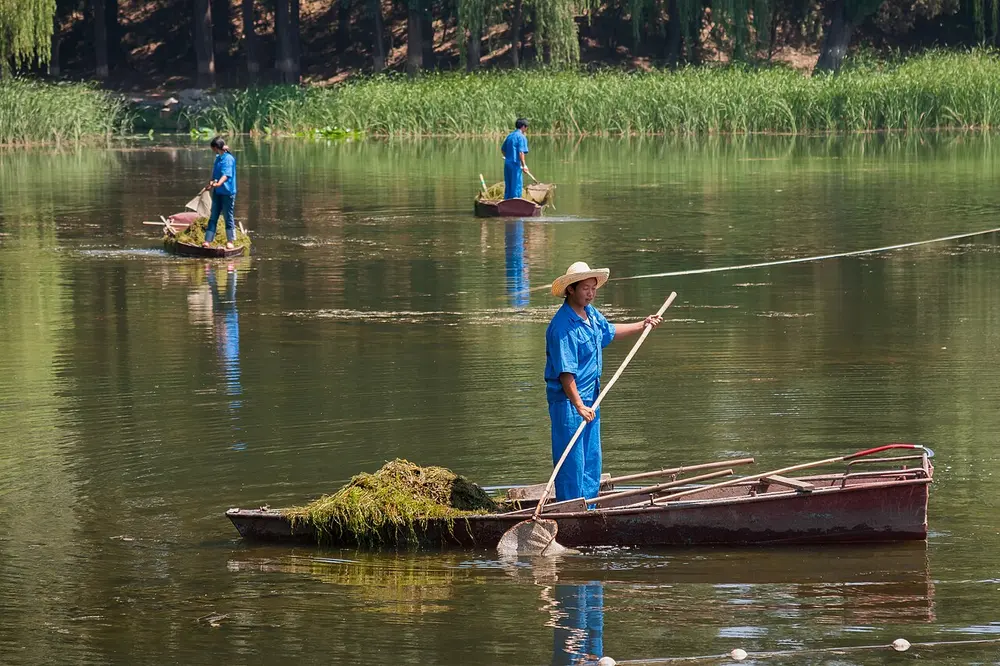
Beijing China Woman-cleaning-West-Lake. Photo: CEphoto, Uwe Aranas / Wikimedia Commons, CC BY-SA 3.0.
Frequently asked questions
Answers to the questions runners ask before entering, drawn from this race's course guide and the directory's own data — the sources behind them are listed below.
When is the Beijing Marathon?
The race is expected in October 2027. It is an October race, run in the cool autumn conditions the city is known for at that time of year.
Is the Beijing Marathon flat or hilly?
It is undulating, with about 100 metres of climbing. The rises are short and gentle, and the wide roads make the course behave much more like a flat city marathon than a hilly one.
Where does the Beijing Marathon start?
The race starts at Tiananmen and heads north through the capital. The second half runs towards the Olympic park and the northern avenues.
Is Beijing a good race for a personal best?
The course is quick: about 100 metres of climbing, wide roads and cool autumn air. Those are good conditions for a fast time, provided you control the opening kilometres in the large field.
Is it suitable for a first marathon?
The gentle profile and wide roads make it approachable for a first attempt. The main challenge is the size of the field rather than the terrain, so conservative pacing and patience at the start matter more than hill training.
Does the Beijing Marathon hold a World Athletics label?
Yes. The race carries a World Athletics Gold Label.
More marathons in China
More marathons in Asia
Sources for this page
What each source below is used for on this page, and where to check this race yourself.
- World Athletics — the label calendar and the road-race regulations. Used to check whether the race holds a World Athletics label, and its elite competition details.
- AIMS — the international course-measurement standard behind the 42.195 km distance, and the AIMS race calendar.
- The organizer's own publications — course maps, race handbooks and published results. The date, course character and climbing on this page are compiled from them and re-checked each season.
“A World Athletics Label denotes a full application of the Competition and Technical Rules in, at a minimum, the elite component of the competition. Labels also denote superior standards in event organisation, safety and runner experience, support from public authorities to the event and a financial commitment to anti-doping.”
Where do these facts come from?
Dates, course type, climbing and time limits are compiled from the organizer's publications and re-checked each season; elevation is an estimate of total climbing rather than a survey figure. Always confirm race-day details with the organizer before making plans.
Last reviewed 27 October 2026