
Great Wall Marathon
Most marathons measure their difficulty in metres of climbing. The Great Wall Marathon measures it in steps.
By Global Marathon Routes editorial team · Last reviewed 27 October 2026
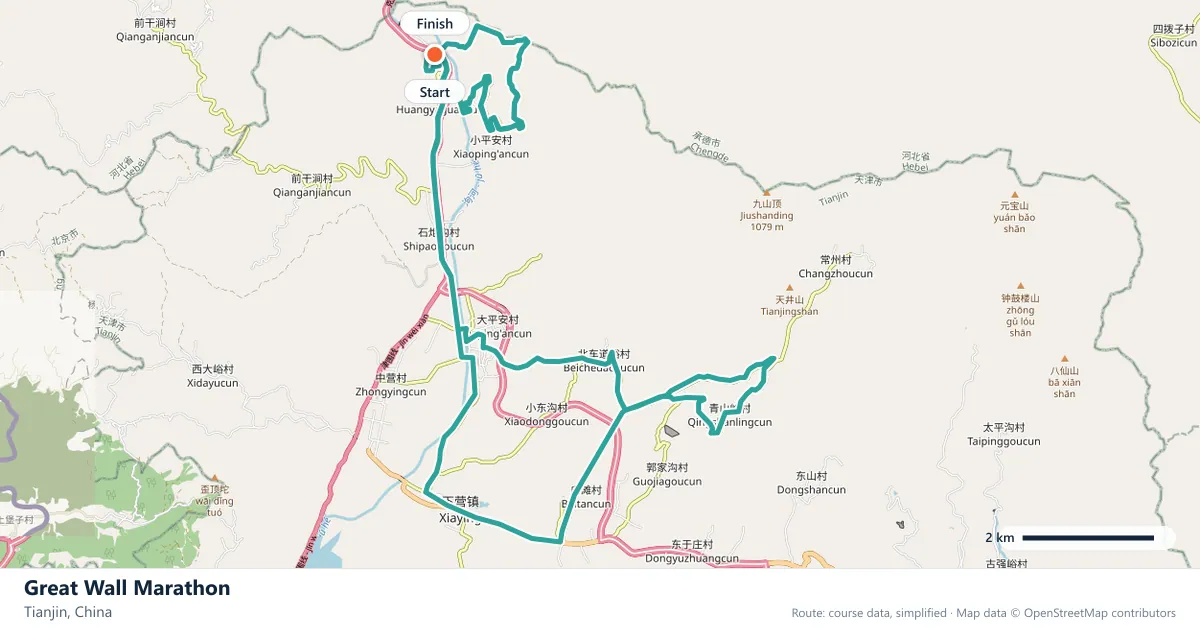
Where does the Great Wall Marathon run?
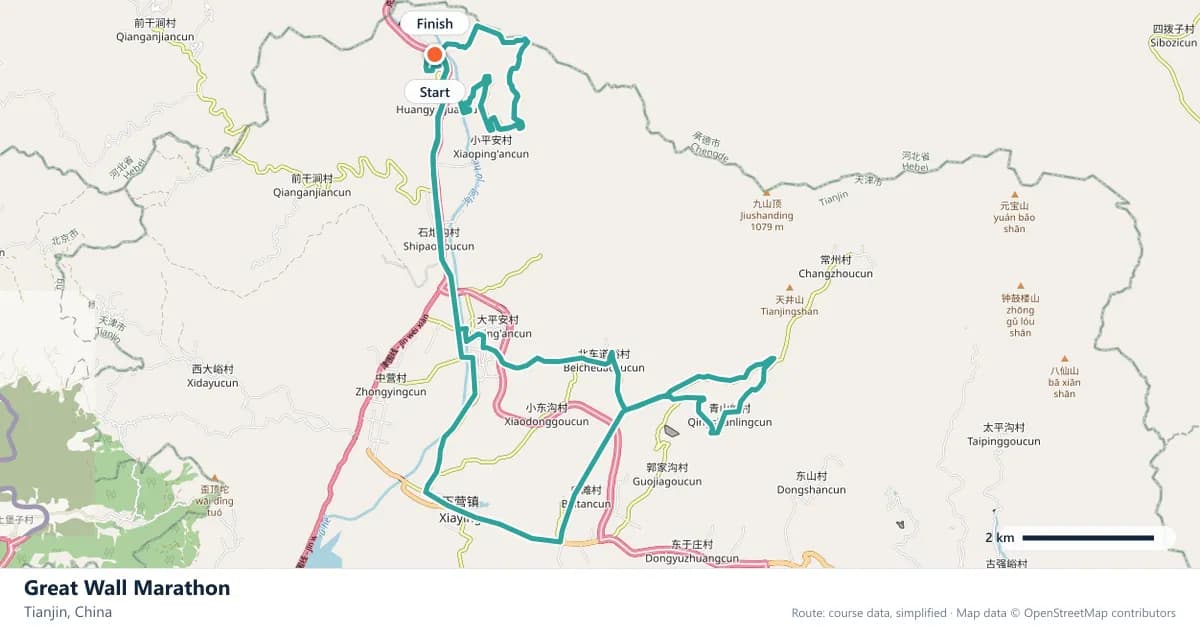
Interactive map
The trace follows the organizer's published course, simplified for the screen: the orange dot is the start, the dark dot the finish. Scroll to zoom, drag to pan.
What is the Great Wall Marathon course like?
A bucket-list marathon in Huangyaguan, north of Tianjin, with several kilometres run on restored Great Wall steps. Around 1,200 metres of climbing and more than 5,000 steps.
- Next edition
- May 2027 (expected)
- Elevation gain
- 1215 m
- Profile
- Hilly
- First run
- —
Course guide
Most marathons measure their difficulty in metres of climbing. The Great Wall Marathon measures it in steps. More than 5,000 of them are packed into the route at Huangyaguan, north of Tianjin, and several kilometres are run on the restored wall itself. The next edition is expected in May 2027, with around 1,215 metres of climbing.
The numbers tell only part of the story. A road marathon of 42.195 kilometres asks for rhythm; this one asks for strength, balance and patience on stone. The wall is not a backdrop you run beside. You run on it, up it and down it, and the legs remember every flight.
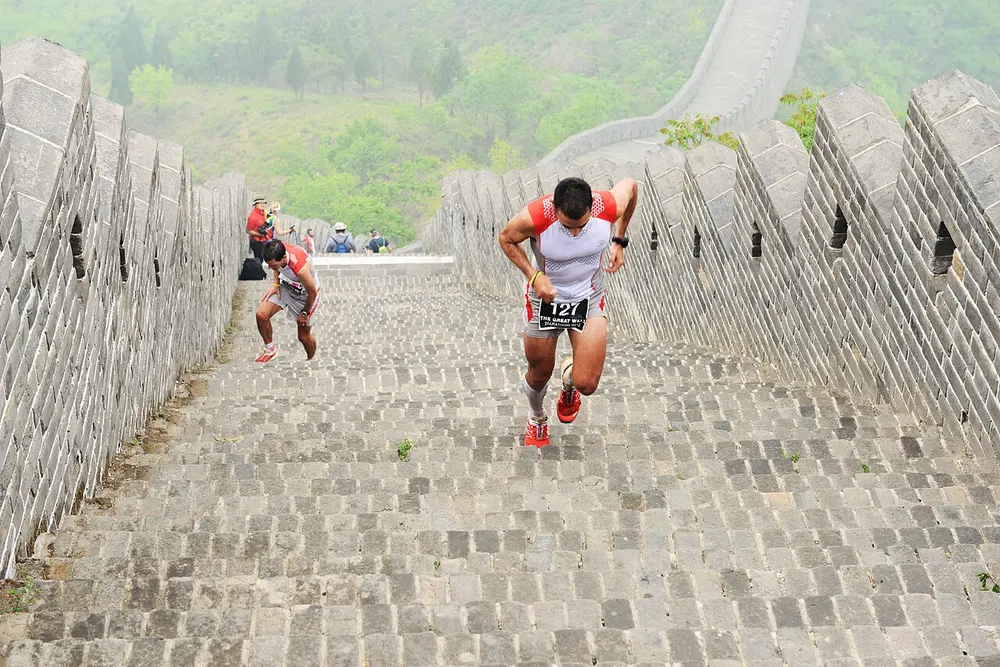
Great Wall Marathon. Photo: Athlete for life / Wikimedia Commons, CC BY-SA 4.0.
The course
The race is based at Huangyaguan, a restored section of the Great Wall in the mountains north of Tianjin. The route includes several kilometres on the wall steps and climbs around 1,215 metres over the full marathon. The wall sections are linked by climbing and descending through the surrounding hills, so the day alternates between stone steps and mountain gradients.
That mix makes the course impossible to judge by road standards. The wall slows everything: the steps are steep, uneven and often narrow, and the flow of runners cannot move at a road pace. The hills between the wall sections add their own load. The result is a marathon measured in time on feet, not in splits.
| Race fact | Detail |
|---|---|
| Date | May 2027 (expected) |
| Location | Huangyaguan, north of Tianjin, China |
| Profile | Hilly |
| Elevation gain | About 1,215 m |
| Steps | More than 5,000 |
| Course character | Several kilometres on restored Great Wall steps, linked by mountain climbing |
The steps
The restored wall at Huangyaguan is a staircase built for defence, not for running. The steps vary in height and depth, and the watchtowers interrupt the line with tight turns and dark interiors. Every one of those features costs time and energy.
There is no way to train perfectly for them, but there are ways to prepare. Stair sessions, hill repeats and long hikes build the specific strength the wall demands. So does practice at descending: the quads take a beating on the way down, and the later steps arrive when the legs are already tired. Walking some sections is normal, and it is often faster than trying to run every step badly.
Climbing and descending
The 1,215 metres of climbing is spread across repeated ascents rather than one long climb. Each wall section tends to rise sharply, and each descent is steep enough to demand control. The descents are not recovery; they are the part of the course that leaves the deepest mark.
That is why the race rewards even effort rather than bravery. Runners who charge the first wall section will find the later ones much harder, and the final descents can turn a strong day into a survival exercise. Save the quads for the second half by walking the steepest downs and keeping the flats relaxed.
Training for a wall
A conventional marathon block is not enough on its own. The Great Wall Marathon rewards time on stairs, trails and hills, and it punishes anyone who arrives with road fitness but no descending practice. Long hikes are useful because they build the same run-walk rhythm the race demands.
The other half of the preparation is mental. The course will be slower than a road marathon, and the watch will confirm it. Runners who accept that early enjoy the day far more than those who try to defend road splits on stone steps.
China Tianjin 5227532 (04). Photo: ermell / Wikimedia Commons, CC BY-SA 3.0.
The Huangyaguan setting
Huangyaguan sits in the mountains, and the restored wall runs along the ridges above the valley. The setting is the reason the race exists. Runners climb through watchtowers and along parapets with long views over the hills, and the experience is unlike any city marathon.
The trade-off is exposure. The wall is high, the weather can change, and there is little shelter on the ridge. The May date is the plan, but the mountains make their own conditions. Carry what you need, dress for the day rather than the start line and treat the scenery as a reward rather than a distraction.
A first marathon with a difference
The Great Wall Marathon can serve as a first marathon, but the preparation should look like a mountain race rather than a road debut. The distance is standard; everything else is not. First-timers who build a long, patient block around stairs and hills give themselves a much better day than those who simply train for 42 kilometres on the flat.
The event is a bucket-list race, and that is the right way to approach it. A personal best is not the point. The point is to finish a marathon on one of the world's great monuments, and to arrive at the line with enough left to enjoy the fact.
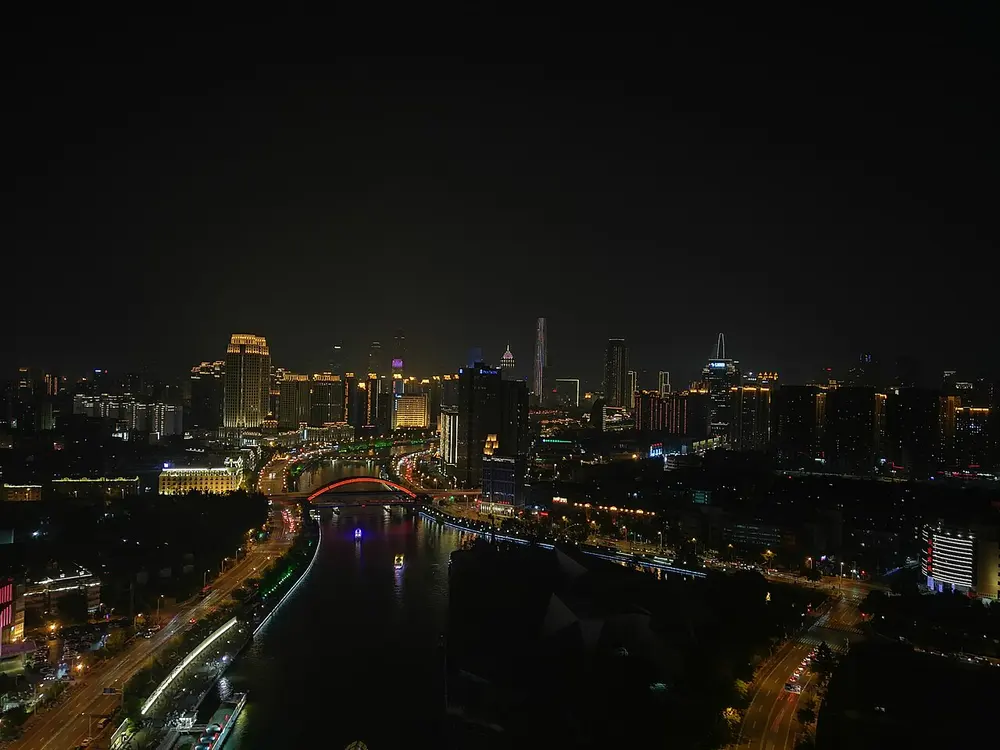
Night view of Tianjin, July 2019. Photo: Willwongprd / Wikimedia Commons, CC BY-SA 4.0.
Frequently asked questions
Answers to the questions runners ask before entering, drawn from this race's course guide and the directory's own data — the sources behind them are listed below.
When is the Great Wall Marathon?
The next edition is expected in May 2027. The exact date is still provisional, so confirm it before booking travel.
How hilly is the Great Wall Marathon?
It climbs around 1,215 metres and includes more than 5,000 steps. Several kilometres are on the restored wall, linked by mountain climbing and descending.
What is the surface like?
The signature sections are restored Great Wall steps, with steep, uneven stone underfoot. The rest of the route climbs and descends through the hills around Huangyaguan.
Is the Great Wall Marathon a good first marathon?
It can be, provided the preparation includes stairs, hills and long days on your feet. It is not a conventional road debut, and runners should expect to walk parts of the wall.
How should I train for the steps?
Build stair sessions, hill repeats and long hikes into the block, and practise descending on tired legs. Time on feet matters more than road speed.
Where is the race held?
The marathon is based at Huangyaguan, north of Tianjin. The route uses the restored wall and the surrounding mountain terrain.
More marathons in China
More marathons in Asia
Sources for this page
What each source below is used for on this page, and where to check this race yourself.
- World Athletics — the label calendar and the road-race regulations. Used to check whether the race holds a World Athletics label, and its elite competition details.
- AIMS — the international course-measurement standard behind the 42.195 km distance, and the AIMS race calendar.
- The organizer's own publications — course maps, race handbooks and published results. The date, course character and climbing on this page are compiled from them and re-checked each season.
Where do these facts come from?
Dates, course type, climbing and time limits are compiled from the organizer's publications and re-checked each season; elevation is an estimate of total climbing rather than a survey figure. Always confirm race-day details with the organizer before making plans.
Last reviewed 27 October 2026