
Naha Marathon
December is the month when most Japanese marathons brace for cold, but Naha is the exception. Okinawa's capital sits far enough south that its marathon is run in warm, heavy air, with the sea close…
By Global Marathon Routes editorial team · Last reviewed 27 October 2026
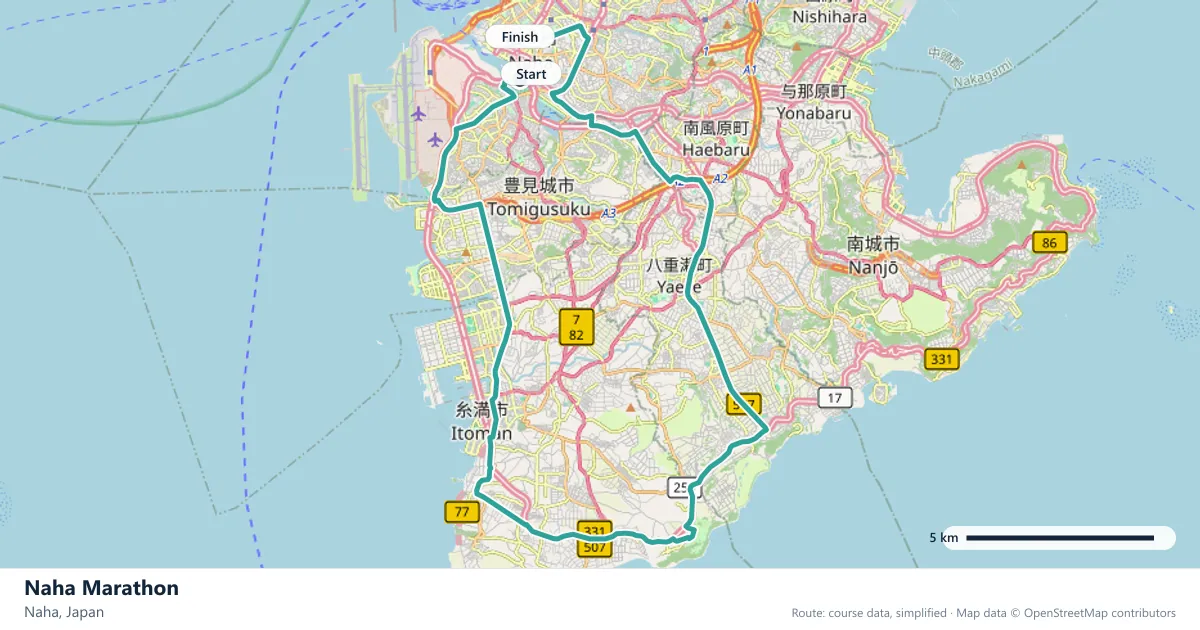
Where does the Naha Marathon run?
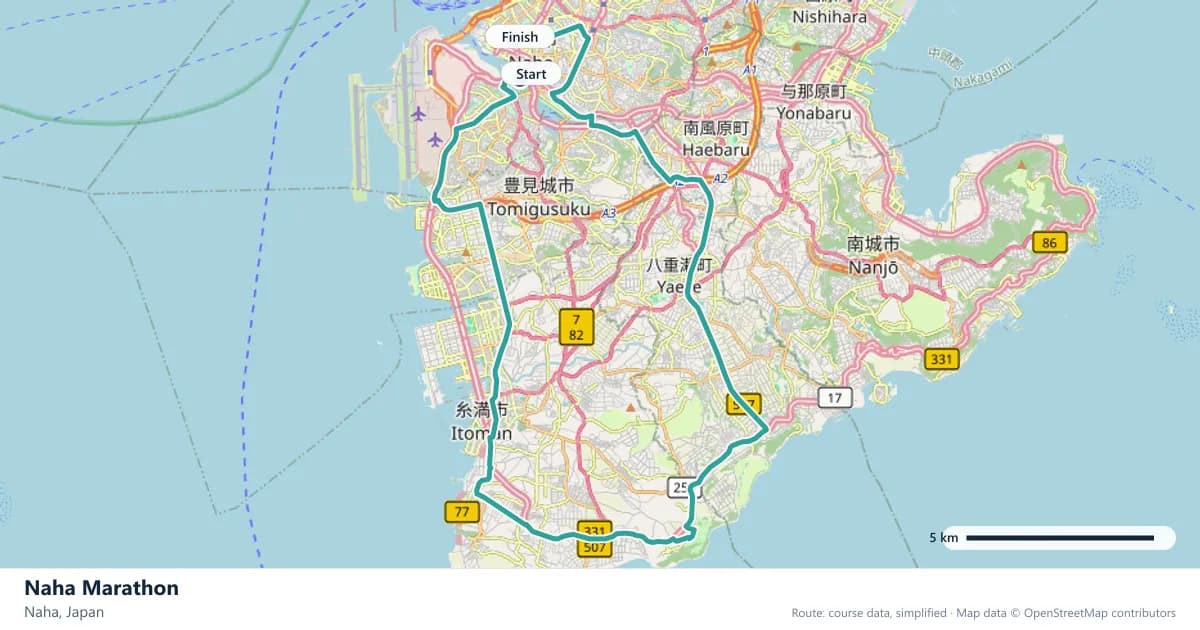
Interactive map
The trace follows the organizer's published course, simplified for the screen: the orange dot is the start, the dark dot the finish. Scroll to zoom, drag to pan.
What is the Naha Marathon course like?
Okinawa's December marathon, running along the coast and through the subtropical hills south of Naha. Warm, humid and rolling, with a famously generous finish-line welcome.
- Next edition
- 06 December 2026
- Elevation gain
- 287 m
- Profile
- Hilly
- First run
- —
Course guide
December is the month when most Japanese marathons brace for cold, but Naha is the exception. Okinawa's capital sits far enough south that its marathon is run in warm, heavy air, with the sea close by and the island's subtropical hills framing the route. The 2026 Naha Marathon is on 6 December, and it asks for a different kind of preparation from a mainland winter race.
The course is hilly, with about 287 metres of climbing, yet there is no single mountain pass to dread. The climbs come as short, repeated rises through the landscape south of the city, and the humidity makes them feel harder than the numbers suggest. Runners who arrive expecting a flat coastal stroll usually meet the first hill sooner than they planned.
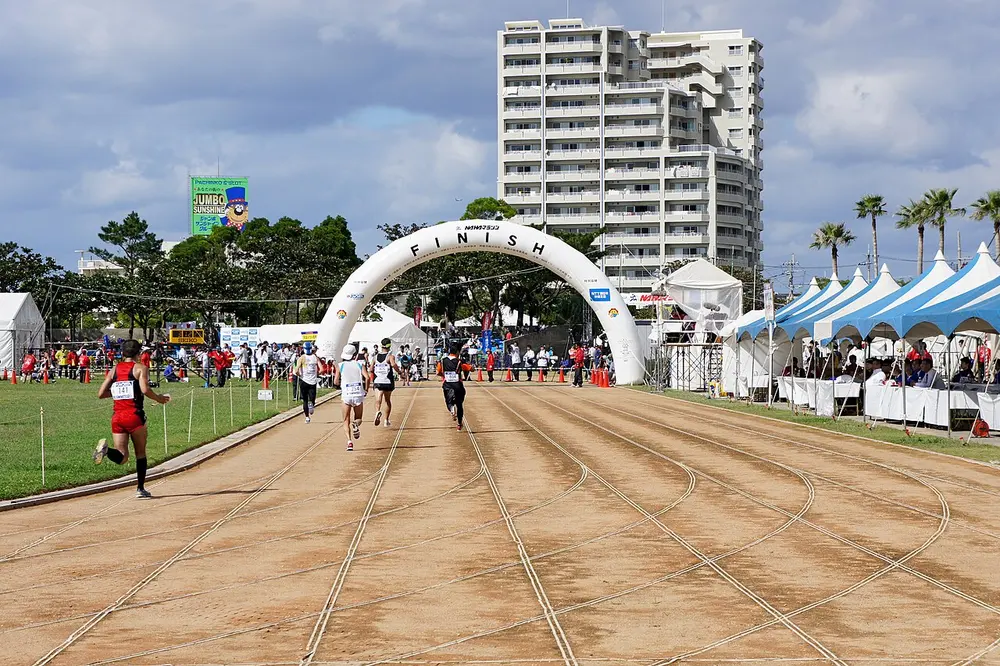
NAHA Marathon01n. Photo: 663highland / Wikimedia Commons, CC BY 2.5.
The course
The route follows the coast south of Naha and works through the hills behind it. Sea views are a constant feature, and the road rolls rather than settling into a long flat stretch. That combination is the race's character: open water on one side, folded green terrain on the other, and very little chance to switch off.
The climbing is spread across the route instead of being concentrated at one point. A short rise is followed by a descent, then another rise, and the pattern repeats often enough that rhythm matters more than any single effort. On tired legs in the second half, those small climbs accumulate.
| Race fact | Detail |
|---|---|
| Date | 6 December 2026 |
| Profile | Hilly |
| Elevation gain | About 287 m |
| Setting | Coast and subtropical hills south of Naha |
A December race in the subtropics
Okinawa does not have a mainland Japanese winter. December here is warm and humid, and the race is built around that reality rather than around the calendar image of a cold-weather marathon. The air can feel heavy from the first kilometres, long before the sun is high, and the sea breeze offers less relief than runners hope for.
That makes the Naha Marathon a hydration and pacing test as much as a hill race. The sensible approach is to start conservatively, drink before you feel thirsty, and accept that the pace you can hold on a cool morning at home is not the pace this course will give you.
Where the 287 metres go
The elevation profile is best read as a series of steps rather than one long ascent. There are no named climbs to study in advance, and no single summit that defines the day. Instead, the route keeps lifting and settling as it threads through the hills south of the city.
For runners who train on flat roads, that pattern is the hidden difficulty. A single short rise is easy; a dozen of them, in warm air, with the sea always suggesting an easy day, is not. The descents are real but brief, and they do not repay the climbing in any meaningful way. The race rewards even effort and a shorter stride on the rises rather than a heroic charge up each one.
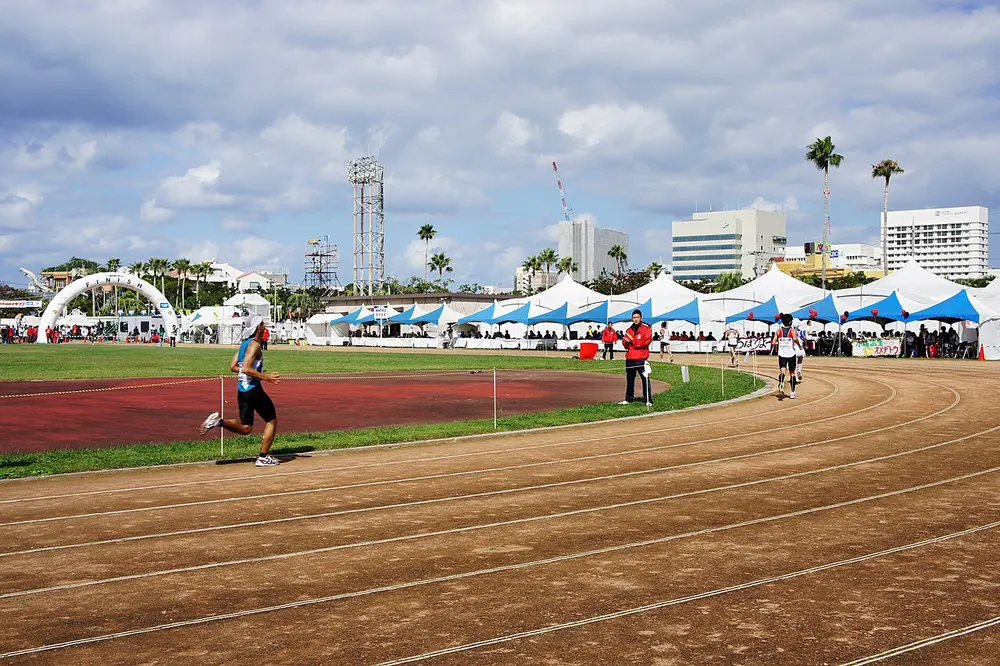
NAHA Marathon02n. Photo: 663highland / Wikimedia Commons, CC BY 2.5.
The finish-line welcome
Naha's finish has a reputation that travels ahead of the race. The welcome is famously generous, with the kind of crowd and volunteer atmosphere that turns a hard, humid marathon into a celebration. It is the detail runners mention when they recommend the race to friends, more often than the scenery or the time they ran.
That reputation is worth enjoying, but it is not a reason to sprint the last kilometre. The final stretch arrives after the hills and the heat have already taken their share, and the best way to meet the welcome is upright and still moving.
Getting to the start
Naha is Okinawa's main city, and its airport is the island's gateway for almost everyone travelling to the race. The course is based in and south of the city, so race morning involves road closures and a journey that deserves more time than a normal commute. Staying close to the start area removes one variable from a day that already has enough of them.
The island's transport is not as dense as mainland Japan's, and the race disrupts the roads it uses. Check the organiser's access plan and leave earlier than a normal commute.
Race-day tests
- Humidity from the start. The air is warm and heavy, and sweat loss begins before the race feels hard. Start drinking early.
- The repeated rises. About 287 metres is spread across many short climbs. Run them by effort, not by the split you planned on flat ground.
- Sea-view pacing. The coast can make the pace feel easier than it is. Check your watch when the view opens up.
- Shelter is scarce. Much of the route is exposed. A cap and sunglasses are practical equipment, not accessories.
- The finish welcome. Look forward to it, but do not empty the tank early to reach it.
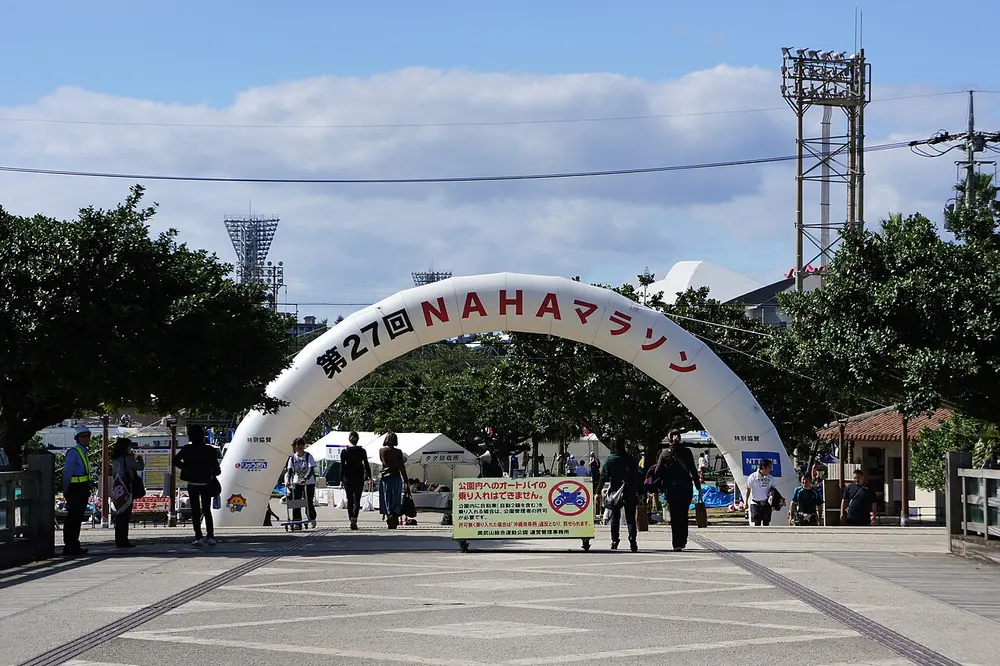
NAHA Marathon03n. Photo: 663highland / Wikimedia Commons, CC BY 2.5.
Frequently asked questions
Answers to the questions runners ask before entering, drawn from this race's course guide and the directory's own data — the sources behind them are listed below.
When is the Naha Marathon in 2026?
The race is on 6 December 2026. It is a December fixture on Okinawa, and the date is confirmed for this edition.
Is the Naha Marathon a flat course?
No. It is hilly, with about 287 metres of climbing. The route rolls through the hills south of Naha in short, repeated rises rather than one long ascent.
Is the Naha Marathon good for a personal best?
The conditions work against fast times. Warm, humid air and constant rolling terrain make even pacing difficult, and the course offers little chance to settle into a rhythm for long. It is better approached as an experience race than as a personal-best attempt.
Is the Naha Marathon suitable for a first marathon?
It is a demanding debut. The humidity and the repeated climbs ask a lot of a runner who has never covered the distance, and the exposed sections add to the load. The course does not offer the gentle, forgiving day that a first marathon usually wants.
Where is the Naha Marathon run?
It runs along the coast south of Naha and through the subtropical hills behind it, on Okinawa in Japan. The sea is a constant presence and the terrain rolls throughout.
What is the finish of the Naha Marathon like?
The finish has a famously generous welcome. Crowds and volunteers give the race a celebratory ending that runners remember, and it provides a strong contrast with the quiet, humid kilometres through the hills.
More marathons in Japan
More marathons in Asia
Sources for this page
What each source below is used for on this page, and where to check this race yourself.
- World Athletics — the label calendar and the road-race regulations. Used to check whether the race holds a World Athletics label, and its elite competition details.
- AIMS — the international course-measurement standard behind the 42.195 km distance, and the AIMS race calendar.
- The organizer's own publications — course maps, race handbooks and published results. The date, course character and climbing on this page are compiled from them and re-checked each season.
Where do these facts come from?
Dates, course type, climbing and time limits are compiled from the organizer's publications and re-checked each season; elevation is an estimate of total climbing rather than a survey figure. Always confirm race-day details with the organizer before making plans.
Last reviewed 27 October 2026