
Leeds Marathon
Leeds is a city built in a bowl of hills, and its marathon makes no attempt to hide them. The next edition is expected in May 2027.
By Global Marathon Routes editorial team · Last reviewed 27 October 2026
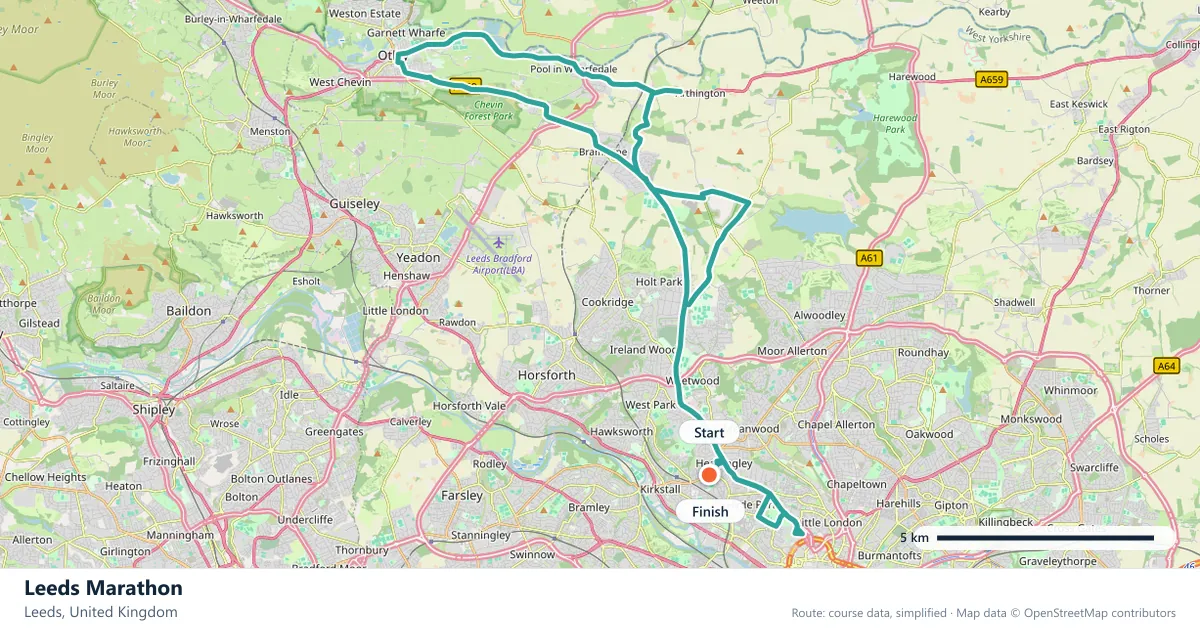
Where does the Leeds Marathon run?
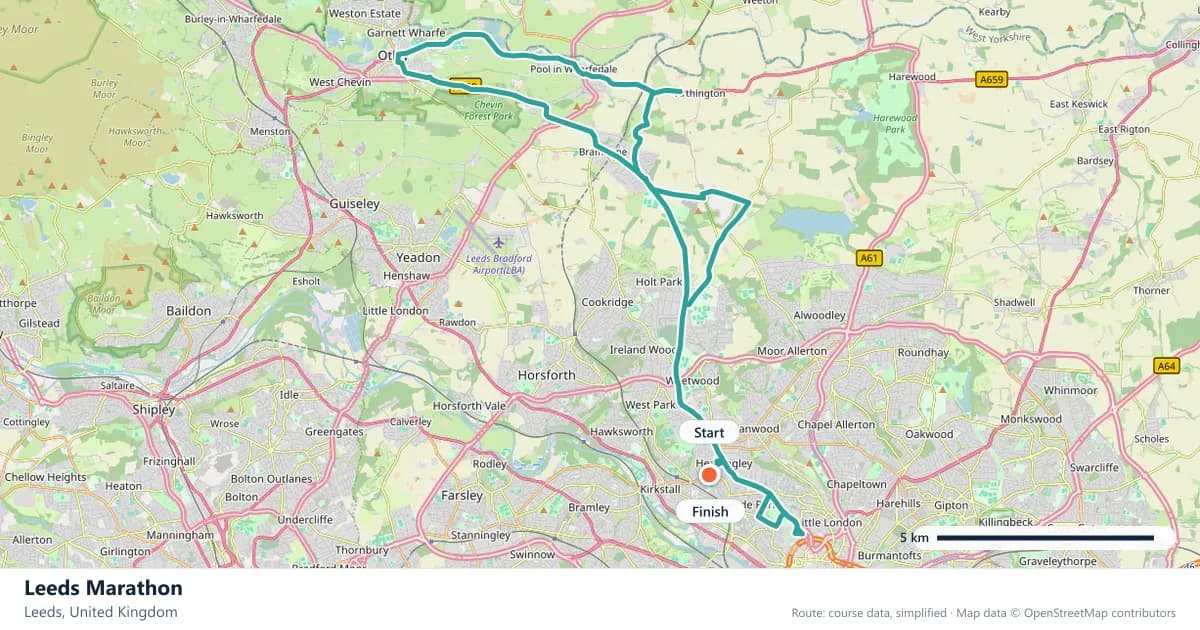
Interactive map
The trace follows the organizer's published course, simplified for the screen: the orange dot is the start, the dark dot the finish. Scroll to zoom, drag to pan.
What is the Leeds Marathon course like?
A Yorkshire city marathon that uses the hills around Leeds rather than hiding from them: nearly 400 metres of climbing on a course that rewards even pacing.
- Next edition
- May 2027 (expected)
- Elevation gain
- 405 m
- Profile
- Hilly
- First run
- —
Course guide
Leeds is a city built in a bowl of hills, and its marathon makes no attempt to hide them. The next edition is expected in May 2027. The course uses the rising ground around Leeds rather than skirting it, with about 405 metres of climbing over 42 km.
The profile is hilly, and that is the defining fact. Nearly 400 metres of gain on a city marathon means the race rewards even pacing and hill-specific training. There is no flat easy option and no long stretch where you can switch off.
Leeds itself is a former wool town that grew into a modern city without losing its stone frontage. The route is a tour of the city's rising ground, and the finish is earned rather than given.
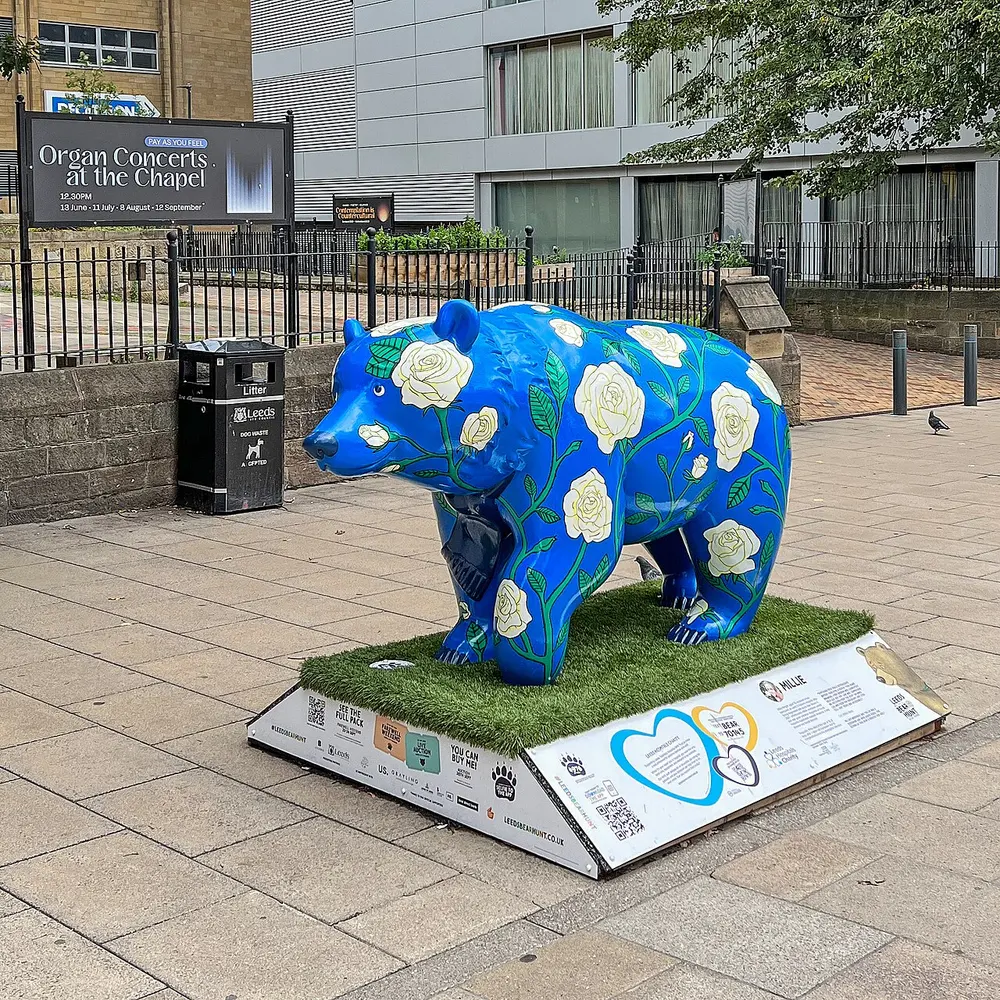
Leeds Bear Hunt. Photo: Tim Green / Wikimedia Commons, CC BY 2.0.
The course
The hills are the race, not an inconvenience to be avoided. With about 405 metres of gain, the climbing is a defining feature and the descents do not cancel it out. This is a city marathon with real elevation, not a token rise over a bridge.
The route changes rhythm constantly. Climbs are followed by descents, and descents by more climbs. The course rewards runners who stay patient and keep their form when the gradient changes. The hills are the reason the race feels bigger than its distance; there is no long flat section where the legs can switch off.
Climbing through the city
Leeds sits on the River Aire, with the city centre in a valley and neighbourhoods climbing the surrounding slopes. The course uses that shape: the centre is the lowest point, and the roads out of it climb in every direction, which is why the race can find 405 metres without leaving Leeds.
Run the rises by effort, not by pace. The descents are not free either: they hammer the quads and tempt you into a pace you cannot hold when the road rises again.
1 City Square, Leeds (12th March 2019) 003. Photo: Mtaylor848 / Wikimedia Commons, CC BY-SA 4.0.
The cost of the hills
The race is decided in the second half. A fast start costs more here than on a flat course, because the climbing arrives when the legs are already tired. The course rewards a conservative first half and a patient middle.
Four hundred metres of climbing is a real challenge for a city marathon. Runners who have trained on hills will find the day manageable; those who have not will find the last ten kilometres a long way. The race is a test of strength rather than speed, and the runners who do well are the ones who can climb without surging and descend without braking.
Leeds in stone and wool
Leeds grew rich on wool and cloth, and its centre still shows it: the Town Hall, the Victorian arcades, the City Square with its statues. Leeds sits between the Yorkshire Dales and the old industrial towns of the West Riding, and the race uses that edge. The stone retaining walls that hold up the hillsides are part of the city's character, and the local support gives the day a community feel.
The city is well connected by rail, which makes it easy to reach for a weekend, but the hills are the reason to train specifically rather than simply run flat mileage.
Planning for an expected date
May 2027 is expected but not confirmed. The month is the reliable marker for planning, but the exact date is not fixed. Wait for the organiser's announcement before booking non-refundable travel.
A spring date means a winter build, with the hills as the main training focus. A spring race also means the training months are dark and cold, so the hills are a useful way to break up long winter runs. Long runs on rolling roads and regular climbing will prepare you better than flat mileage alone.
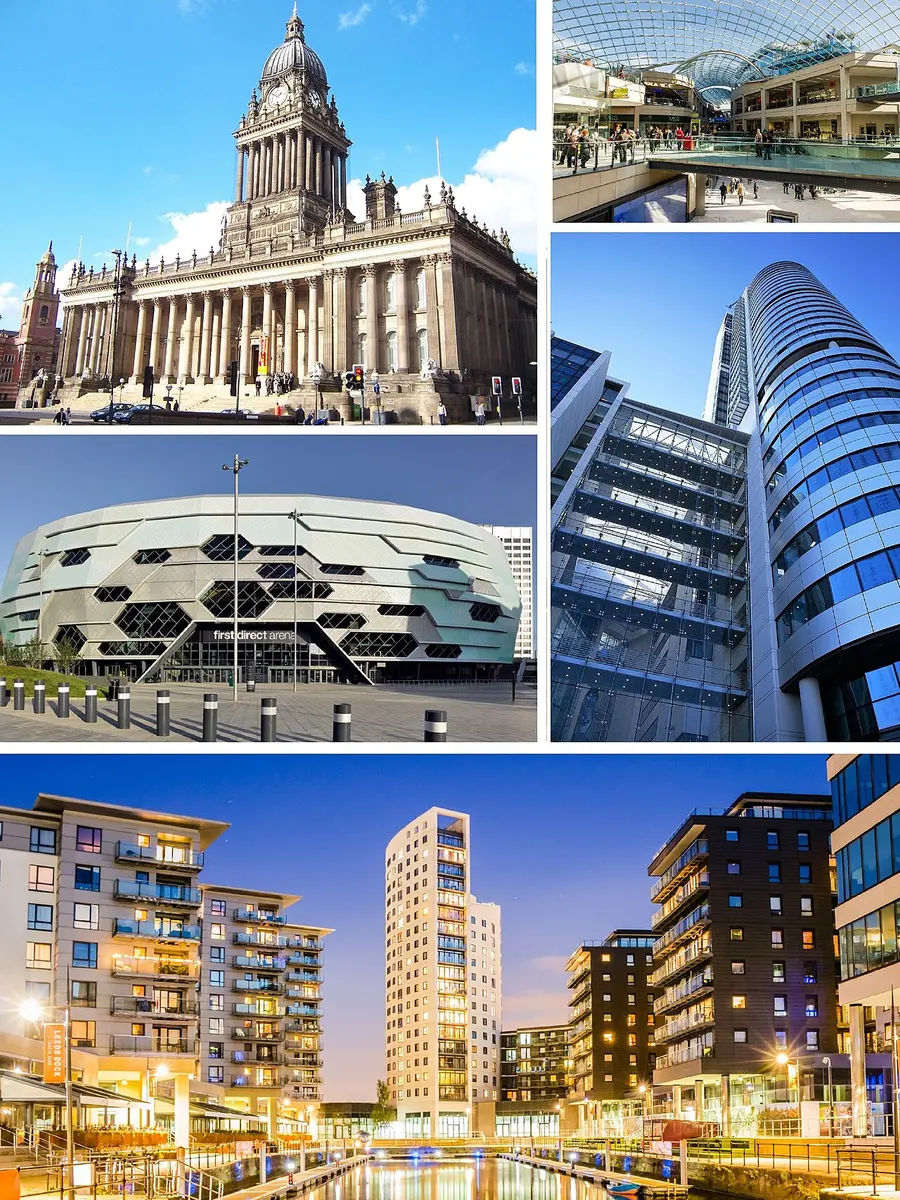
Leeds Montage. Photo: Lad 2011 / Wikimedia Commons, CC BY-SA 4.0.
Frequently asked questions
Answers to the questions runners ask before entering, drawn from this race's course guide and the directory's own data — the sources behind them are listed below.
When is the Leeds Marathon?
The next edition is expected in May 2027. The date is provisional rather than confirmed, so check the organiser's information before making travel plans.
Is the Leeds Marathon a hilly course?
Yes. It climbs about 405 metres over the distance, which is just over 400 metres. The route uses the hills around Leeds and is genuinely hilly by city-marathon standards.
Is Leeds suitable for a first marathon?
It is a demanding choice for a first marathon because of the climbing. The distance is the same as anywhere else, but the hills and descents in the second half require specific preparation.
Is it a fast course?
No. With about 405 metres of climbing, the course is not built for fast times. It suits runners who enjoy hilly racing and are willing to pace by effort rather than chase splits.
Where is the Leeds Marathon run?
It is run in Leeds, using the city and the hills around it. The course is a full 42.195 km and includes just over 400 metres of climbing.
How should I pace the Leeds Marathon?
Run by effort and keep the first half controlled. The climbs come with the course, so a steady, patient rhythm will serve you better than trying to bank time early.
More marathons in United Kingdom
More marathons in Europe
Sources for this page
What each source below is used for on this page, and where to check this race yourself.
- World Athletics — the label calendar and the road-race regulations. Used to check whether the race holds a World Athletics label, and its elite competition details.
- AIMS — the international course-measurement standard behind the 42.195 km distance, and the AIMS race calendar.
- The organizer's own publications — course maps, race handbooks and published results. The date, course character and climbing on this page are compiled from them and re-checked each season.
Where do these facts come from?
Dates, course type, climbing and time limits are compiled from the organizer's publications and re-checked each season; elevation is an estimate of total climbing rather than a survey figure. Always confirm race-day details with the organizer before making plans.
Last reviewed 27 October 2026