
Bremen Marathon
Bremen's marathon runs two laps through the city and along the Weser, and the historic market square sits at the centre of each lap. The next edition is on 3 October 2027.
By Global Marathon Routes editorial team · Last reviewed 27 October 2026
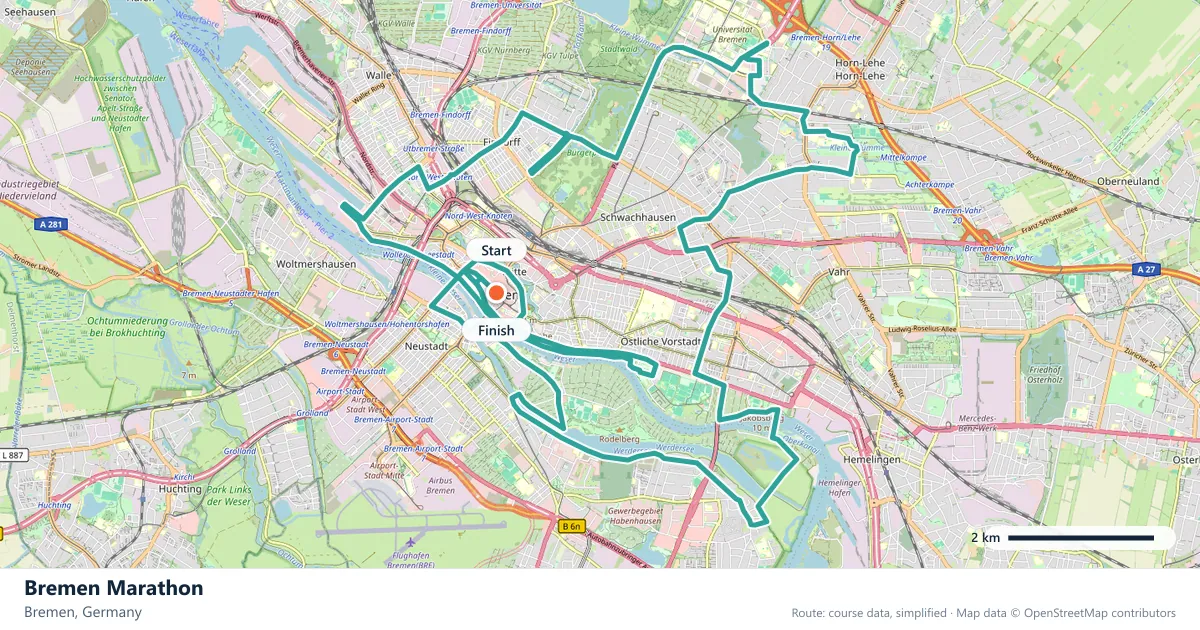
Where does the Bremen Marathon run?
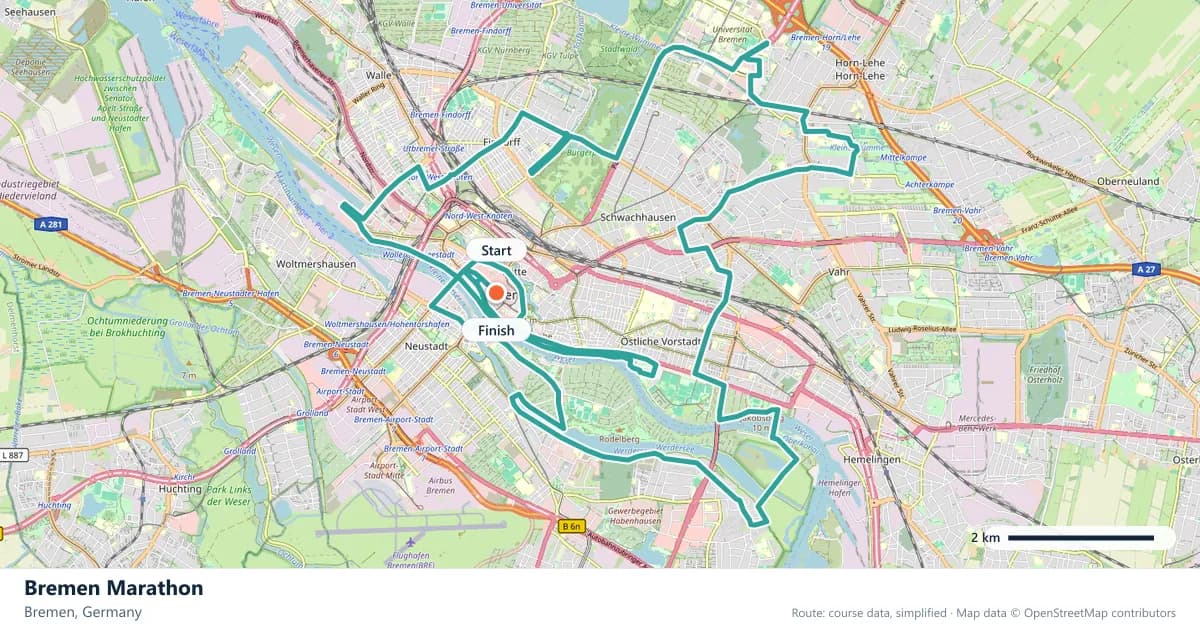
Interactive map
The trace follows the organizer's published course, simplified for the screen: the orange dot is the start, the dark dot the finish. Scroll to zoom, drag to pan.
What is the Bremen Marathon course like?
A flat two-lap city course through Bremen and along the Weser, with the historic market square at its centre. One of the quicker German autumn races.
- Next edition
- 03 October 2027
- Elevation gain
- 78 m
- Profile
- Flat
- First run
- —
Course guide
Bremen's marathon runs two laps through the city and along the Weser, and the historic market square sits at the centre of each lap. The next edition is on 3 October 2027. It is a flat course with about 78 metres of climbing, and it has a reputation as one of the quicker German autumn races.
The two-lap format is the defining feature. Runners cover the same streets twice, which makes the course familiar and lets supporters plan their viewing. The market square, with the town hall and the Roland statue, is the fixed point of the route, and the river provides the long, open stretches.
Bremen is not a marathon that relies on spectacle. Its appeal is the combination of a flat, honest course, a compact northern city and a date that sits near the end of the German racing season. It suits runners who want a straightforward race with a clear rhythm.

Zieleinlauf Bremen Marathon. Photo: Oliver Sebrantke / Wikimedia Commons, CC BY-SA 3.0.
The course
The race runs two laps through Bremen and along the Weser, with the market square at its centre. The 78 metres of climbing are spread so thinly that there is no climb to plan for. The city streets provide the turns, while the river sections provide the straighter running.
The first lap is a learning exercise. You see the corners, the surfaces and the transitions between the square and the river, and you can adjust your pace before the second pass. The second lap is where the race is actually run: the route is familiar, the field has thinned, and the challenge is to keep the effort honest.
Two laps, one city
A two-lap course changes the psychology of a marathon. The first half is partly reconnaissance, and the second half is an execution of what you have learned. That can be an advantage for a debutant, because the route feels less unknown on the second pass. It can also be a disadvantage, because the repetition can make the final ten kilometres feel longer than they are.
Bremen's compact centre keeps the two laps from feeling like a circuit in an empty suburb. The market square, the streets around it and the riverbank all have a distinct character, and the second lap brings them back in a different state of fatigue. Use the familiar landmarks to measure progress rather than to count the distance down.
The market square and the Weser
The market square is the civic heart of Bremen. The town hall and the Roland statue are its best-known features, and the square's scale gives the race a strong central reference point. The course passes through it, and the surrounding streets connect it to the river.
The Weser provides the other half of the course's character. The riverbank sections are flatter and more open than the city streets, and they give the race a northern, maritime feel. Bremen's history as a Hanseatic trading city is part of that atmosphere: the river was the city's connection to the sea, and the race follows that connection.
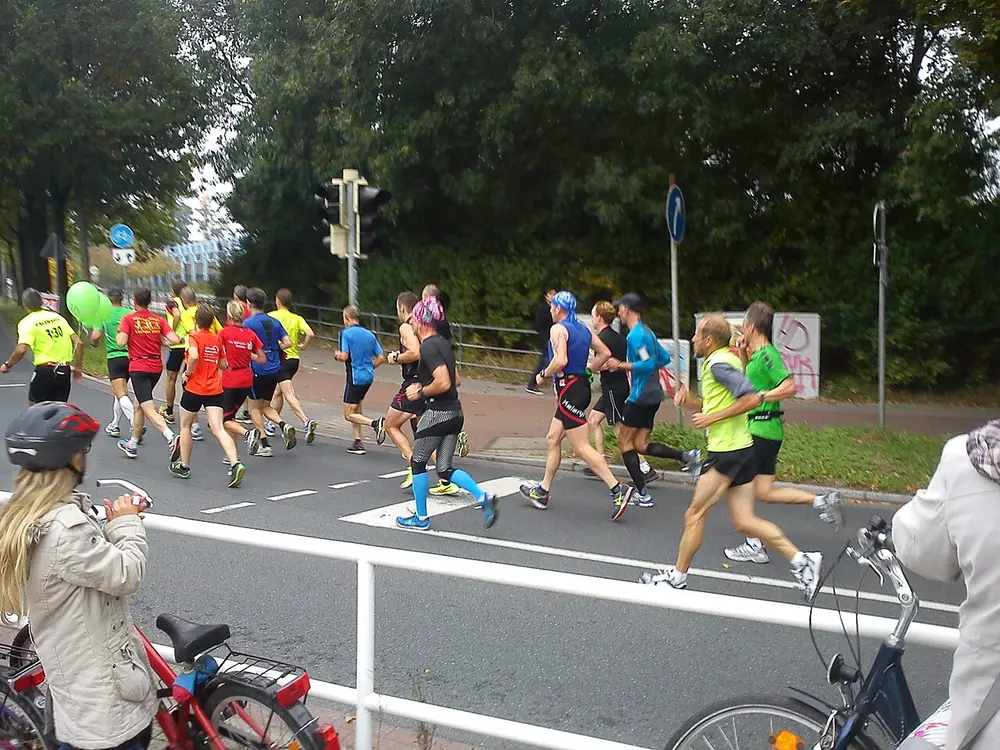
Marathon-HB2013-Start. Photo: House1630 / Wikimedia Commons, CC BY-SA 3.0.
Why the second lap matters
On a flat course, the second lap is where pacing discipline shows. The first lap can feel easy, especially with the crowd and the novelty of the route. The second lap removes both. What remains is the distance and the rhythm you have built.
The 78 metres of climbing will not slow you down, so the race is decided by how well you manage the flat kilometres. The two-lap format makes the second half mentally harder but physically no different. Runners who can stay relaxed and keep their fuelling on schedule will find the course gives them a fair chance of a good time.
An autumn race in northern Germany
October in Bremen is a transitional weekend: the summer is over, the city is back in its normal rhythm and the race marks the end of the German season. The flat course and the autumn date make it a natural target for runners who have built through the summer.
The city is easy to reach and compact enough to walk between the market square, the river and the start area. The race feels like a local event with a wider field rather than a mass-market major, and that is part of its charm. It is a good choice for a personal best or a first marathon, provided you start conservatively and let the course come to you.
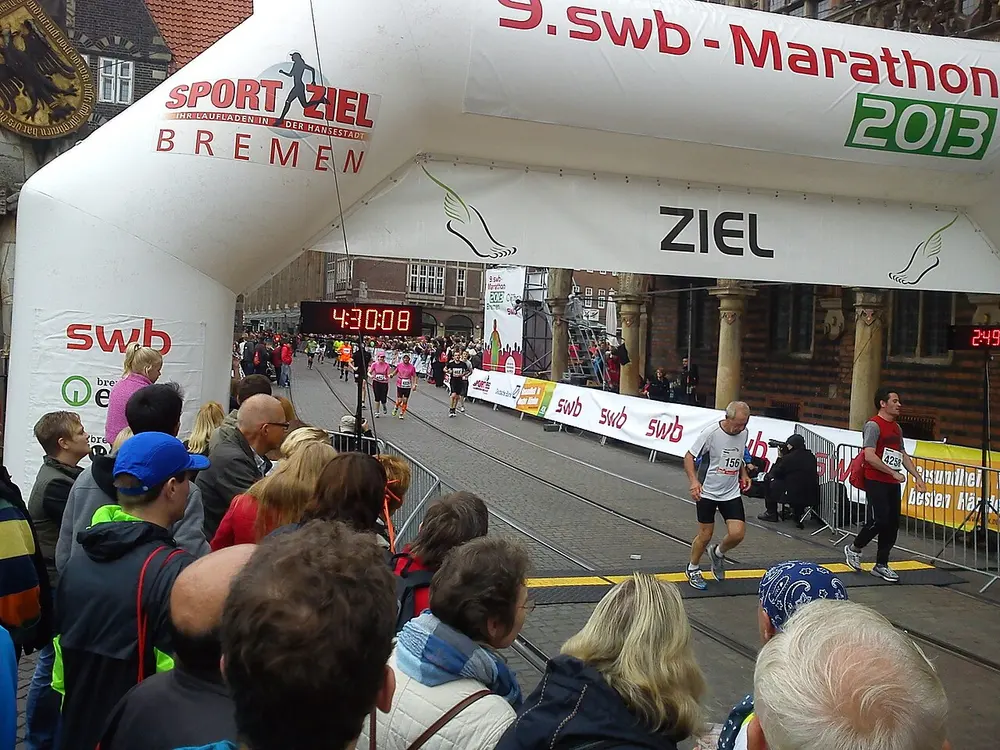
Marathon-HB2013-Ziel1. Photo: House1630 / Wikimedia Commons, CC BY-SA 3.0.
Frequently asked questions
Answers to the questions runners ask before entering, drawn from this race's course guide and the directory's own data — the sources behind them are listed below.
When is the Bremen Marathon?
The next edition is on 3 October 2027. It is an autumn race on a flat two-lap course.
Is the Bremen Marathon a flat course?
Yes. The route climbs about 78 metres in total, with no sustained ascent. The flat profile and the two laps make it one of the quicker German autumn races.
Is Bremen good for a personal best?
The flat course and the autumn date give it a fair chance of fast times. A personal best still depends on pacing and conditions, but there is no hill to interrupt the rhythm.
Is the Bremen Marathon suitable for a first marathon?
Yes. The flat profile and the two-lap layout make the route easy to learn, and the compact city keeps the logistics simple. The main risk is starting too quickly on the first lap.
Where does the Bremen Marathon run?
It runs through Bremen on a two-lap course, with the historic market square at its centre and the Weser providing the riverside sections.
What does a two-lap course mean for runners?
You cover the same streets twice. The first lap is for learning the corners and the transitions; the second is for executing the pace. It is mentally harder but physically no different from a single loop.
More marathons in Germany
More marathons in Europe
Sources for this page
What each source below is used for on this page, and where to check this race yourself.
- World Athletics — the label calendar and the road-race regulations. Used to check whether the race holds a World Athletics label, and its elite competition details.
- AIMS — the international course-measurement standard behind the 42.195 km distance, and the AIMS race calendar.
- The organizer's own publications — course maps, race handbooks and published results. The date, course character and climbing on this page are compiled from them and re-checked each season.
Where do these facts come from?
Dates, course type, climbing and time limits are compiled from the organizer's publications and re-checked each season; elevation is an estimate of total climbing rather than a survey figure. Always confirm race-day details with the organizer before making plans.
Last reviewed 27 October 2026