
Düsseldorf Marathon
Düsseldorf is a city of two riverbanks. The Rhine separates the old town and the shopping streets on the east side from Oberkassel and the western districts, and the bridges stitch the halves…
By Global Marathon Routes editorial team · Last reviewed 27 October 2026
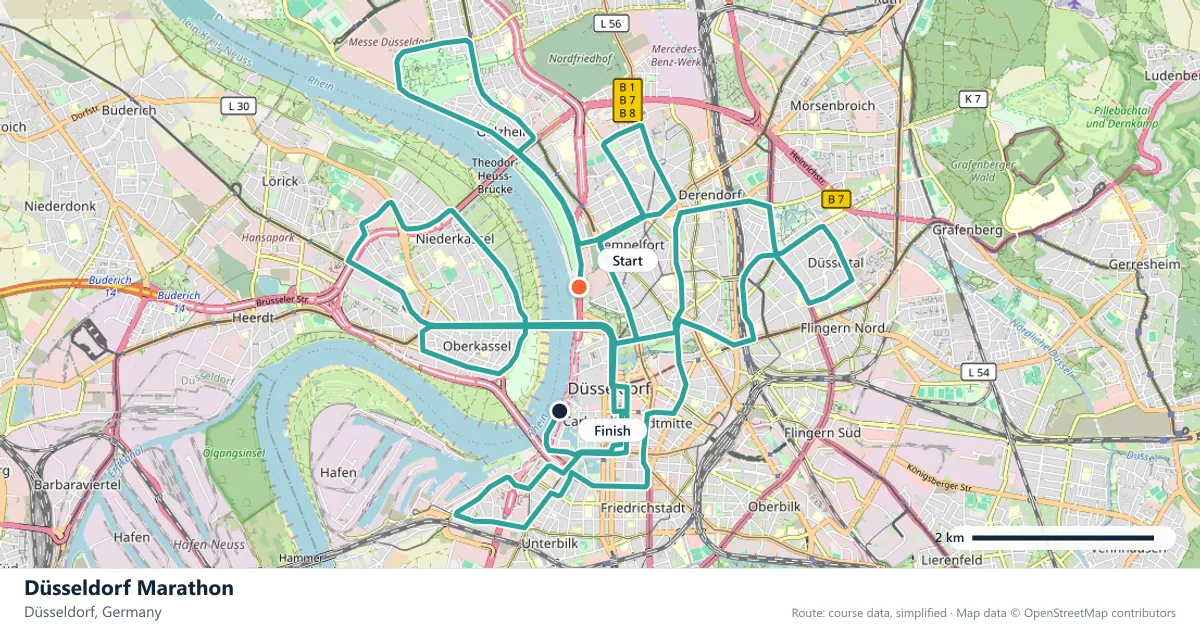
Where does the Düsseldorf Marathon run?
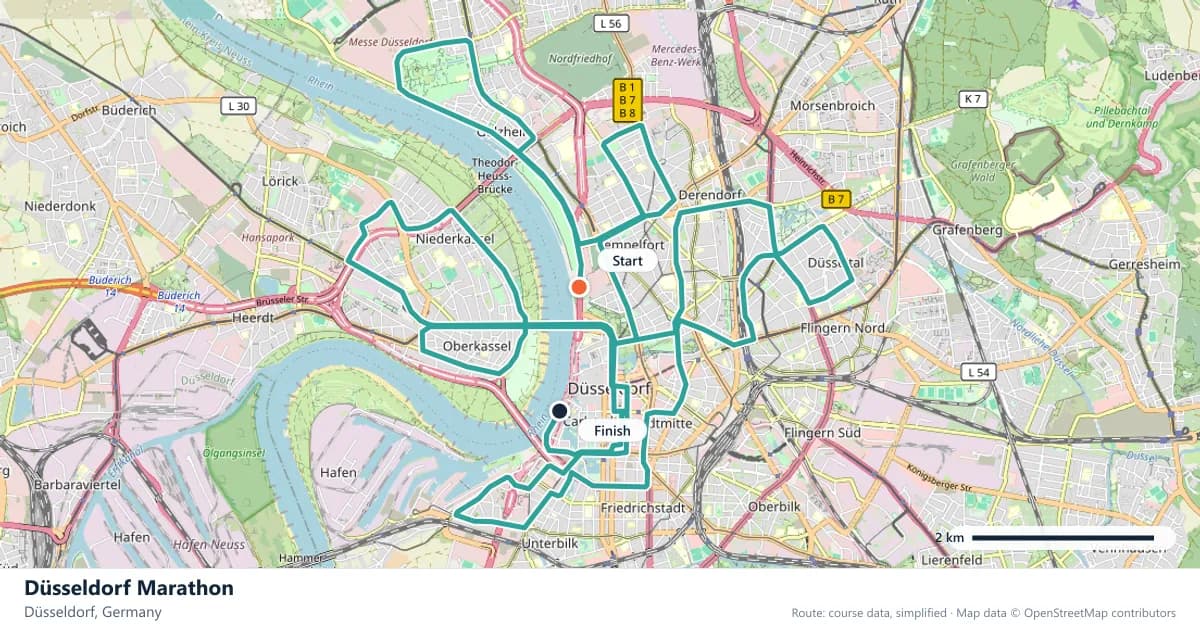
Interactive map
The trace follows the organizer's published course, simplified for the screen: the orange dot is the start, the dark dot the finish. Scroll to zoom, drag to pan.
What is the Düsseldorf Marathon course like?
A flat spring marathon on both sides of the Rhine, taking in the Altstadt, the MedienHafen and the Königsallee. Built for fast times, with pace groups down to sub-3.
- Next edition
- 18 April 2027
- Elevation gain
- 71 m
- Profile
- Flat
- First run
- —
Course guide
Düsseldorf is a city of two riverbanks. The Rhine separates the old town and the shopping streets on the east side from Oberkassel and the western districts, and the bridges stitch the halves together. The marathon uses both banks, taking in the Altstadt, the MedienHafen and the Königsallee before returning across the water. The next edition is on 18 April 2027.
Only about 71 metres of climbing interrupts a flat course built for fast times. Pace groups go down to sub-3, a sign of the race's ambitions, and the wide city roads give runners room to settle into a rhythm. It is a spring marathon with a clear purpose: quick running in a compact, sociable city.
Düsseldorf is not a course that hides behind scenery. The river and the landmarks give the morning variety, but the race is decided on the flat, and the flat is where a disciplined runner can do well.
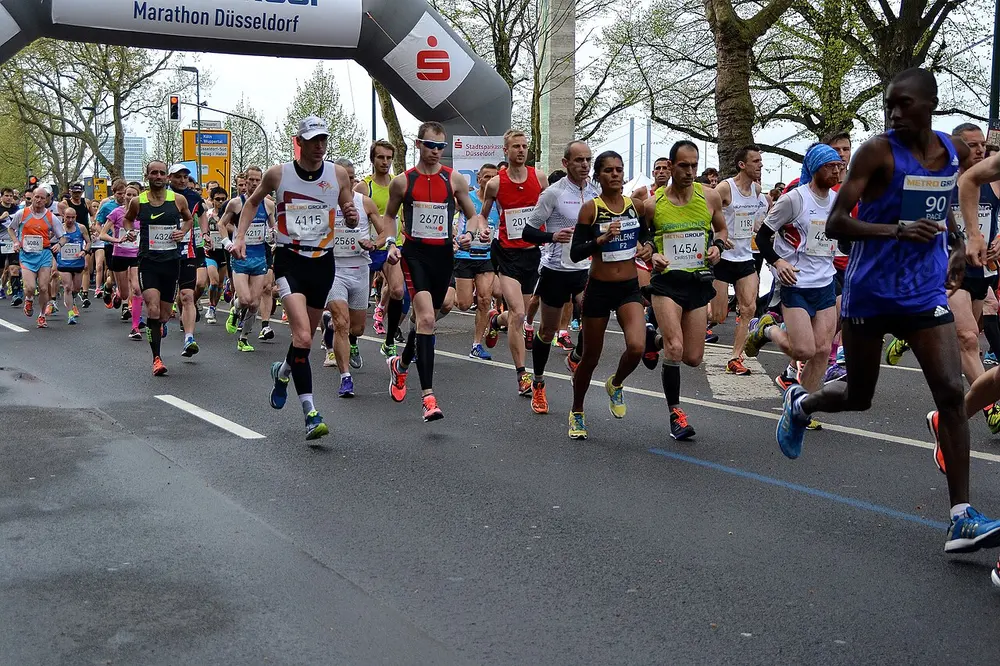
Düsseldorf Marathon 2015-04-26 00051. Photo: Kai Engelhardt from Cologne, Germany / Wikimedia Commons, CC BY-SA 2.0.
The course
The route uses both banks of the Rhine, crossing the river to connect the Altstadt, the MedienHafen and the Königsallee. Each crossing changes the character of the surroundings, from historic streets to modern waterfront, while the road stays flat.
About 71 metres of climbing is spread across the whole 42.195 kilometres, so there is no rise that calls for a change of pace. That is why the race can offer pace groups down to sub-3 and why it attracts runners chasing personal bests. The bridges are the main interruptions, and they are short.
The Altstadt and the MedienHafen
The Altstadt is Düsseldorf's historic core, a dense quarter of narrow streets, breweries and bars that is famously sociable. The marathon passes through it, and the contrast with the modern MedienHafen could hardly be sharper. The harbour district is a recent transformation, with striking contemporary buildings by the water and a waterfront promenade.
That contrast is one of the race's pleasures. The old town supplies the crowd and the atmosphere; the MedienHafen supplies the open views and the sense of a city reinventing its riverfront. Between them, the Königsallee adds a different kind of Düsseldorf: the broad shopping boulevard with its canal and plane trees.
Pace groups to sub-3
The sub-3 pace groups are a practical feature of the race. They give runners a target and a group to share the work, and they signal that the organisers expect fast times. For a runner chasing a personal best, that structure can be useful: the pace is set, the route is flat and the only variable is how well you manage the distance.
Joining a group is still a choice. If the pace matches your training, it can help. If it does not, the flat course will make the group feel easier than it should, and the debt will arrive later. Use the groups as a tool, not as a substitute for your own race plan.
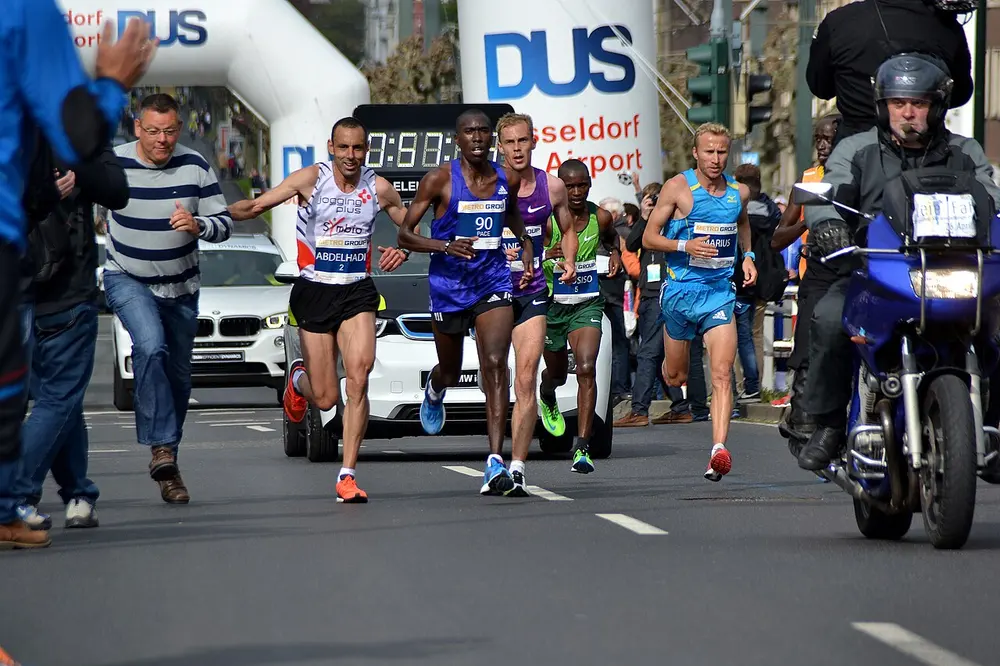
Düsseldorf Marathon 2015-04-26 00126. Photo: Kai Engelhardt from Cologne, Germany / Wikimedia Commons, CC BY-SA 2.0.
A flat course on both banks
With 71 metres of climbing, there is almost no terrain to interrupt the pace. The river crossings add small approaches, but the route is flat by any reasonable standard. That makes it a good course for even splits and a difficult one for runners who rely on hills to control their effort.
The two-bank layout also means the race has a natural symmetry. The city appears on one side, the river on the other, and the bridges mark the transitions. Runners who can stay relaxed through the crossings and keep their fuelling consistent will find the course gives them a fair chance of a fast day.
Spring in the Rhineland
April is a good time for a marathon in Düsseldorf. The winter training is behind you, the city is coming back to life and the race offers a spring target before the summer heat. The flat course and the pace groups make it a popular choice for runners chasing a personal best.
The compact centre and the riverside setting make race weekend easy to manage. The Altstadt, the Königsallee and the MedienHafen are within walking distance of each other, and supporters can move between viewpoints without long journeys. It is a race that combines a fast course with a city that knows how to enjoy a weekend.
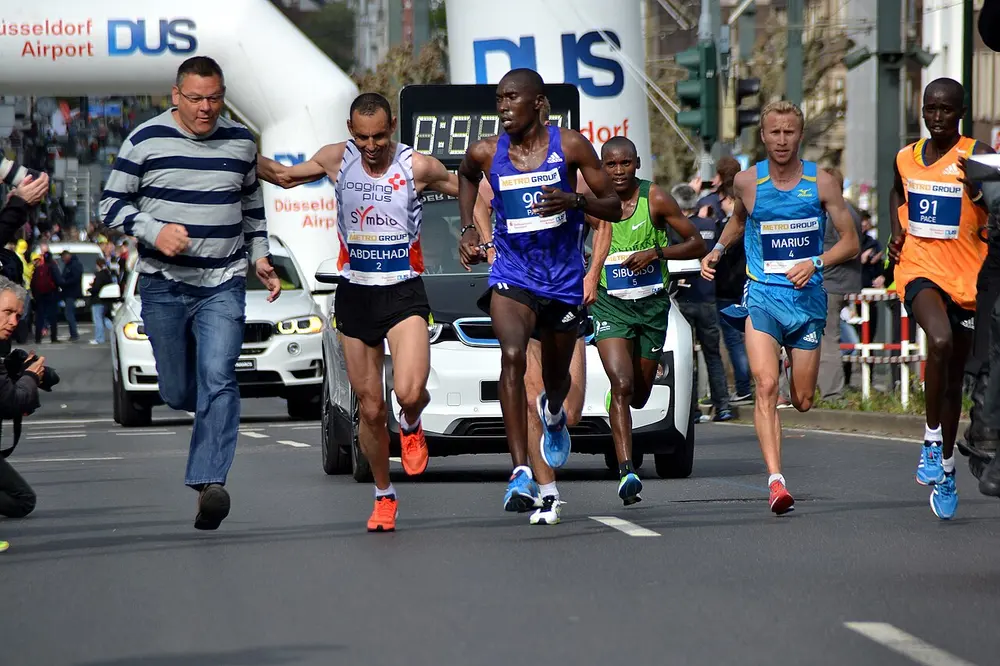
Düsseldorf Marathon 2015-04-26 00127. Photo: Kai Engelhardt from Cologne, Germany / Wikimedia Commons, CC BY-SA 2.0.
Frequently asked questions
Answers to the questions runners ask before entering, drawn from this race's course guide and the directory's own data — the sources behind them are listed below.
When is the Düsseldorf Marathon?
The next edition is on 18 April 2027. It is a spring race in the Rhineland.
Is the Düsseldorf Marathon a flat course?
Yes. It climbs about 71 metres across the full distance, with no sustained ascent. The river crossings add small changes of grade, but the route is flat by any reasonable standard.
Is Düsseldorf good for a personal best?
The flat profile, wide roads and pace groups make it a strong personal-best candidate. A personal best still depends on pacing, but the course offers very little resistance.
Is the Düsseldorf Marathon suitable for a first marathon?
Yes. The limited climbing and straightforward route make it a manageable debut. The pace groups can be useful, but first-time runners should choose a target based on their own training.
Are there pace groups?
Yes. Pace groups are offered down to sub-3, which reflects the flat course and the race's fast ambitions.
Where does the Düsseldorf Marathon run?
It runs on both sides of the Rhine, taking in the Altstadt, the MedienHafen and the Königsallee. The route crosses the river between the two banks.
More marathons in Germany
More marathons in Europe
Sources for this page
What each source below is used for on this page, and where to check this race yourself.
- World Athletics — the label calendar and the road-race regulations. Used to check whether the race holds a World Athletics label, and its elite competition details.
- AIMS — the international course-measurement standard behind the 42.195 km distance, and the AIMS race calendar.
- The organizer's own publications — course maps, race handbooks and published results. The date, course character and climbing on this page are compiled from them and re-checked each season.
Where do these facts come from?
Dates, course type, climbing and time limits are compiled from the organizer's publications and re-checked each season; elevation is an estimate of total climbing rather than a survey figure. Always confirm race-day details with the organizer before making plans.
Last reviewed 27 October 2026