
Bath Marathon
Bath is a city that looks like a stage set: honey-coloured Georgian terraces, the abbey, the Roman baths, and the Avon cutting a low line through it all.
By Global Marathon Routes editorial team · Last reviewed 27 October 2026
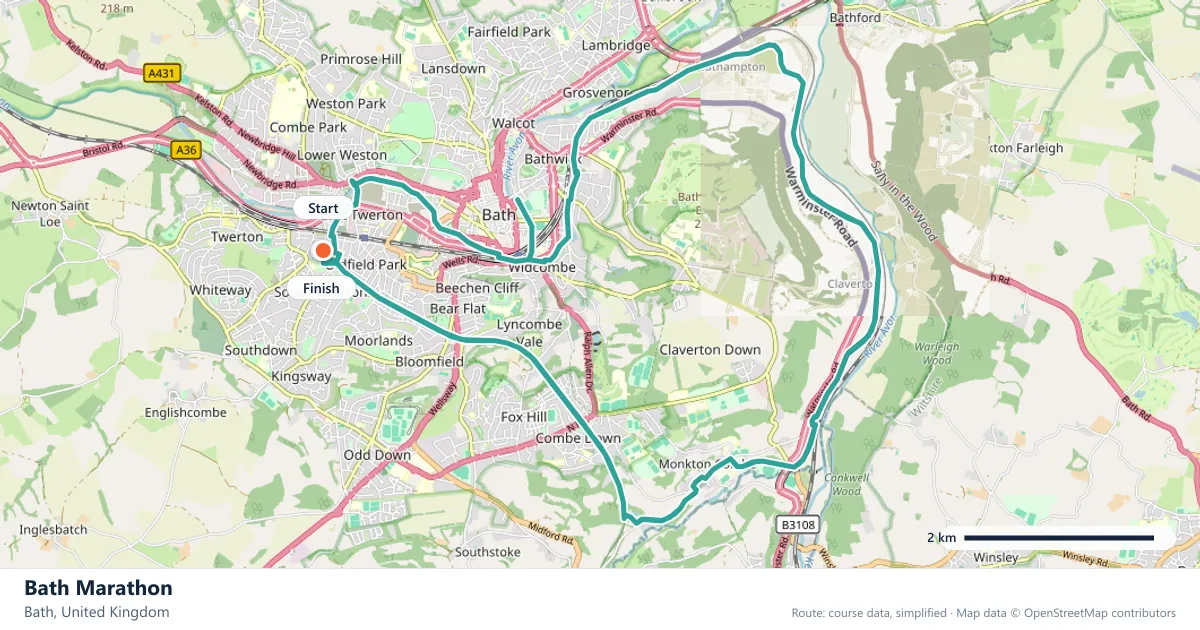
Where does the Bath Marathon run?
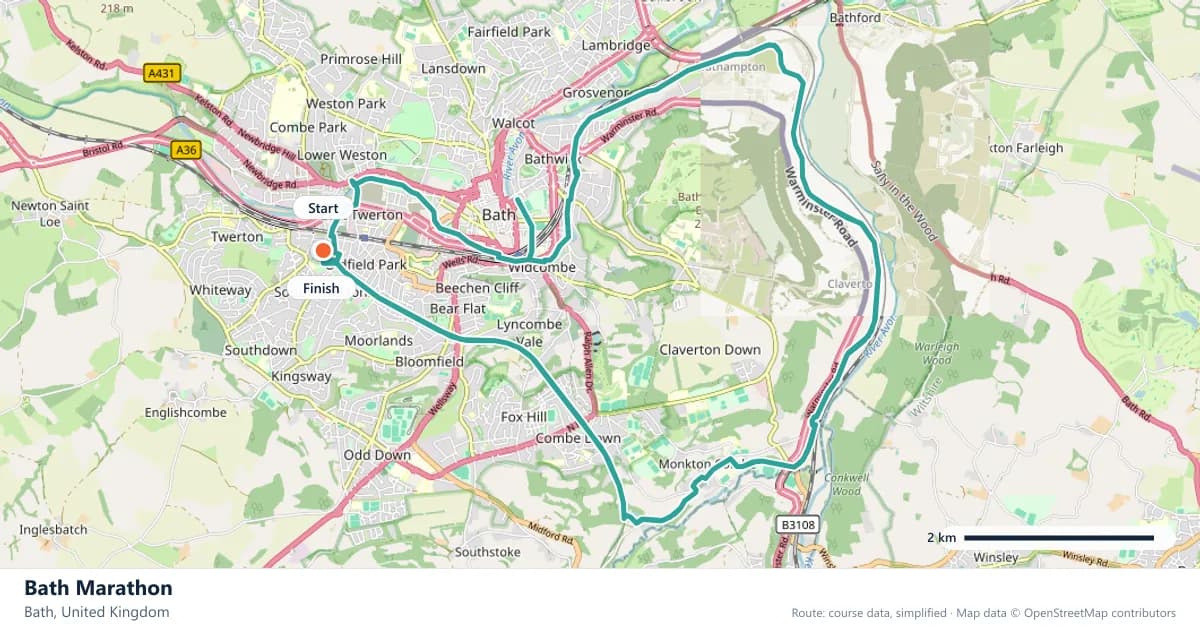
Interactive map
The trace follows the organizer's published course, simplified for the screen: the orange dot is the start, the dark dot the finish. Scroll to zoom, drag to pan.
What is the Bath Marathon course like?
A hilly tour of the Georgian city and the countryside around it, climbing onto the surrounding hills before dropping back towards the Avon. Demanding in the second half.
- Next edition
- 15 August 2027
- Elevation gain
- 430 m
- Profile
- Hilly
- First run
- —
Course guide
Bath is a city that looks like a stage set: honey-coloured Georgian terraces, the abbey, the Roman baths, and the Avon cutting a low line through it all. The marathon starts in the city and makes the hills around it the real course. The next edition is on 15 August 2027.
The route climbs out of Bath onto the surrounding hills before dropping back towards the Avon. The gain is about 430 metres, the profile is hilly, and the second half is the demanding part. This is not a city marathon that hides its terrain behind a flat loop.
It is a race for runners who like a course with a shape. The Georgian streets are the opening, the countryside is the test, and the return to the river is the reward. A first marathon is possible here, but only with hill training and a realistic sense of what 430 metres feels like late in the day.
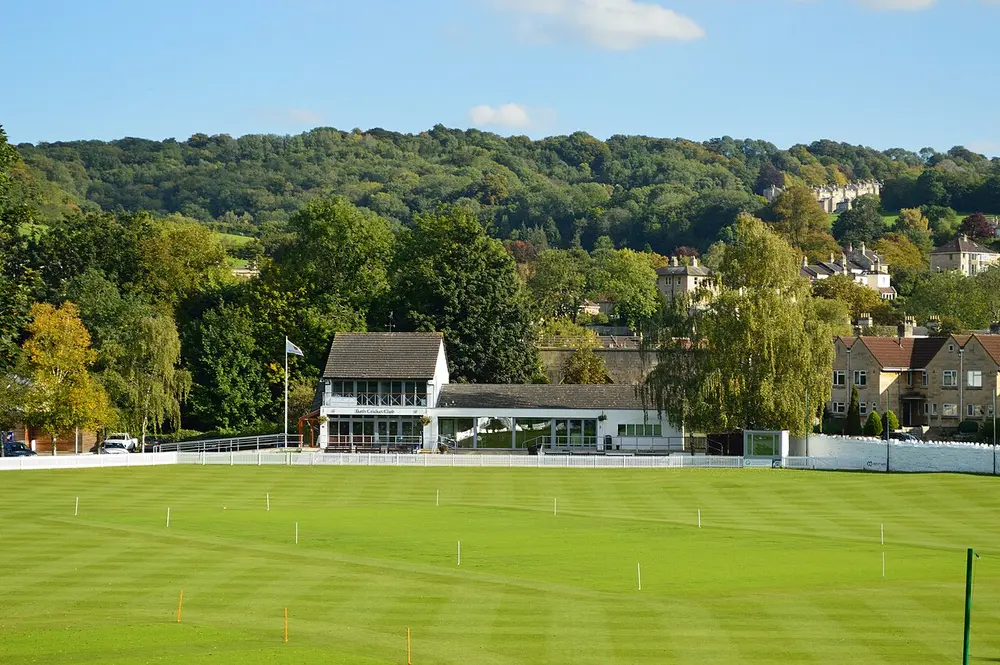
Bath Cricket Club. pavilion skyline. Photo: Rwendland / Wikimedia Commons, CC BY-SA 4.0.
The course
The race leaves the Georgian city, climbs onto the surrounding hills and returns towards the Avon. The 430 metres are spread across the route, but the second half is where the race bites. The city section is the most enclosed; the hills are quieter and more exposed; the final drop to the river is fast but hard on tired legs.
Plan for changes of rhythm: climbing at an even effort, recovering on the descents, keeping something for the late drop. The course does not offer a long flat stretch where you can switch off. It rewards attention.
Climbing out of the Georgian city
Bath sits in a hollow of the Avon valley, and the roads out of the centre rise quickly. The Georgian terraces give way to smaller streets, then to the open hills. The climb is not a single pass; it is a series of ascents that take the race onto higher ground.
Use the early miles to settle, not to bank time. The city's streets are the busiest part of the course and the most distracting; the hills come after, when the field has thinned.
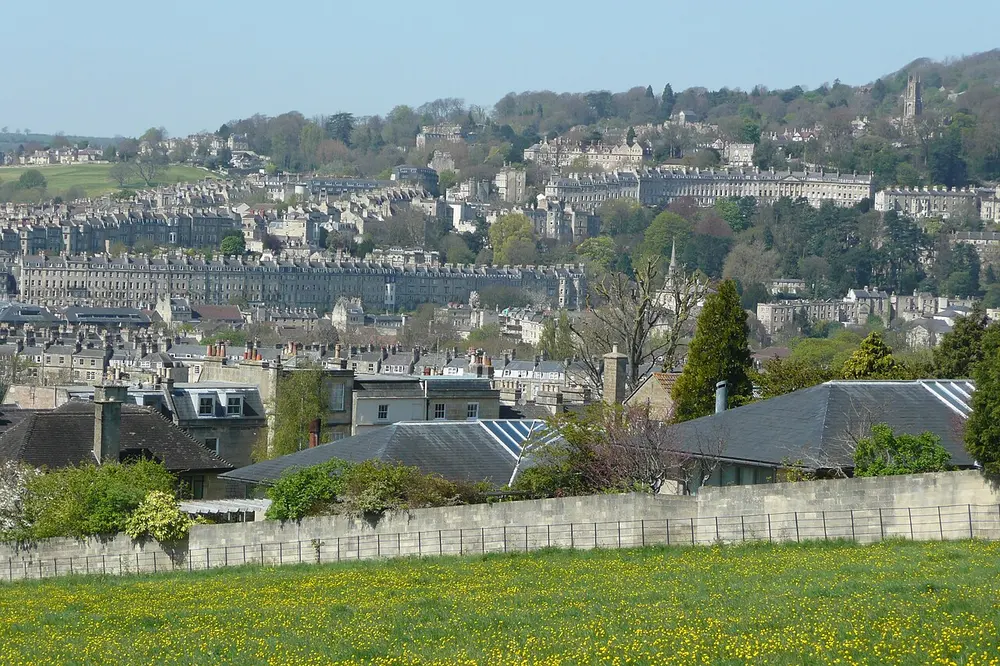
Bath Skyline Walk. Photo: Paul Stephenson from London / Wikimedia Commons, CC BY 2.0.
The drop back to the Avon
The return to the river is the part runners remember. The descent is fast, but by then the legs have absorbed the climbing, and fast downhill running asks a lot of the quads. Keep your form, shorten your stride on the steepest sections, and do not let the pace spike beyond what you can sustain on the flat.
The finish puts you back beside the Avon, with the Georgian city around you. It is a good place to end a hard race, but the final kilometres are not a free ride.
A debut with a sting
The race can serve as a first marathon, and the distance is the same 42.195 km as anywhere else. The difference is the 430 metres and the late descents. A first-timer who has trained on hills can finish well; one who has only run flat long runs will find the second half sobering.
Treat the hills as the main event in training. Long runs on rolling roads and regular climbing will do more for you here than extra speed sessions on the flat.
Bath in August
August is high summer in Bath, and the city is busy with visitors drawn by the Roman baths, the abbey and the Georgian streets. Late summer means the centre is lively and accommodation fills quickly, so book early and expect a crowded city on race weekend.
The date is confirmed for 15 August 2027. The higher ground on the course is open and exposed, a contrast with the sheltered streets at the start. Prepare for a day that changes character as the route moves between the two.
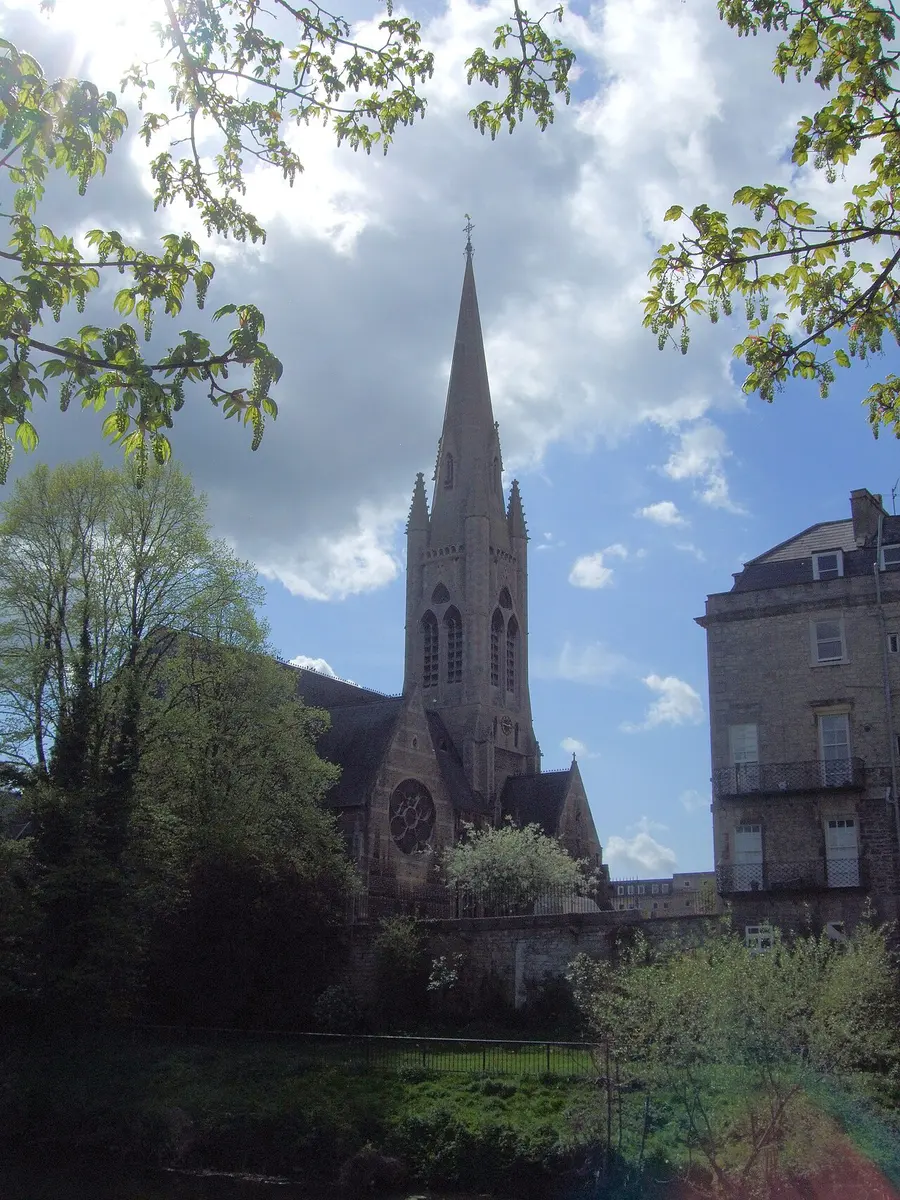
St. John the Evangelist R.C. Church, Bath - Somerset. Photo: Jim / Wikimedia Commons, CC BY 2.0.
Frequently asked questions
Answers to the questions runners ask before entering, drawn from this race's course guide and the directory's own data — the sources behind them are listed below.
When is the Bath Marathon?
The next edition is on 15 August 2027. It is a late-summer race on a hilly course through Bath and its surrounds.
Is the Bath Marathon a hilly course?
Yes. The route climbs about 430 metres, with the hills concentrated in the second half as the course returns towards the Avon. It is genuinely hilly, not a flat city race with a few rollers.
Is the Bath Marathon suitable for a first marathon?
It can be, but the climbing and the demanding second half make it a first marathon only with hill-specific preparation. A flat training block will not be enough.
Is it a good course for a personal best?
The 430 metres and the late descents make it an unlikely place for a fast time. It is a course to choose for the challenge and the setting rather than for the clock.
Where is the Bath Marathon run?
It is run in and around Bath, climbing onto the surrounding hills and returning towards the Avon. The course uses the Georgian city and its countryside rather than a city-centre loop.
What makes the second half hard?
The route climbs onto the surrounding hills and then drops back towards the Avon. By the second half the legs have absorbed the climbing, and the descents ask more of tired muscles. That makes the late miles the defining part of the race.
More marathons in United Kingdom
More marathons in Europe
Sources for this page
What each source below is used for on this page, and where to check this race yourself.
- World Athletics — the label calendar and the road-race regulations. Used to check whether the race holds a World Athletics label, and its elite competition details.
- AIMS — the international course-measurement standard behind the 42.195 km distance, and the AIMS race calendar.
- The organizer's own publications — course maps, race handbooks and published results. The date, course character and climbing on this page are compiled from them and re-checked each season.
Where do these facts come from?
Dates, course type, climbing and time limits are compiled from the organizer's publications and re-checked each season; elevation is an estimate of total climbing rather than a survey figure. Always confirm race-day details with the organizer before making plans.
Last reviewed 27 October 2026