
Cologne Marathon
You see the cathedral before you see the course. Cologne's Dom, with its twin spires and dark Gothic stone, stands above the Rhine and above almost everything else in the city.
By Global Marathon Routes editorial team · Last reviewed 27 October 2026
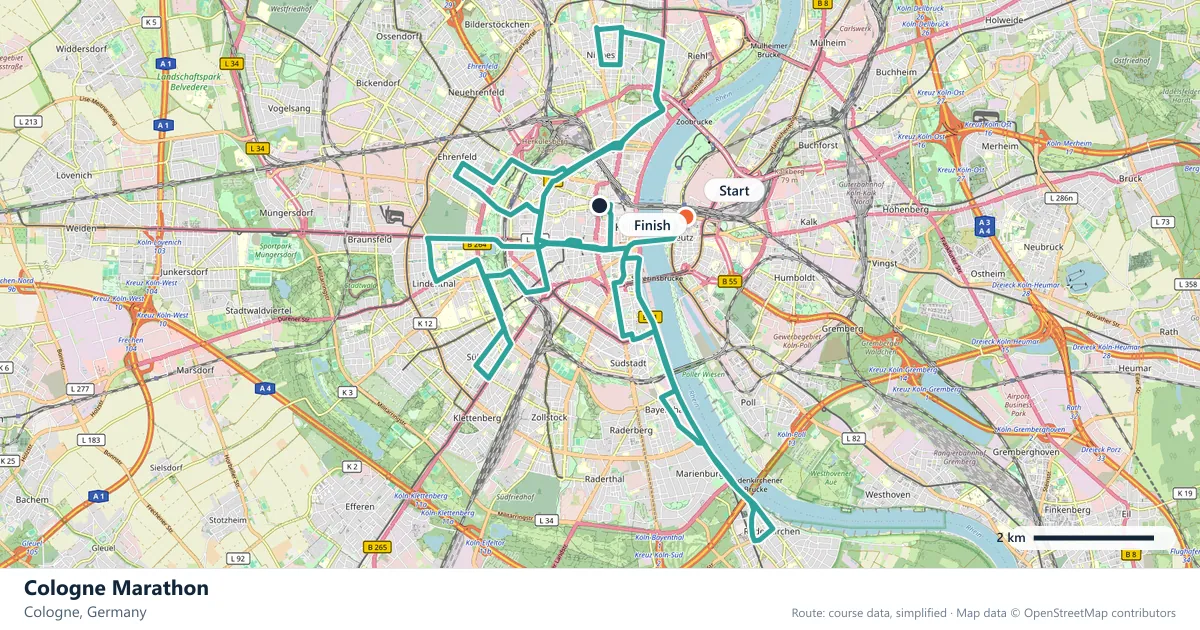
Where does the Cologne Marathon run?
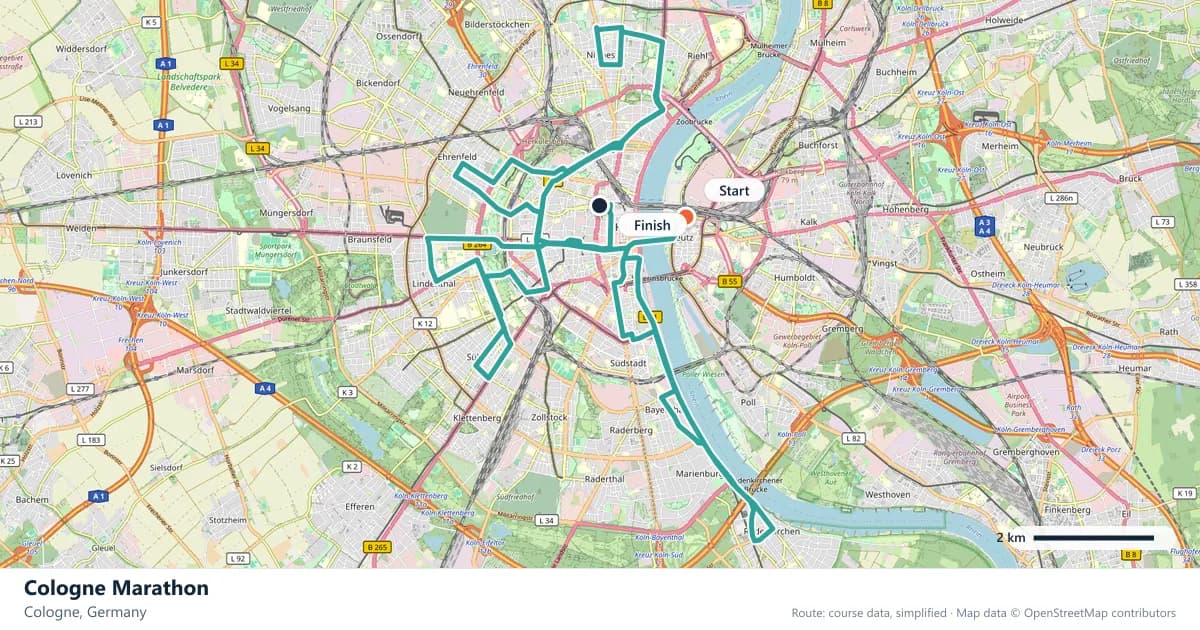
Interactive map
The trace follows the organizer's published course, simplified for the screen: the orange dot is the start, the dark dot the finish. Scroll to zoom, drag to pan.
What is the Cologne Marathon course like?
A flat, fast loop along both banks of the Rhine, with the cathedral dominating the skyline for most of the race. Wide roads and a big, noisy city crowd.
- Next edition
- October 2027 (expected)
- Elevation gain
- 85 m
- Profile
- Flat
- First run
- —
Course guide
You see the cathedral before you see the course. Cologne's Dom, with its twin spires and dark Gothic stone, stands above the Rhine and above almost everything else in the city. The marathon uses it as a fixed point for most of the morning, looping along both banks of the river and returning to the city streets beneath it. The edition covered here took place on 4 October 2026.
The course is flat and fast, with about 85 metres of climbing across 42.195 kilometres. Wide roads let the field spread out, and the two-bank layout gives the race a constant change of perspective without any real change in difficulty. The cathedral dominates the skyline, and the city crowd gives the day a noisy, generous atmosphere.
Cologne is a big-city race with a straightforward course. It is not a landmark tour in the style of Vienna or Prague, but the river, the cathedral and the Rhineland's open, sociable character give it a strong sense of place.
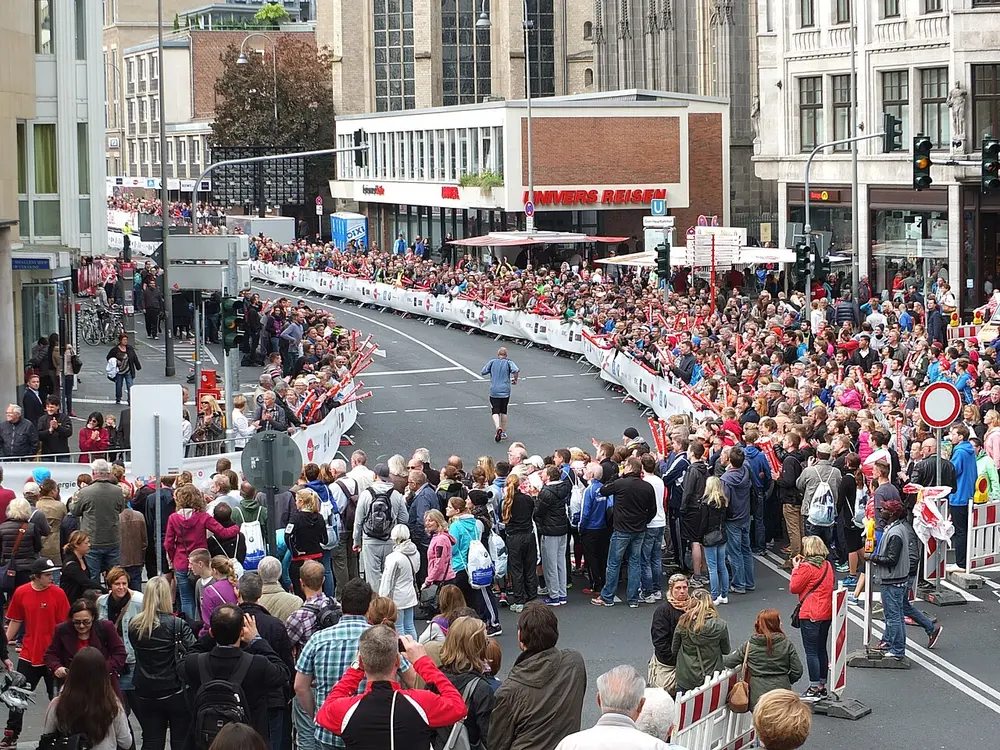
Köln-Marathon, Komödienstraße, 2015. Photo: Euku / Wikimedia Commons, CC BY-SA 3.0.
The course
The race forms a loop along both banks of the Rhine, crossing the river and returning through the city. The 85 metres are spread across the route, and the wide roads let the field settle quickly. The cathedral is the constant reference point, appearing above the rooftops and disappearing again as the course turns.
The two-bank layout is the race's organising idea. Runners get the riverfront on both sides and the city streets in between, and the crossings mark the transitions. The flat profile keeps the effort steady, while the turns and the crowd introduce just enough variation to keep the morning from feeling like a simple time trial.
Both banks of the Rhine
Cologne sits on both sides of the Rhine, with the historic centre on the left bank and the district of Deutz on the right. The river is wide and busy, and its bridges are part of the city's daily life as well as its skyline. The marathon uses those crossings to move between the two halves of the course.
Each crossing changes the view. The cathedral is closer on the left bank, the riverfront opens up on the right, and the city recedes as the route follows the water. On a flat course, those changes are the main landmarks, and they help runners keep their bearings without disrupting the rhythm.
The cathedral above the race
The Dom is more than a backdrop. It is the building that gives Cologne its silhouette, and its presence is a reminder of the city's long history as a trading and religious centre. The spires are visible from much of the route, and the cathedral presides over the city centre.
For runners, the cathedral is a marker rather than a distraction. It appears, it recedes, and the flat kilometres continue. The challenge is to enjoy the sight without letting the crowd and the setting pull you into a pace you have not planned.
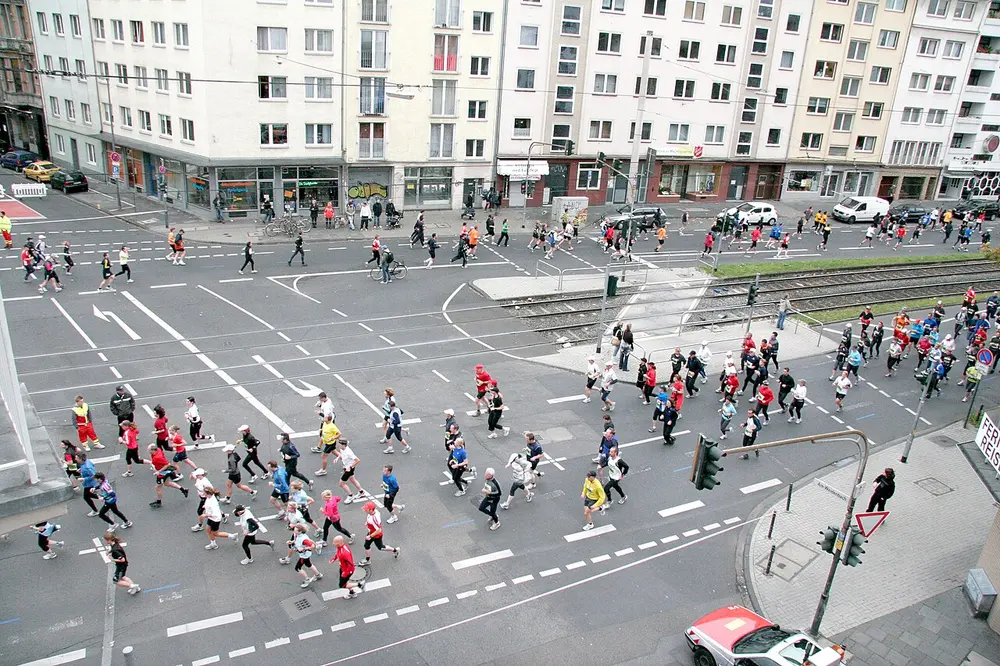
Koeln Marathon 2008 Salierring. Photo: Madmaharaja / Wikimedia Commons, CC BY 3.0.
A city that comes out to watch
Cologne has a reputation for being one of Germany's most sociable cities, and the marathon reflects it. The course is lined with spectators, the city's bars and cafés are part of the race weekend, and the atmosphere is loud in the way that Rhineland crowds tend to be. That support is a genuine advantage in the later stages.
It can also be a trap. A big, noisy crowd makes a fast pace feel easier, and the flat course offers no resistance to keep you honest. The festive atmosphere is part of the appeal, but the race is still 42.195 kilometres. Let the crowd lift you without letting it set your pace.
The autumn date
The race is held in early October, at the end of the German road-running season. The summer training is done, the weather is usually more forgiving than in high summer and the city is back in its normal rhythm. That combination makes Cologne a natural target for a late-season personal best.
The flat course and the big-city support also make it a comfortable first marathon. The route is straightforward, the field is large enough to keep you company and the Rhine gives the morning a clear geography. Start conservatively, use the flat sections to settle and save something for the final return through the city.
Frequently asked questions
Answers to the questions runners ask before entering, drawn from this race's course guide and the directory's own data — the sources behind them are listed below.
When was the Cologne Marathon?
The edition covered here took place on 4 October 2026. It is an autumn race on a flat loop along the Rhine.
Is the Cologne Marathon a flat course?
Yes. The route climbs about 85 metres, with no sustained ascent. The wide roads and the riverbank setting make it a fast German city course.
Is Cologne good for a personal best?
The flat profile, wide roads and autumn date make it a fair course for fast times. A personal best still depends on pacing, especially in the first half when the crowd can pull you along.
Is the Cologne Marathon suitable for a first marathon?
Yes. The course is straightforward, the climbing is limited and the city-centre route is easy to follow. The main risk is starting too quickly in the atmosphere of a big city race.
Where does the Cologne Marathon run?
It runs in Cologne on a loop along both banks of the Rhine, crossing the river and returning through the city. The cathedral dominates the skyline for much of the route.
What is the atmosphere like?
The city crowd is large and vocal, and the course passes through the centre of Cologne. That support is a feature of the race, but runners should be careful not to mistake atmosphere for an easy pace.
More marathons in Germany
More marathons in Europe
Sources for this page
What each source below is used for on this page, and where to check this race yourself.
- World Athletics — the label calendar and the road-race regulations. Used to check whether the race holds a World Athletics label, and its elite competition details.
- AIMS — the international course-measurement standard behind the 42.195 km distance, and the AIMS race calendar.
- The organizer's own publications — course maps, race handbooks and published results. The date, course character and climbing on this page are compiled from them and re-checked each season.
Where do these facts come from?
Dates, course type, climbing and time limits are compiled from the organizer's publications and re-checked each season; elevation is an estimate of total climbing rather than a survey figure. Always confirm race-day details with the organizer before making plans.
Last reviewed 27 October 2026