
Belfast Marathon
Belfast's marathon is a bank-holiday fixture: a city-centre start, a route that follows the Lagan out and back, and a relay programme that turns the day into a social occasion.
By Global Marathon Routes editorial team · Last reviewed 27 October 2026
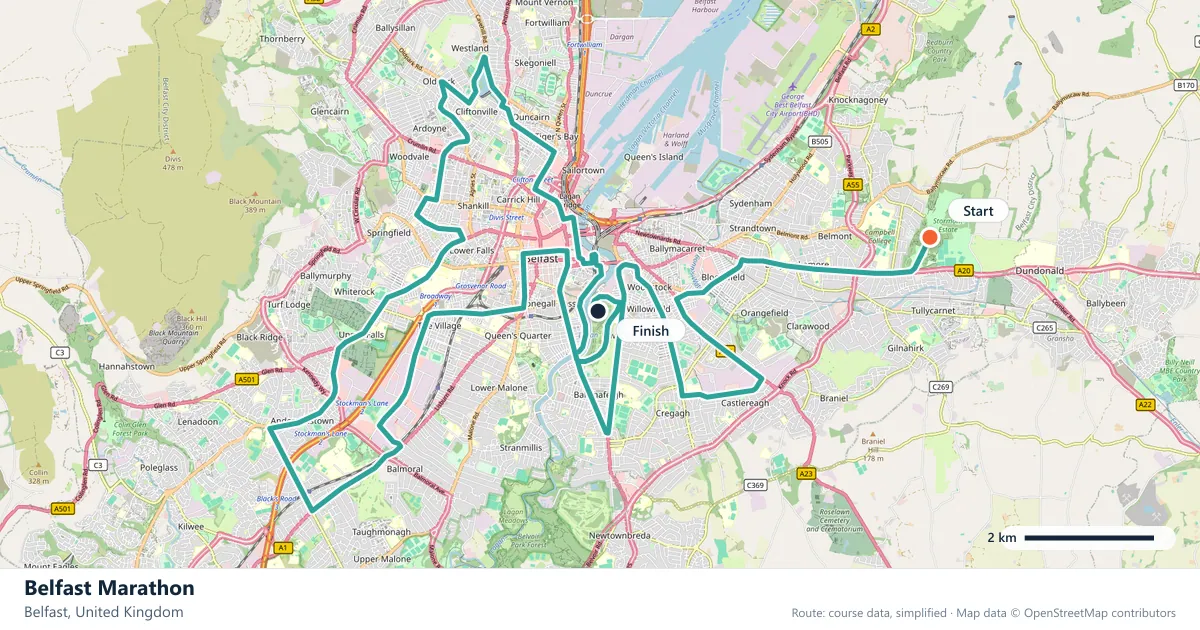
Where does the Belfast Marathon run?
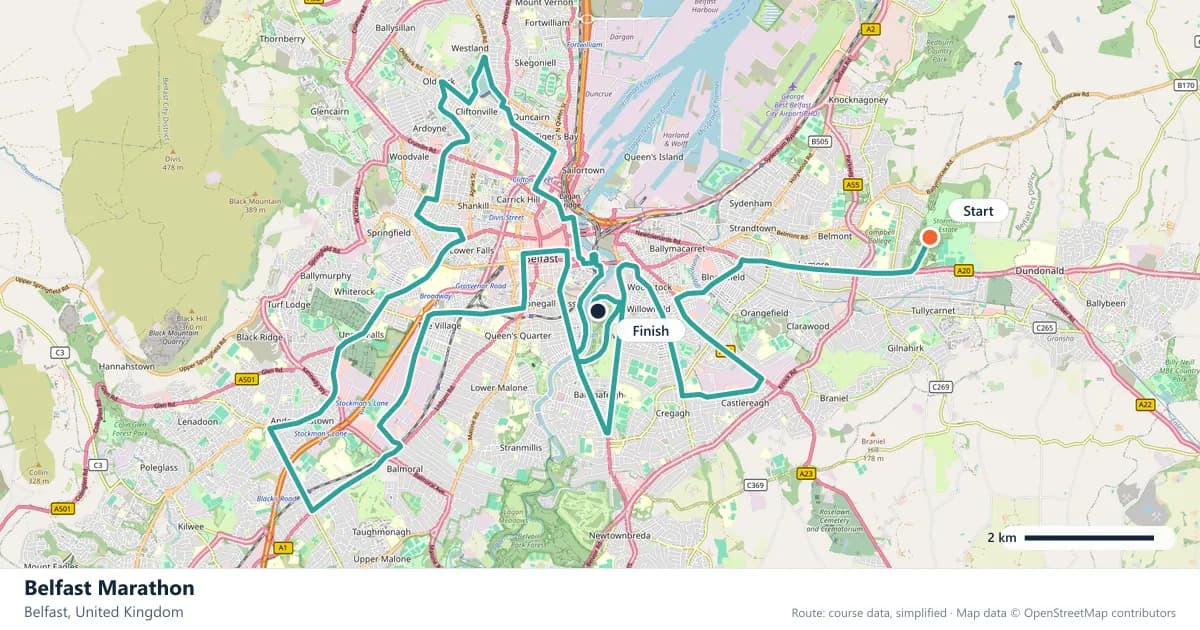
Interactive map
The trace follows the organizer's published course, simplified for the screen: the orange dot is the start, the dark dot the finish. Scroll to zoom, drag to pan.
What is the Belfast Marathon course like?
A bank-holiday fixture that crosses Belfast from the city centre out along the Lagan and back. Rolling rather than severe, with the relays making it a social race as much as a fast one.
- Next edition
- May 2027 (expected)
- Elevation gain
- 190 m
- Profile
- Undulating
- First run
- —
Course guide
Belfast's marathon is a bank-holiday fixture: a city-centre start, a route that follows the Lagan out and back, and a relay programme that turns the day into a social occasion. The next edition is expected in May 2027.
The course is undulating rather than severe. About 190 metres of climbing, spread across repeated rises, makes it a race of rhythm rather than a single climb. The river gives the route a spine, and the city centre gives it a start and a finish that are easy to reach.
Belfast is also one of the more approachable big-city marathons on these islands. The field includes relay runners and first-timers alongside club athletes chasing times, and the atmosphere reflects that mix.
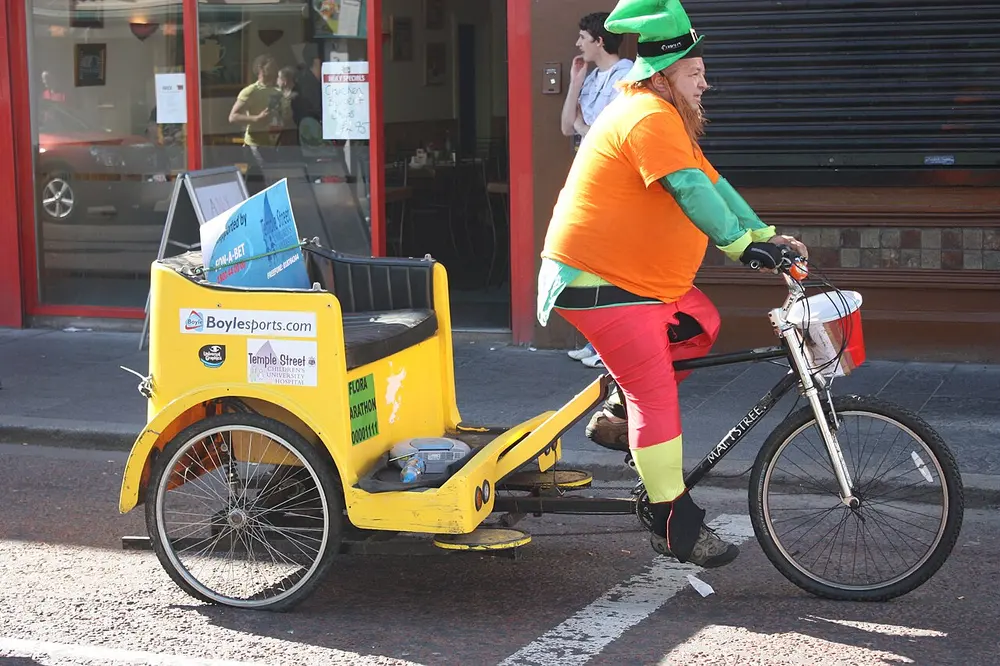
Belfast City Marathon, May 2011 (37). Photo: Ardfern / Wikimedia Commons, CC BY-SA 3.0.
The course
The race starts in the city centre and heads out along the Lagan before returning. The river is the constant: the route follows its banks and uses it to structure the race. The 190 metres arrive as rolling rises, not a single climb, so the course changes rhythm constantly without demanding a sustained effort.
The relay element means the field is mixed. Relay runners and marathoners share the road, which adds atmosphere but also means the people around you may be running a shorter race. Keep your own pace and use the river stretches to recover.
Along the Lagan
The Lagan runs through Belfast to Belfast Lough, and the river corridor is one of the city's open spaces. The route uses it to get out of the centre and back, so the middle of the race has the feel of a river run rather than a city circuit. The water, the bridges and the tree-lined banks give the running a calmer backdrop.
Belfast grew around the river and its shipyards, and the Titanic Quarter, with its cranes on the east bank, keeps that history in view. The river is not just scenery; it is the reason the city is here.
Use the river stretches to recover and the urban sections to stay alert. The changes of direction are gentle, but they add up over 42 km.
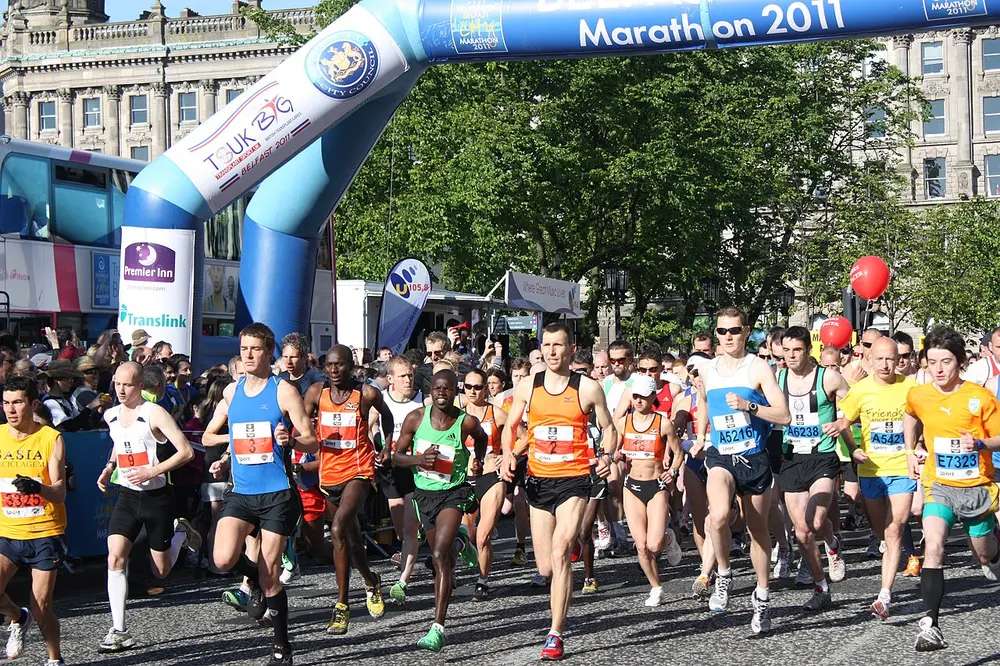
Belfast City Marathon, May 2011 (13). Photo: Ardfern / Wikimedia Commons, CC BY-SA 3.0.
The relay effect
The relay is part of the race's identity. Teams of runners share the course, which means the field is larger and more varied than a marathon-only event. For a solo runner, the effect is positive: more company, more noise, and a sense that the race belongs to the city rather than to a small group of athletes.
The downside is pace discipline. Relay runners may be moving faster or slower than you, and the excitement around the changeover zones can pull you along. Run your own race.
Rolling, not mountainous
About 190 metres is not a mountain course, but Belfast is rarely flat. The rises are short and repeated, and the descents do not give back quite as much as the climbs take. Pace by effort and let the downhills recover you.
The course rewards a steady rhythm more than a fast start. Runners who go out hard on the flat city streets often find the rolling sections harder than the profile suggests.
A May bank holiday
The race is tied to a bank-holiday weekend, which makes it a social event as much as a sporting one. The city is busy, hotels fill, and the relay teams bring a crowd. The date for the next edition is expected in May 2027 but not yet confirmed, so wait for the organiser's announcement before booking non-refundable travel.
The bank holiday also brings a relaxed mood to the city, which suits a race that includes so many relay teams. A holiday weekend means more traffic and more visitors in the centre, so plan your journey to the start with that in mind and arrange your meeting point before race day.
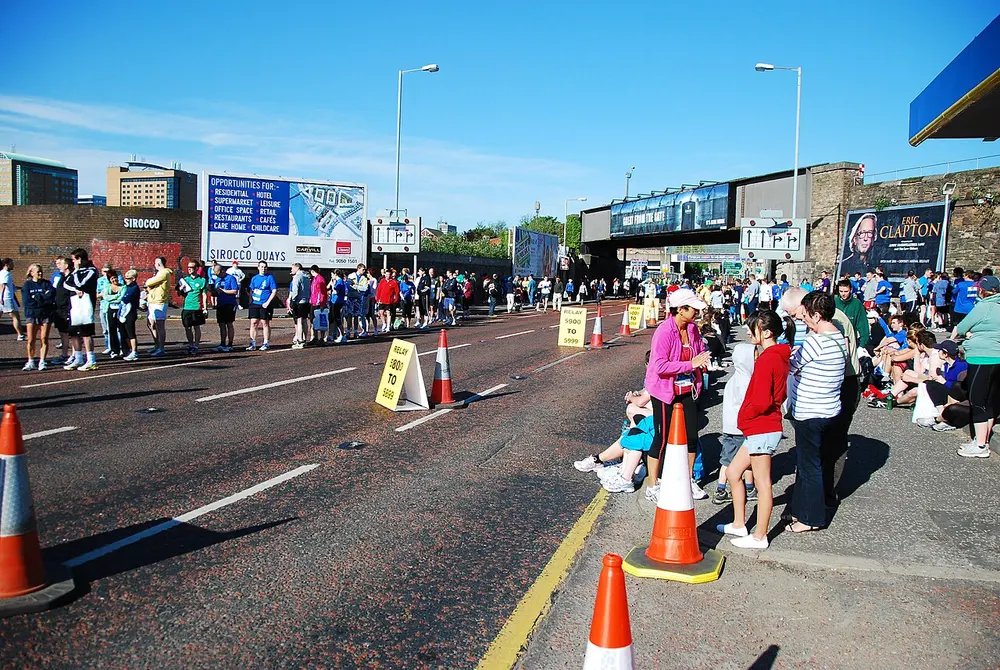
Belfast Marathon - 02 May 2011. Photo: gwaar / Wikimedia Commons, CC BY 2.0.
Frequently asked questions
Answers to the questions runners ask before entering, drawn from this race's course guide and the directory's own data — the sources behind them are listed below.
When is the Belfast Marathon?
The next edition is expected in May 2027, on a bank-holiday weekend. The date is not confirmed, so check the organiser's announcement before finalising travel.
Is the Belfast Marathon a hilly course?
It is rolling rather than severe, with about 190 metres of gain. The route has repeated rises rather than one long climb, so it is best described as undulating. Nothing requires mountain training, but the course is not flat.
Is Belfast suitable for a first marathon?
Yes. The rolling route, city-centre start and mixed field make it an approachable first marathon. The main thing is to pace the early flat miles and not treat the river sections as a chance to catch up.
Does the Belfast Marathon hold a World Athletics label?
Yes. The race holds a World Athletics Label, independent of the expected date.
Where is the Belfast Marathon run?
It is run in Belfast, starting from the city centre and heading out along the Lagan before returning. The river and city streets structure the route.
Is there a relay?
Yes. The relay is a major part of the event, with teams sharing the course with marathon runners. That is what gives the race its sociable character, and it also means you should expect a mixed field around you.
More marathons in United Kingdom
More marathons in Europe
Sources for this page
What each source below is used for on this page, and where to check this race yourself.
- World Athletics — the label calendar and the road-race regulations. Used to check whether the race holds a World Athletics label, and its elite competition details.
- AIMS — the international course-measurement standard behind the 42.195 km distance, and the AIMS race calendar.
- The organizer's own publications — course maps, race handbooks and published results. The date, course character and climbing on this page are compiled from them and re-checked each season.
“A World Athletics Label denotes a full application of the Competition and Technical Rules in, at a minimum, the elite component of the competition. Labels also denote superior standards in event organisation, safety and runner experience, support from public authorities to the event and a financial commitment to anti-doping.”
Where do these facts come from?
Dates, course type, climbing and time limits are compiled from the organizer's publications and re-checked each season; elevation is an estimate of total climbing rather than a survey figure. Always confirm race-day details with the organizer before making plans.
Last reviewed 27 October 2026