
Limerick Marathon
Limerick's marathon is a loop that uses the Shannon as its opening move. The route heads out along the river, turns through the Georgian quarters and returns through the suburbs, rolling for almost…
By Global Marathon Routes editorial team · Last reviewed 27 October 2026
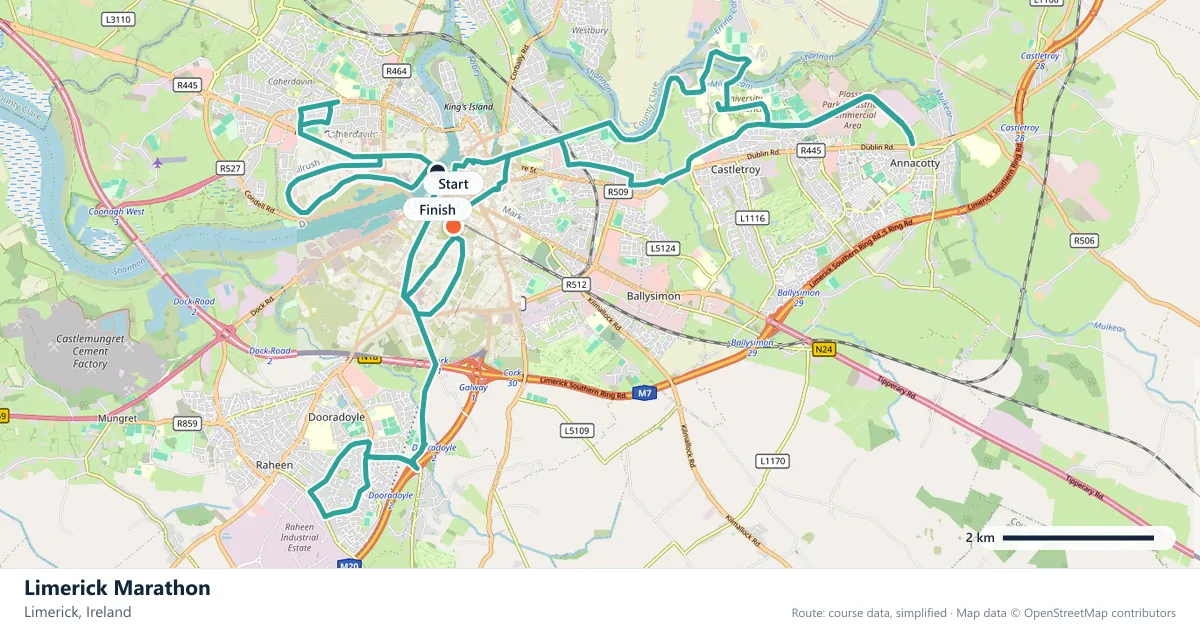
Where does the Limerick Marathon run?
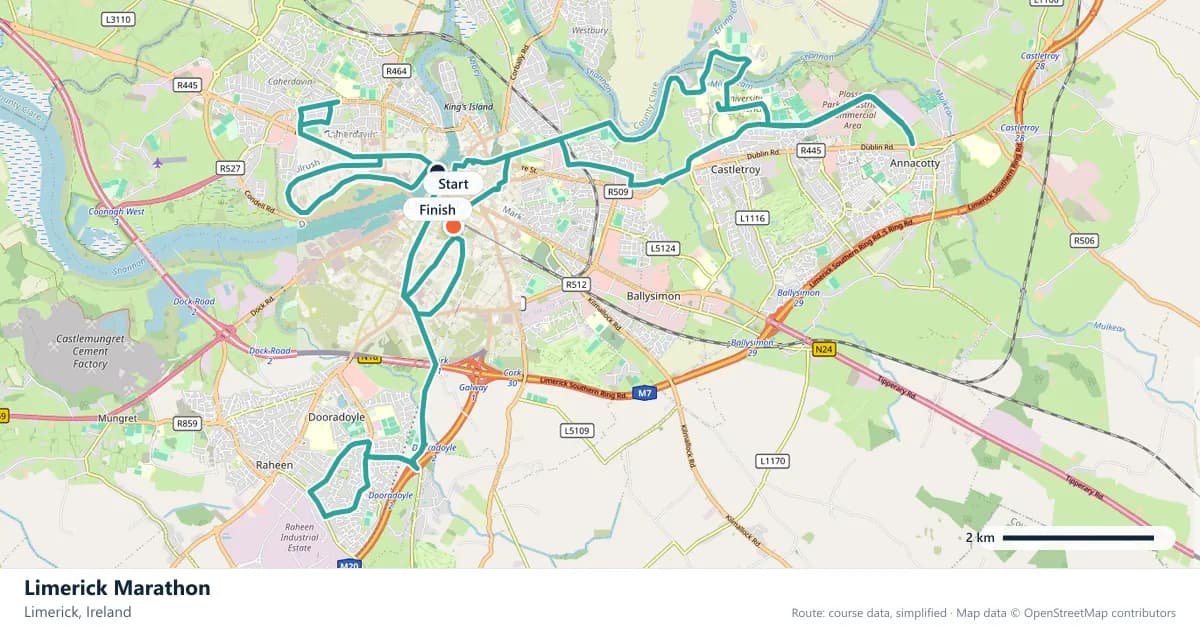
Interactive map
The trace follows the organizer's published course, simplified for the screen: the orange dot is the start, the dark dot the finish. Scroll to zoom, drag to pan.
What is the Limerick Marathon course like?
A loop out of Limerick city along the Shannon, through the Georgian quarters and back through the suburbs. Moderate, rolling ground throughout rather than one defining climb.
- Next edition
- May 2027 (expected)
- Elevation gain
- 227 m
- Profile
- Undulating
- First run
- —
Course guide
Limerick's marathon is a loop that uses the Shannon as its opening move. The route heads out along the river, turns through the Georgian quarters and returns through the suburbs, rolling for almost the whole way. The next edition is expected in May 2027, with about 227 metres of climbing.
There is no signature climb here. The course is undulating in the literal sense: short, repeated changes of gradient that never dominate a single kilometre but accumulate over 42.195 km. Runners who train on rolling roads will recognise the rhythm; runners who only run flat routes will feel it.
Limerick itself is a river city with a Georgian grid at its heart and a castle on the Shannon. The race moves between the water and the streets, and the constant change of setting is what keeps the loop interesting.
The course
The route is a loop from Limerick city, heading out along the Shannon before turning through the Georgian quarters and back through the suburbs. The river and the wide Georgian streets give the route its two distinct halves. The terrain is moderate and rolling throughout rather than concentrated in a single ascent, so the race asks for steady effort rather than a specific hill strategy.
With about 227 metres of gain, the course is undulating rather than flat, but no one section stands out as the day's crux. The climbing is spread across the distance, and the return through the suburbs comes after most of the work is done. That makes the last few kilometres a test of pacing rather than terrain. The loop is easy to follow, and the city centre stays within reach for supporters.
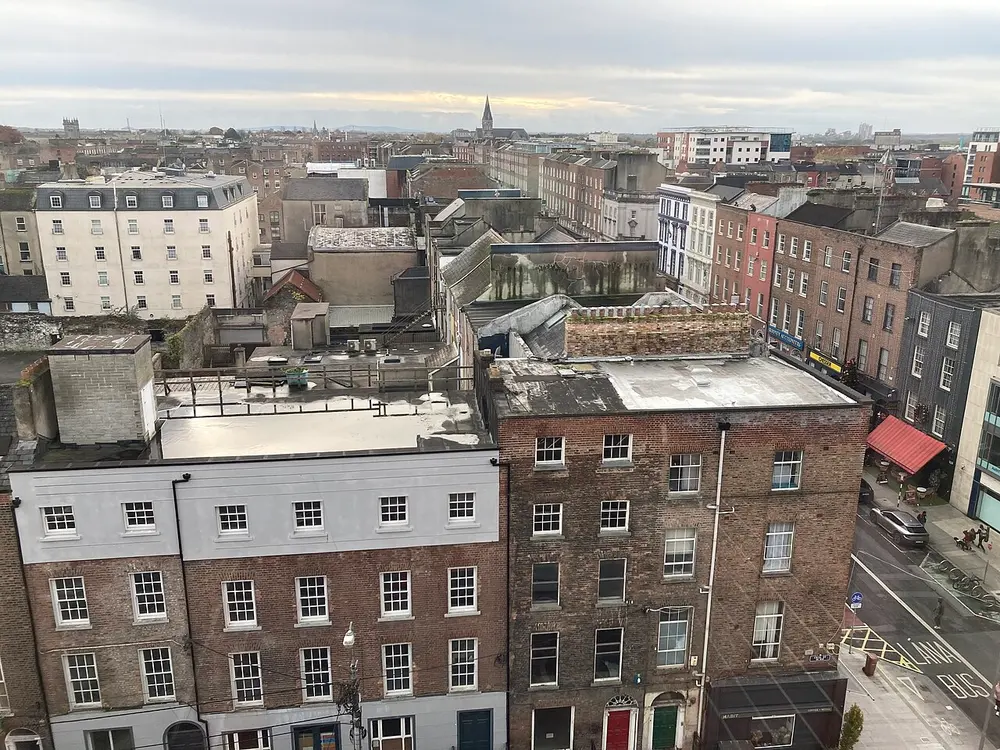
Limerick skyline. Photo: Sheila1988 / Wikimedia Commons, CC0.
The Shannon and the Georgian grid
The Shannon is the reason Limerick exists, and the riverfront is still the city's defining edge. King John's Castle and the Treaty Stone anchor the old side of the city, while the Georgian streets of Newtown Pery spread out in a grid behind them.
The marathon uses that geography. The river gives the course its opening stretch, and the Georgian quarters give it the wide streets and terraces that make Limerick distinctive. The two together produce a route that feels urban without being cramped.
The change from river to city is one of the pleasures of the race. The water opens up the view, the streets close it in again, and the suburbs are where the accumulated rolling starts to tell. Keep something in reserve for them.
Rolling without a signature climb
The absence of one big hill does not make the course easy. The 227 metres are spread across the loop, and the accumulative effect is what makes the race demanding. Each rise is small; together they wear down the legs.
The right approach is to run by effort. Let the pace drop slightly on the uphills, recover on the flats, and avoid forcing a fixed split on every kilometre. On a course like this, consistency of effort beats consistency of pace.
It is also worth including rolling routes in training. Long runs on gentle hills teach the legs to change rhythm without losing form, which is exactly what the second half of Limerick asks for.
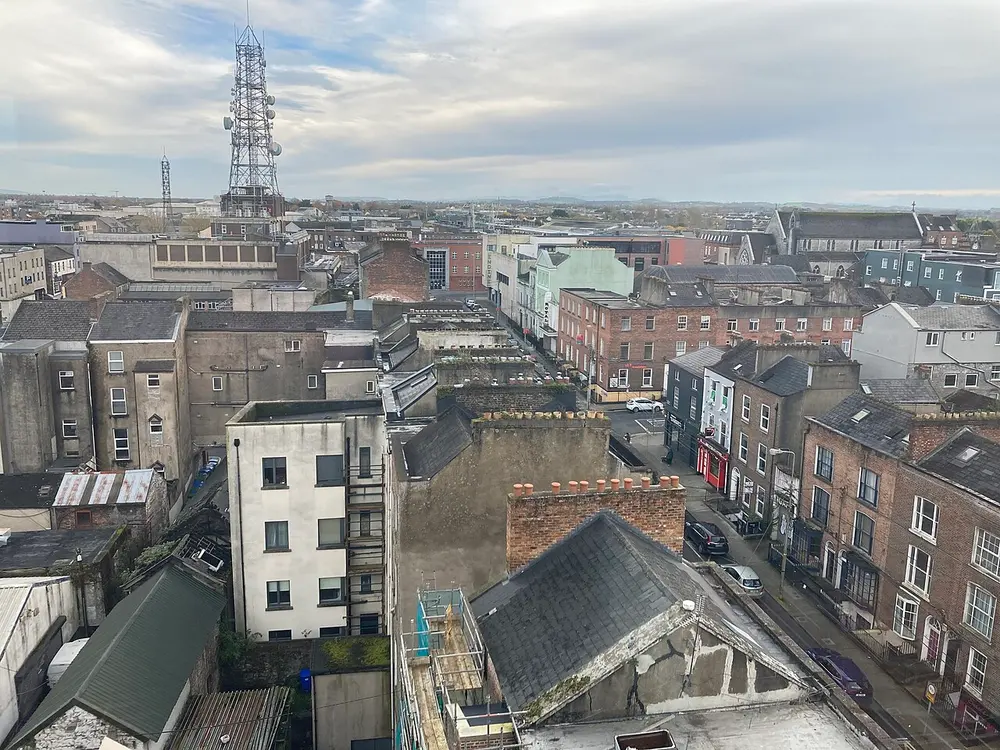
Limerick skyline 2023. Photo: Sheila1988 / Wikimedia Commons, CC0.
A May race in the mid-west
May 2027 is expected rather than confirmed, so check the organiser's announcement before booking travel. The spring date is a good one for a city race: the days are long, the weather is usually settling, and Limerick is easy to explore on foot.
The city has a strong sporting identity and a compact centre, with the river never far away. The Georgian streets give the race a formal, unmistakably Irish setting, and the river keeps returning as a reference point. A race weekend here is a chance to see a part of Ireland that is often passed through on the way to the west coast.
Frequently asked questions
Answers to the questions runners ask before entering, drawn from this race's course guide and the directory's own data — the sources behind them are listed below.
When is the Limerick Marathon?
The next edition is expected in May 2027. The date is provisional, so verify it with the organiser before making travel plans.
Is the Limerick Marathon a flat course?
No. It is undulating, with about 227 metres of gain across the distance. There is no single defining climb, but the rolling ground is present throughout.
Is Limerick suitable for a first marathon?
The route is straightforward and the city setting is manageable, but the rolling ground means a first marathon should be approached with steady pacing rather than a time target. The accumulated climbing is the main challenge.
Where is the Limerick Marathon run?
It is run in and around Limerick. The loop follows the Shannon, passes through the Georgian quarters and returns through the suburbs.
Is the course a loop?
Yes. The Limerick Marathon is a loop that starts and finishes in the city, rather than a point-to-point route. That makes the logistics simpler for runners and supporters.
What is the hardest part of the course?
The accumulation of small rises, especially in the second half. No single climb stands out, but the constant changes of gradient add up, and the return through the suburbs still has to be run.
More marathons in Ireland
More marathons in Europe
Sources for this page
What each source below is used for on this page, and where to check this race yourself.
- World Athletics — the label calendar and the road-race regulations. Used to check whether the race holds a World Athletics label, and its elite competition details.
- AIMS — the international course-measurement standard behind the 42.195 km distance, and the AIMS race calendar.
- The organizer's own publications — course maps, race handbooks and published results. The date, course character and climbing on this page are compiled from them and re-checked each season.
Where do these facts come from?
Dates, course type, climbing and time limits are compiled from the organizer's publications and re-checked each season; elevation is an estimate of total climbing rather than a survey figure. Always confirm race-day details with the organizer before making plans.
Last reviewed 27 October 2026